Winterising your car — a mechanic's checklist: what to check before the frost
Most winter breakdowns can be predicted in autumn: a weak battery, coolant with too little frost protection, worn wipers or tyres. Here is a mechanic's checklist — what you can check yourself and what is worth having done in the workshop before the frost.
8 min read · Pulsecar team · updated:
Winterising your car — the short answer
Getting a car ready for winter is mainly about checking the few components that fail most often in the cold: the battery, tyres, coolant (more precisely, its freezing point), wipers and screenwash, lights, brakes and heating. Diesels add glow plugs and fuel; petrol engines add spark plugs and ignition coils. Most of this can be checked in a quarter of an hour, and a repair in autumn is usually cheaper and far less stressful than a tow truck on a January morning.
Below is a mechanic's checklist: what you can check yourself in the car park, what needs tools (a battery tester, a refractometer, computer diagnostics) and what is best done in a workshop. The best time is October and early November — before night-time temperatures stay below zero for good.
Pre-winter checklist — table
| Item | What to check | When to act |
|---|---|---|
| Battery | Resting voltage, starting test with a tester, terminals, battery age | Slow cranking, battery 5 years old or more, tester shows poor condition |
| Tyres | Tread depth, age (DOT code), cracks, pressure | Winter tread below about 4 mm, hardened or cracked rubber |
| Coolant | Level in the expansion tank, freezing point, colour and cleanliness | Protection weaker than about −35 °C, dirty fluid or sediment, level dropping |
| Wipers and washers | Blades, jets, type of fluid in the reservoir | Streaks, juddering blade, summer fluid still in the reservoir |
| Lights | All bulbs, headlight aim, condition of the lenses | A bulb not working, weak or badly aimed headlights |
| Brakes | Pads, discs, brake fluid, parking brake | Fluid older than about 2 years, thin pads, heavily corroded discs |
| Heating and air conditioning | Warm-up time, windscreen airflow, cabin filter, A/C operation | Windows mist up, heater blows lukewarm, musty smell |
| Glow plugs / spark plugs | Fault codes, cold start | Hard starting in the morning, smoke, rough running after start-up |
| Seals and locks | Rubber condition, seal treatment, lock operation | Doors freezing shut, stiff locks |
Use the table as a checklist: anything that matches the "When to act" column is a sign that the item should be fixed before the frost, not when the car refuses to start.
Battery — the most common cause of winter trouble
Frost hits the battery from two sides: at low temperatures the battery delivers less energy, while a cold engine with thicker oil needs more of it to start. That is why a battery that coped in summer can fail overnight in winter. Warning signs are slower cranking, dash lights dimming during start-up, low-voltage messages and a start-stop system that stops working by itself.
A fully charged battery has a resting voltage (after a few hours parked) of about 12.6–12.7 V; a reading clearly below 12.4 V means it is undercharged. Voltage alone does not tell the whole story, though — a battery can show the right voltage and still collapse under load. That is why we use a tester that assesses starting capacity, and we also measure charging voltage with the engine running. You can read more about symptoms and testing in our guide battery in winter — symptoms.
If you mostly drive short distances, the alternator may not keep the battery topped up. Take a longer drive now and then, or charge the battery with a charger. In cars with start-stop, the battery (AGM or EFB) is replaced with the same type, and in many models the new battery has to be registered with the control unit.
Winter or all-season tyres — tread, age, pressure
- Tread: the legal minimum in Poland is 1.6 mm, but a winter tyre loses its grip on snow and slush much earlier. The usual recommendation is at least about 4 mm of tread.
- Age: the production date is in the DOT code on the sidewall (e.g. 4219 means week 42 of 2019). Tyres older than about 6–8 years often have hardened rubber, even if the tread looks fine.
- Sidewalls: cracks, bulges and cuts rule a tyre out regardless of tread depth.
- Pressure: tyre pressure drops in the cold, so check it more often — on cold tyres, using the sticker on the door pillar or the fuel filler flap.
- Wheels: at the seasonal change it is worth checking balance and rim condition and tightening the bolts to the correct torque.
Above about 7 °C a summer tyre performs better; below that, a winter tyre is the right choice, as its compound stays flexible in the cold and its siped tread grips snow better. All-season tyres are a compromise that makes most sense for city driving and low annual mileage; you will find a detailed comparison in our guide all-season or winter tyres. We change and store tyres on site.
Coolant, heating and misted windows
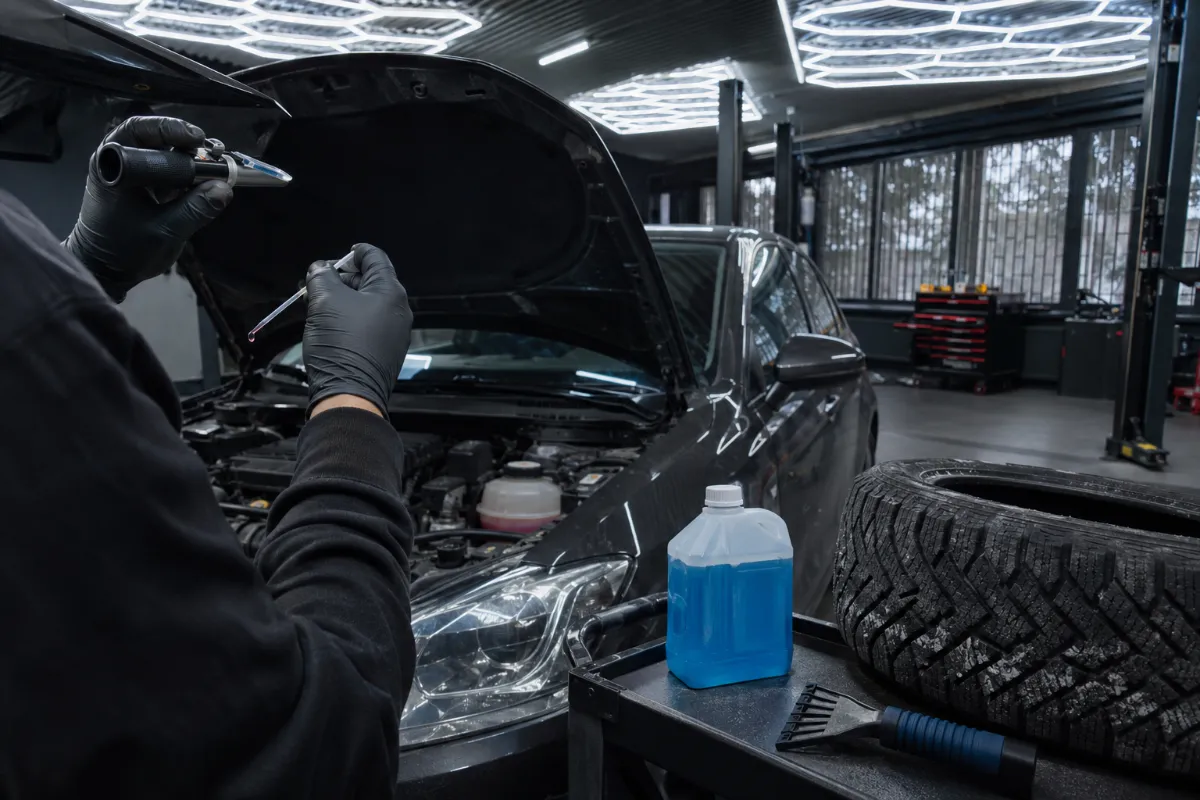
Coolant protects the engine against freezing and corrosion. It loses its properties over time, and topping up with plain water raises its freezing point. Frozen coolant can crack the radiator, heater matrix and hoses, and in extreme cases even damage the engine block. In Polish conditions sensible protection is about −35 °C. We measure the freezing point with a refractometer — a quick test using a few drops of coolant.
Check the level in the expansion tank with the engine cold, and look at the colour and for sediment. Do not mix random coolants of different types — we explain how to choose in our guide which coolant to use. A falling level without a visible leak is a reason for diagnosis, not just for topping up.
The cooling system also heats the cabin. If the heater is weak and the engine takes a long time to warm up, the cause is often the thermostat, an airlock or a clogged heater matrix — see our guide heater not working. Use the air conditioning in winter too: it dries the air and helps clear the windows faster. If they still mist up, check the cabin filter and the causes described in misted-up car windows.
Wipers, washers, lights and locks
- Wiper blades: if they streak, judder across the glass or the rubber is cracked, replace them before winter. Do not switch the wipers on when the blades are frozen to the windscreen.
- Screenwash: use up the summer fluid and fill up with winter screenwash rated to at least −20 °C. Frozen fluid can damage the pump and lines.
- Washer jets: check that they are clear and that the spray actually hits the windscreen.
- Lights: check dipped and main beam, fog lights, brake lights, indicators, reversing lights and the number-plate light. Clouded lenses and badly aimed headlights noticeably reduce visibility.
- Door seals: clean them and treat them with silicone or rubber care spray so the doors do not freeze shut.
- Locks: if the lock barrel is sticking, lock de-icer and a lubricant designed for locks help. Keep the de-icer in your pocket or at home, not inside the locked car.
Remove frost and ice with a scraper and never pour hot water over the windscreen — the sudden temperature change can crack it, especially if there is already a chip. Before driving, clear snow from the whole car, including the roof, lights and number plates.
Brakes, brake fluid and the parking brake
Stopping distances are longer in winter anyway, so the brakes must work perfectly. We check pad and disc thickness, whether both wheels on an axle brake evenly and the condition of the lines. Road salt speeds up corrosion of discs, caliper slide pins and brake pipes — a seized slide pin can make the brake drag and wear the pads unevenly.
Brake fluid absorbs moisture from the air, which lowers its boiling point, and moisture also promotes corrosion inside the system. Manufacturers usually recommend replacing it about every 2 years. If you do not remember when it was last changed, we will measure the water content of the fluid.
The parking brake can freeze, especially after driving on wet roads followed by a frosty night. If you park on level ground in a manual car, you can leave it in gear without applying the handbrake; in an automatic, leave it in P. On a slope, always use the parking brake.
After the first frosts, try a test stop in an empty, safe car park to feel how the car behaves on a slippery surface and how the ABS works.
Engine: oil, plugs, filters and fuel
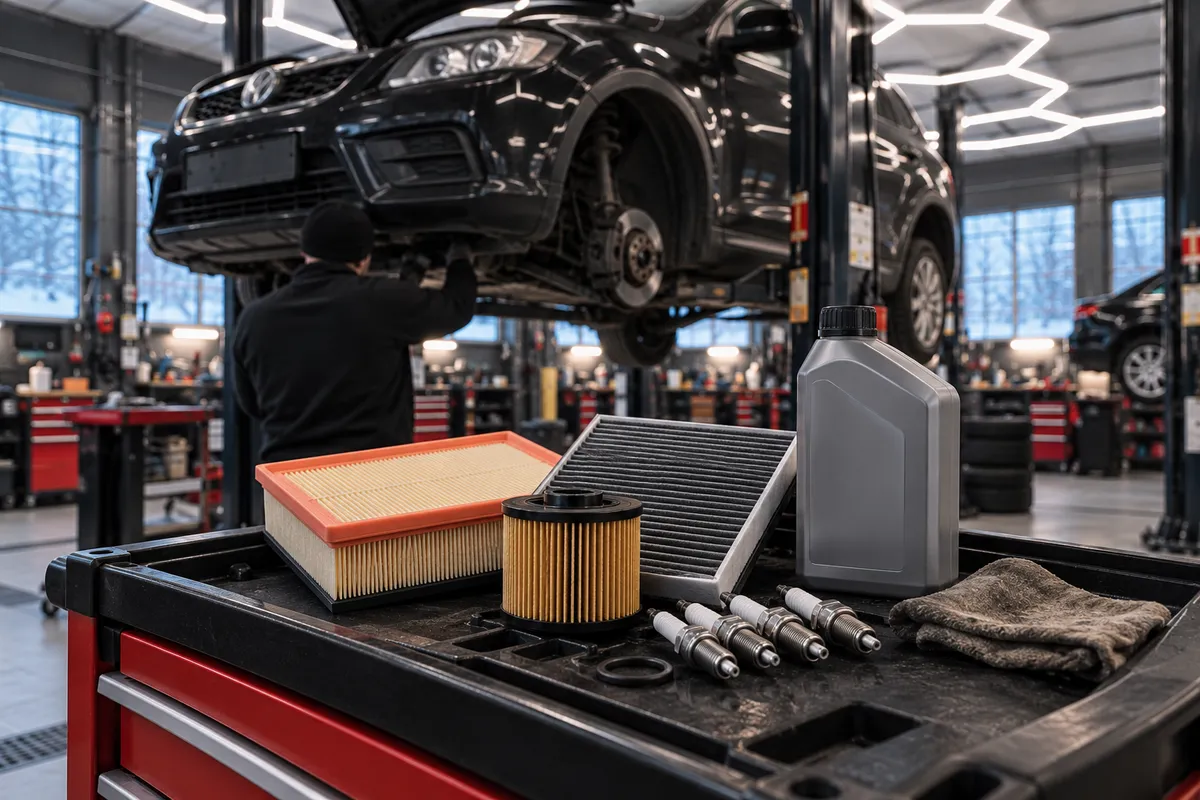
- Engine oil: if an oil change is due in the coming months, do it before winter. Fresh oil of the viscosity recommended by the manufacturer makes cold starts easier.
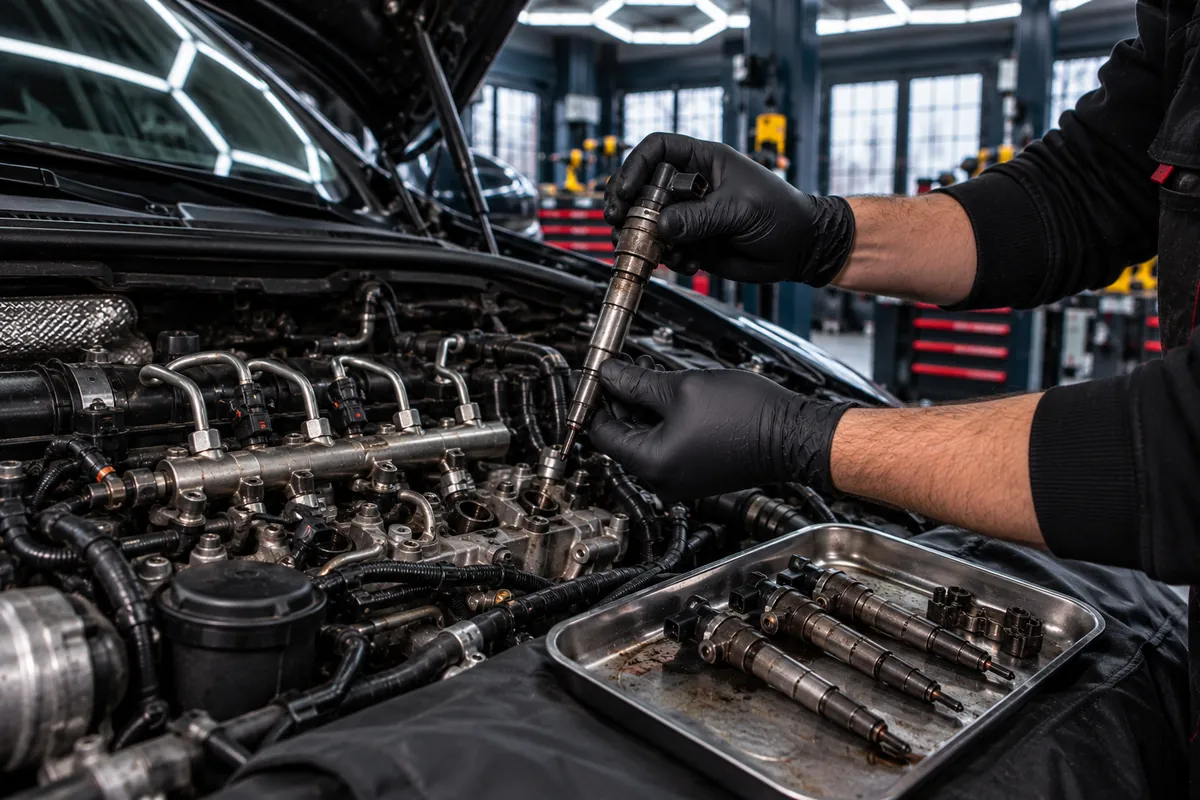
- Glow plugs (diesel): a worn glow plug means hard starting, smoke and rough running after start-up. The control unit often stores a fault code, so computer diagnostics before winter are worthwhile. More in our guide glow plugs and spark plugs in winter.
- Spark plugs and coils (petrol): worn plugs and weak coils struggle most when starting a cold engine.
- Fuel filter (diesel): water and wax that separates out in the cold can block the filter. If it has not been changed for a long time, do it before winter.
- Diesel fuel: fill up at reputable stations that sell winter-grade diesel in the cold season. Do not add petrol or random additives to the fuel.
- Auxiliary drive belt: it hardens in the cold and may squeal on start-up — we check the belt and the tensioner.
If the engine struggles to start, do not crank for longer than a few to a dozen or so seconds at a time, and take breaks. Long cranking overheats the starter and flattens the battery completely, and in a petrol engine it can flood the plugs.
How we check it at Pulsecar
- 1Conversation: we ask about symptoms, mileage, recent replacements and how you use the car — short trips, motorway, parking outdoors.
- 2Computer diagnostics: reading fault codes and live data from the control units, e.g. coolant temperature, glow plug operation and charging voltage.
- 3Battery and charging test: a starting tester and a charging-voltage measurement with the engine running.
- 4Fluid checks: coolant freezing point, water content of the brake fluid, oil level and condition.
- 5Inspection on the lift: tyres, brakes, suspension, lines, leaks and the auxiliary belt.
- 6Checking lights, wipers, washers, heating and air conditioning.
- 7Quote: you receive a list of faults with photos and an explanation of what is urgent and what can wait. We start work only after you approve it.
This scope corresponds to our extended inspection. We give a 6-month warranty on labour; new parts carry the manufacturer's warranty (usually 12–24 months). You will find the workshop at ul. Arkuszowa 176 in Bielany, open Mon–Fri 9:00–18:00 and Saturdays 9:00–15:00. We speak Polish, Ukrainian, Russian, English and Belarusian.
Book a pre-winter check in October or early November. When the first frosts arrive, slots for tyre changes and repairs fill up quickly.
How much does winterising a car cost
| Service | Price |
|---|---|
| Computer diagnostics | 100 zł |
| Extended inspection | 250 zł |
| Oil and oil filter change | 120 zł |
| Cabin / fuel / air filter | 40 zł each |
| Coolant change | from 200 zł |
| Brake fluid change | from 200 zł |
| Bulb replacement | from 30 zł |
| Tyre change R15 / R16 / R17 | 200 / 220 / 240 zł |
| Tyre storage (one season) | 200 zł |
| Wheel alignment — 1 axle / 2 axles | 150 / 300 zł |
| A/C refill with vacuum test | from 199 zł |
The price of a new battery, glow plugs or brake repairs depends on the car model and the parts chosen — we give it in the quote after diagnosis, before any work starts. Current rates are in our price list, and you can book a slot via book a visit.