All-season or winter tyres — who all-seasons suit, 3PMSF and M+S markings, the rules
All-season tyres are convenient and in Warsaw conditions are often enough, but they are always a compromise. We explain who they pay off for, how to read the 3PMSF and M+S markings, what the rules say and when the tread is too shallow.
8 min read · Pulsecar team · updated:
All-season or winter tyres — the short answer
If you drive mainly around Warsaw and the surrounding area, cover a moderate yearly mileage, do not go to the mountains in winter and can leave the car at home on a snowy morning, good all-season tyres with the 3PMSF symbol are usually quite enough. You save on two tyre changes a year and on storing a second set, and on cleared city streets the difference in everyday driving is small.
If, however, you do a lot of long-distance driving, travel to the mountains or abroad in winter, live on a road that is not cleared quickly, or have a powerful, heavy car, two sets — summer and winter — give a clearly bigger safety margin. An all-season tyre is always a compromise: on snow and ice it is weaker than a good winter tyre, and in hot weather weaker than a summer one.
How summer, winter and all-season tyres differ
| Feature | Summer | Winter | All-season |
|---|---|---|---|
| Rubber compound | Harder, works best in warm weather | Soft, stays flexible in frost | In between — a compromise between warm and cold |
| Tread | Fewer sipes, large blocks, stiff | Many sipes (fine cuts), deeper grooves | Sipes and blocks of medium stiffness |
| Snow and ice | Poor — not suitable for winter | The best of the three | Acceptable, but weaker than winter tyres |
| Heat and dry roads | Best — the shortest braking distance | Poor — the rubber feels vague and wears quickly | Longer braking distance than summer tyres |
| Wet roads | Good in warm weather | Good in cold weather | Decent all year round |
| Wear | Usually slow | Fast in warm weather | Usually faster than summer and winter sets used in their own seasons |
Temperature is the key. A winter compound stays soft in the cold, so it grips well already at a few degrees above zero, not only on snow. A summer compound hardens at low temperatures and loses grip. An all-season tyre tries to combine both — which is why it is not the best in any extreme condition, but sensible in typical ones.
3PMSF and M+S markings — what they really mean
- 3PMSF (Three Peak Mountain Snow Flake) — a snowflake symbol against three peaks. The tyre has passed a standardised snow grip test and scored better than a reference tyre. It is the only marking that confirms winter properties with a test.
- M+S (Mud and Snow) — the manufacturer’s declaration about the tread shape. It does not require a snow test and is also found on typical summer tyres, e.g. for SUVs.
- DOT code — the last four digits are the week and year of manufacture, e.g. 3523 means week 35 of 2023. Rubber hardens with age, even when the tread is still deep.
- Load and speed index — e.g. 91V. When changing tyres, do not go below the values approved for your car (you will find them in the vehicle documents or on the sticker).
When choosing all-season tyres, look for the 3PMSF symbol. A tyre marked only M+S gives no certainty that it will cope in winter, and in some countries M+S alone is no longer accepted as a winter tyre.
The 3PMSF symbol only says the tyre passed a snow test. It says nothing about braking on ice, in the wet or in heat — for that, compare the EU tyre label and independent tests of the specific model.
Who all-season tyres suit in Warsaw, and who should have two sets
- All-seasons make sense: mainly city driving, cleared streets, moderate yearly mileage, a small or mid-size car, a calm driving style, the option to sit out a snowstorm.
- All-seasons are also convenient when you have nowhere to store a second set of wheels and do not want to keep track of change dates twice a year.
- Two sets are better: high mileage and lots of motorway driving, winter trips to the mountains or to countries with harsh winters, commuting from places where roads are cleared late.
- Two sets are also worth considering with a powerful, heavy car or SUV, with spirited driving, and when you want the shortest possible braking distance in summer.
In Warsaw, for most of the winter the temperature hovers around zero and snow disappears quickly from the main streets. These are conditions in which a good all-season tyre copes decently. The problem is the odd day with black ice or slush, and trips out of town — then the difference compared with a winter tyre becomes noticeable.
Trade-offs: braking on snow, ice and in heat, wear
| Conditions | All-season compared with a seasonal tyre | What it means |
|---|---|---|
| Snow | Less traction and a longer braking distance than a good winter tyre | Slower, bigger gap, careful on hills |
| Ice and black ice | All non-studded tyres have little grip here, an all-season usually even less than a winter tyre | In black ice it is best to limit driving |
| Cold and rain (0–7°C) | Usually close to a winter tyre, clearly better than a summer one | A typical Warsaw winter is where all-seasons are strong |
| Heat, dry | Longer braking distance and less precise handling than a summer tyre | In summer do not drive as if on sporty summer tyres |
| Long summer trips | Faster heating and tread wear | Check pressure and tread more often |
An all-season tyre works 12 months a year, so at the same yearly mileage it wears roughly twice as fast as each of the seasonal sets, which work for half a year each. In practice the saving on a second set is smaller than it seems — the bigger gain is convenience and no changeovers. Even wear also depends on alignment: with incorrect settings tyres wear on the edges, as we explain in the guide wheel alignment — when.
The rules: do you need winter tyres in Poland
In Poland there is no general obligation to drive on winter tyres — the rules do not require fitting them by a set date. What is required is that tyres are in good technical condition, have adequate tread depth, and are of the same size and tread type on one axle. The exception is roads marked with a sign requiring snow chains. Check the current rules before you travel, as proposals to change this come back from time to time.
It is different abroad. Many European countries require winter tyres — some for a fixed period of the year, some depending on road conditions (snow, ice, slush). Increasingly, only a tyre with the 3PMSF symbol counts as a winter tyre, and some countries require a greater tread depth for it than the general minimum. Before a winter trip, check the rules of your destination and transit countries, e.g. on motoring club or embassy websites.
An insurer or a court may take into account whether the tyres were suited to the conditions. Even without an obligation, driving on summer tyres in winter is a risk — a financial one too.
Tread depth — the legal minimum and a sensible winter minimum
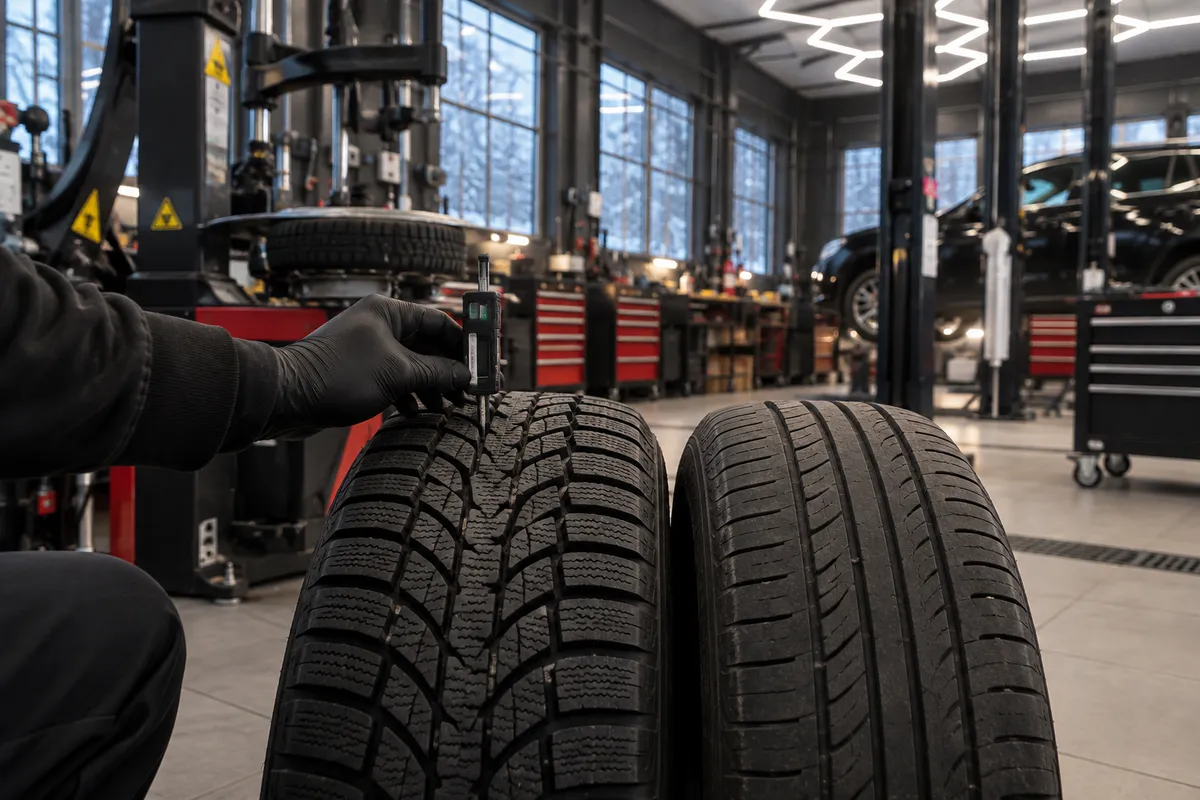
- 1.6 mm — the minimum permitted tread depth in Poland. It is shown by TWI indicators, small raised bars in the tread grooves, marked on the tyre sidewall with the letters TWI or a symbol.
- About 4 mm — a sensible minimum for a winter tyre and an all-season used in winter. Below this, grip on snow and slush drops noticeably and the risk of aquaplaning rises.
- About 3 mm — with summer tyres it is worth starting to plan a replacement, especially if you drive a lot in the rain.
- Uneven wear — more worn edges or centre, saw-toothed blocks — is a sign that pressure, alignment or suspension need checking.
Measure the tread at several points around the circumference and across the whole width of the tyre — the easiest way is with a tread depth gauge, which costs very little. Check the sidewalls too: cracks, bulges and cuts rule a tyre out regardless of tread depth. When to change seasonal tyres and what to watch for during a changeover is covered in the guide tyre change — when.
How we check tyres at Pulsecar
- 1We inspect the tyres: tread depth at several points, wear pattern, sidewalls, production date (DOT) and 3PMSF or M+S markings.
- 2During a changeover we check the condition of rims and valves and set the pressure to the car manufacturer’s recommendation.
- 3If wear is uneven, we suggest an alignment or suspension check — we show the result and photos before any additional work.
- 4We advise whether all-season tyres or two seasonal sets will work better for the way you drive.
- 5If you leave the wheels with us, we label the set and store it until the next season.
Any additional repair is done only after you approve the quote. We give a 6-month warranty on labour. More about the service is on the tyre service page.
How much tyre changing and storage cost at Pulsecar in Bielany
| Service | Price |
|---|---|
| Tyre change R14 | 180 zł |
| Tyre change R15 / R16 | 200 zł / 220 zł |
| Tyre change R17 / R18 | 240 zł / 260 zł |
| Tyre change R19 / R20 | 280 zł / 300 zł |
| Tyre change R21 | 320 zł |
| Tyre storage — one season | 200 zł |
| Wheel alignment — 1 axle / 2 axles | 150 zł / 300 zł |
With two sets of tyres you pay for a changeover twice a year, and if you have no room in a cellar or garage, for storage too. All-season tyres remove these costs, but they wear faster, so you will buy a new set sooner. How to store wheels yourself and what a storage service offers is covered in the guide tyre storage, and the service details are on the tyre storage page. The full list is in our price list.
Visit the Pulsecar workshop at ul. Arkuszowa 176 in Warsaw’s Bielany district — Monday to Friday 09:00–18:00 and Saturdays 09:00–15:00. The easiest way to book a changeover is online or on +48 571 058 591; in the busy season it is worth doing in advance.