Faulty Fuel Injector Symptoms — Diagnosis, Rebuild or Replacement
A rough idle, hard starting or exhaust smoke do not always mean failed injectors. We explain what correction values and the leak-off test reveal, when cleaning is enough and when replacement with coding is needed.
9 min read · Pulsecar team · updated:
Signs of faulty fuel injectors — short answer
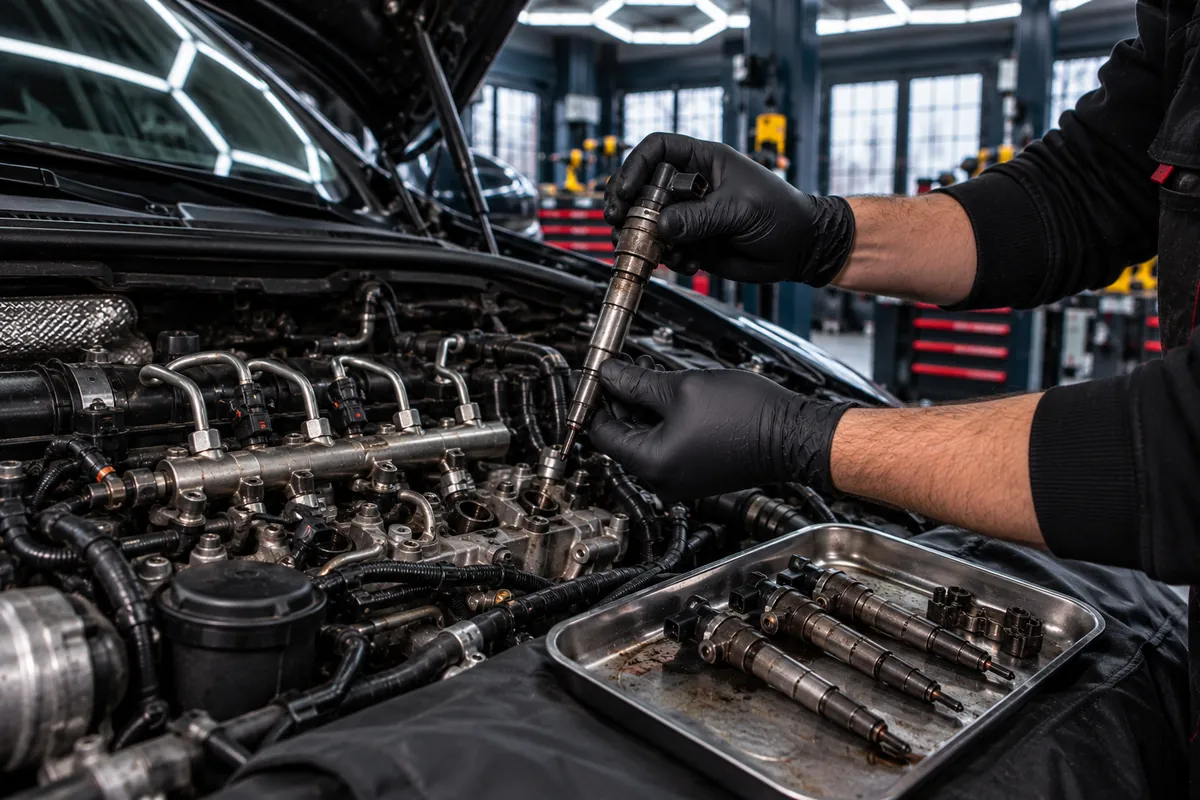
The most common symptoms of faulty injectors are a rough idle, hard starting, “running on three cylinders” right after a cold start, smoke from the exhaust, harsh knocking, a smell of fuel and higher fuel consumption. Often the check engine light comes on too, and a diesel may go into limp mode.
Important: the same symptoms are very often caused by glow plugs, ignition coils and spark plugs, the high-pressure pump, air in the fuel system, an intake leak or low compression in one cylinder. That is why injectors should never be replaced on a hunch. Below we explain what the correction values read by diagnostics and the leak-off test tell us, when cleaning is enough, when a rebuild makes sense and when replacement is needed — and why a new injector has to be coded into the ECU.
How an injector works — common rail diesel and petrol
An injector is an electrically controlled valve that delivers a precisely metered dose of fuel into the engine within a fraction of a millisecond. In a common rail diesel, fuel waits in the rail under very high pressure — around 1,800–2,500 bar in newer systems — and the ECU opens each injector several times per combustion cycle: a pilot injection softens combustion, the main injection produces power, and additional injections help, among other things, to heat the exhaust during DPF regeneration.
Diesels use two main types: solenoid injectors and piezo injectors, which react faster and allow more injections per cycle. Most common rail injectors send part of the fuel back to the tank through a leak-off (return) line — and that “leak-off” is exactly what the leak-off test measures.
Petrol engines use two layouts. Port injection (MPI) sprays fuel into the intake manifold, in front of the intake valve, at a few bar. Direct injection (e.g. TSI, TFSI, GDI) sprays fuel straight into the cylinder at roughly 100–350 bar. The tips of direct injectors sit in the combustion chamber, so they coke up more easily.
Whatever the type, injectors fail in similar ways: a dirty or worn nozzle (poor spray pattern, dripping), a worn control valve (excessive leak-off, wrong quantity), an electrical fault (solenoid, piezo stack, connector, wiring) or an external leak — at the sealing washer, O-rings or leak-off lines.
8 signs of bad injectors — and what else causes them
- Rough idle — the engine shakes, vibration is felt through the steering wheel and seat, the revs “hunt”.
- Running “on three cylinders” when cold — for the first seconds or minutes the engine clearly limps, then smooths out once warm.
- Hard starting — long cranking, especially with a warm engine or after a night (see also car won’t start).
- Exhaust smoke: black under acceleration, or white-grey and pungent (unburnt fuel) after starting (what the smoke colour means).
- Louder, harsher diesel running, a new knock or ticking at certain revs (engine rattle).
- A smell of fuel in the engine bay or cabin, wet leak-off lines and, on a diesel, black tar-like deposits around an injector.
- Higher fuel consumption, loss of power and jerking at steady speed (car jerking).
- A rising oil level on the dipstick and fuel smell in the oil — fuel from a dripping injector drains into the sump.
| Symptom | When it is the injector | More common cause outside the injector |
|---|---|---|
| Rough running of a cold diesel | High correction on one cylinder that drops once warm; high leak-off | Glow plugs or their control unit, low compression in one cylinder |
| Hard starting | Very high leak-off — the pump cannot build rail pressure while cranking | Weak battery, glow plugs, air in the system, fuel filter, high-pressure pump, rail pressure sensor |
| Misfire (petrol) | Stuck or dripping injector on the cylinder with the fault | Ignition coil, spark plug, intake leak, carbon on the valves |
| Black smoke (diesel) | Poor spray pattern, dripping, excessive quantity | Intake leak, turbo, EGR valve, mass air flow meter |
| Knocking, ticking | Worn nozzle; exhaust blow-by past the sealing washer (ticking, tar deposits) | Hydraulic lifters, valve clearance, timing chain, dual-mass flywheel |
| Fuel smell | Leaking leak-off lines, O-rings, washer | Leak at the fuel filter, lines or pump |
| Rising oil level | Dripping injector | Frequently interrupted DPF regenerations (post-injected fuel ends up in the oil) |
An injector is most often indicated by a combination of symptoms: rough running that changes with engine temperature, plus a clearly different fuel correction on one cylinder. Hard starting on its own is much more often caused by glow plugs, a weak battery, air in the system or the high-pressure pump. For petrol misfires a simple test works well: swap the coils between cylinders — if the fault “follows” the coil, the coil is to blame; if it stays on the same cylinder, the plug, injector and compression are checked.
On some engines, failures of a particular injector type are well known — one example is the Mercedes diesel described on the OM651 — injectors page. Even then, it is worth confirming the fault with measurements before buying an expensive set.
A dripping injector is not just a comfort issue. Fuel washes oil off the cylinder wall, dilutes the engine oil and, in a diesel, increases the amount of soot going into the DPF. In extreme cases a leaking injector can overheat and damage a piston — so with heavy smoke and rough running, do not wait.
Engine light flashing and the car shaking? Keep driving to a minimum. A flashing light usually means misfires, which in a petrol engine can quickly overheat and damage the catalytic converter.
Injector corrections and the leak-off test — what the measurements say
A diesel ECU constantly monitors how evenly the crankshaft turns. When a cylinder “pushes” weaker or stronger than the others, the ECU corrects the quantity for that injector so the engine runs smoothly. These corrections — also called injector balance or cylinder balancing — can be read with a scan tool, usually in mg per injection or mm³ per stroke.
Values close to zero mean the cylinders work similarly. A large positive or negative correction on one cylinder suggests a problem but does not prove the injector is at fault — lower compression in that cylinder gives a similar picture. The acceptable range depends on the system and manufacturer; on many engines a few mg at idle (e.g. about ±2–3 mg) is used as a rough limit, but the data for the specific engine is what counts. Readings are taken with the engine cold and warm, because some faults only show in one of those states.
The leak-off test is a simple workshop measurement on a diesel: measuring tubes or clear hoses are connected to the leak-off ports and the amount of fuel each injector returns in the same time is compared — at idle and sometimes during cranking. An injector with clearly higher leak-off than the others usually has a worn control valve. On some piezo injectors leak-off is inherently very small and the result is judged by different criteria.
Additional checks include comparing target and actual rail pressure, cutting out individual injectors (if the ECU and scan tool support it), a compression test and, on petrol engines, per-cylinder misfire counters and injector coil resistance. A full assessment of spray pattern and quantity is only possible on a test bench after the injector has been removed.
Do not clear faults or adaptations “just to see”. Stored corrections and freeze-frame data are valuable diagnostic information — once reset, the symptom may disappear for a while, but the evidence of the fault is lost.
Why injectors fail
- Contaminated fuel and water in the fuel — they cause corrosion and scoring of precision parts with tolerances measured in micrometres.
- A neglected or poor-quality fuel filter that lets fine particles through or does not separate water.
- Metal particles from a worn high-pressure pump — in that case the whole system is usually affected and replacing the injectors alone is not enough.
- Carbon on the tips — especially with short trips and in petrol engines with direct injection.
- Exhaust blow-by past the sealing washer — it overheats the injector and makes it seize in the cylinder head.
- Normal wear at high mileage — wear of the control valve and nozzle.
- Electrical faults: a damaged connector, chafed wiring, a failed solenoid or piezo stack, less often an ECU issue.
If the cause was contaminated fuel or pump debris, new injectors may quickly go the same way as the old ones. That is why with every replacement it is worth finding out why the previous ones wore out, checking the fuel filter and making sure there is no water or metal debris in the system.
Changing the fuel filter regularly as recommended by the manufacturer costs little compared with the price of a single injector. If the car stands for long periods or you fill up at random stations, do not stretch that interval.
How we diagnose injectors
- 1Talking about symptoms: when the engine runs rough (cold, warm, under load), how it starts, whether it smokes and whether the oil level is rising.
- 2Computer diagnostics: reading fault codes with freeze-frame data, injector corrections, rail pressure (target and actual) and misfire counts — with the engine cold and warm.
- 3On a diesel, when needed, a leak-off test and comparison of the injectors; on a petrol engine, checking coils and plugs to rule out the ignition system.
- 4Visual inspection: leak-off lines, fuel traces, tar-like deposits around injectors (blow-by past the washer), connectors and wiring.
- 5Checking side causes: fuel filter and water in the fuel, glow plugs, compression, intake leaks, oil level and smell.
- 6If in doubt — a camera inspection of the cylinders through the spark plug or injector hole (engine endoscopy).
- 7We present the result and a quote with possible options for approval — only then do we start work.
Diagnosis is based on several sources at once: ECU data, measurements on the engine and visual inspection. This makes it possible to identify a specific injector — or rule the injectors out altogether — instead of replacing a full set just because “the engine runs badly”.
Cleaning, rebuilding or replacing injectors
| Solution | When it makes sense | Limitations |
|---|---|---|
| Fuel additive | Prevention, light deposits | Does not fix wear or mechanical damage |
| Cleaning (e.g. ultrasonic with spray test) | Dirty but healthy injector — mainly petrol port injection | Does not replace worn parts; the result must be confirmed by a test |
| Rebuild | Worn nozzle or valve in an injector for which parts and test data are available | Not for every type; quality depends on the specialist and the bench test |
| New or factory-remanufactured | Electrical or mechanical damage, failed rebuild, no parts available | Highest parts cost; requires coding and new seals |
Cleaning helps when an injector is dirty but mechanically sound. For petrol port injection, ultrasonic cleaning combined with a spray pattern and flow check gives good results. Fuel additives can work as prevention, but they will not repair a worn valve or a damaged nozzle.
Rebuilding a diesel injector is more than washing: it means dismantling, replacing worn components (e.g. nozzle, control valve, seals) and checking on a test bench that the quantities are within specification. It is done by a specialist shop with the right equipment. Not every type can be sensibly rebuilt — some piezo injectors and petrol direct injectors are usually replaced with new or factory-remanufactured units.
Replacement is necessary when an injector has mechanical or electrical damage, fails the test after rebuilding, or no rebuild is available for that type. In the quote we present the available parts options with prices, and the decision is yours.
Injector replacement — coding and what to replace at the same time
- A new sealing washer under every injector that is removed — always, even when refitting the same injector.
- O-rings and seals, and often the hold-down bolt or clamp — as specified by the manufacturer.
- Leak-off lines and their connectors if they are brittle or leaking.
- High-pressure lines — on many engines the manufacturer specifies new ones once loosened.
- Thorough cleaning of carbon from the injector seat in the cylinder head.
- The fuel filter and — if the oil is diluted — an oil and filter change.
Every common rail injector has slightly different characteristics, so the manufacturer records them as a correction code on the body (depending on the system, e.g. IMA, QR or C2I/C3I). After fitting, this code has to be entered into the engine ECU with a scan tool. Without coding the ECU assumes the old injector’s data: the engine may run unevenly, smoke and clog the DPF faster. On some cars an adaptation or small-quantity calibration is also performed after replacement. Some petrol direct injectors require coding as well.
Watch out for seized injectors. On some engines an injector literally grows into the cylinder head over the years and removing it requires special tools and time. This cannot be predicted before attempting removal — if the scope of work changes, we agree it with you first.
Should all injectors be replaced? Not always. If measurements point to one faulty injector and the others have correct corrections and leak-off, replacing just one is often enough. At high mileage, with several values close to the limit, replacing the full set at once can be more sensible.
Injector repair cost in Warsaw
| Service | Price | When it is needed |
|---|---|---|
| Computer diagnostics | 100 zł | Reading fault codes, injector corrections and rail pressure — the starting point of diagnosis |
| Fuel filter replacement | 40 zł | Neglected filter, water in the fuel and always after an injector fault |
| Oil and filter change | 120 zł (labour) | When fuel has diluted the oil (rising level, fuel smell) |
| Engine endoscopy | 300 zł | Checking cylinders and pistons after an injector has dripped for a long time |
| Leak-off test, injector replacement and coding | after diagnosis | Depends on the engine, number of injectors and access |
| Injector cleaning or rebuild | after diagnosis | Depends on the injector type and the measurement results |
The cost of injector replacement depends above all on the type and price of the injectors, how many there are, access on the particular engine (on some cars quite a lot of ancillaries must be removed) and whether the injectors come out easily. Parts are priced separately in the quote, and the full list of services is on the Pulsecar price list.
Before work starts you receive a quote for approval, and we give a 6-month warranty on labour. You can read more about mechanical work on the general repair at Pulsecar page.
Fuel injectors in Warsaw’s Bielany — Pulsecar, ul. Arkuszowa 176
Pulsecar is located at ul. Arkuszowa 176 in Warsaw’s Bielany district, convenient for drivers from Żoliborz, Bemowo and Łomianki. We are open Monday to Friday 09:00–18:00 and Saturdays 09:00–15:00.
Call +48 571 058 591 or book a visit online. Describe the symptoms — rough running, hard starting, smoke or a fuel smell — and tell us whether they appear with a cold or a warm engine. We will first establish whether the injectors are to blame, and present a quote before any work begins.