Which coolant to choose — types, mixing and replacement
Coolant is chosen by the manufacturer’s spec, not by colour. We explain how coolant types differ, what mixing can lead to, how to dilute concentrate and what to do when you run low on the road.
8 min read · Pulsecar team · updated:
Which coolant does my car need? Short answer
Your car needs a coolant that meets the car manufacturer’s specification — not a coolant of “the same colour”. The spec is given in the owner’s manual or service data — for example TL 774 codes in VW Group cars (G12, G12++, G13, G12evo), MB 325.x sheets in Mercedes, N 600 69.0 in BMW, WSS-M97B44-D in Ford. The same spec number should be printed on the coolant label.
If you only need to top up, it is best to use the same coolant or one meeting the same spec. Below we explain how IAT, OAT, HOAT and Si-OAT coolants differ, why colour is not a specification, what mixing coolants can lead to, how to dilute concentrate, how often to change coolant and what to do when you run low on the road.
Types of coolant: IAT, OAT, HOAT, Si-OAT
| Technology | Protective additives | Example designations | Typical service life |
|---|---|---|---|
| IAT — inorganic (conventional) | Silicates, phosphates and other inorganic compounds; deplete quickly | Older coolants, e.g. VW G11 (TL 774-C) | Usually approx. 2–3 years |
| OAT — organic | Organic acids (carboxylates), no silicates | E.g. VW G12 / G12+ (TL 774-D/F), GM Dexcool | Often approx. 5 years — per manufacturer |
| HOAT — hybrid | Organic acids plus silicates or — in Asian cars — phosphates (P-HOAT) | Many European (e.g. MB 325.x sheets) and Japanese cars | Usually approx. 4–5 years — per manufacturer |
| Si-OAT (lobrid) | Organic acids with organic silicates | E.g. VW G12++ (TL 774-G), G13 (TL 774-J), G12evo (TL 774-L) | Long; some manufacturers give no fixed interval |
Coolant is not just “antifreeze”. It removes heat from the engine, raises the boiling point (in a pressurised system even above 120°C), protects against freezing and, above all, protects aluminium cylinder heads, radiators and the water pump against corrosion. Corrosion protection comes from additives — inhibitors — and these, not the glycol base, are what distinguish the different technologies.
The coolant type does not always follow directly from the car’s model year — manufacturers changed specs during model production. If you do not have the manual, we will check the required spec by VIN.
Coolant colour is not a specification
Dye is added to coolant mainly to make leaks easy to spot and to tell coolant from water. There is no single standard assigning colours to technologies. Coolants with completely different chemistry can share the same colour, and the same type of coolant is sold in different colours.
Examples: G12evo and G13 are violet or pink, as are some older G12+ coolants, while in Japanese cars a pink or blue coolant often means entirely different chemistry (P-HOAT). A green coolant can be a conventional IAT, but also a modern hybrid coolant.
So when buying, look at the spec on the label, not the colour. A claim like “suits all cars” or “universal” does not replace the specific spec required by the manufacturer.
Can you mix coolants?
- Do not mix IAT (silicate) coolants with OAT coolants without confirmed compatibility.
- Do not go by colour when topping up — check the spec.
- Avoid “stop-leak” additives poured into the coolant — they can clog the heater core and will not replace a repair.
- After adding a larger amount of a different coolant or water, plan a change and check the freezing point.
Mixing coolants of different technologies is one of the most common mistakes. In the extreme case the additives react and form sediment or a gel-like sludge that clogs the narrow passages of the radiator and heater core. More often the effect is less dramatic but just as costly: the inhibitors “dilute” each other, corrosion protection weakens, and after a few years rust, deposits and leaks appear in the system.
A small top-up of a different but compatible spec usually does no harm, and some manufacturers explicitly allow mixing certain coolants (e.g. within newer VAG specs). You will find compatibility information on the label and in the car manufacturer’s data. If you do not know what is in the system and a lot of a different coolant has already been added, the safest option is to replace the coolant in the whole system.
Concentrate or ready-mix — how to dilute
| Concentrate : water | Freezing point (approximate) | When to use |
|---|---|---|
| 1 : 2 (approx. 33%) | approx. −18 to −20°C | Too little protection for Polish winters |
| 2 : 3 (approx. 40%) | approx. −25°C | Minimum recommended by many manufacturers |
| 1 : 1 (50%) | approx. −35 to −37°C | The most common ratio |
| 3 : 2 (approx. 60%) | approx. −45 to −50°C | Very cold climates; more makes no sense |
| Pure concentrate | Higher than the mix (approx. −13°C for ethylene glycol) | Do not use undiluted |
Coolant is sold as concentrate or as a ready-to-use mix (usually with a freezing point of approx. −35°C). Concentrate is not poured into the system undiluted: pure glycol freezes at a higher temperature than the mix and transfers heat worse. Concentrate is diluted with demineralised water — ordinary tap water contains minerals that deposit in the system as scale.
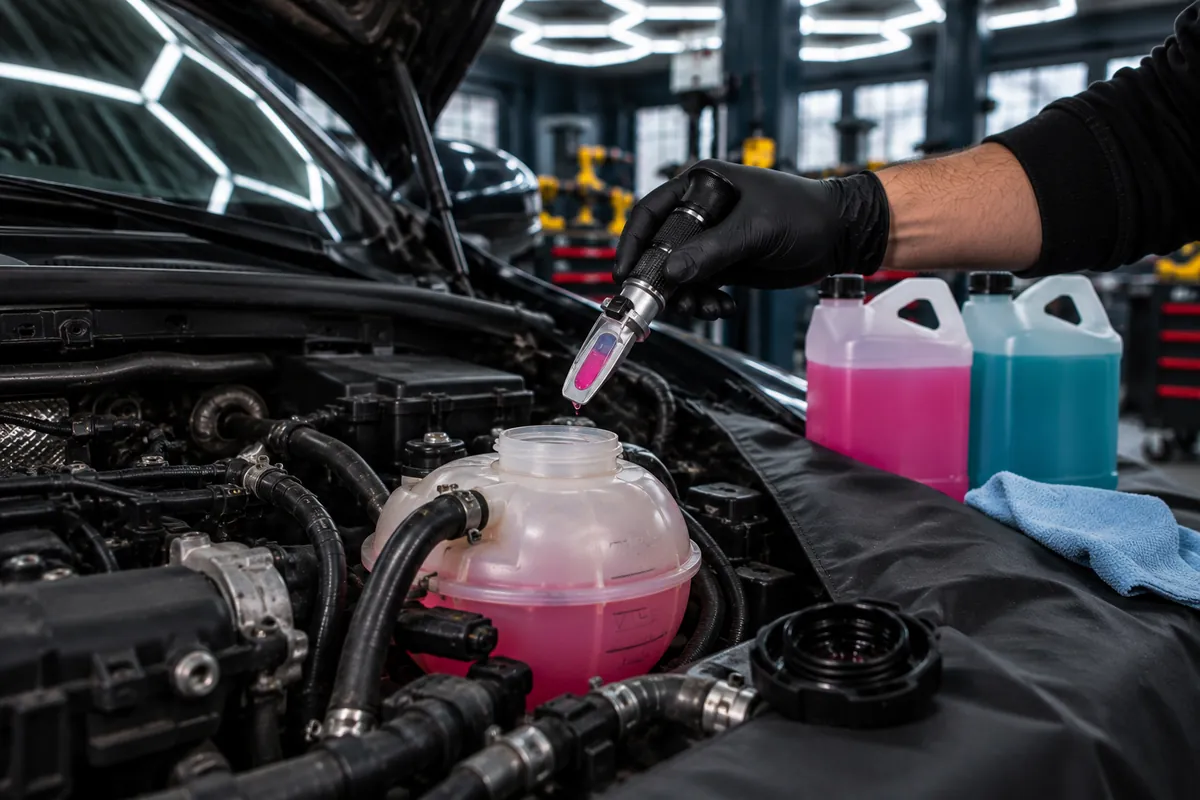
The values in the table are approximate for ethylene-glycol-based coolants — the exact ratios are given by the coolant maker on the label. The frost protection in the car is checked with a refractometer in a few seconds.
How often to change coolant
The interval depends on the coolant technology and the car manufacturer’s recommendations. Conventional IAT coolants are usually changed every 2–3 years. Long-life coolants (OAT, HOAT, Si-OAT) last longer — often approx. 5 years or the mileage given by the manufacturer, and in some newer cars the manufacturer gives no fixed interval, recommending only periodic checks.
Regardless of the interval, it is worth changing the coolant when it has been mixed with another coolant or heavily diluted with water, when it is dirty, rusty or shows traces of oil, and after repairs that require draining the system — e.g. replacing the water pump, radiator, thermostat or head gasket.
Good practice is to check the coolant before every winter: the level in the expansion tank, the appearance of the coolant and the freezing point measured with a refractometer.
Signs of old or wrong coolant
- Brown, rusty or cloudy coolant with sediment in the expansion tank.
- An oily film or “mayonnaise” in the tank — may indicate a head gasket problem.
- Rising engine temperature or engine overheating, especially in traffic or under load.
- An illuminated coolant temperature warning light or a low-level message.
- Weak cabin heating — possibly a clogged heater core or air in the system.
- A sweet smell in the cabin or misting windows — a possible heater core leak.
- Crystalline deposits on hoses and joints or puddles under the car — check leak under the car.
Regular coolant loss always has a cause — the cooling system is sealed, and in a healthy car the level practically does not change. Constant topping up without looking for the leak usually ends in engine overheating, which can mean an expensive cylinder head repair.
If the temperature gauge approaches the red zone or steam comes from under the bonnet, stop in a safe place and switch off the engine. Driving on with an overheated engine risks damaging the head gasket.
Low on coolant on the road — what to do
- 1Stop the car in a safe place and switch off the engine. Do not open the tank cap on a hot engine — the coolant is under pressure and can scald you.
- 2Wait for the engine to cool and check the level in the expansion tank — it should be between the MIN and MAX marks.
- 3Top up with coolant of the same spec, ideally ready-mixed.
- 4If you have no coolant, use distilled or demineralised water as an emergency; tap water only as a last resort to get you home.
- 5Drive gently while watching the temperature gauge, and check the level again once the engine has cooled.
- 6Have a workshop check the cause of the loss and the frost protection as soon as possible.
Water is an emergency solution only. It dilutes the coolant, raises the freezing point and weakens corrosion protection. In winter a system with a lot of water can freeze — ice can crack the radiator and, in extreme cases, even the engine block. After any larger water top-up, measure the freezing point and change the coolant if needed.
How we change coolant at Pulsecar
- 1We check the coolant spec required by the car manufacturer (by VIN and service data).
- 2We assess the coolant condition, level and freezing point, and check accessible hoses, joints and the radiator for leaks.
- 3We present a quote including coolant for approval — only then do we start work.
- 4We drain the old coolant; if it was mixed or is contaminated, we discuss flushing the system with you.
- 5We fill the system with coolant of the correct spec and concentration, then bleed it according to the procedure for the model (in some cars using a diagnostic tool).
- 6We warm up the engine, check thermostat and fan operation, leaks and the final coolant level.
Bleeding is a key step — air pockets in the system can cause local overheating and false temperature readings. In many modern cars with an electric water pump or a complex cooling system the procedure is more involved than simply topping up the tank.
Coolant change — cost in Warsaw
| Service | Price (labour) | When it is needed |
|---|---|---|
| Coolant replacement | from 200 zł | At the interval, after mixing coolants, before winter if protection is weak |
| Computer diagnostics | 100 zł | Temperature warning light, sensor faults, overheating |
| Head gasket replacement | from 1000 zł | Oil in coolant, coolant loss with no visible leak, overheating |
The prices shown are for labour. Coolant is priced separately — its cost depends on the spec and system capacity, which in passenger cars is usually from a few to over a dozen litres. Replacement of the thermostat, water pump, radiator or hoses is priced after diagnosis. Before work starts you receive a quote for approval, and we give a 6-month warranty on labour.
Read more about the service on the cooling system service page, and see the full price list.
Coolant change in Warsaw Bielany — Pulsecar, ul. Arkuszowa 176
We change coolant and repair cooling systems at the Pulsecar workshop at ul. Arkuszowa 176 in Warsaw’s Bielany district — convenient for drivers from Żoliborz, Bemowo and Łomianki. We are open Monday to Friday 09:00–18:00 and Saturdays 09:00–15:00.
Call +48 571 058 591 or book a visit online. Tell us the car model and year — we will check the required coolant spec and prepare a quote before any work begins. Directions are on the contact page.