Periodic technical inspection in Poland — what is checked and how to prepare your car
The periodic technical inspection usually takes a quarter of an hour or so, but one blown bulb or play in the suspension can mean a fail. We explain what the inspector checks, what to bring to the station and how to prepare the car.
8 min read · Pulsecar team · updated:
Periodic technical inspection — the short answer
The periodic technical inspection (badanie techniczne, often called “przegląd rejestracyjny”) — Poland’s equivalent of the MOT — is carried out at a vehicle inspection station (SKP). The inspector checks, among other things, the lights, brake efficiency, play in the suspension and steering, tyres, leaks, exhaust emissions, dashboard warning lights and the windscreen. The most common reasons for a fail are exactly these: blown or badly aimed lights, weak or unevenly working brakes, suspension play, oil leaks and worn tyres.
Important: Pulsecar is not a vehicle inspection station and does not carry out technical inspections. What we can do is prepare your car for the inspection — check it for what the inspector looks at and fix whatever could lead to a fail. You then have the inspection itself done at an SKP station of your choice.
When the technical inspection is due
- New passenger car: first inspection within 3 years of first registration.
- Second inspection: within 2 years of the first.
- Further inspections: every year.
- Car with an LPG system: every year, regardless of the car’s age.
- The date of the next inspection is held in the central vehicle register — you can check it, for example, in the mObywatel app.
You can have the inspection done before the last day of the deadline. Do not leave it to the last minute — if the result is a fail, you will have time to fix things calmly instead of driving with an expired inspection, which can mean a fine.
What the inspector checks at the vehicle inspection station
- Vehicle identification: VIN, rating plate, number plates and agreement with the documents.
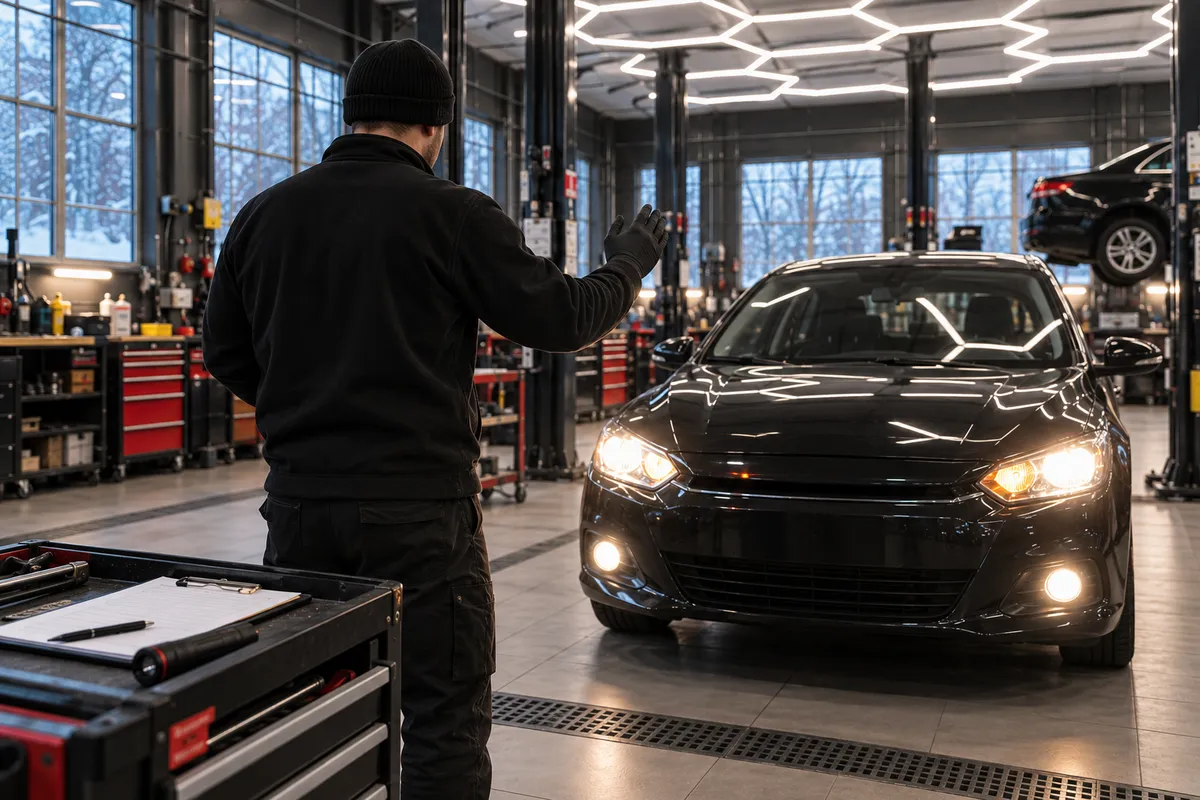
- Lights and signalling: dipped beam, main beam, side lights, indicators, brake lights, reversing lights, fog lights, number plate lighting, headlight aim, horn.
- Brakes: efficiency of the service brake and parking brake on the rollers, the difference in braking force between left and right wheels, condition of lines, discs and drums, fluid level.
- Suspension and steering: play in control arms, ball joints, tie-rod ends and wheel bearings, condition of springs and shock absorbers, CV joint boots.
- Tyres and wheels: tread depth, damage, correct size, the same tyre type on one axle.
- Leaks: engine oil, fluids, fuel, condition of the exhaust system.
- Exhaust emissions: gas composition in a petrol car, smoke opacity in a diesel.
- Warning lights and equipment: lights for airbags, ABS and the engine, among others, seat belts, wipers and washers, mirrors.
- Glass: cracks and chips in the driver’s field of view and in the wiper sweep area.
- LPG system, if fitted: tightness, mounting and tank validity.
Most common reasons for a fail — table
| Item | Typical fault | How to prepare the car |
|---|---|---|
| Lights | Blown bulb, badly aimed headlights, cloudy or misted lenses | Check all lights with a second person, replace bulbs, check headlight aim |
| Brakes | Low efficiency, large difference between wheels, weak parking brake | Check pads, discs and calipers, adjust the parking brake |
| Suspension and steering | Play in ball joints, bushes, tie-rod ends, anti-roll bar links | Suspension check and replacement of worn parts |
| Shock absorbers and springs | Leaking damper, broken spring | Inspection, replacement in pairs on the axle |
| Leaks | Oil from the engine or gearbox, brake fluid, fuel | Find the source of the leak and repair it |
| Tyres | Tread below 1.6 mm, cracks, cuts, different tyres on one axle | Measure the tread, replace tyres |
| Emissions | Emissions too high, heavy diesel smoke | Computer diagnostics and repair of the cause |
| Warning lights | Airbag, ABS or engine light on | Read fault codes and fix the fault |
| Windscreen and wipers | Crack in the wiper sweep area, worn blades, washer not working | Replace blades, top up fluid, have the glass assessed by a windscreen specialist |
| Exhaust system | Leak, loud running, loose mountings | Inspect and repair the exhaust |
A driver can spot many of these faults alone, but suspension play, uneven braking force or the beginnings of a leak are easiest to assess on a lift. About a parking brake that often holds poorly on the rollers, read our guide handbrake — adjustment, and about the symptoms of worn dampers — the article shock absorbers — signs of wear.
How to prepare your car for the inspection yourself
- 1Walk around the car with a second person and check all lights: dipped, main beam, front and rear side lights, indicators, hazards, brake lights (including the third one), reversing lights, fog lights and number plate lighting.
- 2Check the horn, wipers and washers; top up the washer fluid.
- 3Start the engine and see whether all the warning lights go out after a few seconds — especially airbag, ABS and engine.
- 4Measure the tyre tread and look at the tyre sidewalls. Check the pressure.
- 5Look under the car and under the bonnet for fresh oil or fluid stains.
- 6Check the oil, brake fluid and coolant levels.
- 7Test the parking brake on a gentle slope.
- 8Inspect the windscreen in the wiper sweep area and check that the seat belts buckle and retract.
- 9Make sure the VIN and number plates are clean and legible.
What to bring to the vehicle inspection station
- The vehicle registration certificate (dowód rejestracyjny).
- With an LPG system — the system documents, if you have them; the inspector checks, among other things, the tank’s validity date.
- The key for locking wheel bolts, if the car has them — it may be needed during the inspection.
- Cash or a card for the inspection fee.
- For the first inspection of a car imported from abroad, extra documents may be required — it is worth asking at your chosen station beforehand.
Arrive with a warm engine and at least a few litres of fuel in the tank. Take things out of the boot that block access to the spare wheel and floor, and remove items from the dashboard that cover the warning lights.
A failed inspection — what next
The inspector divides faults into minor, major and dangerous. Minor faults do not cause a fail, but are worth fixing. A major or dangerous fault means a fail and the need for a repair.
After a fail you have 14 days to repair the car and return to the same vehicle inspection station. The inspector then checks only the items where faults were found. If you miss that deadline or go to a different station, you face a full inspection and the full fee.
A dangerous fault means a direct risk to road safety — in that situation do not risk driving on and plan the repair straight away. Bring the SKP report to the workshop: based on it we can quickly verify the faults and prepare a quote.
How much the technical inspection at an SKP costs — official fees
| Type of inspection | Fee at the SKP |
|---|---|
| Passenger car | 149 zł |
| Passenger car with an LPG system | 245 zł |
These are the official rates in force since September 2025, set by the Minister of Infrastructure and the same at every vehicle inspection station. You pay the fee at the SKP, not at the workshop. Rates can change, so it is best to confirm the current amount at your chosen station.
How we prepare your car for the inspection at Pulsecar
- 1A talk: when the inspection is due, whether the car had remarks at the SKP before, whether any warning lights are on.
- 2An extended inspection on the lift: lights, brakes, suspension and steering, tyres, leaks, exhaust system, windscreen, wipers.
- 3If needed, a suspension check and reading fault codes when a warning light is on.
- 4A list of faults with photos — split into what could stop the car at the inspection and what can wait.
- 5A quote for approval — we repair only what you agree to.
- 6After the repair the car goes for its inspection at the vehicle inspection station of your choice.
Preparing for the inspection makes particular sense with older cars, after winter and before a sale. If you are buying a used car, also see our guide pre-purchase inspection. More about mechanical repairs is on the general repair page.
How much preparing a car for the inspection costs at Pulsecar
| Service | Price (labour) |
|---|---|
| Extended inspection | 250 zł |
| Suspension diagnostics | 100 zł |
| Computer diagnostics (fault codes) | 100 zł |
| Bulb replacement | from 30 zł |
| Anti-roll bar link replacement | from 100 zł |
| Front brake pads | from 200 zł |
| Front shock absorber replacement | from 200 zł |
| Other repairs | quoted after diagnosis |
Prices are for labour at Pulsecar; parts are quoted separately depending on the model. The fee for the technical inspection itself is charged at the SKP and is not part of our price list. Before repairs start you receive a quote for approval, and we give a 6-month warranty on labour. The full list is in our price list.
Pulsecar is at ul. Arkuszowa 176 in Warsaw’s Bielany district. We are open Monday to Friday 09:00–18:00 and Saturdays 09:00–15:00. Book online or call +48 571 058 591 — ideally a few days before the inspection date, so there is time to get any parts.