
Car battery in winter — weak battery symptoms, voltage check and diagnosis
Frost mercilessly exposes a weak battery: the starter turns slowly, warning lights flicker and start-stop stops working. We explain how to check the battery, when to charge it and when to replace it, and how to tell it apart from an alternator fault.
9 min read · Pulsecar team · updated:
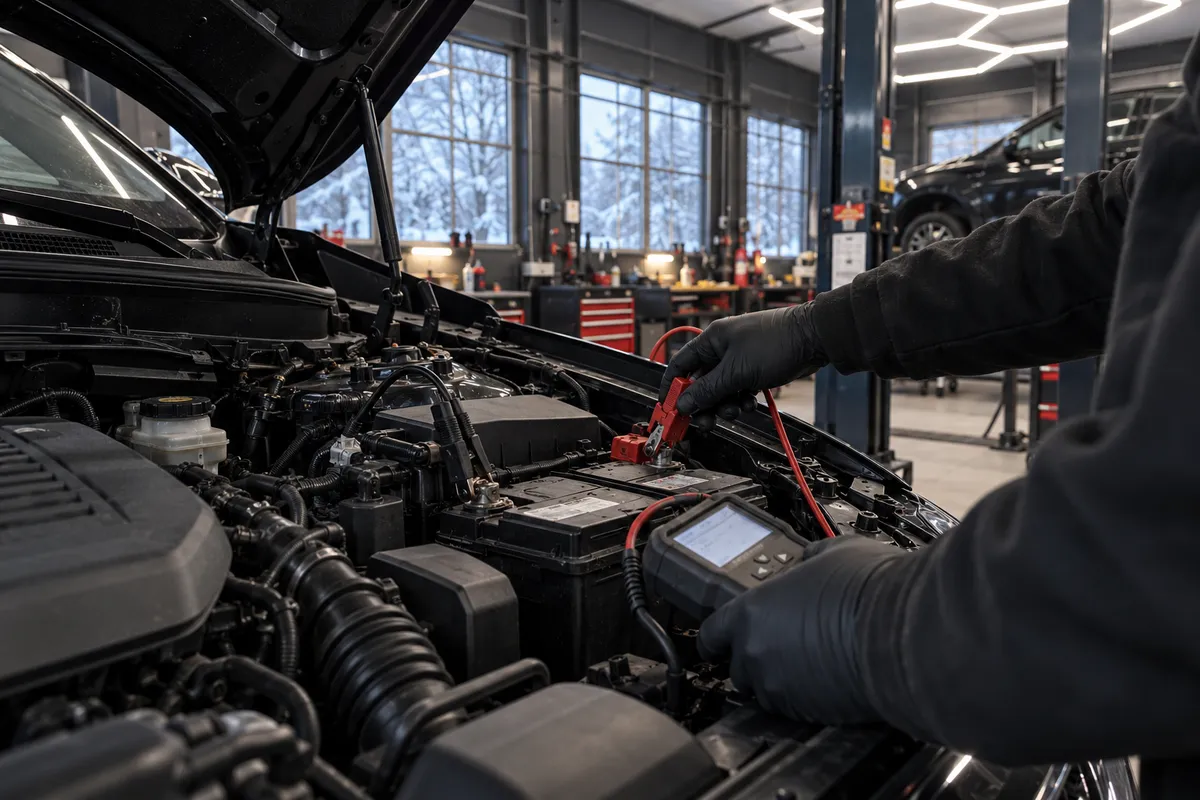
Weak battery in winter — the short answer
If on a frosty morning the starter turns slowly and laboriously, the warning lights dim during cranking and the start-stop system has not switched the engine off for several days, the most likely cause is a weak battery. In winter its performance drops, while a cold engine with thick oil needs more energy to start — which is why a battery that was still coping in summer gives up at the first frost.
Not every starting problem is the battery, though. Similar symptoms come from an alternator that is not charging, excessive current draw when parked, a worn starter motor and, in a diesel, glow plugs. Below we explain how to measure the voltage, what a load test tells you, how to charge a battery safely, what to remember in start-stop cars and what diagnosis in the workshop looks like.
Why batteries fail in winter
A lead-acid battery produces current through a chemical reaction that slows down at low temperatures. At well below freezing a battery delivers noticeably less energy than in summer, while the engine puts up more resistance: the oil is thicker, and in a diesel the glow plugs also draw power. A battery already weakened by age or deep discharges simply stops being enough in winter.
It is also harder to charge a battery in winter. Short trips, heated windows, seats and mirrors, the blower on high and the lights mean the alternator barely keeps up with replacing the energy used for starting. After a few weeks of short journeys the battery is often permanently undercharged, and an undercharged battery ages faster and freezes more easily.
Signs of a weak battery
- The starter turns slowly and laboriously, especially in the morning after a frosty night.
- Warning lights and interior lights dim noticeably during cranking.
- You hear clicking or chattering instead of the starter turning.
- The clock, radio settings or window memory reset overnight.
- The start-stop system stops switching the engine off — often the earliest sign, because the control unit protects a weak battery.
- Low voltage messages, random electronic faults, flickering warning lights after starting.
- White or greenish deposits on the terminals, a swollen case, traces of electrolyte.
- The battery is several years old and has previously been deeply discharged, e.g. after the lights were left on.
If the symptoms appear only when starting and everything works normally once the engine is running, the battery is usually to blame. If, however, the charging light comes on while driving and the car will not start a few days after the battery was charged, the cause may be the alternator or current draw while parked.
How to check the battery voltage
| Resting voltage | Approximate state of charge | What to do |
|---|---|---|
| 12.6–12.8 V | approx. 100% | Battery charged; if the car still starts poorly, a load test is needed |
| approx. 12.4 V | approx. 75% | Top up the charge, find out why it is not full |
| approx. 12.2 V | approx. 50% | Charge with a charger, check charging and current draw |
| approx. 12.0 V | approx. 25% | Charge urgently; in winter there is a risk of a no-start |
| below 11.9 V | discharged | Charge and test — a deep discharge may have damaged the battery permanently |
Voltage is measured with a multimeter directly at the battery terminals. For the reading to be meaningful, the battery must rest: after driving or charging, wait at least a few hours — ideally measure in the morning before starting the car. Straight after driving the voltage is inflated by the so-called surface charge. The values in the table are approximate for a typical 12 V battery; AGM batteries usually have a slightly higher voltage when fully charged.
With the engine running, the charging voltage is usually about 13.8–14.7 V. In newer cars with smart alternator control this value changes while driving — it can be lower with a warm, charged battery and higher during engine braking — so a single reading is not always enough to judge. We cover the signs of faulty charging in the article alternator failure symptoms.
Many cars have a voltage gauge on the dashboard or show voltage in the trip computer menu, but that is only an approximate reading. Judging a battery needs a measurement at the terminals and a load test.
Load testing and battery age
Resting voltage tells you the state of charge, but not the battery’s health. A worn battery can show 12.6 V and still collapse at the first attempt to start, because it has lost capacity and has too much internal resistance. That is why in the workshop we use a tester that compares the actual cranking current with the nominal value on the battery label (e.g. in amps to the EN standard) and assesses its condition. Measuring the voltage while cranking also helps: if it drops clearly below about 10 V, the battery or the starter needs a closer look.
A battery is a wear item. In typical conditions it usually lasts several years — often 4–6 — but short trips, deep discharges, heat and a heavy electrical load shorten its life. The production date is usually on the case or a label. If the battery is already a few years old and fails at the first frost, charging usually only helps for a short time.
If the starter turns briskly but the engine will not fire, the battery is probably not the problem. In a diesel, check the glow plugs — more in the article glow plugs and spark plugs in winter.
Charging the battery — how to do it safely
- 1Use a modern automatic charger with a mode matched to the battery type (standard, EFB, AGM).
- 2Check the car’s handbook to see whether the battery can be charged without disconnecting it — many cars have dedicated charger connection points in the engine bay.
- 3If you disconnect the battery, take off the negative terminal first, and when reconnecting, fit it last. Remember that after disconnection some settings, such as window or radio memory, may need setting up again.
- 4Do not charge a frozen battery — it must first warm up slowly at room temperature.
- 5Charge in a well-ventilated place, away from sparks and open flames.
- 6After charging, wait a few hours and measure the resting voltage — ideally do a load test.
Charging with a charger helps when the battery is healthy but undercharged — for example after short winter trips. If the battery quickly loses voltage after a full charge or fails the load test, it needs replacing. If, on the other hand, a healthy battery goes flat after a few days parked, the current draw is worth checking.
A discharged battery freezes much more easily than a charged one. That is why in winter it is worth keeping it well charged, especially when the car stands for long periods or only does short trips.
AGM and EFB in start-stop cars — registering a new battery
Cars with start-stop have batteries designed for frequent starts: EFB (enhanced flooded batteries) or AGM (with the electrolyte held in a glass mat). AGM is usually used where the load is highest, for example in cars with brake energy recovery. The battery is replaced with the same type or the one recommended by the manufacturer — a standard battery in place of an AGM wears out quickly, and start-stop may stop working properly.
In many newer cars, for example some BMW, Audi and Volkswagen models, the battery works with an energy management system and a sensor on the terminal. After replacement the new battery then has to be registered in the control unit, and sometimes its type and capacity coded too. Without this the car charges the new battery as if it were the old, worn one — which shortens its life and can cause start-stop problems and low voltage messages. We check whether a particular car needs this before the replacement.
Battery, alternator, current draw or starter — table
| Symptom | Most likely cause | How to check it |
|---|---|---|
| Slow start in the morning, everything works once running | Weak or undercharged battery | Resting voltage, load test |
| Charging light while driving, dimming lights, battery keeps going flat | Alternator not charging | Measuring charging voltage and alternator output |
| Car will not start after a few days parked, even with a new battery | Excessive current draw when parked | Measuring current draw after the control units go to sleep |
| A single click, lights normal, starter does not turn | Starter motor or its supply | Voltage drop measurement, checking the starter and cables |
| Starter turns briskly, engine does not fire (diesel) | Glow plugs or fuel system | Computer diagnostics, glow plug test |
Current draw when parked is a common and underrated cause. After the car is locked, the control units gradually go to sleep — this takes from a few to several dozen minutes — and the draw usually drops to a few dozen milliamps or less. Clearly higher values point to a device that does not go to sleep: an add-on such as a dashcam, alarm or radio, boot or glovebox lighting, a faulty module, or sometimes a leaking alternator diode. If the cause is a starter that turns slowly or not at all with a healthy battery, see the article starter motor symptoms.
Diagnosis in the workshop — how we check it at Pulsecar
- 1A talk with the driver: when the car starts poorly, how old the battery is, which routes dominate, whether messages or warning lights appear.
- 2Measuring the resting voltage and testing the battery with a tester, compared with the data on the label.
- 3Measuring the voltage during cranking and the charging voltage with the engine running, also with electrical loads switched on.
- 4Computer diagnostics: low voltage fault codes, battery sensor data, charging history and the state of the start-stop system.
- 5If needed, measuring the current draw when parked and finding the circuit that does not go to sleep.
- 6Checking the terminals, earth and supply cables, and the alternator drive belt.
- 7Presenting the result and a quote for approval — we order parts and start work only after you agree.
This approach avoids replacing a healthy battery when the alternator or a device draining it when parked is to blame. If a replacement is needed, we choose a battery of the right type and — when the car requires it — register it in the control unit. More about electrical diagnostics is on the auto electrician page.
How much does battery diagnosis and replacement cost in Warsaw
| Service | Price |
|---|---|
| Computer diagnostics and charging system test | 100 zł |
| Battery replacement, registration or coding | quoted after diagnosis |
| Alternator or starter replacement, tracing current draw | quoted after diagnosis |
Diagnostics cost 100 zł. The price of a battery depends on its type (standard, EFB, AGM) and capacity, and the cost of replacement on where the battery is fitted and whether the car needs registration. That is why we give the exact amount in the quote before work starts. We give a 6-month warranty on labour, and new parts are covered by the manufacturer’s warranty. Current prices are in our price list.
Pulsecar is at ul. Arkuszowa 176 in Warsaw’s Bielany district. We are open Monday to Friday 09:00–18:00 and Saturdays 09:00–15:00. Book a visit online or call +48 571 058 591.