Glow plugs, spark plugs and the battery in winter — symptoms and replacement
The first frost mercilessly exposes worn plugs and a weak battery. We explain how to find the cause of hard starting in diesel and petrol cars and what to check before winter leaves you stranded.
10 min read · Pulsecar team · updated:
Glow plugs, spark plugs and the battery in winter — short answer
When the frost arrives, starting problems are most often revealed by three things: worn glow plugs in a diesel, worn spark plugs or coils in a petrol engine, and a battery that still coped in summer. Typical signs are long cranking before the engine fires, rough running and smoke for the first few minutes after a cold start, jerking, a flashing glow plug or check engine light and a slowly cranking starter.
All these faults have a similar effect — the car “won’t start” on a frosty morning — but they are fixed in completely different ways. Below we explain how to identify the culprit, how plugs and batteries are tested, when to replace them and how to prepare your car so winter does not leave you stranded in the car park.
Why engines start worse in winter
| Diesel | Petrol | |
|---|---|---|
| What ignites the mixture | The heat of compressed air, assisted by glow plugs | A spark from the spark plug, fed by the ignition coil |
| Typical cause of poor cold starting | Worn glow plugs or their controller, weak battery, summer fuel or a clogged fuel filter | Worn spark plugs, faulty coil, weak battery |
| Characteristic symptom | Long cranking, white-grey smoke and loud running for the first minutes | Jerking, rough running when cold, misfires |
| Warning light | Glow plug light (coil symbol); in some cars it flashes when there is a fault | Engine light (check engine), flashing with severe misfires |
In frost, everything works against starting. The battery delivers less power because its chemical reactions slow down. Engine oil thickens, so the starter has to overcome more resistance and cranks more slowly. Fuel vaporises less readily, and cold cylinder walls draw heat away from the compressed air.
A diesel has no spark plugs — the fuel ignites from the heat of compressed air. With a cold engine that heat may not be enough, which is why glow plugs heat the combustion chambers before and just after starting. In a petrol engine the spark comes from the spark plug; a worn plug needs a higher voltage, and a weakening coil cannot always deliver it — especially when battery voltage drops during cranking.
Fuel matters in a diesel too. Summer diesel can form paraffin wax crystals in frost, which clog the fuel filter. Filling stations in Poland switch to transitional and then winter diesel in autumn, but fuel bought earlier and left sitting in the tank can cause trouble during the first hard frosts.
Glow plugs in a diesel — how they work and signs of wear
- Long cranking before the engine fires, clearly worse in frost than with a warm engine.
- White or grey smoke from the exhaust for the first minutes after a cold start — that is unburnt fuel.
- Rough running, vibration and louder “diesel knock” straight after starting, which disappear once the engine warms up.
- The glow plug light goes out immediately, does not come on at all, or flashes while driving.
- The car only starts after several “pre-heats” — switching the ignition on again and waiting for the light to go out.
- Glow plug circuit faults stored in the engine control unit.
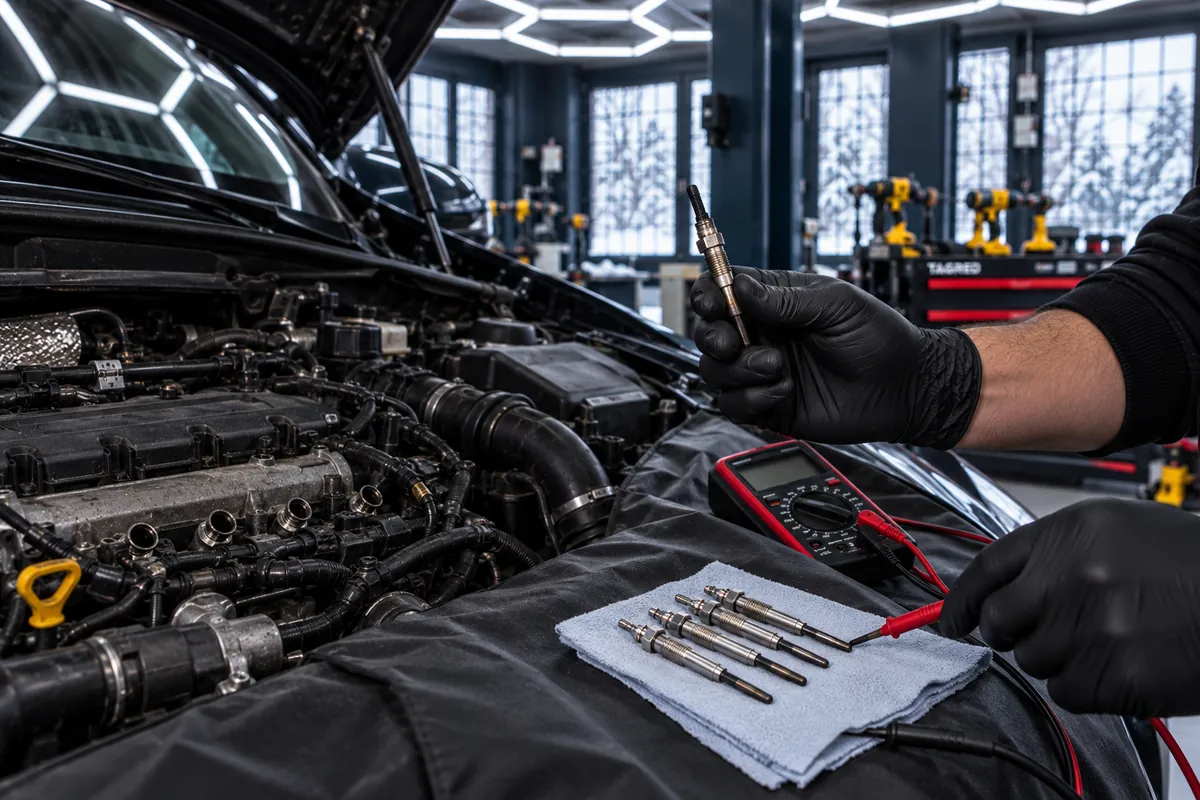
A glow plug is a heating element screwed into the cylinder head which, when the ignition is switched on, reaches a very high temperature within seconds. The glow plug controller (a relay or a separate module) decides how long they heat, depending on engine temperature. In newer diesels the plugs also work after starting (post-glow), which reduces smoke, noise and emissions from a cold engine.
Glow plugs usually have no fixed replacement interval — they are replaced when they stop heating. Their durability depends on the design (metal or ceramic) and the engine. One faulty plug can go unnoticed on milder days, but in frost it shows immediately, and with several faulty plugs the engine may not start at all.
Do not use starting spray (ether) in a diesel with glow plugs — a hot glow plug can ignite the mixture at the wrong moment and damage the engine. We also advise against the old trick of adding petrol to diesel: in modern injection systems it can harm the pump and injectors.
In frost, wait until the glow plug light goes out before starting the engine. In many cars with a START button the control unit does this automatically — a short delay before cranking is then normal.
Glow plug warning light — on, flashing, not going out
- Comes on when the ignition is switched on and goes out after a few seconds — normal; with a warm engine it may go out almost immediately.
- Does not come on at all with a cold engine — possible fault in the glow plug controller, its supply or the light itself.
- Flashes or comes on while driving — in many models this signals a fault stored in the engine control unit, not only in the glow plugs: it may concern e.g. a sensor, boost or injection. The car often goes into limp mode.
- Stays on and does not go out — depending on the model: a fault in the heating circuit or controller.
The meaning of a flashing light differs between makes, so it is always worth checking the owner’s manual and reading the fault codes. You will find a detailed explanation in glow plug warning light. If the car has gone into limp mode, drive gently and get a diagnosis as soon as possible.
Spark plugs and coils in petrol engines — symptoms and replacement intervals
- Jerking when accelerating, especially under load and on damp days.
- Rough idle, vibration, a “shaking” engine.
- Harder cold starting and loss of power.
- The engine light is on or flashing, with misfire codes stored (e.g. P0300–P0304).
- Higher fuel consumption and a smell of unburnt fuel from the exhaust.
| Engine or plug type | Typical interval (approximate) | Notes |
|---|---|---|
| Older naturally aspirated engines, nickel plugs | often every 30,000–60,000 km | Time also counts — check the service book |
| Platinum or iridium plugs (long life) | often every 60,000–120,000 km | The car manufacturer decides, not the plug type alone |
| Turbo engines with direct injection | often shorter than naturally aspirated | High cylinder pressure wears the electrodes faster |
| Cars with LPG | usually shorter than on petrol alone | Gas needs a higher ignition voltage |
These are approximate values — the binding interval is the manufacturer’s for the specific engine, given in kilometres or years (whichever comes first). Spark plug electrodes erode over time and the gap between them grows, so the spark needs an ever higher voltage. A coil with weakened insulation or a cracked plug boot is then the first to give up — most often in frost and damp.
A flashing check engine light usually means severe misfiring. Unburnt fuel then reaches the catalytic converter and can overheat it — reduce load, do not accelerate hard and get to a workshop as soon as possible. More in our guide check engine light on or flashing, and other causes of jerking are covered in car jerking.
The battery in winter — how to tell it is too weak
- The starter cranks noticeably slower than usual, especially in the morning.
- Warning lights and lighting dim when starting.
- Start-stop stops switching the engine off — in many cars this is the first sign of a weak battery.
- After starting, fault messages from various systems appear, or the clock or radio resets.
- The battery is several years old and the car is mainly used for short trips.
A battery loses capacity gradually and usually “dies” in the first serious frost — that is when the starter needs the most current and the battery can deliver the least. In winter, consumers also run longer: heated screens and seats, the blower, the lights — and short trips are not enough to recharge it.
A charged battery after a few hours’ rest usually reads about 12.6–12.7 V. Voltage alone does not tell the whole story, though — a worn battery can show good voltage and still collapse under load. A load test or a battery tester measurement, plus a check of alternator charging, gives a reliable answer. If the charging light comes on while driving, see battery warning light.
Cars with start-stop usually use AGM or EFB batteries — a new one should be of the same type, and in many models it has to be registered in the energy management system so that charging works correctly. If the car only clicks or cranks very slowly with a healthy battery, the cause may lie in the starter or the cables — see the general guide car won’t start.
If the car stands for weeks or only makes short trips, top up the battery from time to time with a charger that has a mode for its type (AGM, EFB, flooded lead-acid), or take a longer drive.
How we diagnose cold-start problems
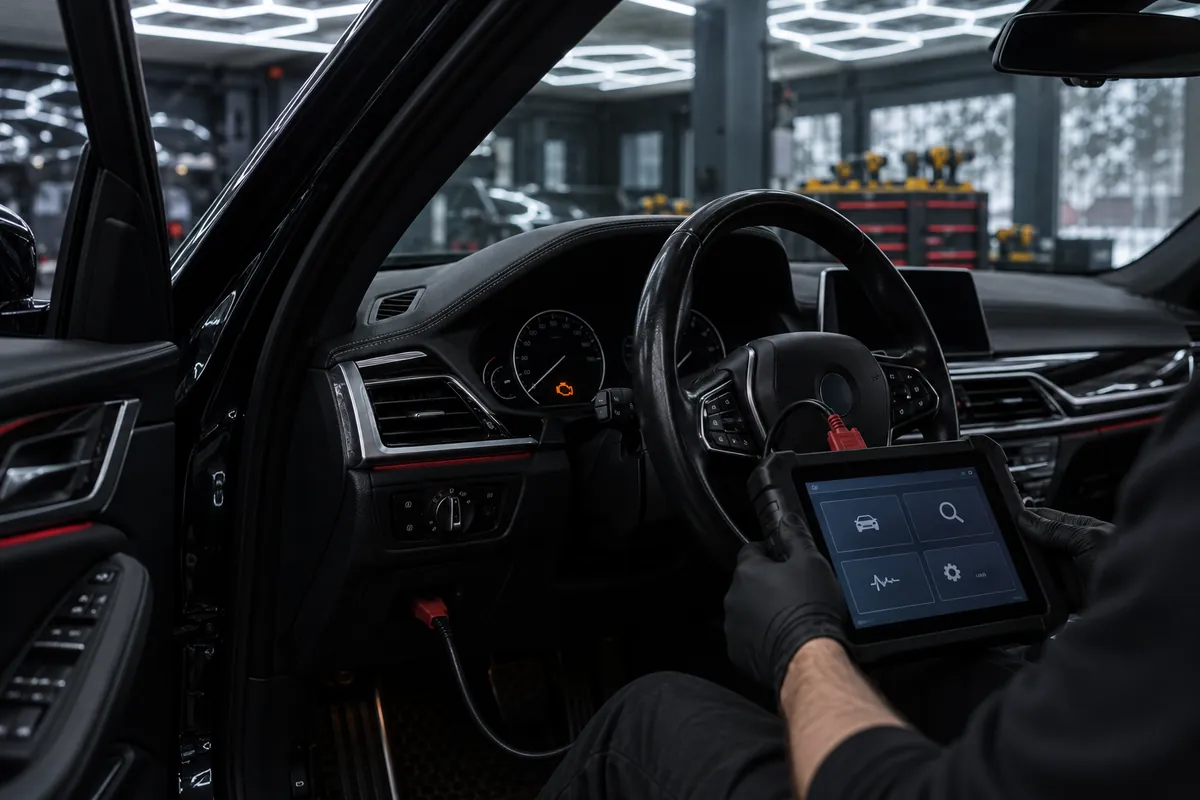
- 1We talk through the symptoms: whether the engine cranks but does not fire, cranks slowly, whether the problem only affects a cold engine and what the warning lights show.
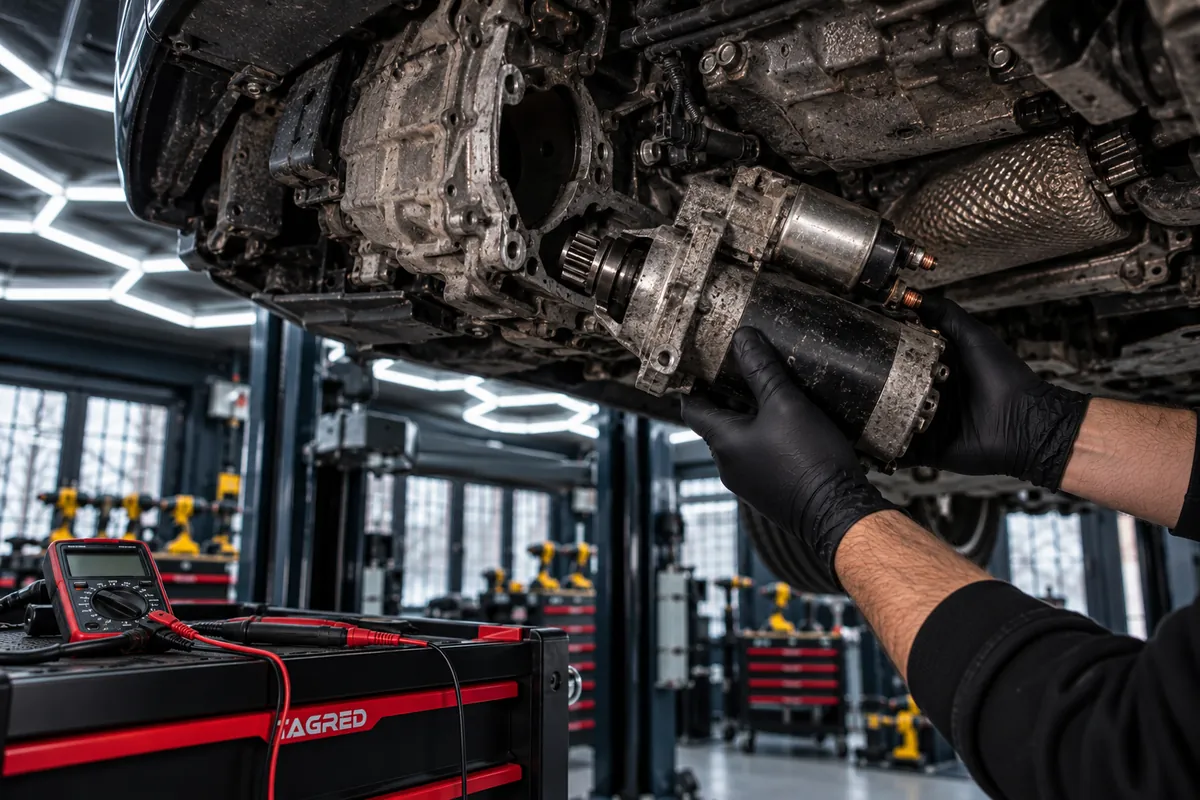
- 2We check the battery and charging: resting voltage, a load test, charging voltage with the engine running, the condition of terminals and earth straps.
- 3Computer diagnostics (100 zł): reading faults from the engine control unit and the glow system, misfire codes, engine temperature sensor readings and — in a diesel — fuel pressure during cranking.
- 4In a diesel: measuring the resistance or current draw of each glow plug and checking whether the controller supplies voltage to them.
- 5In a petrol engine: assessing the spark plugs and coils — comparing cylinders and, if needed, swapping coils between cylinders to see whether the fault “moves” with the coil.
- 6Checking the engine temperature sensor — a wrong reading can shorten glow time or upset the mixture during a cold start.
- 7We present the result and a quote for approval — only then do we order parts and start work.
This order avoids replacing a full set of plugs when the battery, temperature sensor or a clogged fuel filter is to blame — and vice versa: fitting a new battery when the engine will not start because of faulty plugs.
Replacing glow plugs and spark plugs — what to watch out for and the cost
| Service | Price (labour) | Notes |
|---|---|---|
| Computer diagnostics | 100 zł | Reading engine and glow system faults; usually up to 1 hour |
| Glow plug replacement (set) | quoted after diagnosis | Depends on the engine, access and plug condition |
| Spark plug replacement | quoted after diagnosis | Depends on the number of cylinders and access |
| Ignition coil replacement | quoted after diagnosis | After confirming which coil is faulty |
| Fuel filter replacement | 40 zł | Filter charged separately |
Glow plugs are usually replaced as a set, even when only one has failed — the others have the same mileage, and mixing different types can upset the controller. Removal needs the most care: plugs that have sat in the cylinder head for years can seize. Too much force can snap them, and extracting a broken plug is a much bigger and more expensive job. That is why they are undone slowly, with suitable penetrants and — depending on the guidance — on a warm engine, and the new ones are tightened with a torque wrench.
Spark plugs are also replaced as a set, always of the type specified for the engine. At the same time the coils, their rubber boots and connectors are assessed — cracked insulation or oil in the plug well is a typical cause of spark leakage. In engines where reaching the plugs requires removing the intake manifold or covers, the job takes longer.
Parts are priced separately depending on the model. Before work starts you receive a quote for approval, and we give a 6-month warranty on labour. The full price list is on the price list page, and more about electrical repairs on the auto electrician at Pulsecar page.
If a glow plug shows excessive resistance when being undone, we agree the next steps with you first — we do not carry out extra work without the customer’s approval.
How to prepare your car for frost — checklist
- Have the battery checked before the first frosts — especially if it is several years old.
- In a diesel, do not put off replacing glow plugs once the car starts cranking longer or smoking when cold.
- Fill up with winter diesel and change the fuel filter according to the service schedule — if it is nearly due, do it before winter.
- In a petrol car, check when the spark plugs are due — worn plugs cause the most trouble in winter.
- Keep up with oil changes and use the oil recommended by the manufacturer — old or overly thick oil makes starting harder.
- Check the coolant and its frost protection — more in our guide which coolant to choose.
- Switch off the blower and heated screens while starting, and crank for no longer than about 10 seconds.
If the car still will not start, do not keep cranking until it does — that quickly drains the battery and overheats the starter. Take a break, and after further failed attempts have it diagnosed.
Glow plugs and spark plugs in Warsaw Bielany — Pulsecar, ul. Arkuszowa 176
Pulsecar is located at ul. Arkuszowa 176 in Warsaw’s Bielany district, convenient for drivers from Żoliborz, Bemowo and Łomianki. We are open Monday to Friday 09:00–18:00 and Saturdays 09:00–15:00.
Call +48 571 058 591 or book a visit online. Tell us how the car behaves on a cold start — we will check the plugs, battery and charging, and give you a quote for approval before any repair. Directions and contact details are on the contact page.