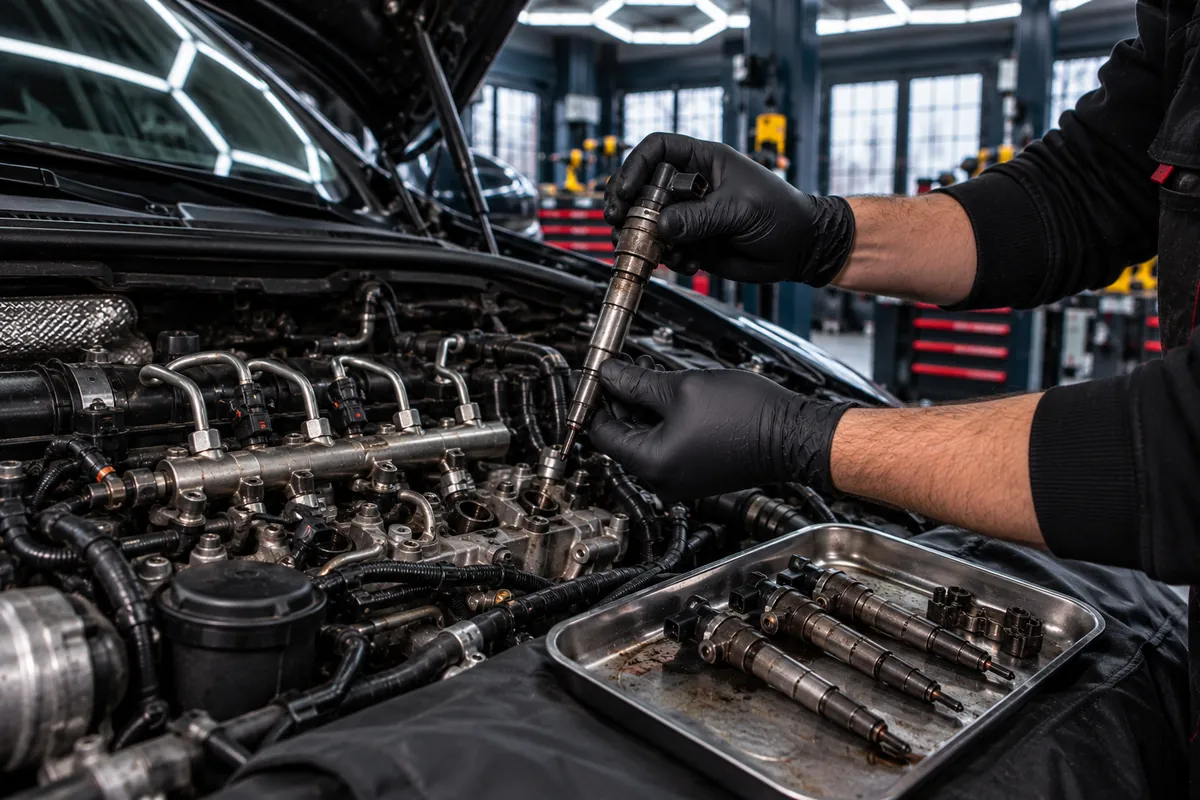
Opel — common faults and weak spots of engines, gearboxes and electrics
Opels are easy to repair, but they have well-known weak spots: the PCV and cooling on the 1.4 Turbo, chains on the 1.3 and 1.6 CDTI, the oil pickup on the 2.0 CDTI, the wet belt on the 1.2 PureTech and M32 gearbox bearings. We go through them engine by engine.
18 min read · Pulsecar team · updated:
Opel — faults at a glance
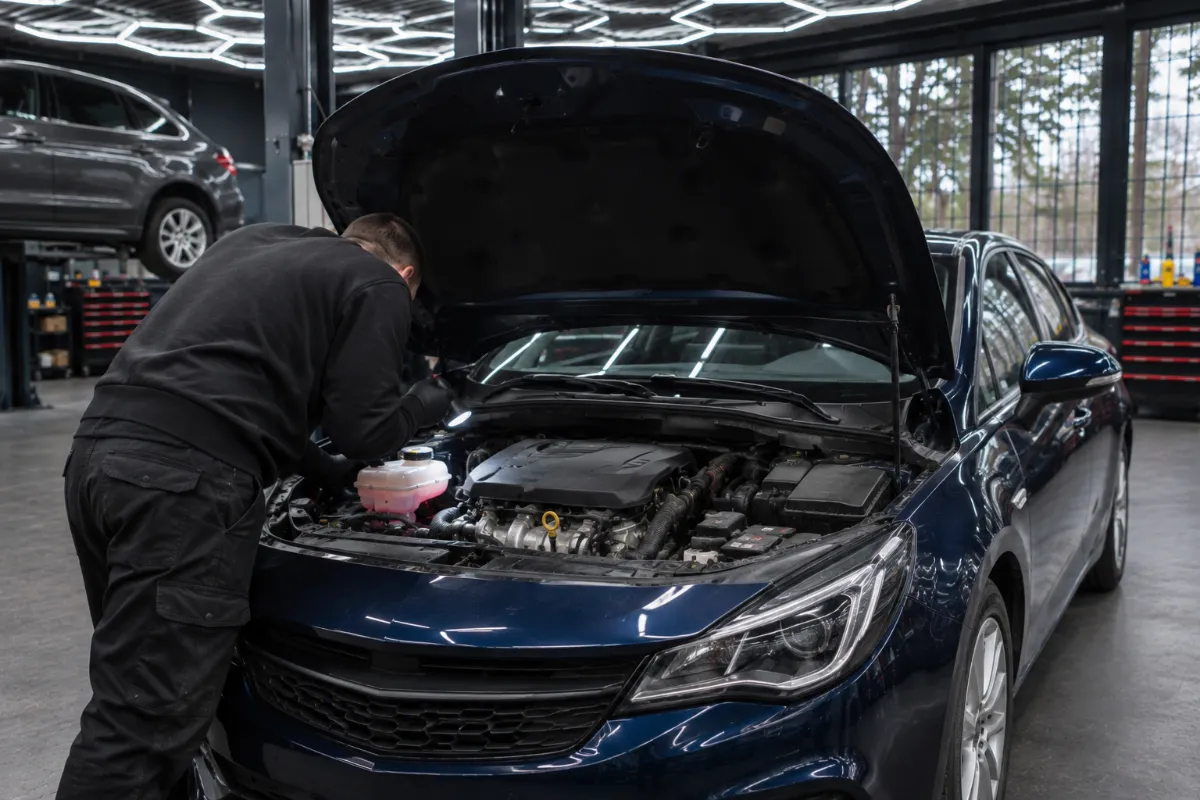
Most Opels on Polish roads are simple cars with cheap parts and well-known weak spots. The most common problems are: a stretching timing chain on some 1.0–1.4 petrol engines (especially the Twinport in the Astra H and Corsa D) and on the 1.3 and 1.6 CDTI diesels, a split PCV diaphragm in the cam cover and coolant loss on the 1.4 Turbo, the oil pickup pipe seal and a drop in oil pressure on the 2.0 CDTI, swirl flaps and the EGR valve on the 1.9 CDTI, the timing belt running in oil on the 1.2 PureTech in newer models, and bearings in the 6-speed M32 gearbox. On top of that come the electrics (the CIM module under the steering wheel in the Astra H and Zafira B), air conditioning and suspension.
Almost every one of these faults gives early warning signs: a rattle after a cold start, a whistle from under the bonnet, coolant loss, the oil pressure warning light after the car has been standing, or a whining gearbox. Below we cover engines, gearboxes and models, and at the end you will find a summary table, a pre-purchase checklist and prices from our price list.
Which engine / model do you have
| Engine | Type | Models and years, approximate |
|---|---|---|
| 1.0 / 1.2 / 1.4 Twinport and Ecotec (incl. Z12XEP, Z14XEP, A14XER) | petrol, naturally aspirated, timing chain | Corsa C/D/E, Astra H/J, Meriva, Adam (approx. 2003–2019) |
| 1.6 Twinport (Z16XEP), 1.8 | petrol, naturally aspirated | Astra H, Zafira B, Vectra C (approx. 2004–2010); 1.8 also in e.g. Insignia A |
| 1.4 Turbo (A14NET, B14NET) | petrol, turbo, timing chain | Astra J, Corsa D/E, Meriva B, Mokka, Zafira C, Insignia A, Adam S (approx. 2009–2019) |
| 1.6 Turbo (A16LET), 1.6 SIDI Turbo | petrol, turbo | Astra J, Insignia A (approx. 2009–2017) |
| 1.2 PureTech (Stellantis) | petrol, 3 cylinders, timing belt running in oil (until approx. 2023) | Corsa F, Mokka B, Crossland X, Grandland X (from 2017) |
| 1.3 CDTI (Z13DTH, Z13DTJ, A13DTE) | diesel, Fiat design, timing chain | Corsa D, Astra H/J, Meriva A/B, Combo |
| 1.7 CDTI (Z17DTH, A17DTJ, A17DTR) | diesel, Isuzu design | Astra H/J, Corsa C/D, Meriva A, Zafira B |
| 1.9 CDTI (Z19DTH, Z19DTJ) | diesel, Fiat design | Astra H, Zafira B, Vectra C, Signum (approx. 2004–2010) |
| 2.0 CDTI (A20DTH and related) | diesel, timing belt | Insignia A, Astra J, Zafira C, Cascada (approx. 2008–2017) |
| 1.6 CDTI (B16DTH and related) | diesel, chain at the gearbox end | Astra J/K, Zafira C, Mokka A, Insignia B (from approx. 2013) |
| 1.6 CDTI (R9M) | diesel, timing belt | Vivaro B (approx. 2014–2019) |
Years and models are approximate — the same model could have different engines depending on the model year, power output and market. You can find the exact engine code in the data decoded from the VIN (see checking a car by VIN), on the plate on the engine block or during computer diagnostics. The code determines what to look out for: the 1.4 Twinport and the 1.4 Turbo are completely different engines, just like the 1.6 CDTI in the Astra K and the 1.6 CDTI in the Vivaro.
Opel in our workshop — what the data says
Based on jobs completed at Pulsecar from January to October 2026: Opel accounts for approx. 5.3% of the cars we serviced — the sixth most common make in our workshop.
The jobs that come up most often on Opels are: computer diagnostics (approx. 43% of Opel jobs), oil and filter change (approx. 19%), air-conditioning service (approx. 13%) and wheel alignment (approx. 10%). One job can include several tasks, so the figures do not add up to 100%.
On an Opel, a repair almost always starts with reading the fault codes — the engine warning light, Easytronic messages, CIM module faults or swirl flap faults all leave a trace in the control units. Air conditioning comes back often — several Opel models are known for compressor and A/C electrical faults, which we describe below.
Petrol 1.0, 1.2 and 1.4 Twinport / Ecotec (Z14XEP, A14XER) — chain, coils and flaps
The naturally aspirated 1.0, 1.2 and 1.4 (including the Twinport) are the most popular petrol engines in the Corsa C and D, Astra H and J and Meriva. They have a timing chain, but it is not "for life": in the Corsa D it is considered not very durable, and in the Astra H with the 1.4 Twinport (Z14XEP) premature stretching is reported, especially with short-journey driving. The symptom is a rattle for a few seconds after a cold start, later camshaft position faults. A neglected chain can jump teeth and damage the engine.
Not every rattle is the chain. In the Astra H with 1.2 and 1.4 engines (Z12XEP, Z14XEP), noise and misfires (fault codes P0300–P0304) could be caused by camshaft housing bolts that had not been tightened enough — after the fix, a yellow mark appeared on the timing cover. That is why it is worth doing diagnostics before replacing the timing gear.
Other typical faults are ignition coils (1.0, 1.2, 1.6 Twinport), sticking flaps in the Twinport intake manifold (jerking, rough running) and oil consumption at high mileage. On the 1.6 Twinport (Z16XEP) a leaking oil pressure sensor can let oil travel along the wiring loom all the way to the engine control unit, and on the 1.8 the oil cooler gasket leaks — you then see an oily film in the coolant expansion tank.
On naturally aspirated Opels with a chain, change the oil every approx. 10–15 thousand km or once a year and keep an eye on the level. A rattle after a cold start is a signal for diagnostics, not for putting the repair off.
1.4 Turbo (A14NET, B14NET) and 1.6 Turbo — PCV, cooling and turbo
The 1.4 Turbo (Astra J, Corsa D and E, Meriva B, Mokka, Zafira C, Insignia A) is regarded as a successful engine, also on LPG — some versions had a factory-fitted system. The best-known fault is a split PCV diaphragm in the plastic cam cover: the engine draws in unmetered air, you get rough idling, a whistle from under the bonnet, a lean mixture fault (e.g. P0171), and the oil filler cap is hard to unscrew with the engine running. During the repair the non-return valve in the intake manifold is checked too — otherwise the fault can quickly come back.
The second typical issue is slow coolant loss, often with no puddle under the car: the water pump seal, a plastic thermostat housing with hairline cracks, the turbo coolant lines, the expansion tank and its cap. On top of that come leaks from the oil cooler gasket and the front crankshaft seal, intake leaks (fault P0299) and cracks in the exhaust manifold integrated with the turbocharger.
The chain on the 1.4 Turbo is not a recognised defect — some mechanics see no problems with it, although cases of stretching are reported in the Zafira C and Mokka. A rattle when cold is a reason to measure it, not to replace it automatically.
The 1.6 Turbo (A16LET) and the 1.6 SIDI Turbo with direct injection (Astra J, Insignia A) do not have such recurring faults. The A16LET (until approx. 2012) has a timing belt, and its SIDI successor has a chain. On the SIDI, cooling problems, oil leaks at the front of the engine and the carbon build-up in the intake typical of direct injection are reported.
A whistle from under the bonnet and rough idling on a 1.4 Turbo are most often the PCV. Coolant loss with no puddle — check the water pump, thermostat and turbo lines before it ends in overheating and a head gasket failure.
1.2 PureTech (Corsa F, Mokka B, Crossland, Grandland) — timing belt running in oil
Newer Opels from the Stellantis era got the three-cylinder 1.2 PureTech, the same as Peugeot and Citroën. In versions up to roughly mid-2023 the timing belt runs in an oil bath. On short journeys fuel dilutes the oil, which speeds up the degradation of the belt: it swells, delaminates and crumbles. The debris clogs the oil pump pickup, the screens of the variable valve timing solenoids and the vacuum pump filter — there was even a service campaign over the risk of reduced brake servo assistance.
Symptoms appear late: the oil pressure warning light, unusual noises, and in extreme cases the engine cutting out. According to reports, problems often appear at approx. 60–100 thousand km, sometimes earlier. Stellantis extended the warranty for this fault to 10 years or 175 thousand km for, among others, the Corsa F, Crossland X, Mokka and Grandland X built up to 20 June 2022 — provided the car was serviced in line with the manufacturer's recommendations; to use this warranty, diagnosis and engine repair must be carried out within the authorised dealer network. Facelifted versions from roughly mid-2023 already have a chain.
In practice: oil to the specification in the handbook, changed once a year or every approx. 10 thousand km with city driving, periodic measurement of the belt with a gauge, and when it is replaced — inspection and cleaning of the oil pump pickup.
Diesels 1.3 CDTI (Fiat) and 1.7 CDTI (Isuzu)
The 1.3 CDTI is a Fiat diesel (MultiJet) in the Corsa D, Astra H and J, Meriva and Combo. It has a timing chain that can slacken and stretch, and the whole engine is very sensitive to a low oil level — even a small loss puts strain on the chain tensioner, the turbocharger and the bearing shells. Change the oil at least every approx. 15 thousand km. Also typical are a clogging EGR valve (rough running, stalling), seized variable geometry on the turbocharger, and at high mileage — injectors, the high-pressure pump and the DPF.
The 1.7 CDTI comes from an Isuzu design and is regarded as more durable than the 1.3; the timing is driven by a belt (e.g. in the Corsa D). Problems mainly concern ancillaries: the dual-mass flywheel (replaced together with the clutch), the turbo control solenoid valve, the DPF with city driving, injectors, glow plugs and the alternator. In older versions, oil from a leaking seal at the oil pump can get onto the belt. More about the dual-mass flywheel in the article dual-mass flywheel — symptoms.
Own a Opel and something worries you?
We check the engine, gearbox, suspension and the fault memory of all control units. Computer diagnostics costs 100 zł, and you get a written quote to approve before any repair.
On the 1.3 CDTI, check the oil level every few fill-ups. This small diesel copes very badly with even a brief shortage of oil — the chain, turbo and bearing shells suffer.
1.9 CDTI (Z19DTH, Z19DTJ) — swirl flaps, EGR and dual-mass flywheel
The 1.9 CDTI is a Fiat diesel in the Astra H, Zafira B, Vectra C and Signum. The best-known fault of the 16-valve version is the swirl flaps in the intake manifold and their actuator: the flaps get coked up with carbon and stick, or the actuator stops moving them. Symptoms are a loss of power, the warning light and fault codes P2075 or P1109. Opel introduced more resistant flaps on engines built from the end of February 2007. The repair is replacing the actuator, and if the flaps themselves stick — the manifold together with the actuator.
Other typical issues on the 1.9 CDTI are the EGR valve, which clogs and stays open (rough idling, stalling), the dual-mass flywheel, the head gasket at high mileage, the alternator and the timing belt — the manufacturer specified replacement every approx. 120 thousand km or 10 years, but with an unknown history it is better to do it straight after purchase, together with the water pump and idlers. We write more about the EGR valve in the article EGR valve — symptoms.
2.0 CDTI (A20DTH) — oil pickup, timing belt and DPF
The 2.0 CDTI (Insignia A, Astra J, Zafira C) is a well-regarded diesel, but it has one fault that must not be ignored. The seal of the oil pickup pipe in the sump hardens, oil drains from the pump back into the sump and the pump sucks in air. The symptom is a low oil pressure message after a cold start, especially in the morning or after the car has been standing for a long time. Driving with this symptom risks damaging the bearing shells. The repair requires dropping the sump, but it is many times cheaper than an engine rebuild; some mechanics treat this seal as a wear item and replace it as a precaution.
The timing is driven by a belt. The recommended replacement interval depends on the version (approx. 120–150 thousand km or 6–10 years), and belt failures are reported around these mileages — so it is worth shortening the interval and replacing the full kit with the water pump, idlers and crankshaft pulley. Other typical faults are the DPF with city driving, the EGR valve, injectors, the dual-mass flywheel, the vacuum pump (hard brake pedal) and fuel leaks from the high-pressure pump onto the alternator. The Insignia A with the 2.0 CDTI was also covered by an engine control unit software update campaign relating to exhaust emissions — check by VIN whether it has been done.
The oil pressure warning light after a cold start on a 2.0 CDTI is a signal to stop the car and get urgent diagnostics. The pickup seal is usually to blame — a cheap part whose neglect ends in an engine rebuild.
1.6 CDTI (B16DTH) — chain at the gearbox end
The newer 1.6 CDTI (from approx. 2013, incl. the Astra J and K, Zafira C, Mokka A, Insignia B) is refined and economical, but it has a known weak spot: the timing chain located at the gearbox end. A stretched chain rattles and causes running problems, and replacing it is labour-intensive — in the Mokka it may be necessary to take the engine out. Not every car has this problem, and regular oil changes are key.
Also reported are injectors sensitive to fuel quality, a cracking exhaust manifold, glow plugs, the DPF and increased oil consumption where fuel diluted the oil during DPF regeneration.
Gearboxes — M32, Easytronic and automatics
- M32 and M20 (6-speed manuals, incl. with the 1.4 Turbo, 1.6 Turbo, 1.3, 1.7, 1.9 and 1.6 CDTI): the bearings wear — the symptom is a whine, louder in some gears, and a gear lever that moves when accelerating and on engine braking. In the Insignia, cars from 2010–2012 are considered the least durable; after changes the problem is rarer, but it has not gone away. Change the oil at least every approx. 60 thousand km. Worn engine mounts give a similar symptom, so check them first.
- Easytronic (automated manual, incl. Corsa D, Astra H, Meriva A, Zafira B, Astra K with the 1.0 Turbo): the clutch actuator module fails most often. Symptoms are the letter F on the display, no gear or no neutral, no start and judder when pulling away with a warm gearbox. After the repair a clutch adaptation is needed.
- Automatics: the 6-speed Aisin (incl. with the 2.0 CDTI in the Insignia A and Astra J) is slow but has no dramatic flaws; pre-facelift Insignia units were criticised for durability. In petrol Astra J models with GM 6T30 and 6T45 automatics, clutch drum failures and a cracking wave spring retaining ring are reported. Regular oil changes extend the life of an automatic — see automatic gearbox oil.
- Insignia A: the gear-change cables can corrode and stick on cold days — a stiff gear lever does not always mean a damaged gearbox.
Electrics and air conditioning — CIM, blower resistor, AFL
In the Astra H (from 2004) and Zafira B (from 2005) a typical fault is the CIM module under the steering wheel (column switches, airbag clockspring, steering angle sensor). Symptoms are a scraping noise when turning the wheel, problems with the horn (on the Astra H up to model year 2010 fixed with a software update) and steering angle sensor faults; the sensor has to be calibrated after the repair.
The Zafira B was subject to a recall in the United Kingdom after fires around the blower motor resistor, linked to incorrect earlier repairs. If the blower only works on the highest speed or you can smell burning from the vents, do not put off diagnostics and check by VIN whether the recall has been done.
The Insignia A can suffer from AFL xenon headlight failures, battery drain, tailgate lock faults and, before the facelift, a corroding A/C wiring harness that can damage the control panel and compressor. In the pre-facelift Corsa D moisture gets into the fuse box. In the Astra J A/C compressors fail, and frequent A/C faults are reported in the Mokka A.
With air conditioning we start with a leak test and electrical diagnostics — simply recharging a leaking system is a waste of money. More in the article A/C recharge.
Models — suspension, body and what to look out for
- Astra H (2004–2010): anti-roll bar links, track rod ends and top strut mounts wear fastest, but they are cheap; the rear beam is durable and corrosion is rare.
- Astra J (2009–2015): play in the suspension (bushes, ball joints, track rods), electric power steering faults, misting headlights and moisture in the cabin.
- Astra K (2015–2021): shock absorbers and bushes; on the pre-facelift 1.4 Turbo, jerking fixed with a software update; freezing infotainment.
- Insignia A (2008–2017): fast-wearing brakes, a noisy steering rack, leaking FlexRide shock absorbers after approx. 150 thousand km and Haldex 4x4 drive that needs oil changes. A recall concerning corrosion of the rear toe links, which could break (production 12.2007–07.2013) — check by VIN whether it has been done.
- Corsa D (2006–2014): suspension knocks, worn bushes and track rods, ABS faults due to corroded sensor rings; corrosion of the doors and sills (especially 2009–2010) and the bonnet (2010–2012).
- Zafira C: a campaign concerning the parking brake software (2011–2014). Mokka A: seizing rear brakes, a leak from the coolant expansion tank and, on 4x4 versions, sludge in the Haldex coupling oil, which stops the rear axle from being driven.
- Vivaro: the Vivaro B has a Renault-designed 1.6 CDTI engine (code R9M), the same as in the related Renault Trafic III — the DPF, EGR, turbocharger and dual-mass flywheel are typical on fleet vehicles; see Renault — faults and weak spots. The newer Vivaro (from 2019) has Stellantis BlueHDi diesels, covered by separate service campaigns (incl. one concerning the water pump pulley on the 1.5 BlueHDi) — check them by VIN.
Summary table — engine/model, weak spot, symptom, what to do
| Engine / model | Weak spot | Symptom | What to do |
|---|---|---|---|
| 1.0–1.4 Twinport / Ecotec | Timing chain | Rattle after a cold start | Diagnostics, measurement, timing replacement |
| 1.4 Turbo | PCV diaphragm, intake valve | Whistle, uneven revs, P0171 | Replace the cam cover and valve |
| 1.4 Turbo | Water pump, thermostat, turbo lines | Coolant loss with no puddle | Leak test, replace the component |
| 1.2 PureTech | Timing belt running in oil | Oil pressure light, noise | Belt measurement, pickup check, authorised dealer check by VIN |
| 1.3 CDTI | Chain, sensitivity to low oil | Rattle, timing faults | Oil level checks, timing replacement |
| 1.7 CDTI | Dual-mass flywheel, turbo control, DPF | Vibration, loss of power | Diagnostics, ancillary repair |
| 1.9 CDTI | Swirl flaps, EGR | Loss of power, P2075, rough running | Replace the actuator or manifold, EGR |
| 2.0 CDTI | Oil pickup seal | Low oil pressure after standing | Urgent: replace the seal |
| 1.6 CDTI | Chain at the gearbox end | Rattle, rough running | Diagnostics, timing replacement |
| M32 / M20 gearbox | Bearings | Whine, moving gear lever | Check the mounts, gearbox repair |
| Easytronic | Clutch actuator module | Letter F, no gear | Diagnostics, repair, adaptation |
| Astra H, Zafira B | CIM module | Scraping when turning, horn, faults | Module repair, sensor calibration |
The same symptoms can have different causes, so it is always worth doing diagnostics before buying parts.
Recognise any of these symptoms?
Don't wait until a small fault turns into an expensive repair. Come to our workshop in Bielany — we will tell you what is urgent and what can wait.
How to look after an Opel
- Oil every approx. 10–15 thousand km or once a year, to the specification in the handbook. For chains, the turbo on the 1.4 Turbo and the wet belt on the 1.2 PureTech, this is the basis of durability. On the 1.3 CDTI, check the level every few fill-ups.
- Replace a timing belt with a margin to spare, especially on the 2.0 and 1.9 CDTI, always with the water pump, idlers and tensioner. More in the article timing belt replacement — symptoms and price.
- Change the oil in the M32 gearbox every approx. 60 thousand km.
- Take a diesel on a longer run now and then so the DPF can regenerate and the EGR and swirl flaps do not clog up.
- Keep an eye on the coolant — on the 1.4 Turbo, loss with no puddle is a typical sign of a leak.
- React to warning lights. The oil pressure light means stop immediately, not drive home.
Buying a used Opel — checklist
- 1Identify the engine and model year by VIN — this determines what to look out for (1.4 Twinport or 1.4 Turbo, 1.3, 1.6 or 2.0 CDTI, 1.2 PureTech).
- 2Check the history: oil change intervals, the date and mileage of the timing replacement, the pickup seal replacement on the 2.0 CDTI.
- 3Listen to a cold start — a rattle from the front or from the gearbox end (1.6 CDTI) is a warning sign.
- 4Read the fault memory of all control units, including stored faults: oil pressure, valve timing, swirl flaps, mixture, gearbox, CIM.
- 5Check the coolant and oil: the level, an oily film in the expansion tank, signs of leaks at the water pump and oil cooler.
- 6On the test drive, listen to the M32 gearbox in all gears and watch the gear lever when accelerating and on engine braking. On an Easytronic, check for smooth pulling away with a warm gearbox.
- 7Check the air conditioning (vent temperature, blower on all speeds) and inspect the car on a lift: suspension, leaks, corrosion of the sills and doors.
- 8On an Opel with the 1.2 PureTech or newer, check service campaigns and the extended warranty with an authorised dealer by VIN.
We carry out this kind of check as part of a pre-purchase inspection — it is worth doing before signing the contract, not after.
How we check Opels at Pulsecar
We start with a conversation and computer diagnostics of all control units, not just the engine: we read current and stored faults, oil pressure and boost parameters, fuel trims, camshaft position, the state of the DPF, as well as gearbox, CIM module and air-conditioning faults. Then we inspect the car on a lift — oil and coolant leaks, the condition of the timing gear and auxiliary belt, suspension, engine mounts. If needed, we carry out a cylinder endoscopy and a cooling system leak test.
After the diagnosis you get a written quote, and we only start work once you have approved it. We show you photos of what we found, and during major repairs, e.g. timing, you may get access to an online camera. Warranty: 6 months on labour, new parts according to the manufacturer's terms (usually 12–24 months); we give no workshop warranty on parts supplied by the customer. We serve customers in Polish, Ukrainian, Russian, English and Belarusian. You can book a visit online or call: +48 571 058 591.
How much Opel diagnostics and repair cost
| Service | Price |
|---|---|
| Computer diagnostics | 100 zł |
| Oil and filter change | 120 zł |
| A/C recharge with vacuum test | from 199 zł |
| Wheel alignment (2 axles) | 300 zł |
| Coolant change | from 200 zł |
| Manual gearbox oil change | from 200 zł |
| Engine endoscopy | from 300 zł |
| Pre-purchase inspection | 300 zł |
| Timing belt replacement | from 600 zł |
| Clutch replacement | from 600 zł |
| Turbocharger replacement | from 600 zł |
| Timing chain replacement | from 1000 zł |
These are starting prices from our price list. The final amount depends on the engine and parts — e.g. a chain at the gearbox end on the 1.6 CDTI is much more work than a chain on the 1.4 Twinport. Repairs to the M32 gearbox, Easytronic, CIM module, the swirl flap manifold or the oil pickup seal on the 2.0 CDTI are priced after diagnosis — the exact amount is always in the quote before work starts. We carry out most of this work as part of our mechanical repairs service.