Automatic transmission fluid change — interval, symptoms and cost
“Lifetime” fluid wears out too, and neglected fluid can shorten a gearbox’s life. We explain how often to change the fluid in automatic, DSG and CVT gearboxes and what the cost depends on.
9 min read · Pulsecar team · updated:
How often should automatic transmission fluid be changed? Short answer
In a classic torque-converter automatic it is worth changing the ATF usually every approx. 60,000–100,000 km, in a wet-clutch DSG most often every approx. 60,000 km (in line with the VAG service schedule for many versions), and in a CVT — according to the manufacturer, often somewhere around 40,000–90,000 km. With city driving, towing, taxi use or heavy loads it is worth shortening the interval.
If the manufacturer calls it a “lifetime” fill, that does not mean the fluid never wears out. Below we explain how conventional automatics, wet- and dry-clutch DSG and CVT differ, how to recognise worn fluid, what the difference between a static and a dynamic change is, and what an automatic transmission fluid change costs in Warsaw.
“Lifetime” fluid — where the myth comes from
Many car makers do not include an automatic transmission fluid change in the service schedule, or describe it as a “lifetime” fill. In practice “lifetime” usually means the period the manufacturer used for its durability and running-cost calculations — not 300,000–400,000 km with subsequent owners.
Fluid in an automatic works in tough conditions: it carries control pressure, lubricates gears and bearings, cools the clutches and brakes inside the gearbox, and in a torque converter it transmits torque. Over time it oxidises, loses the additives responsible for correct friction and collects particles of friction material and metal. The result is harsher or delayed shifts and faster wear of the valve body, solenoids and clutches.
Some gearbox manufacturers themselves recommend a fluid change after a certain mileage or time in their workshop materials, even when the car maker does not require it. That is why on cars out of warranty we treat an ATF change as sensible prevention rather than an unnecessary expense.
Types of automatic gearboxes and the fluid they use
| Gearbox type | Which fluid | Typical change recommendation | What to watch out for |
|---|---|---|---|
| Conventional torque-converter automatic, e.g. ZF 6HP/8HP, Aisin, Mercedes 7G-Tronic | ATF to the gearbox manufacturer’s specification | Often approx. 60,000–100,000 km or per manufacturer | The filter is sometimes integrated into the sump pan; some fluid stays in the torque converter |
| Wet-clutch DSG, e.g. DQ250, DQ381, DQ500 | DSG fluid to VAG spec, shared by clutches and gears (in most versions) | Usually every approx. 60,000 km — per service schedule | Changed together with the filter; level set at a specified temperature |
| Dry-clutch DSG — DQ200 | Two separate circuits: gear oil in the gearbox and hydraulic fluid in the mechatronic unit | No fixed interval from the manufacturer | Clutches do not run in oil; the mechatronic fluid has its own reservoir |
| CVT, e.g. Jatco, Aisin, Audi multitronic | Dedicated CVT fluid — not ordinary ATF | Often approx. 40,000–90,000 km — per manufacturer | Very sensitive to the wrong fluid and level |
The table shows typical cases, not the standard for your car. Even within one gearbox family there are versions with different fluid, quantity and procedure requirements. We identify the gearbox by VIN and transmission code — the trade name alone is not enough to choose the fluid.
Not sure which gearbox your car has? Give us the make, model, year and engine, or the VIN — we will check the transmission type and the required fluid.
Wet vs dry DSG — how the fluid change differs
In wet-clutch DSG gearboxes (including the 6-speed DQ250 and the 7-speed DQ381 and DQ500) the clutches run in oil that cools and lubricates them. In most of these designs the same oil feeds the mechatronic unit and lubricates the gears, so it quickly picks up clutch wear products. Changing the oil together with the filter at the manufacturer’s interval is basic maintenance for them. The level is set within a strictly specified oil temperature range, read with a diagnostic tool.
The 7-speed DQ200 has dry clutches that do not run in oil — so there is no “clutch oil” in it. Instead it has two separate circuits: gear oil lubricating the gears in the gearbox housing, and a separate hydraulic fluid in the mechatronic unit that powers the gear-shift and clutch actuators. These fluids have different specifications and must not be confused.
The manufacturer does not schedule a regular change of either fluid in the DQ200. A gear oil change is considered as prevention at high mileage, and the mechatronic fluid is usually topped up or replaced when the unit is repaired or leaking. DQ200 judder when pulling away is more often caused by clutch wear or a mechatronic fault than by the oil itself — read more on our DSG DQ200 judder page.
A separate group are longitudinal dual-clutch gearboxes, e.g. the S tronic DL501 in Audis, which have separate circuits for the gears and for the clutches with hydraulics. Maintenance therefore depends on the specific gearbox code.
CVT — why the fluid matters so much here
In a continuously variable transmission torque is transmitted by a steel push belt or chain running between two pulleys of variable diameter. A precisely defined friction must exist between the metal surfaces — it is provided by a dedicated CVT fluid with specific properties. Ordinary ATF or a fluid of a different spec can cause belt slip, judder when pulling away and accelerated wear.
Manufacturers use their own fluid specs, e.g. NS-2 and NS-3 for Nissan, CVTF TC or FE for Toyota or HCF-2 for Honda. The fluid quantity and the level-check method (usually at a specified temperature) differ between transmissions. With a CVT it especially does not pay to look for a “universal” substitute.
Signs of worn automatic transmission fluid
- Jerks or bumps when shifting — see also car jerking — causes.
- Delayed engagement of D or R after moving the selector, especially when cold.
- Slipping: engine revs rise but the car accelerates less.
- Shudder under light acceleration at low speed — often when the torque converter lock-up clutch engages.
- Harsh downshifts when braking or “hanging” in one gear.
- An illuminated transmission warning light or limp mode.
- Dark fluid with a burnt smell (where it can be checked with a dipstick or check plug).
The same symptoms can have other causes: worn clutches inside the gearbox, a mechatronic or valve body fault, sensor errors, or even engine problems. That is why, with clear symptoms, we start with diagnostics before changing the fluid. We cover this in more detail in our guide to gearbox problems.
Fresh fluid improves the operation of a healthy gearbox, but it will not fix mechanical or electronic damage. If the gearbox slips badly or has gone into limp mode, keep driving to a minimum and book a diagnosis.
Static or dynamic fluid change?
| Static change | Dynamic change | |
|---|---|---|
| What it involves | Draining fluid from the pan or drain plug and refilling per procedure | Exchanging fluid using a machine connected to the gearbox circuit, usually with the engine running |
| How much fluid is replaced | Part of it — in torque-converter automatics often only approx. 30–60% | Most of the fluid in the gearbox |
| Fluid consumption | Roughly as much as was drained | Usually more than the gearbox capacity |
| When it makes sense | Regular maintenance; on a neglected gearbox — gradually, in several stages | When you want to replace as much fluid as possible in a gearbox in good condition |
In wet-clutch DSG gearboxes a static drain usually removes a larger share of the oil than in a conventional automatic, because they have no torque converter. In torque-converter automatics a significant amount of fluid stays in the converter, cooler and passages, so a static change alone is sometimes repeated after some mileage.
The method is chosen to suit the gearbox design, its condition and the manufacturer’s recommendations. Whatever the method, the filter is replaced (where it is designed to be), along with the seals, and the level is set according to the procedure.
Changing the fluid at high mileage — is it risky?
A popular piece of advice says: “if the fluid has never been changed, leave it, or the gearbox will fail”. That is an oversimplification. A gearbox that fails shortly after a fluid change was usually already heavily worn — fresh fluid with different friction properties reveals slipping that the old fluid and deposits were still masking.
With a neglected, very high-mileage gearbox the risk does exist, so we proceed carefully: first diagnostics and an assessment of the fluid (colour, smell, debris in the pan or on the magnets), then a gradual static change rather than aggressive flushing. If diagnostics point to mechanical damage, we tell you before the change — so you can decide knowingly whether a fluid change still makes sense.
The cheapest protection is regularity: a gearbox whose fluid has been changed every few tens of thousands of kilometres has no “old fluid” problem and no such dilemmas.
How we change automatic transmission fluid
- 1We identify the gearbox by VIN and transmission code, and check the required fluid specification and quantity.
- 2We run computer diagnostics: fault codes, fluid temperature and — where possible — adaptation values.
- 3We assess the fluid and check the gearbox for leaks; if there are fault symptoms, we discuss the diagnostic result first.
- 4We present a quote including fluid, filter and seals for approval — only then do we start work.
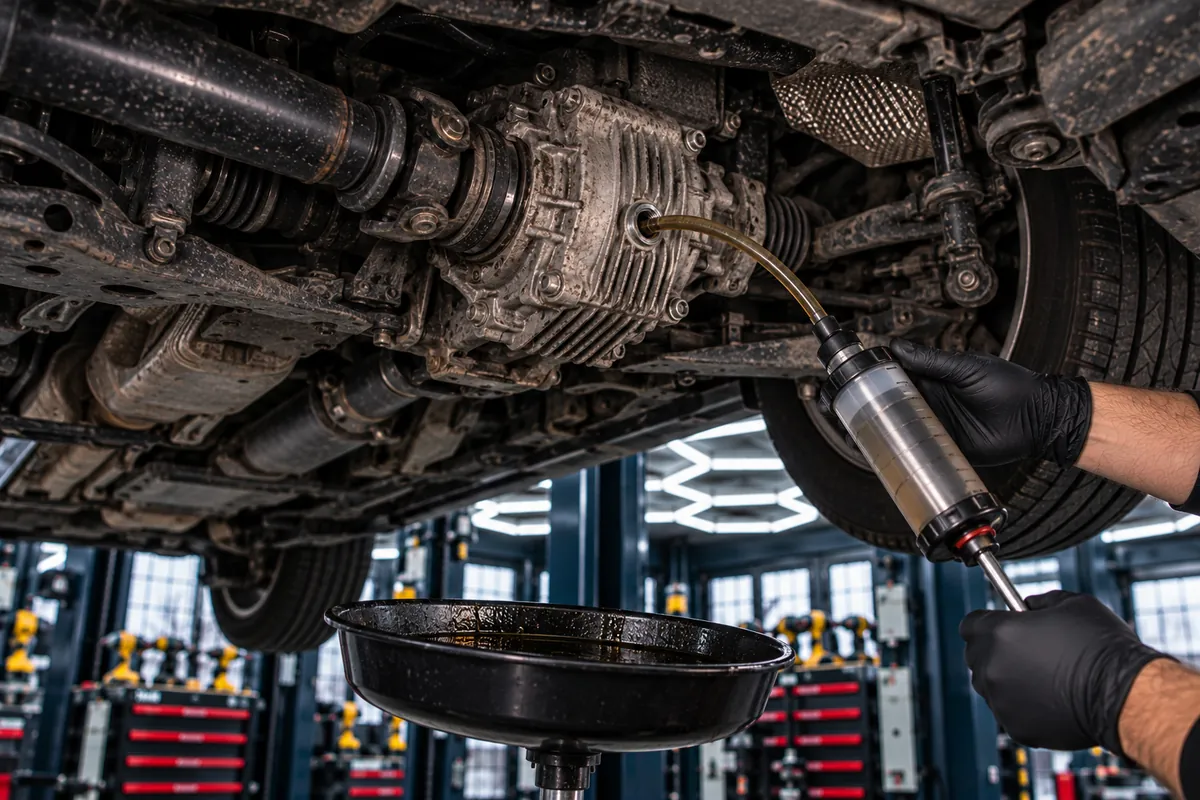
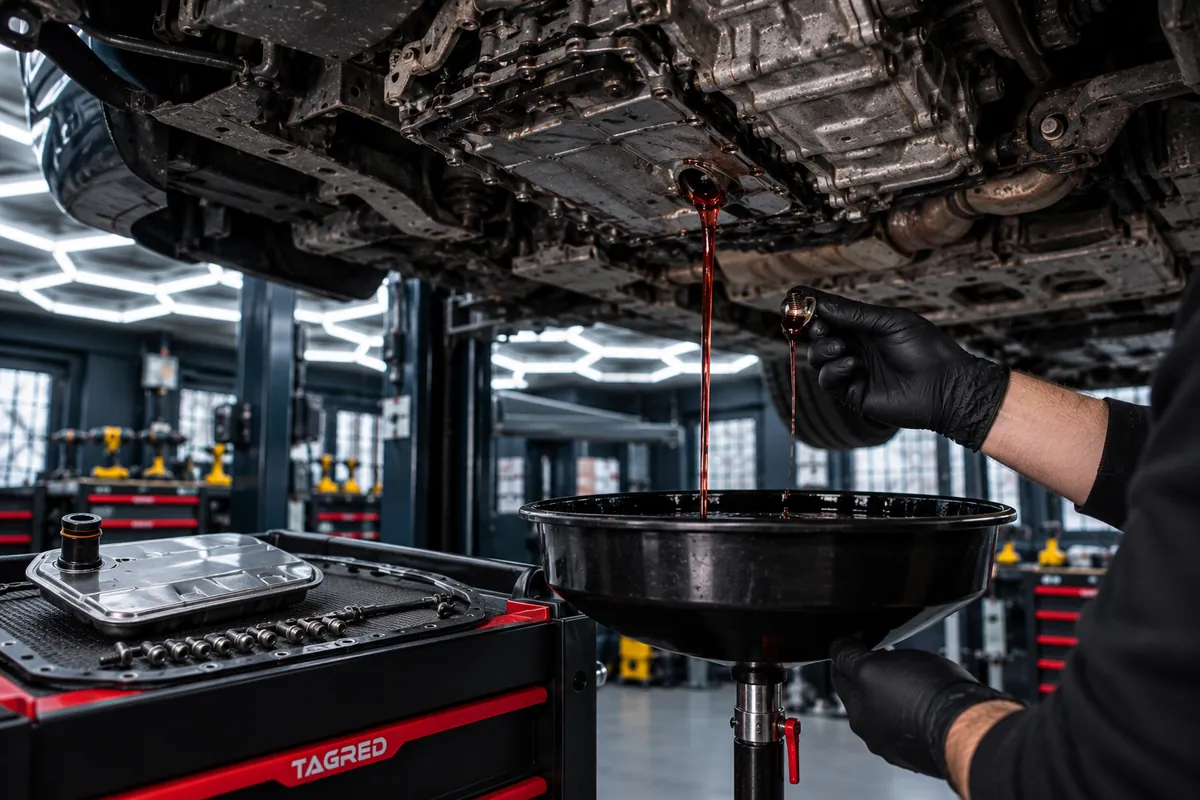
- 5We drain the fluid, replace the filter or the pan with integrated filter (if specified) and the seals, and fill the gearbox with fluid of the correct spec.
- 6We set the level at the temperature specified by the manufacturer and, if the procedure requires it, run a gearbox adaptation with the diagnostic tool.
- 7We check for leaks and verify gearbox operation on a test drive.
The fluid change itself usually takes about an hour; on gearboxes with difficult access to the pan or filter it can take longer — we give the timeframe together with the quote. If the gearbox needs repair, we handle it as part of our gearbox repair service.
Automatic transmission fluid change — cost in Warsaw
| Service | Price (labour) | When it is needed |
|---|---|---|
| Automatic transmission fluid change (automatic, DSG, CVT) | from 400 zł | At the interval, after buying a car with no history, at the first symptoms |
| Manual gearbox oil change | 200 zł | Per manufacturer recommendation or during a repair |
| Computer diagnostics | 100 zł | Jerking, gearbox faults, limp mode |
| Automatic gearbox replacement | from 800 zł | When the gearbox is mechanically damaged |
The prices shown are for labour. Fluid, filter and seals are priced separately — the cost depends on the type and quantity of fluid, which ranges from a few to over a dozen litres depending on the gearbox. Before work starts you receive a quote for approval, and we give a 6-month warranty on labour.
Read more about the service on the ATF fluid change at Pulsecar page, and see the full price list. Mercedes owners will find details in our article on the 7G-Tronic fluid change.
Buying a car with an automatic? No confirmed fluid change in the service history is a good reason to do it right away — it costs a fraction of a gearbox repair.
Automatic transmission fluid change in Warsaw Bielany — Pulsecar, ul. Arkuszowa 176
We change fluid in automatic, DSG and CVT gearboxes at the Pulsecar workshop at ul. Arkuszowa 176 in Warsaw’s Bielany district — convenient for drivers from Żoliborz, Bemowo and Łomianki. We are open Monday to Friday 09:00–18:00 and Saturdays 09:00–15:00.
Call +48 571 058 591 or book a visit online. Tell us the car model, year and mileage — we will check the gearbox type and prepare a quote before any work begins. Directions are on the contact page.