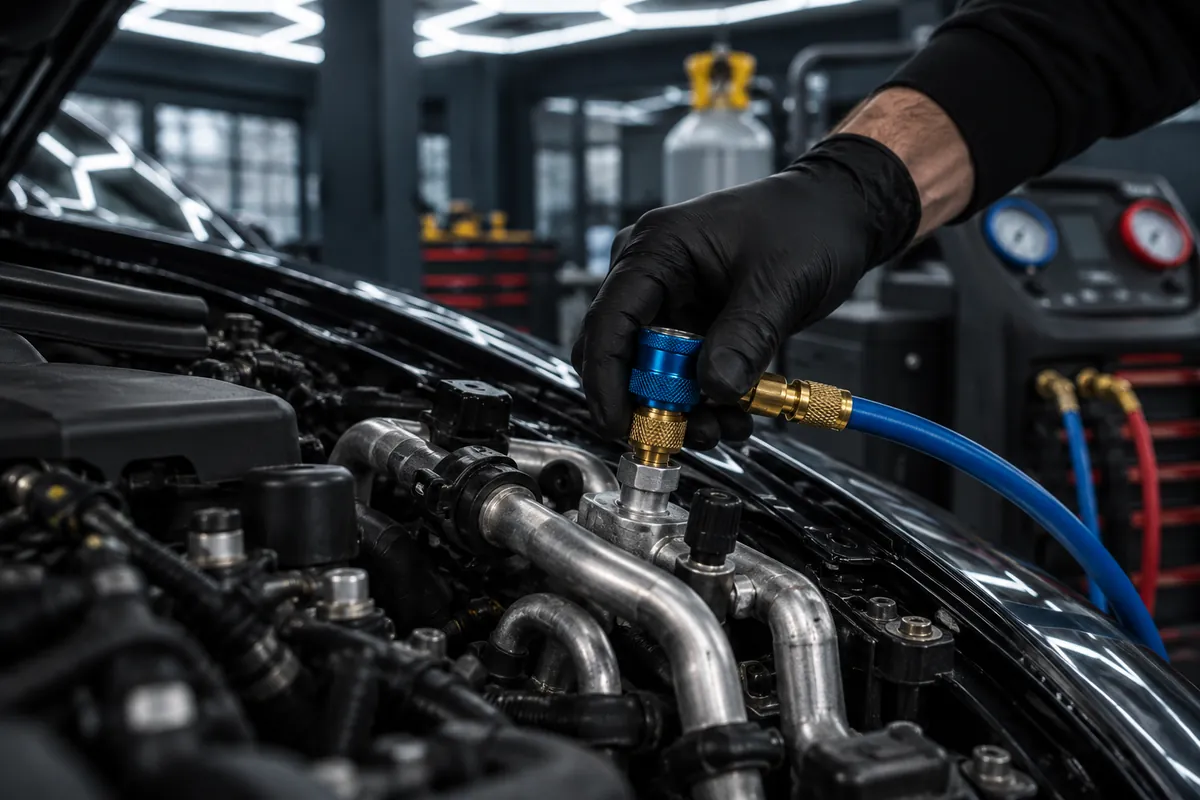
AC Refill — Cost, How Often, and Which Refrigerant
Air conditioning cools a little worse every year, because the system naturally loses refrigerant. We explain how often to service it and what the price is made up of.
9 min read · Pulsecar team · updated:
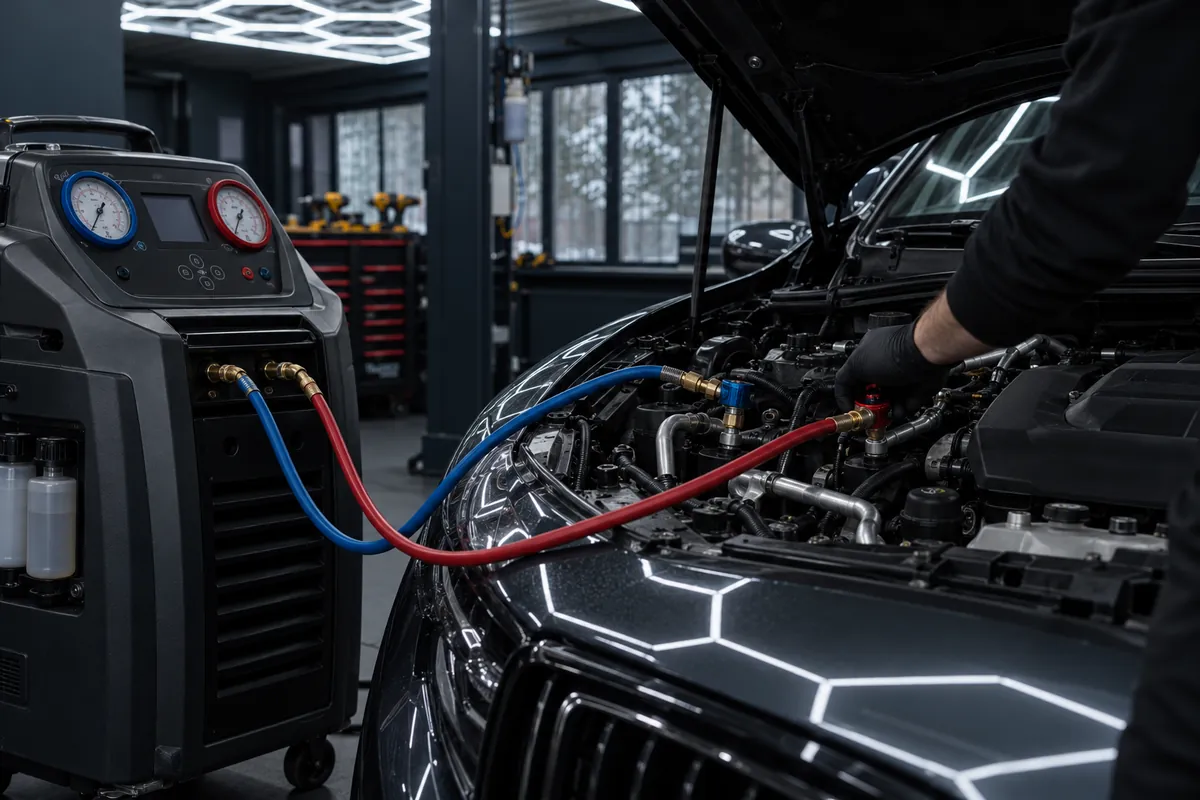
Car AC recharge — how much does it cost and how often?
A car air conditioning recharge at Pulsecar costs 199 zł for the service with a vacuum check, plus refrigerant at 40 zł per 100 g (R134a or R1234yf). In a typical passenger car whose system holds about 450–550 g of refrigerant, the whole service usually comes to around 380–420 zł. It is worth servicing the AC once a year, ideally before summer.
Below we explain what the price is made up of, how to check which refrigerant your car uses, what an AC recharge looks like step by step, and when a recharge alone is not enough.
Why the air conditioning cools worse every year
An AC system is never perfectly sealed. Every year a small amount of refrigerant escapes through seals, O-rings and flexible hoses. You will not notice it for the first season or two, but over time cooling gets weaker and the car takes longer and longer to cool down on a hot day.
Oil circulates together with the refrigerant and lubricates the compressor. When refrigerant runs low, less oil reaches the compressor too, and it runs longer in worse conditions. That is why a regular AC recharge is not just about comfort — it also protects the most expensive part of the system.
Air conditioning is also a safety feature. Dry air clears fogged windows faster in autumn and winter, and in hot weather a driver in a cool cabin gets less tired and stays focused for longer. That is why the system deserves attention all year round, not only when July arrives.
Signs your system is low on refrigerant
- The vents blow cool rather than cold air, especially when stationary or in traffic.
- After standing in the sun, the car takes noticeably longer to cool down than it used to.
- The compressor keeps switching on and off (you hear the compressor clutch clicking in cycles).
- In autumn and winter the windows fog up even with the AC on — the system is not drying the air well.
- The AC only cools while driving and stops at idle.
A faulty condenser fan, pressure sensor or compressor can cause similar symptoms. If the AC stopped cooling suddenly rather than gradually, see our guide AC not cooling — possible causes.
AC recharge price in Warsaw
| Service | Price at Pulsecar |
|---|---|
| AC recharge with vacuum check | 199 zł |
| R134a refrigerant | 40 zł / 100 g |
| R1234yf refrigerant | 40 zł / 100 g |
| Cabin filter replacement | 40 zł |
| Computer diagnostics (e.g. for control faults) | 100 zł |
The service price covers recovering the old refrigerant, pulling a vacuum, checking the system for leaks and refilling it. Refrigerant is billed separately because cars have different system capacities — from small city cars to large SUVs and cars with a rear evaporator. Current rates are also in our price list.
Before we start, we give you a quote to approve. If it turns out during the work that the system leaks, we tell you first and agree on the next steps — nothing is done without your consent.
Don’t compare “from” prices alone. Ask whether a vacuum test is included and how many grams of refrigerant will be billed — only then do you know what you will actually pay.
Example cost of a car AC recharge
| Refrigerant amount (example) | Refrigerant (40 zł/100 g) | Service with vacuum test | Total |
|---|---|---|---|
| 450 g | 180 zł | 199 zł | 379 zł |
| 500 g | 200 zł | 199 zł | 399 zł |
| 550 g | 220 zł | 199 zł | 419 zł |
This is only an example for a typical passenger car with a system holding about 450–550 g of refrigerant. The correct amount for your car is given by the manufacturer on the sticker under the bonnet — some small cars take less, while large SUVs or vans with rear-seat air conditioning take considerably more. The rate of 40 zł per 100 g is the same for R134a and R1234yf.
How to check which refrigerant your car uses (R134a or R1234yf)
- 1Open the bonnet and look for the air conditioning sticker — usually on the front panel above the radiator, on the underside of the bonnet or near the strut towers.
- 2Read the refrigerant designation: R134a (HFC-134a) or R1234yf (HFO-1234yf).
- 3Check the refrigerant amount in grams (e.g. 500 ± 25 g) and the oil type (e.g. PAG) — this data is needed for a correct refill.
- 4If the sticker is missing or unreadable, the refrigerant type can be identified by the service valves — R1234yf has different connectors from R134a. Just drop by and we will check on the spot.
In practice, older cars usually have R134a, and most cars built since around 2017 have R1234yf. The two refrigerants must never be mixed or swapped. For a detailed comparison of both gases, their properties and the regulations, see R1234yf or R134a refrigerant — what is the difference.
How a car AC recharge works, step by step
- 1Initial check: we test the compressor and fan and measure the vent temperature before servicing.
- 2Refrigerant recovery: the service station draws the refrigerant out of the system and measures how much was left — this shows how big the loss was.
- 3Vacuum: the station creates a vacuum in the system, removing air and moisture.
- 4Leak test: the system is held under vacuum for a while. If the vacuum drops, the system leaks and there is no point refilling it.
- 5Oil top-up: we add oil matching the amount recovered with the refrigerant.
- 6Refill: we charge the exact amount of refrigerant specified by the manufacturer.
- 7Final check: we check the operating pressures and the air temperature at the vents.
The service itself usually takes about 30 minutes. It only takes longer if the leak-tightness needs a closer check or a leak has to be traced. More about the scope of work on our car air conditioning service page.
If recovery shows the system held almost the amount it should, yet cooling is still weak, the cause lies elsewhere — for example in the condenser fan, a clogged condenser, the compressor or the expansion valve.
How often should you recharge car AC?
| Task | How often |
|---|---|
| AC check and recharge with vacuum test | once a year, every 2 years at the latest, ideally before summer |
| Cabin filter replacement | once a year or per the service schedule, more often with allergies |
| AC disinfection | when the vents give off a musty smell |
| Running the AC | regularly all year round, including winter |
If the car sits in a garage and is rarely driven, losses can be even bigger, because seals dry out when the system does not run for a long time. And after replacing the radiator or condenser, or after a front-end collision, the AC needs recharging straight away because the system was opened.
During a service it is also worth looking at the condenser in front of the radiator. Clogged with leaves, insects and road dirt, it sheds heat less effectively, so the AC cools worse even with a full system.
The best time for a service is April–May. With the first heatwave, workshop queues grow — and a weak AC in a July traffic jam is the least pleasant moment to get it fixed. You can set up a service reminder.
When a recharge alone is not enough
- Refrigerant lost a few weeks after a recharge — almost certainly a leak.
- An oil stain or a greenish trace of dye on the joints — the leak point.
- The compressor does not engage even though the system is full — an electrical or control problem.
If recovery shows very little refrigerant left in the system, or the vacuum test reveals a leak, a recharge only postpones the problem. The refrigerant will leak out again, and the compressor will keep running in poor conditions.
The most common leak points are the condenser at the front of the car (exposed to stones and corrosion), hoses and their joints, service valves, the compressor seal and the evaporator hidden under the dashboard. Leaks are traced using, among other things, UV dye added to the system and an electronic leak detector.
If we find a leak, the quote sets out what needs repairing or replacing, and the recharge is done after the repair. When the compressor does not engage because of a sensor or control-unit fault, computer diagnostics and auto electrics help — for 100 zł we read the fault codes instead of replacing parts blindly.
DIY recharge cans and other mistakes
- “Do-it-yourself” recharge cans do not remove moisture and do not let you check how much refrigerant is in the system — it is easy to overfill, and too much is as harmful as too little.
- Adding refrigerant to a leaking system without finding the leak is money down the drain.
- Mixing R134a with R1234yf or using substitutes contaminates the system and the service equipment.
- The wrong oil harms the compressor — hybrids and EVs with an electric compressor use a special oil with insulating properties.
- Refrigerant must not be vented into the atmosphere — during service it has to be recovered with a station.
Run the AC for 10–15 minutes at least once every week or two, including in winter. This spreads oil through the system, keeps the seals from drying out and clears fogged windows faster.
AC recharge in Warsaw — Pulsecar in Bielany
We recharge car air conditioning at the Pulsecar workshop at ul. Arkuszowa 176 in Bielany, easy to reach from Żoliborz, Bemowo and Łomianki too. We handle both refrigerants — R134a and R1234yf — and every service starts with a vacuum test. We give a 6-month warranty on labour.
We are open Monday to Friday 9:00–18:00 and Saturday 9:00–15:00. The easiest way to get a slot is online booking or by phone at +48 571 058 591 — directions are on our contact page.