Dual-mass flywheel — symptoms, diagnosis and replacement with the clutch
A worn dual-mass flywheel shows itself through knocks and vibration that are easy to confuse with other faults. We explain how to recognise it, tell it apart from a worn clutch and when replacement is really needed.
9 min read · Pulsecar team · updated:
Symptoms of a worn dual-mass flywheel — short answer
The most common symptoms of a worn dual-mass flywheel are noticeable vibration at idle (felt through the seat, steering wheel and clutch pedal), a metallic knock or clatter when the engine is switched off and started, judder when pulling away, and droning when accelerating from low revs in a high gear. The symptoms usually build up gradually over weeks or months.
A dual-mass flywheel is usually replaced together with the clutch, because reaching either of them requires removing the gearbox. Below we explain how to tell a worn flywheel from a worn clutch and other faults, how diagnosis works and what drives the repair cost in Warsaw.
What a dual-mass flywheel is and why it wears out
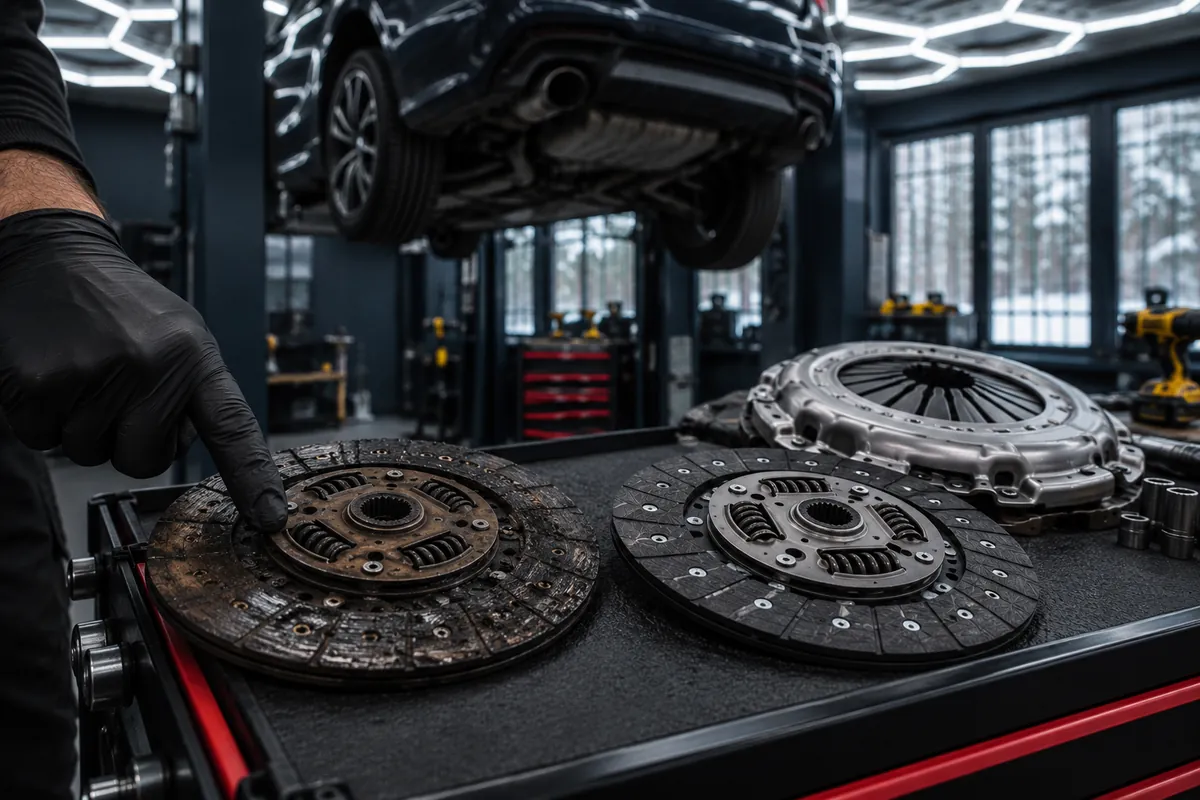
A dual-mass flywheel (DMF) replaces the conventional solid flywheel. It consists of two masses: a primary one bolted to the crankshaft and a secondary one that the clutch disc bears against. Between them sit arc springs packed in grease and a bearing. The job of this assembly is to damp the engine’s torsional vibrations before they reach the gearbox and the body.
DMFs are used mainly in diesels and in turbocharged petrol engines that produce a lot of torque at low revs. Thanks to the DMF the gearbox runs more quietly and the car pulls smoothly even at low revs. The price is durability: the springs, their guides, the grease and the bearing wear over time, and the play between the masses grows.
How fast it wears depends more on driving style and engine condition than on mileage alone. A DMF suffers from lugging the engine at very low revs in a high gear, pulling away in second, frequent towing, dropping the clutch abruptly and rough engine running — e.g. due to worn injectors or misfires. That is why some flywheels last over 200,000 km, while others need replacing much earlier.
7 signs of a worn dual-mass flywheel
- Vibration and shaking at idle — felt through the seat, steering wheel or clutch pedal.
- A metallic knock or several thuds when switching the engine off — the masses hit each other as the engine stops.
- Clatter or a knock when starting the engine.
- Judder and vibration when pulling away, despite smooth clutch control.
- Droning, humming or rattling when accelerating from low revs in a high gear.
- Knocks on load changes — when you suddenly press or lift off the accelerator.
- A rattle in neutral that goes quiet when the clutch pedal is pressed — this can come from poor damping by the DMF, but also from worn gearbox bearings.
None of these symptoms alone proves the flywheel must be replaced. Engine mounts, injectors or the clutch itself can behave in a similar way. The most characteristic DMF sign is a knock when the engine is switched off combined with vibration at idle.
Symptoms are often more pronounced in diesels, when pulling away uphill and with a loaded car, because that is when the most torque passes through the flywheel at low revs.
Note exactly when you hear the knock: when switching off, when pulling away, in neutral or when accelerating in a high gear. Write it down before your visit — this information noticeably shortens the diagnosis.
Dual-mass flywheel or clutch — how to tell the symptoms apart
| Symptom | What it more often points to | Notes |
|---|---|---|
| Revs rise but the car does not accelerate | Clutch — slipping disc | A worn DMF usually does not cause slipping |
| Knock when switching off and starting the engine | Dual-mass flywheel | Typical sign of excessive play between the masses |
| Vibration at idle | DMF, engine mounts, rough engine running | Mounts and cylinder balance need checking |
| Judder when pulling away | Clutch disc (e.g. oil-contaminated) or DMF | Often both parts are worn at the same time |
| Clutch bites very high | Worn clutch disc | The biting point moves up as the linings wear |
| Whine or squeal when the pedal is pressed | Release bearing or concentric slave cylinder | Noise appears only with the clutch pressed |
| Hard to engage gears, grinding | Clutch not fully disengaging, hydraulics or gearbox | The DMF is rarely the main cause here |
The clutch and the DMF work together and often wear at a similar rate, so the symptoms overlap. If your main problem is that the engine revs up but the car does not accelerate, read our guide slipping clutch — symptoms and test.
If the trouble is rather with engaging gears, grinding or a whining gearbox, see gearbox problems.
What else causes symptoms similar to a worn DMF
- Worn engine or gearbox mounts — vibration when stationary and a knock when pulling away or on sudden throttle.
- Rough engine running: worn diesel injectors, misfires, an intake leak — vibration at idle and jerking (see car jerking — causes).
- The alternator freewheel pulley or the crankshaft pulley damper — clatter and vibration at idle and when switching off.
- Loose heat shields or damaged exhaust mounts — buzzing at certain revs.
- Worn CV joints or drive shafts — knocks when pulling away and turning.
- An oil-contaminated or worn clutch disc — judder when pulling away, but without knocks at switch-off.
That is why replacing a DMF “by ear”, without checking these parts, can be an expensive mistake. Engine mount replacement at Pulsecar costs from 150 zł in labour — much less than a repair that requires removing the gearbox, so it is worth ruling out first.
If the check engine light is on, the vibration may come from an engine fault rather than the drivetrain — then we start the diagnosis by reading fault codes.
How we diagnose a dual-mass flywheel
- 1We talk through the symptoms: when the knock or vibration appears, the mileage and when the clutch was last replaced.
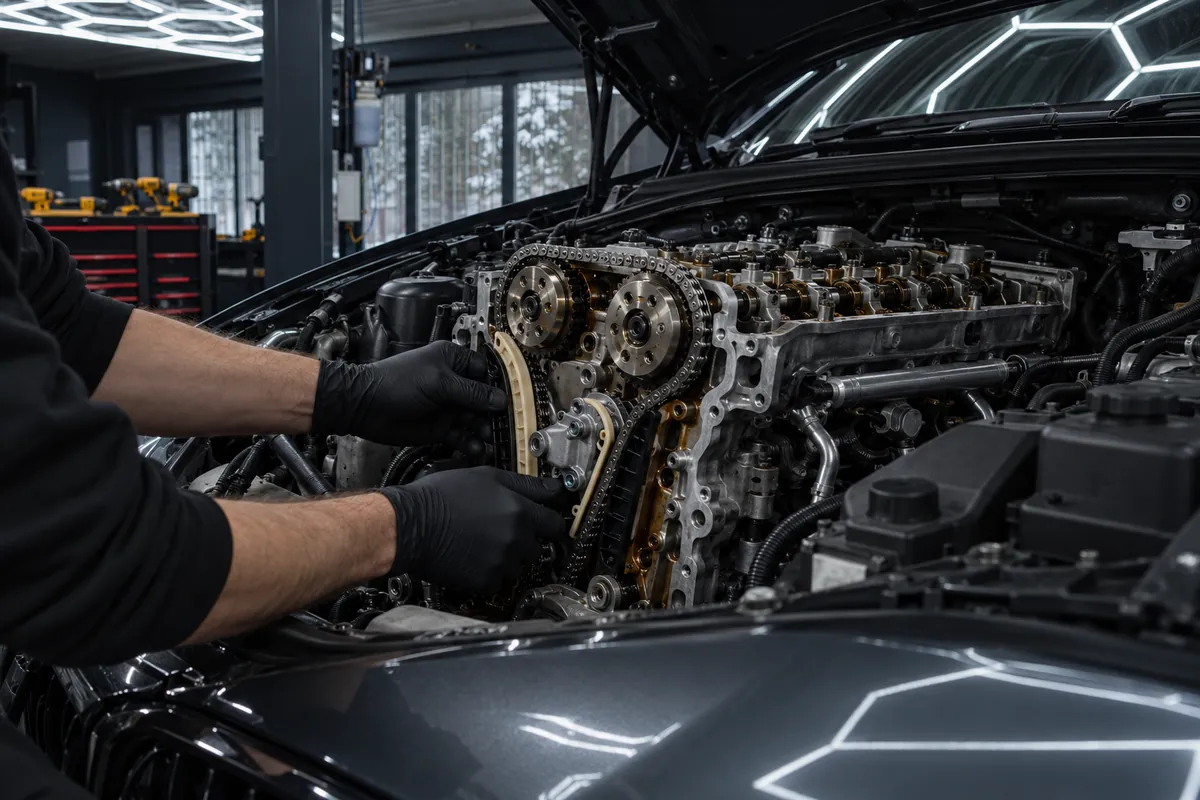
- 2Test drive: pulling away, accelerating from low revs in a high gear, switching off and starting the engine, idling in neutral with the clutch pressed and released.
- 3Computer diagnostics (100 zł): reading fault codes and engine data — in many diesels also injector correction values, which show whether the vibration comes from uneven cylinder operation.
- 4Checking the engine and gearbox mounts, crankshaft pulley, alternator pulley and exhaust mounts.
- 5With the gearbox removed — assessing the DMF against the manufacturer’s criteria: rotational and axial play between the masses, grease leaks, heat discoloration, the condition of the friction surface.
- 6We present the result and a quote for approval — only then do we order parts and start work.
The preliminary diagnosis lets us identify the culprit with high probability, but a definitive assessment of the DMF is only possible after removal. If, once the gearbox is off, the scope of work should be different than expected, we agree it with you first.
Replacing the dual-mass flywheel together with the clutch
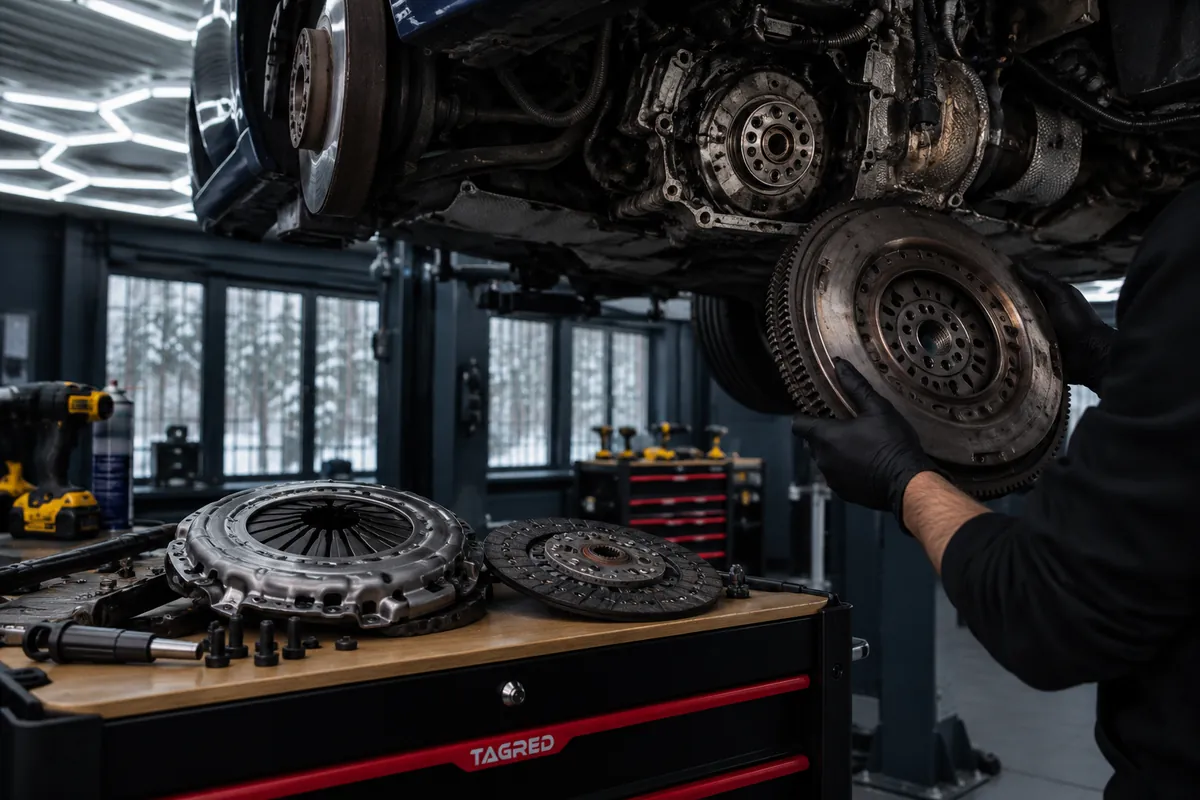
- The complete clutch kit: disc, pressure plate and release bearing or concentric slave cylinder.
- Flywheel bolts — in many designs they are single-use.
- The rear crankshaft oil seal and the gearbox input shaft seal — an oil leak will ruin a new disc.
- Manual gearbox oil, if the scope of the repair or the oil condition justifies it.
- The gearbox mount, if worn — its condition is easy to assess with the gearbox out.
The dual-mass flywheel is bolted to the crankshaft, and the clutch pressure plate is bolted to the flywheel. To reach them the gearbox has to come off, often together with the drive shafts, starter and underbody parts. The labour is therefore largely shared, which is why a worn DMF is practically always replaced together with the clutch, and the DMF is always checked during a clutch replacement.
Clutch kits with a dual-mass flywheel are available, and for some models also kits with a solid flywheel instead of the DMF. The latter are cheaper but usually mean more vibration and a noisier gearbox, and not every car manufacturer approves them — make that decision consciously, after talking to a mechanic. Be careful too with “remanufactured” flywheels of unknown origin.
A new DMF with an old, oily clutch, or a new clutch on a worn DMF, is a typical route to doing the job twice. Removing the gearbox again means paying the same labour a second time.
Dual-mass flywheel replacement cost in Warsaw
| Service | Price (labour) | Notes |
|---|---|---|
| Clutch replacement | from 600 zł | The amount depends on the model and gearbox access |
| Dual-mass flywheel replacement | quoted after diagnosis | Done together with the clutch; scope and cost agreed before work |
| Computer diagnostics | 100 zł | Reading fault codes, ruling out rough engine running |
| Engine mount replacement | from 150 zł | When vibration and knocks come from the engine mounts |
| Manual gearbox oil change | from 200 zł | Oil charged separately |
The cost of a DMF replacement depends mostly on the part itself — a dual-mass flywheel often costs more than the clutch kit, and prices vary a lot between models — and on gearbox access (4x4 drive, engine layout, the number of parts to remove). That is why we give the final amount including parts after identifying the car and diagnosing it. Parts are priced separately, and the full list of services is on the Pulsecar price list.
Before work starts you receive a quote for approval, and we give a 6-month warranty on labour. You can read more about the service on the clutch replacement at Pulsecar page.
How to make a dual-mass flywheel last longer
- Do not lug the engine at very low revs in a high gear — when it starts to drone, shift down.
- Pull away in first gear and do not slip the clutch for longer than needed.
- Avoid stalling when pulling away and do not bump-start the car.
- Keep the engine running smoothly: healthy injectors, spark plugs and ignition mean less load on the DMF.
- Do not delay repairing a slipping clutch — overheating harms the dual-mass flywheel too.
- After power-increasing modifications, check that the clutch and DMF can handle it.
Dual-mass flywheel in Warsaw Bielany — Pulsecar, ul. Arkuszowa 176
Pulsecar is located at ul. Arkuszowa 176 in Warsaw’s Bielany district, convenient for drivers from Żoliborz, Bemowo and Łomianki. We are open Monday to Friday 09:00–18:00 and Saturdays 09:00–15:00.
Call +48 571 058 591 or book a visit online. Tell us when the knocks or vibration appear — we will check whether the DMF, the clutch or another part is to blame, and prepare a quote before any work begins.