EGR Valve — Fault Symptoms, Cleaning or Replacement
A clogged EGR valve can seriously upset how an engine runs, especially in a diesel driven around town. We explain how to recognise the fault, when cleaning is enough and why disabling the EGR is not worth it.
8 min read · Pulsecar team · updated:
Symptoms of a bad EGR valve — short answer
A clogged or stuck EGR valve most often causes: rough idle, jerking and flat spots when accelerating, loss of power up to limp mode, black smoke from the exhaust (mainly in diesels), stalling when stationary and an illuminated check engine light with an exhaust gas recirculation fault.
The problem mainly affects diesels used for short trips, but many petrol engines have an EGR valve too. In many cases cleaning is enough; sometimes the valve or its cooler needs replacing. Disabling or blanking off the EGR, however, is against the law in Poland and across the EU. Below we explain how EGR works, how to recognise a fault, how diagnosis works and what determines the repair cost.
What the EGR valve does and why it clogs
EGR (Exhaust Gas Recirculation) is the exhaust gas recirculation system. The EGR valve routes part of the exhaust gas back into the intake manifold, where it mixes with fresh air. Exhaust gas does not take part in combustion, so it lowers the temperature in the combustion chamber — and this limits the formation of nitrogen oxides (NOx), one of the key pollutants regulated by Euro standards.
The valve works mainly at part load: at idle, during gentle driving and at low revs. Under hard acceleration the ECU usually closes it so the engine gets as much air as possible. In diesels the exhaust gas often passes through an EGR cooler before returning to the intake, and newer designs also have low-pressure EGR that takes exhaust gas only after the DPF.
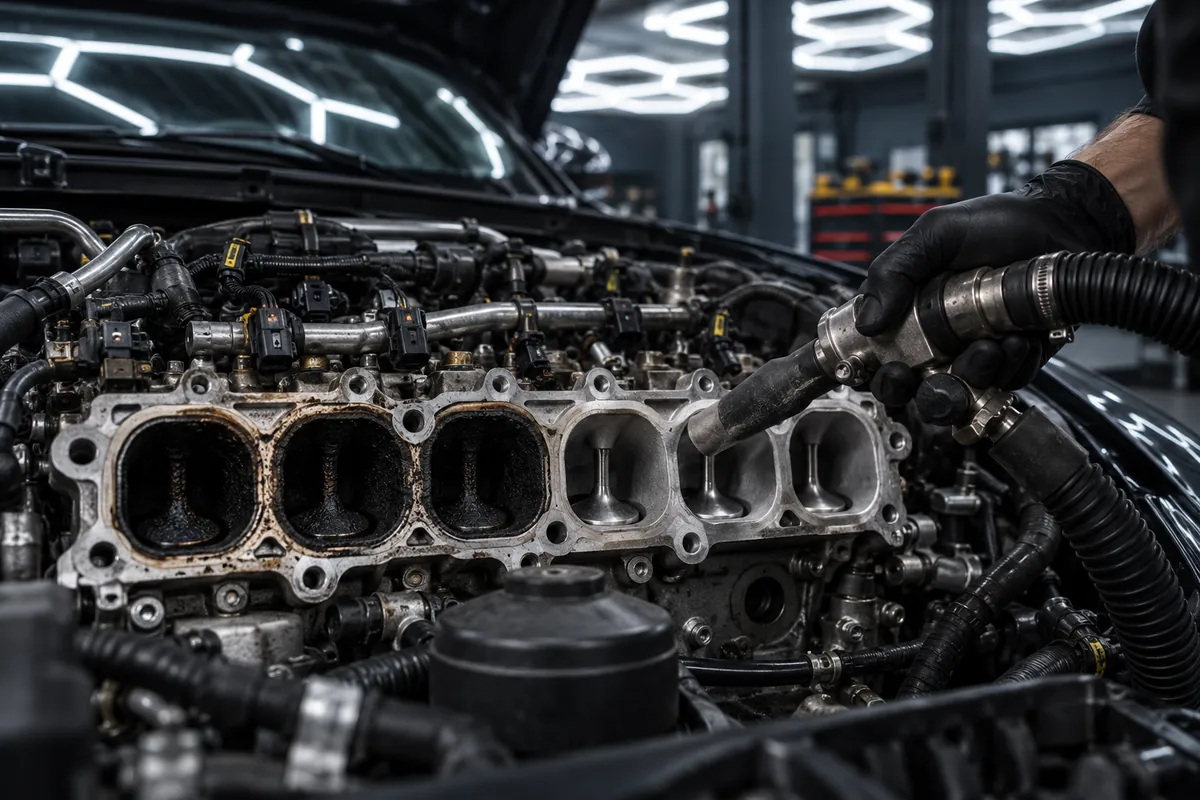
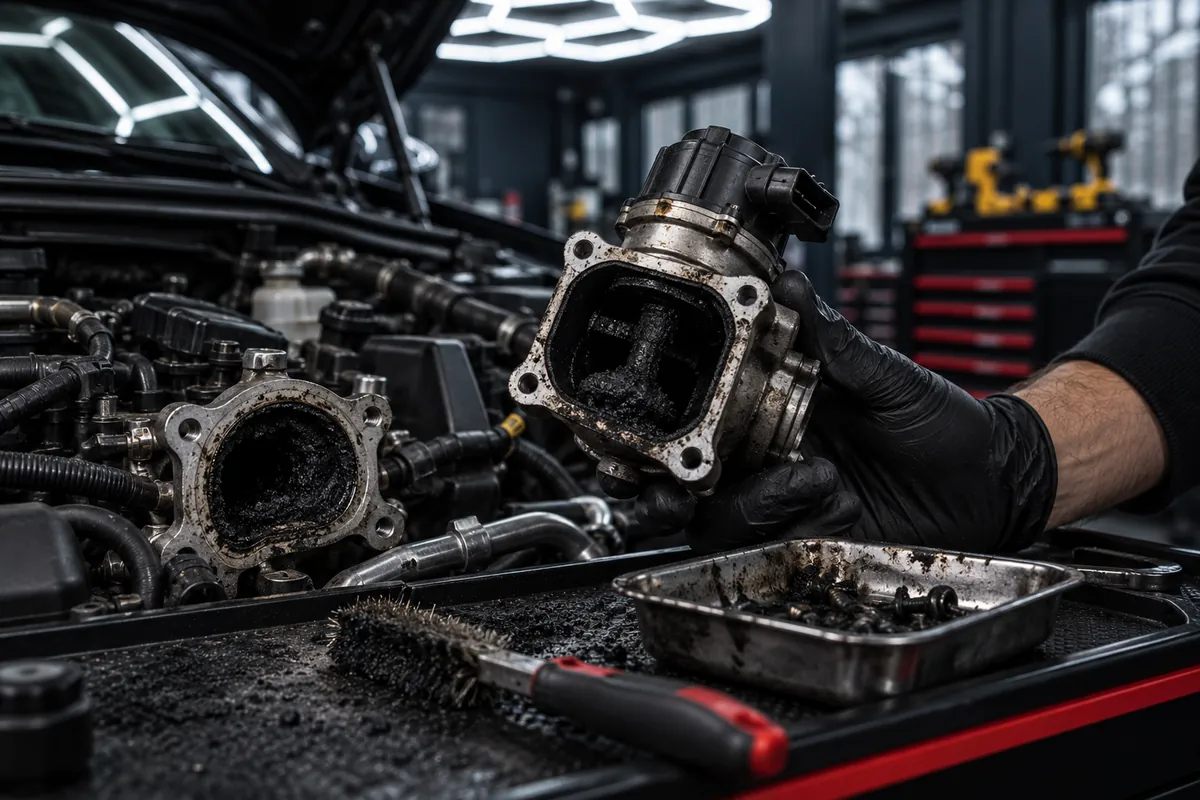
Diesel exhaust contains soot. In the manifold it mixes with oil mist from the crankcase ventilation and forms a sticky, and eventually hard, carbon deposit. It builds up on the valve head and seat, in the passages, on the throttle body and in the manifold. The valve starts sticking, does not close or does not open, and the ECU logs a fault.
Modern EGR valves are mostly electric — with a stepper or DC motor and a position sensor. Older ones are often vacuum-operated, controlled by a solenoid valve. The type determines whether the valve can be cleaned effectively or whether the electronics have failed.
7 signs of a clogged or stuck EGR valve
- Rough idle, hunting revs, vibrations.
- Engine stalling after pulling away, at traffic lights or when slowing to a stop.
- Jerking and flat spots when accelerating, especially at low revs (car jerking — possible causes).
- Loss of power and limp mode — the engine will not rev.
- Black smoke from the exhaust when accelerating, typical of a diesel with the valve stuck open (what smoke colour means).
- Check engine light with an EGR flow or valve position fault.
- Higher fuel consumption and more frequent DPF regenerations — more soot in the exhaust clogs the filter faster (DPF warning light).
The symptoms depend on the position in which the valve has stuck. A valve stuck open lets exhaust in when the engine needs fresh air — hence jerking, smoke and stalling. A valve stuck closed often causes no noticeable symptoms apart from a stored fault and higher NOx emissions; in some petrol engines knocking may appear.
The same symptoms are also caused by other faults: an intake leak, mass air flow meter, injectors, boost pressure sensor or turbo problems. That is why the EGR valve is replaced only after confirming that it is the cause.
Diesel jerks only during gentle low-rev driving, and the problem disappears under hard acceleration? That is a typical picture of an EGR problem — at full load the valve is closed, so its fault stops interfering.
Stuck open or stuck closed — how the fault affects the engine
| Valve condition | Typical symptoms | Typical fault codes* |
|---|---|---|
| Stuck open / leaking | Rough idle, stalling, jerking, black smoke, loss of power | P0402 (EGR flow excessive), valve position faults, sometimes MAF faults |
| Stuck closed / blocked passages | Often no noticeable symptoms, higher NOx emissions, possible knocking in petrol engines | P0401 (EGR flow insufficient), valve position faults |
| Failed valve electronics | Limp mode, warning light, symptoms depend on where the valve stopped | P0403–P0409 (control circuit, position sensor — depending on manufacturer) |
| Leaking EGR cooler (diesel) | Coolant loss without an external leak, white smoke, risk of overheating | Often no EGR fault — the coolant loss must be traced |
*P040x codes are generic (OBD), but manufacturers also use their own codes and interpret them differently. A fault code points to the problem area, not to a specific part to replace. You can read more about fault codes in our guide check engine light — what it means.
A leaking EGR cooler is especially dangerous. Coolant then enters the intake and cylinders: the level in the expansion tank drops and white, sweet-smelling smoke comes from the exhaust. Driving in this condition risks engine overheating and, in extreme cases, hydraulic lock.
Why the EGR valve clogs
- Short trips and city driving — the engine rarely reaches full temperature, so more soot and condensate settle in the intake.
- Long idling and driving at low revs — exactly when the EGR is most often open.
- A lot of oil vapour from the crankcase ventilation, especially in a high-mileage engine.
- Faulty injectors or an incorrect fuel quantity — more soot in the exhaust.
- Infrequent oil changes and oil not meeting the manufacturer’s specification.
- DPF problems and frequently interrupted regenerations.
- Poor-quality fuel.
There is no fixed mileage at which an EGR valve clogs — in a car driven mainly on longer routes it can last a very long time, while in a diesel used only in town problems sometimes appear after a few tens of thousands of kilometres. Regular longer drives outside the city and oil servicing to the correct specification clearly slow the process down.
Fuel additives that “clean the EGR” may slightly slow carbon build-up, but they will not remove hard deposits in the valve and manifold. If the valve is already sticking, mechanical cleaning or replacement is needed.
Cleaning or replacing the EGR valve
| Solution | When it makes sense | What to watch out for |
|---|---|---|
| EGR valve cleaning | Valve clogged with carbon, but the mechanism and electronics work | Carbon must also be removed from the passages and manifold; after refitting the valve often needs an adaptation in the ECU |
| Cleaning the valve with the manifold and throttle body | Heavily contaminated intake, loss of power despite a working valve | Scope depends on the design — on some engines removing the manifold is labour-intensive |
| EGR valve replacement | Failed valve motor or position sensor, worn mechanism, cracked housing | Adaptation is usually required after replacement; it is worth removing the cause of clogging |
| EGR cooler replacement | Leak (coolant loss) or a blocked cooler | Check the cooling system and top up the coolant afterwards |
Cleaning makes sense when the valve is mechanically and electrically sound and the only problem is carbon. If the valve motor or position sensor has failed, cleaning will not help. After cleaning or replacing the valve, on many cars the ECU needs an adaptation (learning the end positions) with a diagnostic tool — without it the fault may come back.
The valve itself is usually only part of the problem. The same soot builds up in the intake manifold and on the throttle body, and in some diesels on the swirl flaps too. You can read more about how the intake gets clogged and how to clean it in our intake cleaning guide and on the intake and EGR cleaning service page.
Disabling the EGR — why it is illegal and not worth it
Offers to “delete the EGR” — in the ECU software or with a blanking plate — are common in online ads. Such a modification means the car no longer meets the conditions of its type approval and the emission standard under which it was registered. Both EU and Polish regulations require emission control systems fitted by the manufacturer to be present and working.
The EU roadworthiness testing directive (2014/45/EU) treats missing, modified or obviously defective emission control equipment as a major defect. In practice this means a risk of failing the periodic technical inspection — the inspector can check, among other things, the engine warning light and stored faults. During a roadside check, the police may also retain the registration certificate of a car that excessively pollutes the environment.
Beyond the law there is the engineering: disabling the EGR does not remove the cause of intake clogging (crankcase ventilation, injectors, short trips), it raises combustion temperature and NOx emissions, and in newer cars with SCR/AdBlue and extensive self-diagnostics it can trigger further faults. It also makes selling and servicing the car harder.
Buying a used diesel? Ask the seller directly whether the EGR or DPF has been disabled, and book a pre-purchase inspection. Restoring the original configuration can be expensive.
How we diagnose the EGR valve
- 1Talking about symptoms and how the car is used: short trips, when the jerking occurs, whether coolant is being lost.
- 2Computer diagnostics: reading fault codes with freeze-frame data, comparing target and actual valve position, and mass air flow and intake pressure readings.
- 3Actuator test (if the ECU allows it): we check whether the valve opens and closes on command from the scan tool.
- 4Checking the valve’s wiring: power, ground, connector, cables; on vacuum valves — the vacuum lines and control solenoid.
- 5Inspecting the valve and intake: the amount of carbon on the valve, in the passages, manifold and throttle body; if suspected — checking the EGR cooler for leaks.
- 6Ruling out other causes: intake leaks, mass air flow meter, injectors, boost.
- 7We present the result and a quote for approval — only then do we start work.
It is important to tell whether the valve is dirty or faulty. A clean valve with a failed motor will still not work after cleaning, and a new valve fitted into a clogged manifold will soon report the same faults.
EGR valve repair cost in Warsaw
| Service | Price | Notes |
|---|---|---|
| Computer diagnostics | 100 zł | Reading fault codes, EGR parameters and a valve test — usually up to an hour |
| EGR valve cleaning | after diagnosis | Depends on access to the valve and the amount of carbon |
| Manifold and throttle body cleaning | after diagnosis | When carbon has built up in the intake |
| EGR valve or cooler replacement | after diagnosis | Part priced separately; ECU adaptation after replacement |
| Oil and filter change | 120 zł (labour) | When the oil is neglected — less vapour in the intake |
The cost of an EGR repair depends heavily on the engine: on some cars the valve is easily accessible on the manifold, on others a lot of ancillaries must be removed, and the EGR cooler can be buried deep under the manifold. That is why we give the price for cleaning or replacement after diagnosis and identifying the engine. The full list of services is on the Pulsecar price list.
Before work starts you receive a quote for approval, and we give a 6-month warranty on labour. Electrical and computer diagnostics are carried out as part of our auto electrician and computer diagnostics service.
EGR valve repair in Bielany — Pulsecar, ul. Arkuszowa 176
Pulsecar is located at ul. Arkuszowa 176 in Warsaw’s Bielany district, convenient for drivers from Żoliborz, Bemowo and Łomianki. We are open Monday to Friday 09:00–18:00 and Saturdays 09:00–15:00.
Call +48 571 058 591 or book a visit online. Describe the symptoms — jerking, smoke, stalling or a warning light. We will first establish whether the EGR valve is to blame, and present a quote for cleaning or replacement before any work begins.