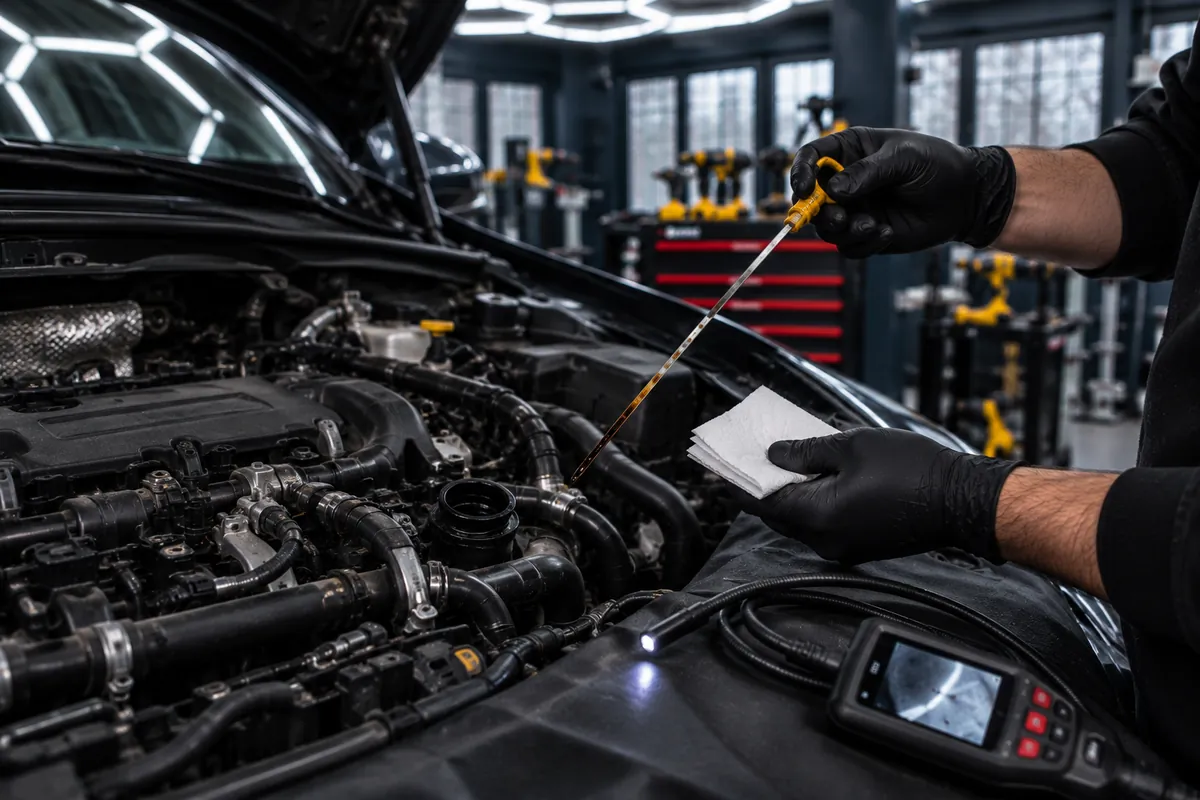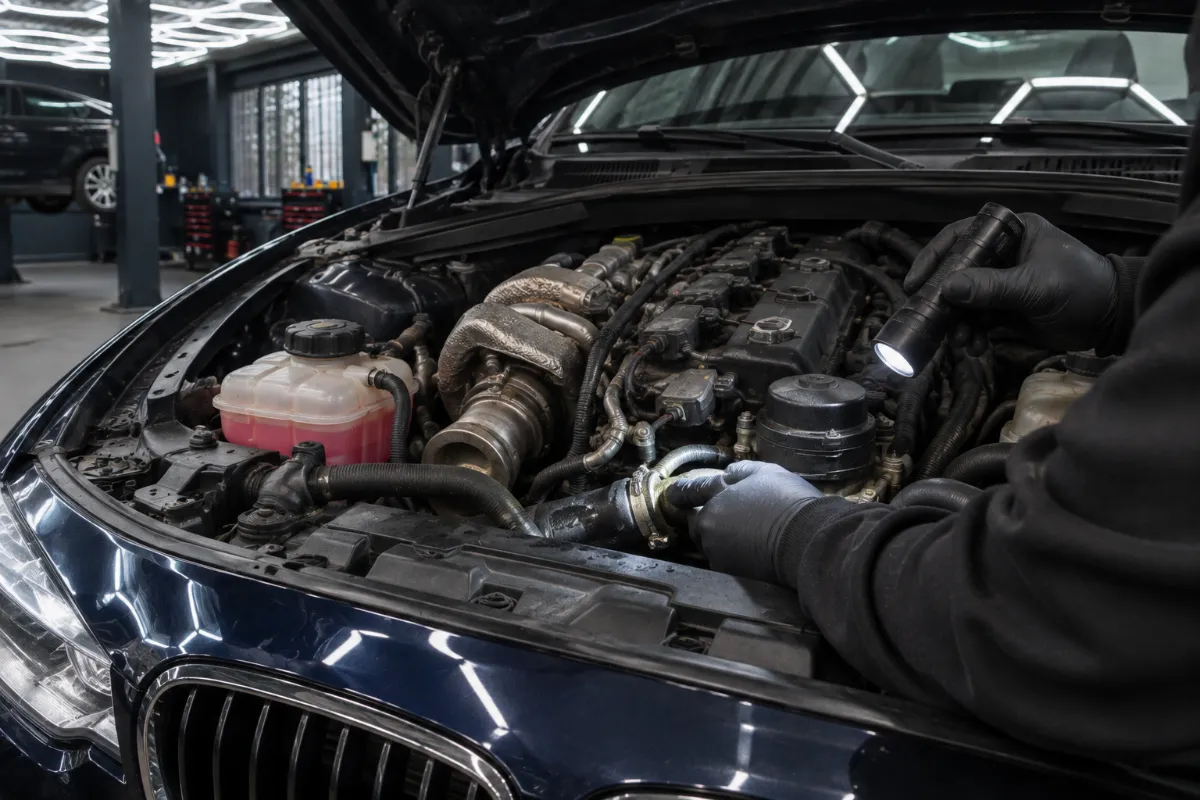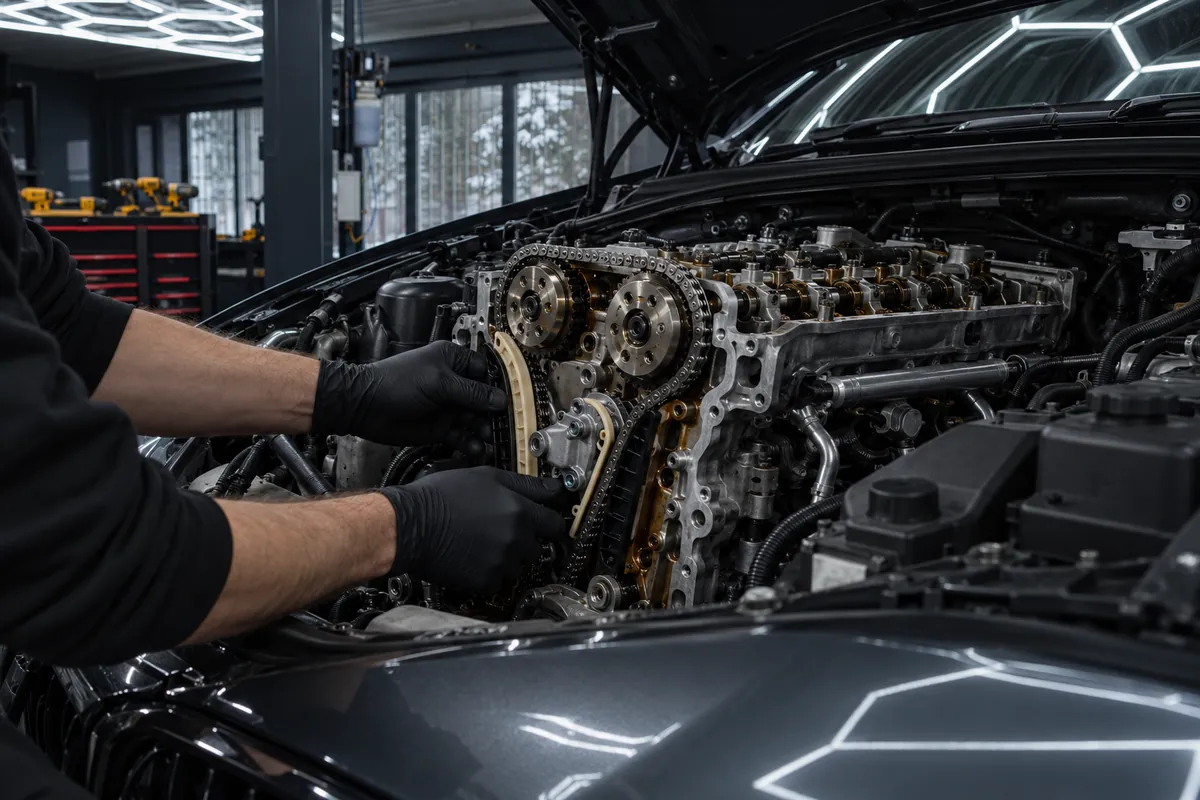
Renault — common faults and weak spots in engines, gearboxes and electrics
Renault is cheap to repair but has a few well-known weak spots: bearing shells and injectors on the 1.5 dCi, oil use and the chain on the 1.2 TCe, the turbo on the 1.9 dCi, the EDC gearbox and the key card. We cover them engine by engine and model by model.
18 min read · Pulsecar team · updated:
Renault faults at a glance
Renaults are cheap to buy and cheap for parts, but they have a few well-known weak spots. The most important are: crankshaft bearing shells and injectors on the 1.5 dCi (K9K), bearing shells and the turbocharger on the older 1.9 dCi (F9Q), excessive oil consumption and a stretching timing chain on the 1.2 TCe petrol (H5Ft), the chain and thermostat on the 0.9 TCe, the variable valve timing unit and ignition coils on the 1.6 16V (K4M), and on newer diesels — the EGR, DPF and turbocharger. On top of that come the EDC dual-clutch gearbox, the old DP0 automatic, the key card instead of a key and minor electrical faults.
Most faults give warning signs early: oil loss between changes, rattling after a cold start, a knock from the bottom of the engine, black smoke, judder when pulling away or a message saying the card has not been detected. Below you will find an engine table, a description of each group, a summary table, a checklist for buying a used Renault and prices from our price list. Where Dacia, Nissan, Mercedes or Opel use the same engines, we point it out briefly.
Which engine / model do you have
| Engine | Type | Models and years, approx. |
|---|---|---|
| 1.5 dCi (K9K) | diesel, 4-cylinder, timing belt | Clio II–IV, Megane II–IV, Scenic II–IV, Captur I, Kadjar, Kangoo, Dacia (from 2001) |
| 1.5 Blue dCi (K9K) | diesel, 4-cylinder, AdBlue | Captur II, Megane IV, Kadjar, Kangoo, Dacia (from 2018) |
| 1.9 dCi (F9Q) | diesel, 4-cylinder | Megane II, Scenic II, Laguna II, Trafic II (approx. 1999–2010) |
| 2.0 dCi (M9R) | diesel, 4-cylinder, timing chain | Laguna III, Megane, Koleos, Espace, Trafic II/III (from 2006) |
| 1.6 dCi (R9M) | diesel, 4-cylinder, timing chain | Scenic III/IV, Megane III/IV, Kadjar, Talisman, Espace V, Trafic III (from 2011) |
| 2.3 dCi | diesel, 4-cylinder | Master III (from 2010) |
| 0.9 TCe (H4Bt) | petrol, 3-cylinder, turbo, chain | Clio IV, Captur I, Dacia Sandero/Logan II (approx. 2012–2019) |
| 1.2 TCe (H5Ft) | petrol, 4-cylinder, turbo, chain | Clio IV, Captur I, Megane III/IV, Scenic III/IV, Kadjar, Dacia Duster (approx. 2012–2018) |
| 1.3 TCe (H5Ht) | petrol, 4-cylinder, turbo | Clio V, Captur, Megane IV, Scenic IV, Kadjar, Arkana, Dacia (from 2018) |
| 1.6 16V (K4M) | petrol, 4-cylinder, timing belt | Clio II/III, Megane I–III, Scenic I–III, Laguna, Kangoo, Dacia (until approx. 2016) |
| 1.2 16V (D4F) | petrol, 4-cylinder, timing belt | Clio (incl. IV), Twingo |
The years are approximate and depend on the market and version. You can read the exact engine code (e.g. K9K, H5Ft, R9M) from the plate on the engine, from the VIN data — see checking a car by VIN — or during computer diagnostics. This matters because, for example, the 1.5 dCi comes in many variants with different ancillaries and injection systems.
Renault in our workshop — what the data says
Based on jobs completed at Pulsecar from January to October 2026: Renault accounted for 3.1% of the cars we serviced, roughly one in every thirty-two cars in the workshop. Among all makes, Renault came 9th.
Renault has a very wide range: from the city Clio and Captur, through the family Megane and Scenic, to the Trafic and Master vans, plenty of which are on the road in Warsaw. That is why we split this guide into engines, gearboxes and model groups — the engine you have matters most. Also bear in mind that a single job can cover several pieces of work.
1.5 dCi (K9K) — bearing shells, injectors, EGR and DPF
The 1.5 dCi is Renault's most popular diesel — from 2001 it went into the Clio, Megane, Scenic, Kangoo, Captur and Kadjar, as well as Dacias (Logan, Sandero, Duster) and Nissans. In the version designated OM607 it also runs in the Mercedes A- and B-Class (W176, W246), CLA and Citan — more on those in the article Mercedes — common faults and weak spots. It is economical and simple, but it has two well-known problems.
The first is the crankshaft bearing shells. They wear faster than in most diesels, and when a shell spins, the result is a seized engine and often serious damage to the con rod or block. The risk rises with long intervals between oil changes and with hard driving. Some mechanics recommend replacing the bearing shells as a precaution at around 120–140k km — a far cheaper job than an engine rebuild. In newer versions the problem is reported less often and usually at higher mileages.
The second is the injection system. Lower-powered versions (usually up to 90 hp) mostly had a Delphi system, which is sensitive to fuel quality — the injectors could need replacing after just a few tens of thousands of kilometres. More powerful versions usually had the more durable Siemens (later Continental) system, which can suffer from leaking return line seals, and some newer versions (Euro 5) also used a Bosch system. The surest way to tell which system a particular car has is by the markings on the pump and injectors. A leaking injector means more than smoke and hard starting — it can also burn through a piston. We describe the symptoms in the article injectors — symptoms.
Other common failures are the EGR valve, the DPF in city driving, the dual-mass flywheel (more often on more powerful versions), sensors and the alternator clutch pulley. The timing is belt-driven — specialists recommend replacing the belt roughly every 100–120k km or every 5 years.
On the 1.5 dCi, change the oil every approx. 10–15k km, not every 30k km. A knock from the bottom of the engine, a drop in oil pressure or metal particles in the oil — stop the car and come in for diagnostics before a bearing shell spins.
1.9 dCi (F9Q) — bearing shells, turbocharger and injection
You will find the 1.9 dCi in the Megane II, Scenic II, Laguna II and Trafic II. It has a similar weakness to the 1.5 dCi, only more pronounced: the big-end bearing shells have no locating tabs, and the manufacturer's recommended oil change interval of 30k km was too long. The result can be a spun bearing shell and a ruined crankpin and con rod — the repair often turns out to be uneconomical and ends with the engine being swapped for a used one.
The second known problem is the turbocharger, which on early examples failed as early as 50–70k km, mainly due to poor lubrication. On the Laguna II, oil getting from the turbocharger into the intake is also reported. Add to that the common-rail injectors, the EGR valve and the dual-mass flywheel. Cars from before the 2005 facelift had the most trouble; the later 130 hp version is considered better.
2.0 dCi (M9R) and 2.3 dCi — chain, EGR, DPF and bearing shells
The 2.0 dCi (M9R), developed together with Nissan, has been used since 2006 in the Laguna III, Megane, Koleos, Espace and Trafic, as well as the Nissan X-Trail and Qashqai and the Opel Vivaro. It is regarded as one of Renault's more durable diesels of that era: the timing chain usually only stretches after 200k km, and the Bosch piezo injectors last longer than those on the 1.5 and 1.9 dCi.
Its weak spots are the EGR valve and the intake manifold flaps, the DPF, which usually needs attention after 150–200k km (sooner with city driving), and the dual-mass flywheel on more powerful versions. With 30k km oil change intervals, bearing shell wear is also reported, and on the Laguna III — minor oil leaks around the intercooler. It makes sense to change the oil every approx. 15k km.
The 2.3 dCi is the engine of the Master III (from 2010) and its twins: the Opel Movano and Nissan NV400. The biggest troublemakers are the DPF and the SCR system with AdBlue on Euro 6 versions, a leaking EGR cooler, the injectors and the intake hoses — including ones chewed by martens.
1.6 dCi (R9M) and Blue dCi — turbocharger, chain and cracked blocks
The 1.6 dCi (R9M), introduced in 2011, replaced the older 1.9 dCi. You will find it in the Scenic III and IV, Megane III and IV, Kadjar, Talisman, Espace V and Trafic III, as well as the Nissan Qashqai and the Mercedes C-Class and Vito. It has a timing chain — a metallic noise for a few seconds after a cold start is a sign to have it checked. The most frequently reported problems concern the variable-geometry turbocharger, followed by sensors, injectors, the DPF and the EGR valve.
It is worth knowing about a Renault special technical operation described by the French motoring press (L'argus, 2019) — this is not a recall, and owners did not receive notifications. It concerned the second-generation 1.6 dCi in the Espace V, Talisman and Trafic III built from December 2014 to March 2018: a manufacturing defect in the block could cause it to crack. The symptoms are unusual noise, an oil leak, the engine cutting out and coolant loss. According to those reports, Renault contributed to the cost of replacing the engine after a failure, even out of warranty — its share depended on age, mileage and adherence to service intervals. You can check whether a particular car was covered by the programme by VIN at an authorised dealer.
The newer 1.5 Blue dCi (from 2018) and 1.7 Blue dCi have an AdBlue system and a shorter fault history. Here what matters most is a healthy DPF and SCR, good-quality AdBlue and a quick response to exhaust after-treatment errors.
Own a Renault and something worries you?
We check the engine, gearbox, suspension and the fault memory of all control units. Computer diagnostics costs 100 zł, and you get a written quote to approve before any repair.
1.2 TCe (H5Ft) — oil consumption and timing chain
The 1.2 TCe (H5Ft), rated at 100–130 hp, is Renault's most problematic engine of recent years. It went into the Clio IV, Captur, Megane, Scenic, Kadjar and Kangoo, as well as the Dacia Duster, Nissans and the Mercedes Citan. The main problem is excessive oil consumption — in some examples over 1 litre per 1,000 km. The cause cited is excessive clearances between the pistons, rings and cylinders. Engines built from October 2012 to July 2016 are said to be most at risk.
The consequences go beyond topping up oil: carbon deposits on the valves, burnt exhaust valves and, if the car is driven with too little oil, engine damage. The second reported problem is the timing chain, which on some cars stretches prematurely. The symptom is rattling after a cold start. If the chain jumps on this engine, the valves hit the pistons.
Renault did not announce a recall. According to owners and workshops, authorised dealers usually started with an ECU software update and, if oil consumption was still too high, replaced the piston rings. There are also reports of the manufacturer contributing to the cost, usually with a full authorised dealer service history — decisions were made case by case. You can read more about measuring oil consumption in the article oil consumption — causes.
Have a 1.2 TCe? Check the oil level at every fill-up and note down top-ups. If it uses more than approx. 0.5 litres per 1,000 km or you hear rattling after a cold start, come in for diagnostics and ask an authorised dealer, by VIN, whether the updates have been done.
0.9 TCe, 1.3 TCe and 1.6 16V — thermostat, chain, cam phaser and coils
The 0.9 TCe (H4Bt) is a three-cylinder turbo from the Clio IV, Captur and Dacia Sandero and Logan II. A typical fault is coolant leaking from the plastic thermostat housing and hose joints — check the level in the expansion tank and look for dried coolant traces. Premature timing chain stretch and tensioner faults (rattling after a cold start) are also reported, and on some examples — problems with the turbocharger wastegate.
The 1.3 TCe (H5Ht), developed jointly with Mercedes and used since 2018, has a much better reputation than the 1.2 TCe. Isolated cases of coolant leaks are reported and, occasionally, injector faults that can lead to valve damage — it is worth checking the injection system periodically during diagnostics.
The 1.6 16V (K4M) is a simple naturally aspirated engine from older Clios, Meganes, Scenics, Lagunas and Kangoos and the first Dacias. It has a timing belt and, in many versions, a cam phaser (variable valve timing unit), which rattles after starting once worn and causes rough running and camshaft sensor errors. The phaser is best replaced together with the timing belt. Ignition coils also fail often, and a distorted thermostat housing can cause oil to mix with coolant — it is not always the head gasket, but that has to be ruled out. The simple 1.2 16V (D4F) mainly needs a timing belt change every approx. 120–140k km or 5 years and valve clearance adjustment.
Gearboxes — EDC, DP0 automatic and manuals
- EDC is a dual-clutch gearbox. The 6-speed version with dry clutches (DC4) works with lower-torque engines, including the 1.5 dCi and 1.2 TCe in the Clio IV and Captur I. More powerful diesels (mainly in the Talisman and Kadjar) got a 6-speed EDC with wet clutches, and some petrol engines in the Megane, Kadjar and Talisman a 7-speed one, also with wet clutches. Typical symptoms are judder when pulling away, uneven 1–2 shifts and gearbox errors. In the dry EDC the clutches wear; adaptation and up-to-date software often improve how it works, and cars built after 2017 have noticeably fewer reports. We describe similar symptoms in the article DSG gearbox — symptoms.
- The DP0 (the equivalent of PSA's AL4) is a four-speed automatic from older Meganes, Scenics, Kangoos, Fluences and Dacias. It overheats, and then the main solenoid valve fails quickly; the bushes and electronics also wear. Symptoms are jerks, delayed gear engagement and limp mode. Oil changes and gentle driving while the gearbox is cold help, but they don't change the design — if you buy a car with a DP0, choose one with low mileage and a documented service history.
- Manual gearboxes are usually durable, but bearing noise is reported on the Clio IV, imprecise gear selection and worn gearbox mounts on the Megane II, and on the Master III — noise in 5th and 6th gear at high mileages.
Electrics — key card, multimedia, parking brake and air conditioning
- Key card instead of a key (Megane II and III, Scenic II and III, Laguna, Clio III): the card stops being detected, the car won't start or won't lock. First we check the battery in the card and the second card, then the reader and the module. If the starter turns but the engine doesn't fire, the culprit can also be the crankshaft position sensor rather than the card.
- Multimedia: a freezing radio in the Megane II, the R-Link screen freezing and going blank in 2015–2016 Kadjars (an update usually helps) and MediaNav in the Captur I, which can fail to switch off after the engine is turned off and drain the battery.
- Random warning messages in the Clio III and IV — before replacing parts we check the battery, earth connections and the fault memory.
- Parking brake: the Scenic II with an automatic parking brake (built up to 20 June 2005) was covered by a service campaign — check by VIN whether it was carried out.
- Air conditioning: on the Megane III the air conditioning sometimes switches itself off, and Clio III owners report repeated condenser replacements. Before topping up the refrigerant we do a vacuum test to detect any leak.
Suspension and brakes — Clio, Megane, Scenic, Laguna, Captur
Renault suspension is simple and cheap to repair, but on Polish roads it wears fairly quickly. On the Clio IV the first to go are the control arm bushes, tie-rod ends and anti-roll bar links; on the Clio III — play develops in the front suspension. On the Megane II and III, anti-roll bar links, control arm bushes, wheel bearings and upper strut mounts are typical. On the Captur I the front MacPherson strut components wear faster, and on the Laguna III — the front anti-roll bar links and, at high mileages, the rear beam mounts.
An important point on the Megane II and III: the rear brake discs are integrated with the wheel bearing, so replacing the discs costs more than on many other cars. Noise from the rear while driving is often a worn bearing — it is replaced together with the disc. After replacing suspension parts, have the wheel alignment done.
Trafic and Master — Renault vans in the city
The Trafic II (from 2001, twin of the Opel Vivaro and Nissan Primastar) had 1.9, 2.0 and 2.5 dCi engines, and the Trafic III (from 2014; until 2019 also sold as the Opel Vivaro, as well as the Nissan NV300 and Fiat Talento) — the 1.6 dCi and 2.0 dCi. They share the weak spots of the engines described above, including the technical operation concerning the 1.6 dCi block from 2014–2018. On top of that come turbochargers seized after a hot engine has been switched off straight away, injectors, alternators and sliding door guides.
The Master III (from 2010, twin of the Opel Movano and Nissan NV400) has the 2.3 dCi. Apart from the DPF, SCR and EGR cooler, the control arm ball joints wear, the rear calipers seize and power steering pump faults occur. The biggest risk is vans that are regularly overloaded. We cover Opel engines and models separately in the article Opel — common faults and weak spots.
On a van working in the city, check the oil, filters and DPF operation more often than on a passenger car. After hard driving, let the engine idle for a moment before switching it off — this protects the turbocharger.
Summary table — engine/model, weak spot, symptom, what to do
| Engine / model | Weak spot | Symptom | What to do |
|---|---|---|---|
| 1.5 dCi (K9K) | Crankshaft bearing shells | Knock from the bottom of the engine, drop in oil pressure | Urgent diagnostics, bearing shell replacement |
| 1.5 dCi (K9K) | Delphi / Siemens injectors | Hard starting, smoke, rough running | Back-leak test, repair or replacement |
| 1.9 dCi (F9Q) | Bearing shells, turbocharger | Knock, loss of power, smoke, oil loss | Diagnostics, oil pressure check |
| 2.0 dCi (M9R) | EGR, intake flaps, DPF | Limp mode, loss of power | Diagnostics, cleaning or replacement |
| 1.6 dCi (R9M) | VGT turbocharger, block (2014–2018) | Loss of power; coolant loss, oil leak | Diagnostics, VIN check at an authorised dealer |
| 1.2 TCe (H5Ft) | Oil consumption | Oil loss between changes | Consumption measurement, update, piston rings |
| 1.2 TCe (H5Ft) | Timing chain | Rattling after a cold start | Chain and tensioner replacement |
| 0.9 TCe (H4Bt) | Thermostat housing | Coolant loss | Thermostat housing replacement |
| EDC (dry) | Clutches, control | Judder when pulling away, gearbox errors | Diagnostics, adaptation, software |
| DP0 (automatic) | Solenoid valve, overheating | Jerks, limp mode | Diagnostics, gearbox oil change |
| Megane, Scenic, Laguna | Card and reader | Card not detected, no start | Card battery, reader diagnostics |
| Master III (2.3 dCi) | DPF, SCR, EGR cooler | Errors, reduced power, exhaust smell | Exhaust system diagnostics |
The same symptom can have several causes — hard starting on a 1.5 dCi can just as well be the injectors as the crankshaft position sensor. That is why it pays to have diagnostics done before buying parts.
Recognise any of these symptoms?
Don't wait until a small fault turns into an expensive repair. Come to our workshop in Bielany — we will tell you what is urgent and what can wait.
How to look after a Renault
- Oil more often than the service schedule says: every approx. 10–15k km or once a year, to the specification in the owner's manual. This protects the bearing shells, turbocharger and timing chain.
- Check the oil level every few fill-ups, and on the 1.2 TCe at every fill-up.
- Timing on time: replace the belt on the 1.5 dCi, 1.6 16V and 1.2 16V together with the water pump and pulleys, and on the 1.6 16V also the cam phaser if it is worn. More in the article timing belt replacement — symptoms and price.
- Take a diesel on a longer run now and then so the DPF can regenerate. Don't interrupt regeneration and don't ignore the DPF warning light.
- Use good-quality fuel and replace the fuel filter — especially on the 1.5 dCi with the Delphi system.
- On the EDC gearbox, have diagnostics and clutch adaptation done at the first signs of judder, and on the DP0 automatic change the oil and avoid overheating.
- Look after the battery — low voltage can trigger a series of random electronic faults.
Buying a used Renault — checklist
- 1Identify the engine and model year by VIN — that determines what to look out for (1.5 dCi, 1.9 dCi, 1.2 TCe, 1.6 dCi, EDC, DP0).
- 2Check the history: oil change intervals, timing work, any replacement of bearing shells, injectors or piston rings.
- 3Listen to a cold start — chain rattle, a knock from the bottom of the engine and rough running are warning signs.
- 4Read the fault memory of all control units, including previously stored faults.
- 5Check the level and condition of the oil and coolant and look for leaks around the thermostat; on the 1.2 TCe ask about top-ups.
- 6On the test drive, assess the gearbox: smooth pulling away, no judder on the EDC and no delays on the DP0, no bearing noise on a manual.
- 7Check the suspension on a lift, the rear discs with bearings on the Megane II and III, and tyre wear.
- 8Ask an authorised dealer, by VIN, about campaigns and updates (e.g. 1.6 dCi from 2014–2018, Scenic II, 1.2 TCe software).
- 9On a Trafic or Master, check whether the van has been overloaded: suspension, brakes, clutch, DPF condition.
We carry out this kind of check as part of our pre-purchase car inspection. On a 1.5 dCi or 1.2 TCe with an uncertain history, it is also worth considering a cylinder endoscopy.
How we check a Renault at Pulsecar
We start with a conversation and computer diagnostics of all control units: we read current and stored faults, injector corrections, boost pressure, DPF condition, EDC gearbox parameters and battery voltage. Then we inspect the car on a lift — oil and coolant leaks, timing drive, suspension, brakes. If needed, we carry out a cylinder endoscopy, e.g. on a 1.2 TCe with high oil consumption.
After the diagnosis you get a written quote, and we only start work once you have approved it. We show you photos of what we found, and during major repairs, e.g. timing or engine work, you can get access to an online camera. Warranty: 6 months on labour, and on new parts according to the manufacturer's terms (usually 12–24 months); we do not give a workshop warranty on parts supplied by the customer. We serve customers in Polish, Ukrainian, Russian, English and Belarusian. You can book a visit online or call: +48 571 058 591.
How much Renault diagnostics and repairs cost
| Service | Price |
|---|---|
| Computer diagnostics | 100 zł |
| Oil and filter change | 120 zł |
| Fuel filter replacement | 40 zł |
| Engine endoscopy | from 300 zł |
| Pre-purchase car inspection | 300 zł |
| A/C recharge with vacuum test | from 199 zł |
| Automatic gearbox oil change | from 400 zł |
| Timing belt replacement | from 600 zł |
| Turbocharger replacement | from 600 zł |
| Clutch replacement | from 600 zł |
| Timing chain replacement | from 1000 zł |
| Engine repair | from 2000 zł |
These are starting prices from our price list. The final amount depends on the engine and parts — e.g. the chain on a 1.2 TCe or 2.0 dCi is a different job from the one on a 0.9 TCe. We price bearing shell replacement, injectors, piston rings on the 1.2 TCe, EDC or DP0 gearbox repair and DPF system work after diagnosis — the exact amount is always in the quote before work starts. Engine repairs are carried out as part of our engine overhaul and repair service.