Audi — common faults and weak spots in engines, gearboxes, suspension and electrics
Audis are solid cars, but with well-known weak spots: oil consumption in the 1.8 and 2.0 TFSI, chain tensioners in V6 TDIs, multitronic, S tronic mechatronics, control arms in the A4 and A6. We cover them engine by engine and model by model.
19 min read · Pulsecar team · updated:
Audi faults — the short answer
The Audis from 2004–2018 that we most often see on Polish roads have solid bodies and well-sorted chassis, and most problems concern a handful of specific engines and gearboxes. The best-known weak spots are: high oil consumption and the timing chain tensioner in the 1.8 and 2.0 TFSI of the second-generation EA888 (roughly up to 2012), the oil pump drive in the older 2.0 TDI with unit injectors, the timing chains at the back of the 2.7 and 3.0 TDI V6, the flaps in the intake manifolds, the multitronic gearbox, the mechatronics of S tronic gearboxes and the front suspension control arms on the A4 and A6. Larger models add air suspension (A6 allroad, Q7) and damp in the boot, which harms the electronics.
Most of these faults give warning signs early on: rising oil consumption, rattling after a cold start, jerking when pulling away, a flashing PRNDS display, coolant loss or knocking from the front. Below we describe the engines, gearboxes and models, and at the end you will find a summary table, a pre-purchase checklist and prices from our price list.
Which Audi engine and model do you have
| Engine | Type | Models and years (approx.) |
|---|---|---|
| 1.4 TFSI (EA111) | petrol, turbo, timing chain | A3 8P (approx. 2007–2012) |
| 1.4 TFSI (EA211) | petrol, turbo, timing belt | A3 8V, A4 B9 (from approx. 2012) |
| 2.0 TFSI (EA113) | petrol, turbo, timing belt | A3 8P, A4 B7, A6 C6, TT (approx. 2004–2009) |
| 1.8 / 2.0 TFSI (EA888 gen. 1–2) | petrol, turbo, timing chain | A3 8P, A4 B8, A5, A6 C6, Q5 8R (approx. 2007–2012) |
| 1.8 / 2.0 TFSI (EA888 gen. 3) | petrol, turbo, timing chain | A3 8V, facelifted A4 B8, A4 B9, A6 C7, Q5 (from approx. 2011–2012) |
| 3.2 FSI | petrol, V6, naturally aspirated | A4 B8, A5, A6 C6, Q5 8R (approx. 2004–2012) |
| 3.0 TFSI (supercharged) | petrol, V6, mechanical supercharger | A4/S4 B8, A5/S5, A6 C6/C7, Q5/SQ5, Q7 4L (approx. 2008–2018) |
| 2.0 TDI PD | diesel, unit injectors, belt | A3 8P, A4 B7, A6 C6 (approx. 2004–2008) |
| 2.0 TDI CR (EA189) | diesel, common rail, belt | A3 8P, A4 B8, A5, A6 C6/C7, Q5 8R (approx. 2008–2015) |
| 2.0 TDI (EA288) | diesel, common rail, belt | A3 8V, A4 B9, facelifted A6 C7, Q5 FY (from approx. 2012) |
| 2.7 / 3.0 TDI V6 | diesel, V6, timing chains | A4 B7/B8, A5, A6 C6/C7, Q5 8R, Q7 4L (approx. 2004–2018) |
The years are approximate — they depend on the market and version, and during changeover periods the same model could have two engine generations. You can read the exact engine code (e.g. CDNC, CJEB, CAGA) from the car's data by VIN (see checking a car by VIN), from the vehicle data sticker or during computer diagnostics. On an Audi the engine code matters — it determines whether a particular car has the oil or timing problem.
Audi in our workshop — what the data shows
Based on jobs completed at Pulsecar from January to October 2026: Audi accounts for about 8.0% of the cars we serviced — the third most common make in our workshop.
The jobs that recur most often on Audis are: computer diagnostics (approx. 38% of Audi jobs), oil service (approx. 20%), wheel alignment (approx. 12%), brake pads and discs (approx. 11%) and air conditioning (approx. 10%). One job can include several tasks, so the figures do not add up to 100%.
These figures fit the character of the make: many Audi faults leave a trace in the control units' memory, so a repair starts with diagnostics. The multi-link front suspension of the A4, A5 and A6 is sensitive to alignment, and oil servicing in TFSI and TDI engines directly affects the life of the timing gear and the turbocharger.
1.8 and 2.0 TFSI EA888 second generation — oil consumption
This is Audi's best-known problem of the last fifteen-odd years. The 1.8 and 2.0 TFSI EA888 second-generation engines (roughly 2008–2012) were given low-friction pistons and thin rings, which in some engines wore quickly or stuck. Oil consumption can then reach as much as about 1 litre per 1000 km. The codes most often mentioned include CDHA, CDHB (1.8) and CDNB, CDNC, CAEA, CAEB (2.0) — in the A3 8P, A4 B8, A5, A6 C6 and Q5 8R.
Symptoms are frequent topping up of oil, bluish smoke, sooted spark plugs and rough running, and if neglected — falling oil pressure and damaged bearing shells. Not every engine burns oil to the same degree: some only started at higher mileages. Diagnosis starts with checking the crankcase breather valve (PCV), but if the oil really is being consumed past the rings, the pistons and rings have to be replaced with revised ones — that is already a major engine repair.
The third-generation EA888 received revised pistons and rings: in the 1.8 TFSI from approx. 2011 (e.g. CJEB), in the 2.0 TFSI from approx. 2012 (e.g. CNCD). These engines usually use far less oil, and when consumption rises the breather is checked first. How much oil use is still normal is explained in our article on engine oil consumption.
Buying a 1.8 or 2.0 TFSI from 2008–2012? Ask for documentation of the piston and ring repair. Without it, assume that this expense may be waiting for you.
EA888 — timing chain, breather and cooling
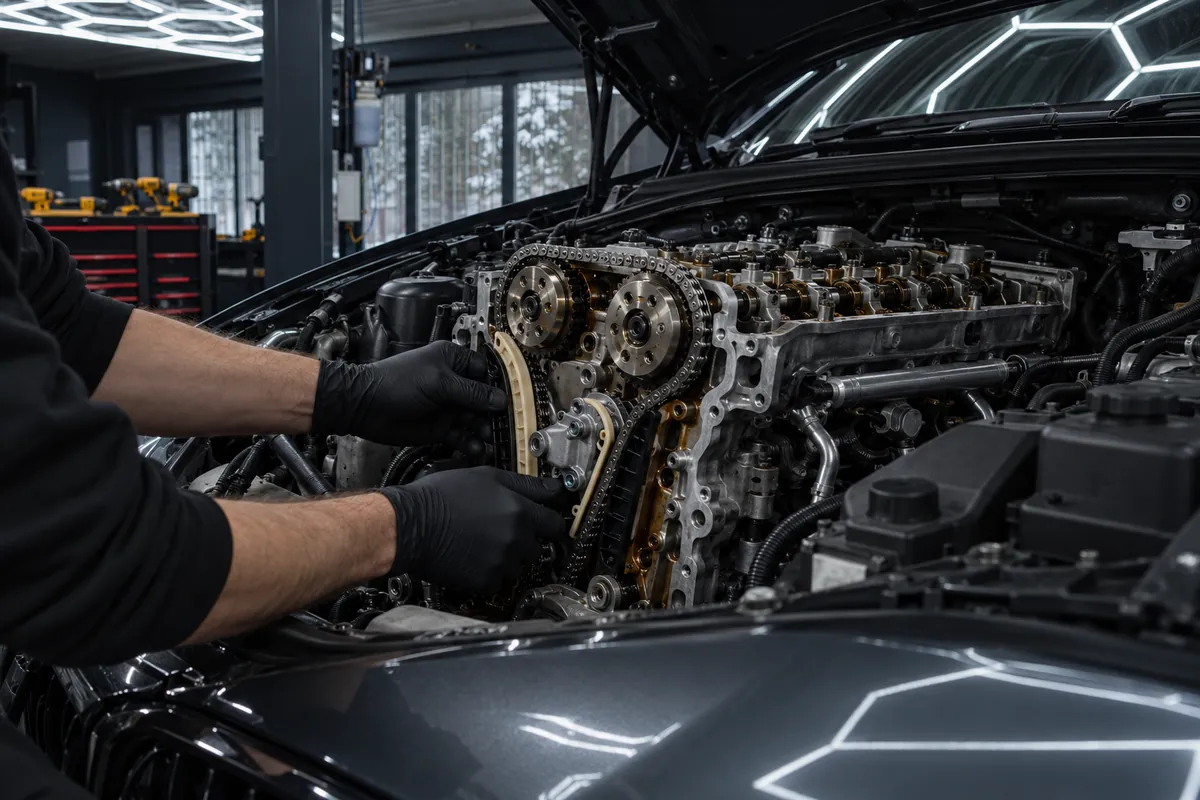
The second well-known issue in first- and second-generation 1.8 and 2.0 TFSI engines is the timing gear. The hydraulic chain tensioner can lose pressure after the engine is switched off, and a stretched chain can jump a tooth on a cold start. Symptoms are rattling for a second or two after start-up, loss of power and camshaft correlation faults (e.g. P0016, P0017). A jumped chain usually ends in serious engine damage. The repair replaces the whole kit — chain, guides, tensioner and sprockets — not just the tensioner. In the third generation the tensioner was improved.
The third generation has weak spots in its ancillaries: a leaking water pump and plastic thermostat housing (slow coolant loss) and the breather diaphragm. On the 2.0 TFSI (including the A4, A5, A6) there were also service campaigns concerning the auxiliary electric coolant pump, which could seize and overheat — the scope depends on the market and model year, so check by VIN with an authorised dealer whether it applies to your car and whether it has been done. All generations can suffer leaks from the covers, coil failures and carbon build-up on the intake valves.
Rattling after a cold start on a TFSI is a signal to have the timing gear checked within a few days.
Older 2.0 TFSI (EA113) and 1.4 TFSI
The 2.0 TFSI EA113 (approx. 2004–2009: A3 8P, A4 B7, A6 C6, TT) has a timing belt and does not have the ring problem known from the EA888. Its typical weak spots are the high-pressure pump cam follower, which wears together with the camshaft lobe (falling fuel pressure, warning light, lack of power), the breather valve — when faulty it increases oil consumption and carbon build-up — and the turbocharger diverter valve.
The 1.4 TFSI in the A3 8P is the older EA111 design with a timing chain that tends to stretch. The newer 1.4 TFSI EA211 (A3 8V, A4 B9) has a timing belt and is clearly better. Its typical issues are coolant leaks from the thermostat housing and water pump, coils, carbon build-up and a rattling turbo wastegate linkage; on some engines from the first years of production increased oil consumption was reported.
The same engines are used in Volkswagens and Skodas — we cover them in more detail in Volkswagen — common faults and weak spots and Skoda — common faults and weak spots.
Petrol V6 — supercharged 3.0 TFSI and 3.2 FSI
The mechanically supercharged 3.0 TFSI (compressor in the V of the engine) is used in, among others, the A4/S4 B8, A5/S5, A6 C6/C7, Q5/SQ5 and Q7 4L. It is a powerful engine with an elaborate cooling system. The most common faults are the thermostat and water pump — on early engines the thermostat could stick and lead to overheating — and leaks, including at the rear timing cover. Add to this the breather valve (changed to a revised one on early versions), coils, carbon build-up and clogged secondary air passages. Oil consumption does occur, but is usually lower than in the second-generation 2.0 TFSI.
The naturally aspirated 3.2 FSI (A4 B8, A5, A6 C6, Q5 8R) has the typical flaws of a direct-injection engine: carbon build-up, broken intake manifold flaps and coils. The timing chains at the back of the engine and the variable valve timing units are an expensive matter — on a V6 any timing job means many hours of labour.
Own a Audi and something worries you?
We check the engine, gearbox, suspension and the fault memory of all control units. Computer diagnostics costs 100 zł, and you get a written quote to approve before any repair.
On the 3.0 TFSI keep an eye on coolant temperature and level. After overheating, it is worth checking the water pump as well when replacing the thermostat.
2.0 TDI diesels — PD, EA189 and EA288
The 2.0 TDI with unit injectors (PD) is mainly found in the A3 8P, A4 B7 and A6 C6 from approx. 2004–2008. The most serious problem concerns versions with balancer shafts (including BLB, BRE, BNA, BPW, BRD): the hexagonal oil pump drive shaft can round off in its socket, and in the worst case oil pressure is lost and the engine or turbocharger seizes. Versions without balancer shafts (e.g. BKD) do not have this problem. Cracking cylinder heads, unit injectors (piezo on the BRD, covered by a service campaign) and the EGR valve are also reported on the PD.
The 2.0 TDI common rail EA189 (approx. 2008–2015: A3 8P, A4 B8, A5, A6, Q5 8R) is regarded as one of the group's better diesels. Typical issues are the EGR and DPF with town driving, the dual-mass flywheel, the turbocharger and, on some engines (reported especially with the CAGA code), internal wear of the high-pressure pump. The EA189 was covered by service campaigns for the exhaust aftertreatment software; some mechanics believe that after the update deposits build up faster in the intake manifold.
The newer 2.0 TDI EA288 (A3 8V, A4 B9, facelifted A6 C7, Q5 FY) has different ailments: a sticking shroud in the water pump (if it stays closed, there is a risk of overheating), leaking hoses and thermostat housing, the EGR cooler, the DPF and the AdBlue system — crystallisation on the injector and failed NOx sensors. The manufacturer specifies a long timing belt interval, but mechanics recommend replacing it at approx. 120,000–150,000 km or every 5–7 years, together with the water pump.
An oil pressure warning light on a 2.0 TDI PD is a reason to switch the engine off immediately and bring the car in on a tow truck.
2.7 and 3.0 TDI V6 — rear-mounted chains, flaps, injectors
The V6 diesels (2.7 and 3.0 TDI) power the A4 B7/B8, A5, A6 C6/C7, Q5 8R and Q7 4L. They are lively and economical, but expensive to repair. The key issue is the timing gear: the chains sit at the back of the engine, on the gearbox side — four on older 3.0 TDIs, two on the updated ones (from approx. 2011–2012). The hydraulic tensioners can lose pressure and the chains stretch. The symptom is a metallic rattle for a few seconds after a cold start; neglect can end with a chain jumping and the valves hitting the pistons. The repair requires taking the gearbox off, so it means many hours of work.
The second typical issue is the swirl flaps in the intake manifolds: worn plastic linkage joints cause fault codes (e.g. P2015, P2011) and rough running. Often replacing the linkages is enough; if the manifold is worn — the manifold itself. On the early 2.7 TDI (BPP), faults with the piezo injectors are reported, and on all versions — the EGR, the DPF with its differential pressure sensor and the turbocharger actuator.
On the newer 3.0 TDI (including the A6 C7) a common fault is a leak from the coolant control valve in the V and from the oil cooler seals, and Euro 6 versions have an AdBlue system with sensors and a dosing module.
On a V6 TDI change the oil every approx. 15,000 km or once a year — it is the cheapest protection for the timing chains.
Gearboxes — multitronic, S tronic, tiptronic and quattro
- Multitronic (CVT, front-wheel drive only: A4 B7/B8, A5, A6 C6/C7): jerking when pulling away and stopping, revs fluctuating at approx. 30–50 km/h, a flashing PRNDS. The control unit, clutches and drive chain (the so-called belt) fail, and old fluid speeds up wear — change it every approx. 60,000 km. Do not tow a car with a failed multitronic on a rope — use a tow truck.
- S tronic DL501 (7-speed, wet clutches, quattro with a longitudinal engine: A4, A5, A6, A7, Q5): the mechatronics fail most often — valves, pressure and speed sensors. Symptoms are a jolt when stopping, a harsh 2-to-1 downshift, slipping, a flashing PRNDS, limp mode, even no reverse. Most reports concern the first years of production. The oil and filter are changed periodically.
- S tronic DQ200 (7-speed, dry clutches, A3 with smaller engines): cracking mechatronics housing, worn clutch, jerking when pulling away. More powerful A3 and S3 versions have wet-clutch gearboxes (including the 6-speed DQ250), considered more durable. More in our article DSG gearbox — symptoms.
- Tiptronic (conventional ZF automatic, including the A6 C6 quattro, Q7, some A4 and Q5): regarded as the most durable choice, provided the fluid is changed — see automatic gearbox oil.
- quattro: on models with a longitudinal engine the drivetrain is durable; at high mileages a worn propshaft centre bearing can occur. On the A3 and TT, quattro means a Haldex clutch, which needs periodic oil changes — see 4x4 drive oil.
A3 8P and 8V — engines, DSG and body
The A3 8P (approx. 2003–2012) is a car in which you will find almost all the engines described above: 1.4 TFSI EA111, second-generation 1.8 and 2.0 TFSI, 2.0 TFSI EA113, 2.0 TDI PD and CR — which is why the engine code matters most when buying. Apart from that, the A/C compressor and sensors fail, ABS module faults occur, and the body, although fairly rust-resistant, most often corrodes on the door edges, sometimes on the front wings and the tailgate.
The A3 8V (approx. 2012–2020) is clearly more durable: the EA211 and third-generation EA888 engines do not have the oil problem on such a scale. Typical issues are the DQ200 gearbox, leaks from the thermostat housing and water pump, the DPF on the 2.0 TDI EA288, freezing infotainment, LED lighting and noises from the front suspension. Service campaigns are also reported for the 8V, including ones concerning the passenger airbag (cars built roughly from July to mid-November 2014) and the rear hubs (some cars from August 2017) — before buying, check by VIN with an authorised dealer whether they apply to the specific car and whether they have been carried out.
A4 and A5 (B8, B9) and Q5 — suspension, electrics, water
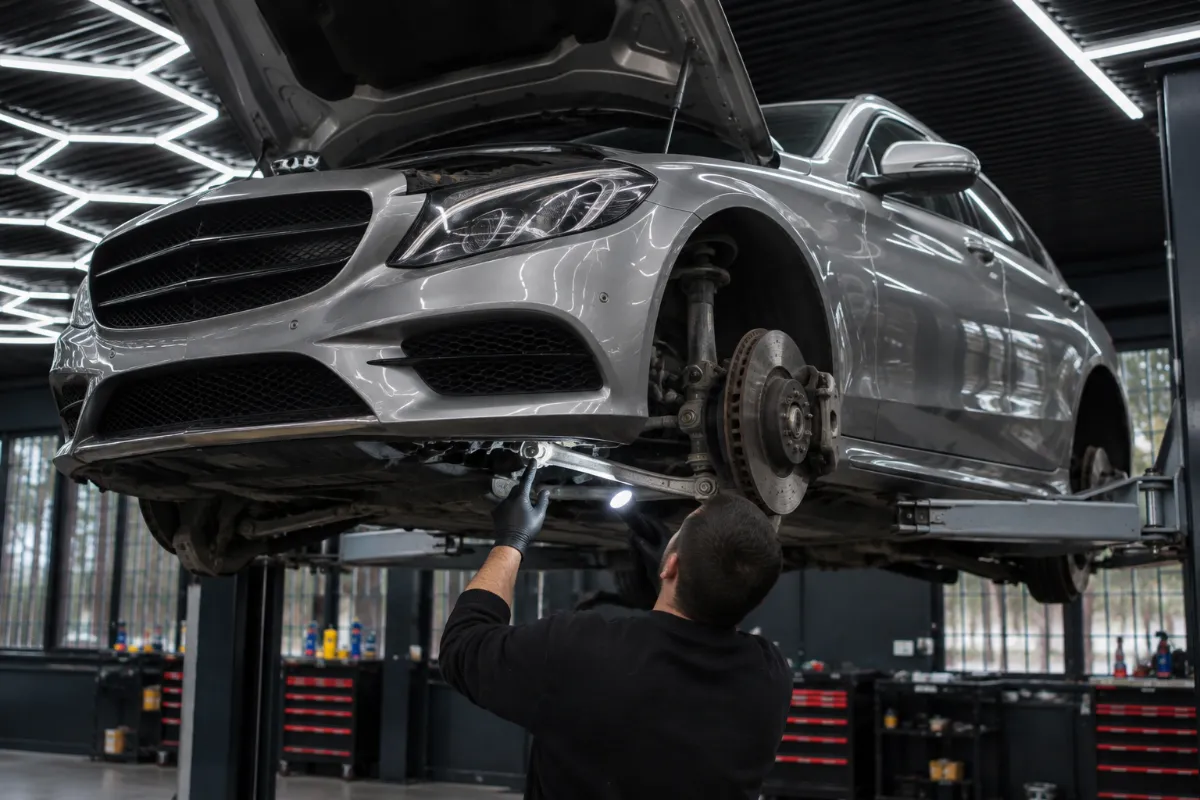
The A4 B8 (approx. 2007–2015) and its twins the A5 and Q5 8R have multi-link front suspension. The bushes and ball joints wear gradually: knocking over bumps, play in the steering, a shaking steering wheel and uneven tyre wear appear. Knocking steering racks are also reported. After replacing control arms the alignment must be set. On the B8 the rear pads and discs wear faster than on many cars, which is linked to the electric parking brake.
Electrical issues on the B8 are mainly about damp and software. Blocked drains under the scuttle and in the sunroof and a leaking tailgate can let water into the boot, where the amplifier and MMI modules sit — symptoms are sound dropouts, MMI restarts and random fault codes. On pre-facelift cars the LEDs in the lights fail, and on the Q5 8R — the LED daytime running light strips. A freezing MMI is often fixed by a software update. The B8 was also subject to a number of service campaigns, including ones concerning the brake servo and airbags — their scope depends on the engine and production date, so check by VIN with an authorised dealer whether the car has had them.
The A4 B9 (from 2015) no longer has the multitronic. Cracking thermostat housings on the 2.0 TFSI, coolant leaks and AdBlue faults on the 2.0 TDI are reported, and on mild hybrid versions from approx. 2017–2019 — an overheating belt starter-generator. Over time play develops in the front control arm bushes.
A6 C6/C7, allroad and Q7 4L — air suspension, MMI and timing
The A6 C6 (approx. 2004–2011) is cheap to buy today but expensive to run. The front suspension has eight control arms, and a full set made of good parts is a considerable expense. The first model years (approx. 2004–2008) had more minor faults. Typical issues are failures of the intake manifold flap motor, window regulators, coils and the variable valve timing units on the 2.8 and 3.2 FSI. The most sensible choice is usually a V6 TDI with tiptronic; the most risk comes with a 2.0 TDI PD with multitronic.
Air suspension on the A6 allroad and Q7 4L is a separate cost category. The compressor, air springs and air struts (rubber cracking, especially in winter) fail, as does the control electronics. Symptoms are the car sitting low on one corner overnight, the compressor running for a long time, hissing and suspension fault messages. A leaking air spring overloads the compressor, so the cause must be fixed, not just the compressor replaced.
On the A6 C7 (2011–2018) and Q7 4L, the 3.0 TDI, 3.0 TFSI and — on the A6 — the S tronic need the most attention. On the Q7 4L, blocked panoramic roof drains, pre-facelift MMI faults and worn control arm bushes are also reported, and on the petrol 4.2 FSI — timing chain tensioners.
Summary table — engine/model, weak spot, symptom, what to do
| Engine / model | Weak spot | Symptom | What to do |
|---|---|---|---|
| 1.8 / 2.0 TFSI EA888 gen. 2 | Rings and pistons | High oil consumption, smoke | Measure consumption, breather, endoscopy |
| 1.8 / 2.0 TFSI EA888 gen. 1–2 | Timing chain and tensioner | Rattle after a cold start | Replace the complete timing kit |
| 2.0 TFSI EA113 | Fuel pump cam follower, breather | Lack of power, engine warning light | Diagnostics, replace parts |
| 3.0 TFSI | Thermostat, water pump | Overheating, leaks | Cooling system diagnostics |
| 2.0 TDI PD (BLB, BRE etc.) | Oil pump drive | Oil pressure warning light | Stop immediately, repair |
| 2.0 TDI EA189 / EA288 | EGR, DPF, water pump, AdBlue | Limp mode, coolant loss | Diagnostics, fix the cause |
| 2.7 / 3.0 TDI V6 | Rear chains and tensioners | Rattle after a cold start | Check and replace the timing chains |
| 2.7 / 3.0 TDI V6 | Swirl flap linkages | Codes P2015/P2011 | Replace linkages or manifold |
| Multitronic | Control unit, clutches, belt | Jerking, flashing PRNDS | Diagnostics, fluid, repair |
| S tronic DL501 / DQ200 | Mechatronics, clutches | Jolts, limp mode | Read fault codes, oil service |
| A4 B8, A5, Q5, A6 | Front control arms and bushes | Knocking, play, tyre wear | Replacement, alignment |
| A6 allroad, Q7 4L | Air suspension | Car sinks overnight | Leak tracing, repair |
The table shows the most common cases. The same symptoms can have different causes, so it is always worth doing diagnostics before ordering parts.
Recognise any of these symptoms?
Don't wait until a small fault turns into an expensive repair. Come to our workshop in Bielany — we will tell you what is urgent and what can wait.
How to look after an Audi so it doesn't break down
- Change the oil more often than Long Life suggests: every approx. 15,000 km or once a year, with oil meeting the VW standard specified for the engine. On TFSI and V6 TDI engines it is the cheapest protection for the timing gear, turbocharger and rings.
- Check the oil level every few fill-ups, especially on 1.8 and 2.0 TFSI engines from 2008–2012. Rising consumption is a signal for diagnostics before the bearing shells suffer.
- Change the automatic gearbox oil: on multitronic and S tronic every approx. 60,000 km, on tiptronic according to mileage and oil condition.
- Keep an eye on the coolant. A slow loss is most often the water pump, thermostat housing or hoses — a small leak is much cheaper than the consequences of overheating.
- Clean the water drains under the scuttle and in the sunroof once a year, preferably in autumn — a simple way to avoid damp in the boot.
- Have the alignment set after any suspension work. Audi's multi-link suspension does not tolerate deviations well — it wears tyres and bushes faster.
Buying a used Audi — checklist
- 1Establish the engine and gearbox codes and the model year by VIN — this determines what to look out for (EA888 gen. 2, 2.0 TDI PD, V6 TDI, multitronic, DL501, DQ200).
- 2Check the service history: oil change intervals, timing replacement, any piston and ring repair on a TFSI, gearbox oil.
- 3Listen to a cold start, ideally after the car has stood for several hours. A rattle lasting a few seconds is a warning sign on TFSI and V6 TDI engines.
- 4Read the fault memory of all control units, including stored faults: valve timing, intake flaps, oil pressure, gearbox, air suspension.
- 5Check the oil and coolant: levels and traces of leaks at the water pump, thermostat and in the V of the engine.
- 6On the test drive pay attention to pulling away and stopping — jolts, slipping and a flashing PRNDS are signs of gearbox problems.
- 7On a lift inspect the control arms, bushes and steering rack; with air suspension check that the car does not sink after standing.
- 8Look under the boot carpet and in the spare wheel well, and check by VIN with an authorised dealer whether service campaigns have been carried out.
We carry out this check as part of our pre-purchase inspection — it is worth doing before signing the contract, not after. On TFSI engines from 2008–2012 and V6 TDIs, a cylinder endoscopy is a good addition.
How we check Audis at Pulsecar
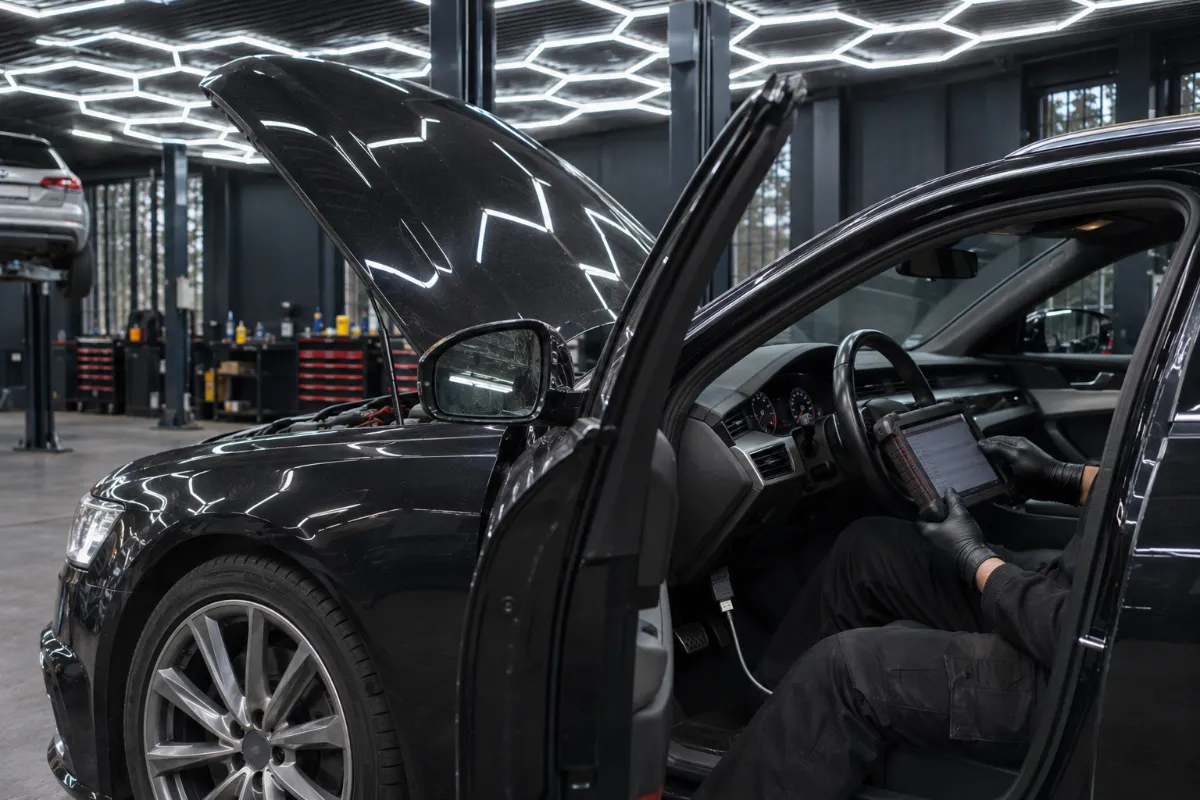
We start with a conversation and computer diagnostics of all control units: we read current and stored faults, valve timing parameters, boost pressure, DPF condition, gearbox adaptations and air suspension data. Then we inspect the car on a lift — oil and coolant leaks, control arms, steering rack, brakes. If needed, we carry out a cylinder endoscopy, e.g. when oil consumption past the rings is suspected.
After diagnosis you receive a written quote, and we only start work once you have approved it. We show you photos of what we found, and during major repairs, e.g. timing work, you may get access to an online camera. Warranty: 6 months on labour; on new parts according to the manufacturer's terms (usually 12–24 months); we give no workshop warranty on parts supplied by the customer. We serve customers in Polish, Ukrainian, Russian, English and Belarusian. You can book a visit online or call: +48 571 058 591.
How much do Audi diagnostics and repairs cost
| Service | Price |
|---|---|
| Computer diagnostics | 100 zł |
| Oil and filter change | 120 zł |
| Wheel alignment (2 axles) | 300 zł |
| Brake pads and discs — front | from 300 zł |
| Control arm replacement | from 200 zł |
| A/C recharge with vacuum test | from 199 zł |
| Engine endoscopy | from 300 zł |
| Pre-purchase inspection | 300 zł |
| Automatic gearbox oil change | from 400 zł |
| Timing chain replacement | from 1000 zł |
| Engine repair / overhaul | from 2000 zł |
These are starting prices from our price list. On an Audi the cost depends heavily on the engine: timing work on a 2.0 TFSI is a different scale of job from the chains on a V6 TDI, where the gearbox has to come off. Repairs of the pistons and rings on the EA888, S tronic mechatronics, the multitronic, flap manifolds or air suspension are priced after diagnosis — the exact amount is always in the quote before work begins. We replace timing gear as part of our timing replacement service.