Škoda — common faults and weak points of the Fabia, Octavia, Superb, Yeti, Kodiaq and other models
Škoda has a reputation for sensible, durable cars, but every model has its weak spots: the timing chain in the 1.2 HTP and older TSI engines, oil consumption in the 1.8 TSI, DSG gearboxes, Haldex and water in the cabin. We go through them model by model.
19 min read · Pulsecar team · updated:
Škoda faults at a glance
Škoda uses Volkswagen Group engines, gearboxes and components, so its weak points largely overlap with VW, Seat and Audi. The most common problems are: a stretching timing chain in the three-cylinder 1.2 HTP (Fabia, Roomster) and in the 1.2 and 1.4 TSI of the older EA111 family (Fabia II, Octavia II, Yeti, Rapid, Superb II), heavy oil consumption in the second-generation 1.8 and 2.0 TSI EA888, ancillaries on TDI diesels (EGR, DPF, injectors, water pump), mechatronics and clutches in DSG gearboxes, and neglected oil in the Haldex coupling on 4x4 versions.
On top of that come faults typical of specific models: water in the cabin when the drains below the windscreen are blocked, minor electrical faults (central locking, infotainment, lighting), anti-roll bar links and control arm bushes. Most of them give warning signs early — a rattle after a cold start, loss of oil or fluid, a jerking gearbox, a wet floor mat. Below we describe them model by model, with a summary table, a checklist and prices.
Which engine and model do you have
| Engine | Type | Models and years, approximate |
|---|---|---|
| 1.2 HTP (6V / 12V, codes incl. AWY, BMD, BBM, BME, BZG, CGPA) | petrol, 3 cylinders, timing chain | Fabia I and II, Roomster (approx. 2001–2014) |
| 1.4 16V / 1.6 MPI | petrol, 4 cylinders, naturally aspirated | Fabia I/II, Octavia I/II, Roomster (until approx. 2013) |
| 1.2 TSI / 1.4 TSI (EA111, incl. CBZA, CBZB) | petrol, turbo, timing chain | Fabia II, Roomster, Octavia II, Yeti, Rapid, Superb II (approx. 2008–2015) |
| 1.8 TSI / 2.0 TSI (EA888 gen. 1–2, incl. CDAA, CDAB, CCZA) | petrol, turbo, timing chain | Octavia II, Superb II, Yeti (approx. 2007–2013) |
| 1.0 / 1.2 / 1.4 / 1.5 TSI (EA211) | petrol, turbo, timing belt | Fabia III/IV, facelifted Rapid, Scala, Octavia III/IV, Superb III, Karoq, Kodiaq (from approx. 2013–2015) |
| 1.8 / 2.0 TSI (EA888 gen. 3) | petrol, turbo, timing chain | Octavia III RS, Superb III, Kodiaq, Karoq (from approx. 2013) |
| 1.4 TDI PD / 1.9 TDI PD / 2.0 TDI PD | diesel, unit injectors, timing belt | Fabia I/II, Roomster, Octavia I/II, Superb I/II (until approx. 2010) |
| 1.6 / 2.0 TDI CR (EA189) | diesel, common rail, timing belt | Fabia II, Roomster, Octavia II, Superb II, Yeti, Rapid (approx. 2009–2015) |
| 1.6 / 2.0 TDI (EA288) | diesel, common rail, timing belt | Octavia III/IV, Superb III, Rapid, Karoq, Kodiaq (from approx. 2013) |
The years are approximate — they depend on the market, power output and version, and in some models older and newer engines were sold side by side. You will find the engine code on the sticker in the boot (usually near the spare wheel), in the VIN data (see checking a car by VIN), or we can read it during computer diagnostics. This matters especially with the 1.2 and 1.4 TSI, where the same displacement means two completely different engines: the older one with a chain (EA111) and the newer one with a belt (EA211).
Škoda in our workshop — what the data says
Based on jobs completed at Pulsecar from January to October 2026: Škoda accounts for about 4.8% of the cars we serviced, roughly one car in twenty in the workshop. Among all makes it ranks eighth by number of cars.
Because Škoda shares engines and gearboxes with Volkswagen and Audi, you will find the technical details of the VAG engines themselves in the articles Volkswagen — common faults and weak points and Audi — common faults and weak points. Here we focus on what concerns specific Škoda models.
Fabia I and II, Roomster — 1.2 HTP and 1.4 TDI PD
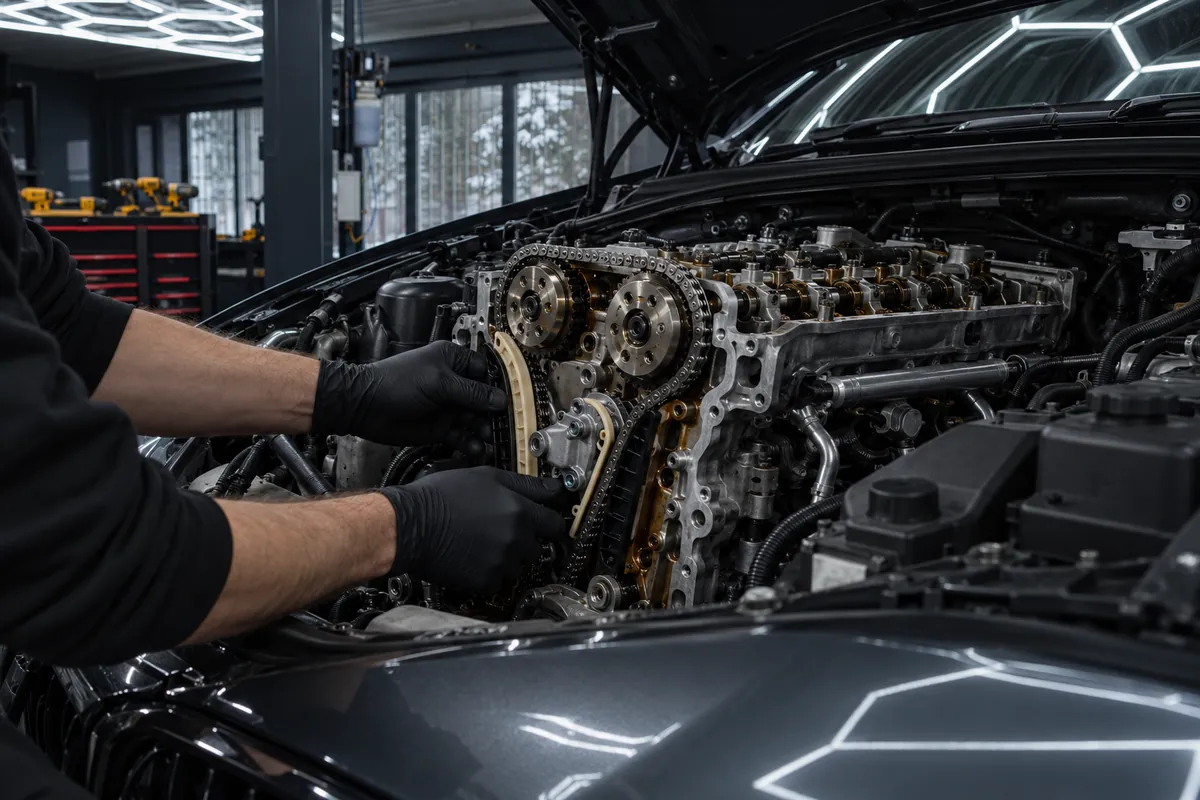
The three-cylinder 1.2 HTP (6-valve and 12-valve versions) is the most popular engine in older Fabias and the Roomster — and also the one you need to watch most closely. The camshafts are driven by a chain, which in this engine can stretch, especially when the oil is changed infrequently. Symptoms are a rattle for a few seconds after a cold start and rough running. A neglected chain can jump teeth, and then the valves hit the pistons.
The second weak point of the 1.2 HTP is burnt valve seats and cylinder head damage — they cause loss of compression, shaking at idle and misfires. Ignition coils also often fail (each cylinder has its own).
In the four-cylinder 1.4 16V you may come across a freezing crankcase breather (especially in winter on short trips), ticking hydraulic tappets and ignition module failures. In the three-cylinder 1.4 TDI PD diesel (Fabia, Roomster), crankshaft end float is reported at high mileage, and it cannot be corrected without major engine work — worth checking when buying.
If a Fabia or Roomster with the 1.2 HTP rattles after a cold start or runs unevenly, start with a timing diagnosis and a compression test rather than replacing yet another coil.
1.2 TSI and 1.4 TSI (EA111) — timing chain in the Fabia, Octavia, Yeti and Rapid
The older 1.2 TSI engines (from 2009–2010, codes incl. CBZA and CBZB) and the 1.4 TSI of the EA111 family went into the Fabia II, Roomster, Octavia II, Yeti, Superb II and the pre-facelift Rapid. Their known weakness is the timing chain: it stretches, the guides wear and the tensioner loses effectiveness. The typical symptom is a loud rattle for a moment after a cold start. The manufacturer revised the tensioner and timing components, and the problem occurs less often in the updated versions, but with a car of unknown history you should assume the timing needs checking. The whole kit is replaced — chain, guides, tensioner and sprockets — not just the chain.
Older TSI engines (especially the 1.4 TSI) can also suffer from excessive oil consumption. Long oil change intervals accelerate timing wear. The 1.2 TSI is also not well suited to an LPG conversion.
The switch to the new EA211 family with a timing belt happened around 2013–2015, depending on the model: the Octavia III had the EA211 from the start of production (2013), while the Rapid got the new engines with the facelift in 2015. That is why you should always check the engine code on cars from those years. We describe the technical details of the EA111 engines, shared with Volkswagen, in the article Volkswagen — common faults and weak points.
A rattle after a cold start on a 1.2 or 1.4 TSI EA111 (with a chain) is a signal to have the chain checked soon, not to “keep an eye on it”.
1.8 TSI and 2.0 TSI (EA888) — oil consumption in the Octavia, Superb and Yeti
The 1.8 TSI is the punchy engine of the Octavia II, Superb II and Yeti (incl. CDAA and CDAB), while the 2.0 TSI (e.g. CCZA) can be found in the Superb II. Their biggest problem concerns the second-generation EA888 (from 2008; especially 1.8 TSI engines with codes starting with “CD”): badly designed rings and pistons cause heavy oil consumption — in extreme cases over 1 litre per 1,000 km. High oil consumption is also reported in older 2.0 TSI engines from this period. The symptom is frequent topping up, and a severe oil shortage risks engine damage.
The repair usually involves replacing the pistons and rings with newer, revised ones (from late third-generation production), with thorough cleaning of the oil passages. It is a big and expensive job, so when buying it is worth asking for the invoice for such a repair. In these engines you also need to watch the timing chain (it can stretch, though less often than in the 1.4 TSI), the water pump and thermostat (coolant leaks) and the crankcase breather.
The third-generation EA888 (in Škodas from around 2012–2013, incl. the Octavia III RS, Superb III, Kodiaq) largely solved the oil consumption problem, though isolated cases still occur. How to measure oil consumption and when to worry is covered in the article oil consumption — engine burning oil.
When buying an Octavia II, Superb II or Yeti with the 1.8 TSI, check the oil level on a cold engine and ask the seller how much they top up between changes.
Newer EA211 petrol engines — 1.0, 1.2, 1.4 and 1.5 TSI
EA211 engines (from around 2013–2015) are found in the Fabia III and IV, Scala, facelifted Rapid, Octavia III and IV, Superb III, Karoq and Kodiaq. They have a timing belt instead of a chain and are noticeably less troublesome than the EA111. The manufacturer does not give a fixed belt replacement interval — it recommends inspections at high mileage — but many mechanics advise checking it earlier, at around 120,000–150,000 km, especially in fleet cars.
Typical EA211 faults are leaks from the water pump module and thermostat housing (the plastic parts deform over time), carbon build-up on the intake valves in the 1.4 and 1.5 TSI with short-distance driving (loss of power, misfires), coils and spark plugs, and sometimes higher oil consumption. In the three-cylinder 1.0 TSI (Fabia, Scala, Kamiq, Octavia IV, Karoq), play in the turbocharger wastegate linkage is reported — a rattle when cold and an underboost fault code.
The 1.5 TSI with cylinder deactivation (ACT) can develop vibrations when switching between two- and four-cylinder operation, and in some versions with a manual gearbox owners reported difficulty pulling away — a software update helped, though not always. Overall the EA211 is a good choice provided the oil is changed regularly — every 15,000 km or once a year rather than on Long Life.
Own a Škoda and something worries you?
We check the engine, gearbox, suspension and the fault memory of all control units. Computer diagnostics costs 100 zł, and you get a written quote to approve before any repair.
TDI diesels — from the 1.9 PD to the 2.0 TDI EA288
The 1.9 TDI PD with unit injectors is a classic in the Fabia, Octavia I/II, Superb and Roomster. It is considered very durable, but at high mileage the unit injectors and turbocharger wear, and in some variants (incl. BXE and BLS) big-end bearing failures have been reported. The 2.0 TDI PD in the Octavia II and Superb II (incl. BKD and BMN) has a known tendency to crack its cylinder head — the warning signs are disappearing coolant and rough running.
The 1.6 and 2.0 TDI CR (EA189, approx. 2009–2015) in the Fabia II, Roomster, Octavia II, Superb II, Yeti and Rapid were covered by an emissions-related service campaign (a software update — it is worth checking by VIN whether it was done). Their weak points are the injectors, the EGR valve, the DPF in city driving, the variable-geometry turbocharger in the 1.6 TDI and a faster-wearing water pump in the 1.6 TDI.
The newer 1.6 and 2.0 TDI EA288 (Octavia III/IV, Superb III, Karoq, Kodiaq) most often cause trouble with the cooling system: a sticking shroud in the water pump, leaks from the intercooler integrated into the intake manifold and from the EGR cooler — hard to spot, because the coolant is lost slowly. In early examples timing belts were reported to snap, often preceded by a pump failure. On top of that come the DPF and the AdBlue system (pump, module, injector), a fault in which can, after a while, prevent the engine from being restarted.
On EA288 diesels check the coolant level regularly. A slow loss with no visible puddle is a signal for diagnostics before overheating or a pump and belt failure occurs.
DSG gearboxes — dry DQ200 versus wet DQ250 and DQ381
In Škodas you will come across two main types of dual-clutch gearbox. The seven-speed DQ200 with dry clutches (torque limit approx. 250 Nm) is paired with less powerful engines: the 1.0, 1.2, 1.4 and 1.5 TSI and the 1.6 TDI — incl. in the Fabia, Rapid, Scala, Octavia and Yeti. The wet DQ250 (6 speeds), DQ381 and DQ500 (7 speeds) went into the more powerful versions: 2.0 TDI, 2.0 TSI, Octavia RS, Superb, Kodiaq and Karoq 4x4.
The DQ200 has two typical weaknesses. The first is the mechatronics — the aluminium pressure accumulator housing can crack, pressure drops, and you get jerking, delayed gear changes, a flashing letter on the display and limp mode. The second is the clutches: in a car driven mostly in town they can wear out much sooner than in one used mainly on long runs. The symptom is judder and jerking when pulling away, especially when cold and in traffic jams. The manufacturer does not specify periodic oil changes for the DQ200.
Wet gearboxes are tougher but very sensitive to neglected oil. In the DQ250 it is changed every 60,000 km, and for the DQ381 the manufacturer specifies a change every 120,000 km — with mostly city driving or towing it is worth doing it earlier. The most common failures are the mechatronics and worn clutches, usually in cars with no oil change history or ones that often tow a trailer. On Octavia II and Superb II cars with the six-speed DSG built around 2008–2009, a service campaign was carried out — the gearbox control unit could misread the clutch temperature; for a car from those years it is worth checking by VIN whether it was done. We describe the symptoms in detail in the article DSG gearbox — symptoms.
Haldex 4x4 drive — Octavia, Superb, Yeti, Kodiaq and Karoq
The 4x4 versions of the Octavia, Superb, Yeti, Kodiaq and Karoq have on-demand rear-axle drive with a Haldex coupling. The system is considered reliable, but it has one typical ailment: sludge builds up in old oil, clogging the filter and disrupting the coupling pump. The rear axle then stops being driven, and the driver often only notices it in snow.
That is why it is worth changing the Haldex oil (and on older generations also the filter) regularly — usually every 2–3 years, depending on the generation — and always after buying a car without documented servicing. In cars with very high mileage, especially ones that often tow a trailer, rear differential problems also occur. You can read more about servicing the drive in the article 4x4 drive — Haldex oil.
Water in the cabin — what to check
- Drains below the windscreen (scuttle). Leaves and pine needles block the drain holes under the plastic cover by the wipers. Water then reaches the cabin filter housing and ends up under the floor mat. A wet cabin filter clogged with leaves is a typical sign.
- Air-conditioning condensate drain. When it is blocked or has slipped off, water drips into the cabin on the passenger side — usually only with the air conditioning switched on.
- Sunroof and panoramic roof drains. Tubes in the pillars that have slipped off or become clogged leave water on the front floor (incl. the Octavia, Karoq).
- Seals and spare wheel well. In some Fabias and Karoqs water in the spare wheel well is reported, and leaking door seals can let water onto the rear floor.
- Consequences. Moisture under the carpet harms the wiring looms and connectors under the floor, which can cause random electrical faults.
Electrics and air conditioning — model by model
- Fabia II and Roomster: reported failures of the heating and ventilation control unit, minor electrical faults, central locking motors, especially in the tailgate.
- Octavia II: a third brake light that often lets water in and stops working as a result, xenon headlight levelling faults, rear lighting failures.
- Superb II: reported broken wires in the door wiring looms — central locking, windows or the Twindoor tailgate mechanism not working.
- Octavia III and Superb III: freezing infotainment (a software update usually helps), window switch panels, cameras, tailgate actuators.
- Newer models (Fabia IV, Scala, Octavia IV, Kodiaq, Karoq): infotainment software bugs and phone connectivity issues, calibration of the driver-assistance camera after windscreen replacement, and on the pre-facelift Kodiaq — condensation forming inside the LED headlights.
- Rapid and other models: air-conditioning compressor clutch failures — often just the clutch can be replaced instead of the whole compressor.
- All models: a weak battery — in ADAC statistics a frequent reason for roadside assistance call-outs, incl. for the Kodiaq, Yeti and Superb II.
With air conditioning we first check for leaks and the amount of refrigerant, then the compressor and its clutch — usually a cheaper route than replacing the whole system by trial and error.
Suspension, bearings and corrosion
- Octavia III: fast-wearing anti-roll bar links and front control arm bushes — they can often be replaced without replacing the whole arm. Lower-powered versions have a torsion beam at the rear, more powerful ones multi-link suspension, which is more expensive to maintain.
- Superb III and Kodiaq: worn control arm bushes (on the Superb with DCC adaptive suspension in early model years — the rear control arm bushes), more expensive DCC dampers. Rear brake problems are also reported on the Kodiaq.
- Rapid: ADAC reports point to the springs and shock absorbers. Roomster: mainly the front suspension components wear, the rear beam is durable.
- Octavia II: suspension springs, shock absorbers and brake discs are items frequently flagged in German TÜV reports.
- Rear wheel bearings: on a small batch of Octavia III and Superb III cars from the 2018 model year a campaign was carried out to replace the rear bearing housings. A noise that rises with speed is a signal to have the bearing checked.
- Corrosion: Škodas generally resist rust well. It is worth inspecting the tailgate on the Octavia II (around the number plate lights), the rear control arms on the Yeti and, on the Superb III, the area around the tailgate gas strut mountings.
Bodywork and paint repairs are not our speciality — but we check the condition of the underbody on a lift and tell you where corrosion needs attention.
Summary table — engine/model, weak point, symptom, what to do
| Engine / model | Weak point | Symptom | What to do |
|---|---|---|---|
| 1.2 HTP (Fabia, Roomster) | Timing chain, valve seats | Rattle after start-up, rough running | Timing check, compression test |
| 1.4 TDI PD (Fabia, Roomster) | Crankshaft end float | Reported at high mileage | Check end float before buying |
| 1.2 / 1.4 TSI EA111 | Chain and tensioner | Rattle on a cold engine | Replace the complete timing kit |
| 1.8 / 2.0 TSI EA888 gen. 2 | Rings and pistons | Heavy oil consumption, smoke | Measure consumption, piston repair |
| 1.0 TSI | Turbo wastegate linkage | Rattle, boost fault code | Diagnostics, actuator repair |
| 1.4 / 1.5 TSI EA211 | Water pump and thermostat, carbon build-up | Coolant loss, misfires | Cooling system check, intake cleaning |
| 1.9 / 2.0 TDI PD | Big-end bearings, unit injectors, 2.0 cylinder head | Knocking, coolant loss | Diagnostics, coolant check |
| 1.6 / 2.0 TDI CR (EA189) | EGR, injectors, DPF | Loss of power, limp mode | Diagnostics, campaign check by VIN |
| 1.6 / 2.0 TDI EA288 | Water pump, coolers, AdBlue | Coolant loss, AdBlue warning | Cooling and SCR diagnostics |
| DSG DQ200 | Pressure accumulator, clutches | Jerking when pulling away, limp mode | Diagnostics, mechatronics repair |
| DSG DQ250 / DQ381 | Oil, mechatronics | Jerking, delayed gear changes | Oil per schedule (DQ250 every 60,000 km) |
| Haldex 4x4 | Sludge in the oil, pump | No drive to the rear axle | Oil and filter change |
| Octavia, Superb, Fabia | Drains below the windscreen | Wet floor mat, damp cabin filter | Clear the drains |
The same symptom can have different causes, so it is always worth running diagnostics before buying parts.
Recognise any of these symptoms?
Don't wait until a small fault turns into an expensive repair. Come to our workshop in Bielany — we will tell you what is urgent and what can wait.
How to look after a Škoda
- Oil more often than on Long Life: every 15,000 km or so or once a year, always meeting the VW specification in the handbook. In engines with a chain (1.2 HTP, EA111, EA888) this is the foundation of a durable timing drive.
- Check the oil level every few fill-ups, especially in the 1.8 and 2.0 TSI and the older 1.2 and 1.4 TSI.
- Timing on time. On diesels and the EA211, replace the belt with the rollers and water pump according to schedule, and if the history is unknown — straight after purchase. More in the article timing replacement — symptoms and price.
- In wet DSGs change the oil according to schedule — in the DQ250 every 60,000 km, in the DQ381 every 120,000 km at the latest — and in the Haldex every 2–3 years.
- Take a longer trip every now and then — it helps diesels burn off the DPF and limits carbon build-up in TSI petrol engines.
- In autumn clear leaves from the scuttle and check that it is dry under the floor mats.
- Look after the battery — in Škodas with Start-Stop and extensive electronics a weak battery can mimic other faults.
Buying a used Škoda — checklist
- 1Establish the engine code and model year by VIN — check whether a 1.2 or 1.4 TSI is the older EA111 with a chain or the newer EA211 with a belt.
- 2Check the service history: oil change intervals, timing, DSG oil and Haldex oil.
- 3Listen to a cold start — a rattle on the 1.2 HTP, 1.2/1.4 TSI or 1.8 TSI is a warning sign.
- 4Check the oil level and ask about topping up; on the 1.8 TSI ask for the invoice for any piston repair.
- 5Read the fault codes from all control units — engine, gearbox, ABS, airbags, air conditioning and comfort.
- 6On the test drive check the DSG cold and warm: pulling away without judder, smooth gear changes, no flashing indicator.
- 7Look under the floor mats and in the spare wheel well — moisture means blocked drains or leaks.
- 8On diesels check the coolant and the condition of the DPF and AdBlue system; on 4x4 cars — whether the rear-axle drive works.
- 9Inspect the car on a lift: leaks, control arm bushes, anti-roll bar links, bearings.
- 10Check with an authorised dealer by VIN whether service campaigns have been carried out (e.g. the emissions update on the EA189, eCall on the Octavia IV from 2019–2020).
We carry out this kind of check as part of our pre-purchase inspection. Manufacturer service campaigns are carried out free of charge by authorised dealers — it is worth knowing whether they have been done before you buy the car.
How we check a Škoda at Pulsecar
We start with a conversation and computer diagnostics of all control units: we read current and stored fault codes, timing and boost parameters, DSG gearbox adaptations, DPF condition, battery voltage and Haldex coupling operation. Then we inspect the car on a lift — oil and coolant leaks, timing, suspension, the drains below the windscreen. If needed, we carry out a compression test or cylinder endoscopy.
After diagnosis you receive a written quote, and we only start work once you have approved it. We show you photos of what we found, and for larger repairs, e.g. timing, you can get access to an online camera. Warranty: 6 months on labour, on new parts according to the manufacturer's terms (usually 12–24 months); we give no workshop warranty on parts supplied by the customer. We serve customers in Polish, Ukrainian, Russian, English and Belarusian. You can book an appointment online or call: +48 571 058 591.
How much Škoda diagnostics and repairs cost
| Service | Price |
|---|---|
| Computer diagnostics | 100 zł |
| Oil and filter change | 120 zł |
| Cabin filter | 40 zł |
| Air-conditioning recharge with leak test | from 199 zł |
| Coolant change | from 200 zł |
| Engine endoscopy | from 300 zł |
| Pre-purchase inspection | 300 zł |
| Automatic gearbox oil change | from 400 zł |
| Timing belt replacement | from 600 zł |
| Clutch replacement | from 600 zł |
| Timing chain replacement | from 1000 zł |
These are starting prices from our price list. The final amount depends on the engine and parts — e.g. the timing on a 1.4 TSI EA111 is more work than on a simple naturally aspirated engine. Repairs to the DSG mechatronics, pistons in the 1.8 TSI, the Haldex coupling or the AdBlue system are priced after diagnosis — the exact amount is always in the quote before work begins. We replace timing chains and belts as part of our timing replacement service.