Ford — common faults and weak spots in engines, gearboxes and chassis
Fords handle well and are cheap to run, but have known weak spots: the timing belt running in oil in the 1.0 EcoBoost, overheating in the 1.6 EcoBoost, the turbo in the 1.6 TDCi and the PowerShift gearbox. We cover them engine by engine and model by model.
19 min read · Pulsecar team · updated:
Ford faults at a glance
Fords from the last fifteen years or so are comfortable, handle well and have relatively cheap parts, but almost every engine has its own well-known weak spot. In the petrol 1.0 EcoBoost it is the timing belt running in oil and the cooling system; in the 1.6 EcoBoost, localised overheating of the cylinder head (covered by a recall); in the 1.6 TDCi, seized turbochargers caused by contaminated oil; in the 2.0 TDCi and 2.2 TDCi, the dual-mass flywheel, the DPF and the turbo actuator; and in the newer 2.0 EcoBlue, once again a belt in oil, the injectors and AdBlue. On top of that come the PowerShift gearbox, the multi-link rear suspension and corrosion on older Focuses.
Most of these faults give warning signs early on: coolant loss, the oil pressure warning light, judder when pulling away, a whistling turbo, a rising oil level in a diesel. Below we cover the engines, gearboxes and models, and at the end you will find a summary table, a pre-purchase checklist and prices.
Which engine and model do you have
| Engine | Type | Models and years, approximate |
|---|---|---|
| 1.0 EcoBoost | petrol, 3 cylinders, turbo, timing belt in oil (newer versions: chain) | Fiesta, Focus, B-Max, C-Max, Mondeo, EcoSport, Courier, Puma (from c. 2012) |
| 1.5 / 1.6 EcoBoost | petrol, 4 cylinders, turbo, direct injection | Focus, C-Max, Kuga, Mondeo, S-Max, Galaxy, Fiesta ST (c. 2010–2019) |
| 1.6 Ti-VCT | petrol, 4 cylinders, naturally aspirated, timing belt | Focus II and III, C-Max, Fiesta, Mondeo (c. 2004–2018) |
| 1.8 / 2.0 Duratec HE | petrol, 4 cylinders, timing chain | Focus II, C-Max I, Mondeo III and IV, S-Max, Galaxy (c. 2000–2015, depending on model) |
| 1.6 TDCi / 1.5 TDCi | diesel, 4 cylinders | Fiesta, Focus, C-Max, Kuga, Mondeo (1.6 c. 2004–2015, 1.5 from c. 2014) |
| 2.0 TDCi (Duratorq) | diesel, 4 cylinders | Focus, C-Max, Mondeo IV and V, S-Max, Galaxy, Kuga (c. 2004–2018, depending on model) |
| 2.2 TDCi | diesel, 4 cylinders, timing chain | Transit, Transit Custom (c. 2006–2016) |
| 2.0 EcoBlue / 1.5 EcoBlue | diesel, 4 cylinders, Euro 6 with AdBlue | Transit, Transit Custom (from 2016), Mondeo V, Kuga III, Focus IV |
| 2.0 Hybrid / 2.5 PHEV / 1.0 mHEV | hybrid / plug-in hybrid / mild hybrid | Mondeo V Hybrid, Kuga III PHEV, Focus IV and Puma mHEV |
Years and models are approximate — the same model had different engines depending on model year, market and power output. You can find the exact engine code from the car's VIN data (see checking a car by VIN), on the identification plate or during computer diagnostics. With a Ford this matters a lot: for example, a 1.0 EcoBoost from different years may have either a timing belt or a timing chain.
Ford in our workshop — what the data says
Based on jobs completed at Pulsecar from January to October 2026: Ford accounts for 5.0% of the cars we serviced, or roughly one car in twenty in the workshop. Among all makes it ranks seventh.
Our data has no separate breakdown of jobs for Ford, so we do not give one. The weak spots described below come from the manufacturer's recalls, reports and the experience of owners and mechanics — and in the workshop we always start by diagnosing the specific car.
1.0 EcoBoost — timing belt in oil, oil pump and cooling
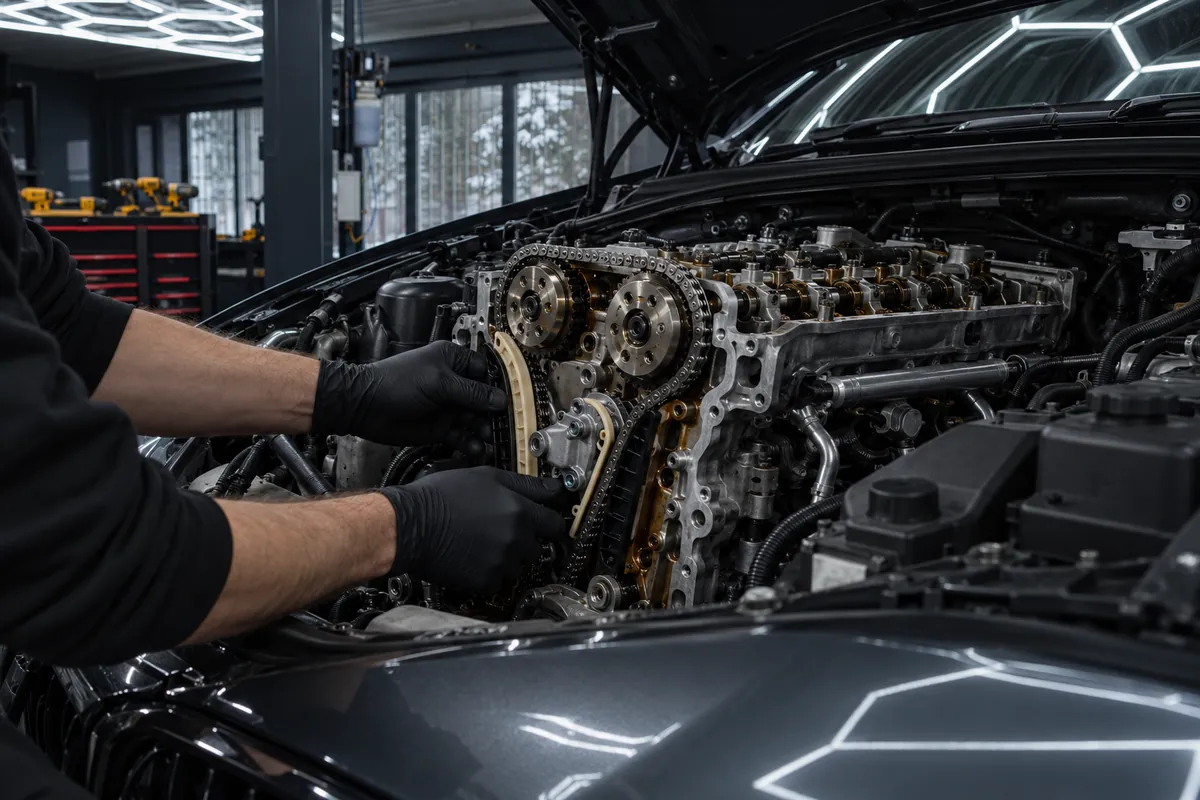
The three-cylinder 1.0 EcoBoost (most often 100 or 125 hp, later also 140 hp) is the most popular petrol Ford of recent years. In the first generation the camshafts are driven by a belt running in an oil bath, and the oil pump by a second, smaller belt, also in oil. Over time the rubber ages and fragments of it end up in the sump, where they can block the oil pump pickup strainer. The result is a drop in oil pressure, a seized turbocharger and, in the worst case, a seized engine. Such failures are being investigated by, among others, the US agency NHTSA.
The manufacturer quotes an interval of around 10 years or 200,000–240,000 km (depending on version), but many mechanics recommend replacing it earlier, usually at around 100,000–120,000 km, and even sooner with town driving and neglected oil. In newer versions (according to some sources from late 2018, depending on model and version) the camshafts are driven by a chain, but the oil pump still has a belt in oil — so the first step is to identify the engine version. Warning signs are the oil pressure warning light, rough running, rattling and rubber particles in the oil filter at an oil change.
The second group of problems is cooling. On cars built from October 2011 to October 2013 (including the Focus and Fiesta), a rigid plastic coolant bleed hose could crack, leading to engine overheating. Under a recall Ford replaced the hose and fitted a coolant level sensor with a warning. Expansion tanks also crack, and overheating can end in a cracked cylinder head — the symptom is coolant loss with no visible leak and white smoke while warming up. Add to that leaks from under the plastic rocker cover, carbon build-up on the intake valves and wear in the high-pressure fuel pump drive (jerking, loss of power).
In the 1.0 EcoBoost the oil is part of the timing drive. Use oil that meets exactly the Ford specification in the handbook, change it every 10,000–15,000 km or so and check the coolant level every few fill-ups. If you do not know when the belt was last replaced, have it done after you buy the car.
1.5 and 1.6 EcoBoost — cylinder head overheating and recalls
The four-cylinder 1.6 EcoBoost (Focus, C-Max, Kuga, Mondeo, S-Max, Galaxy, Fiesta ST, Transit Connect) has a known cooling system flaw: when the coolant level is too low, the cylinder head can overheat locally and crack, and pressurised oil can leak onto hot engine parts — with a risk of fire. Ford ran recalls for cars with the 1.6 EcoBoost built in roughly 2010–2014 (the exact scope depends on the model): in 2018 they covered the Fiesta ST, Focus, C-Max, Kuga and Transit Connect, and in 2021 they were extended to the Mondeo, S-Max and Galaxy. According to information provided to the Polish consumer protection office UOKiK, a total of about 5 thousand cars in Poland were identified in the two campaigns. The fix is a coolant level sensor and a software update, so that the car warns the driver when the coolant level is too low.
Apart from cooling, the 1.6 EcoBoost is reported to suffer from a sticking turbocharger wastegate actuator, cracked turbine housings, carbon build-up on the intake valves and wear in the high-pressure pump drive. The newer 1.5 EcoBoost is considered less troublesome, but here too some owners report slow coolant loss. In the USA a class action has been filed alleging that in the 1.5, 1.6 and 2.0 EcoBoost engines coolant can get into the cylinders — these are allegations, not a confirmed defect or a recall in Europe. Any unexplained coolant loss in these engines needs diagnosis. If the problem concerns boost, we describe the symptoms in the article turbocharger — symptoms of failure.
Have a 1.6 EcoBoost from 2010–2014? Check with an authorised dealer by VIN whether the coolant level sensor recall has been carried out. It is free, and the sensor warns you in time of a drop in coolant level that could otherwise end in a very expensive cylinder head repair.
Naturally aspirated petrol engines — 1.6 Ti-VCT and 2.0 Duratec HE
The 1.6 Ti-VCT with port injection is the simplest and one of the least troublesome Ford engines — a good choice if you want peace of mind. It has a timing belt; the manufacturer quotes an interval of up to 180,000 km (depending on model year), but it is better to replace it earlier. The Ti-VCT variable valve timing units are not particularly failure-prone if the oil is changed regularly — with long intervals you get loss of power and timing errors. There are also engine control unit faults (a software update usually helps) and lambda sensor faults. With an LPG conversion it is worth protecting the valve seats.
The 1.8 and 2.0 Duratec HE (a Mazda design) in the Focus II, C-Max, Mondeo III and IV, S-Max and Galaxy has a timing chain and is considered durable. Its typical weak spots are the thermostat, which is reported as a common fault after around 90,000 km (the engine fails to warm up or overheats), a leaking rocker cover and a valve in the intake manifold, which turns on the engine warning light and may limit revs.
1.6 TDCi and 1.5 TDCi — injector washers and the turbocharger
The 1.6 TDCi is a diesel developed jointly with the PSA group (sold in Peugeots and Citroëns as the 1.6 HDi). Its best-known flaw starts with something small: the copper washers under the injectors stop sealing, combustion gases blow past into the cylinder head and carbon gets into the oil. The contaminated oil blocks the strainer in the turbocharger oil feed pipe, the turbo gets too little lubrication and its bearings seize. Earlier symptoms are hissing or “chuffing” at the injectors, a smell of exhaust in the engine bay and black deposits in the oil.
With this kind of failure, replacing the turbocharger alone is not enough — the new one will soon fail. You also need to clean or replace the sump and the oil pickup, the turbo oil feed pipe with its strainer, the intercooler and the injector washers. Beyond that, the 1.6 TDCi can suffer from a clogged EGR valve, a DPF that struggles with town driving, a dual-mass flywheel failing at around 120,000–180,000 km, a smell of fuel in the cabin from leaking injector seals and a clutch pedal that sinks to the floor (master or slave cylinder). The Fiesta Mk7 had a recall for the glow plug control unit.
The 1.5 TDCi, which replaced the 1.6 TDCi around 2014, has a better reputation and does not have such a recurring, characteristic flaw. In both engines with the 6-speed manual gearbox, whining gearbox bearings can occur, audible when accelerating and on engine braking.
Own a Ford and something worries you?
We check the engine, gearbox, suspension and the fault memory of all control units. Computer diagnostics costs 100 zł, and you get a written quote to approve before any repair.
On a 1.6 TDCi change the oil every 10,000 km or so and look around the injectors at every service. Replacing the washers in time costs many times less than replacing the turbo and cleaning the lubrication system.
2.0 TDCi and 2.2 TDCi — dual-mass flywheel, DPF and turbo actuator
The 2.0 TDCi (Duratorq) is the core diesel of the Mondeo, S-Max, Galaxy, Kuga, C-Max and Focus. The engine itself is durable; the weak spots are in the ancillaries. The dual-mass flywheel on manual cars usually wears out at 120,000–170,000 km (in the heavy S-Max and Galaxy sometimes earlier) — the symptom is rattling at idle and vibration through the clutch pedal (more in the article dual-mass flywheel — symptoms). The DPF clogs on short journeys, and interrupted regenerations dilute the oil with fuel — an oil level clearly above the maximum is a warning sign when buying.
A common problem is a variable-geometry turbocharger actuator seized with carbon — the car goes into limp mode and boost pressure faults are stored. Add to that the EGR valve, the injector washers (as on the 1.6 TDCi), injectors wearing out at high mileage and the timing belt, which mechanics advise replacing before 160,000 km.
The 2.2 TDCi in the Transit and Transit Custom (up to around 2016) has a timing chain, which rarely stretches and usually only at very high mileage. What fails most often is the turbo actuator (reduced power, a flashing glow plug light), the DPF with its fuel vaporiser, the injectors after around 100,000 km, the EGR, the dual-mass flywheel and the 1st and 2nd gear synchromesh (the gear jumps out under load). Some Transit Customs built around the turn of 2014 and 2015 were covered by an injector recall.
2.0 EcoBlue and 1.5 EcoBlue — belt in oil, injectors and AdBlue
The 2.0 EcoBlue (from 2016 in the Transit and Transit Custom, later also in the Mondeo V and Kuga III, among others) replaced the 2.0 and 2.2 TDCi. It has an SCR system with AdBlue, plus a design familiar from the 1.0 EcoBoost: the camshafts are driven by a belt running in oil, and the oil pump also by a belt. If the oil is neglected or diluted with fuel, the belt degrades faster and its fragments can block the oil pump pickup strainer. For Transits with the 2.0 EcoBlue, Ford shortened the recommended belt replacement interval (with tensioner and idler) from 10 years or 240,000 km to 6 years or 160,000 km; on passenger cars it is worth inspecting the belt roughly every 100,000 km.
The second issue is the injectors. Ford acknowledged that some 2.0 EcoBlue engines built between 25 February and 13 September 2019 were fitted with injectors from a faulty supplier batch, and on the Transit Custom increased oil consumption was sometimes linked to the injectors. Symptoms are rough running, smoke and harder starting. The third area is the NOx sensors, the AdBlue pump, heaters and injector, and the DPF with town driving. We write more about the costs and how these systems work in the article DPF and AdBlue — running costs of Euro 6 diesels.
The smaller 1.5 EcoBlue (in the Focus IV, among others) has a conventional timing belt, and some examples are reported to have problems with the small chain linking the camshafts. Here too you need to keep an eye on AdBlue and DPF regeneration.
When buying a Transit or Mondeo with the 2.0 EcoBlue from 2016–2019, ask for the oil change history and whether the timing belt and oil pump belt have already been replaced. Also check with an authorised dealer by VIN whether the car was covered by the injector recall.
Gearboxes — PowerShift, automatics and manuals
- Dry-clutch PowerShift (DPS6 / 6DCT250) — Fiesta, Focus, C-Max, B-Max. Typical symptoms are judder and vibration when pulling away, harsh shifts in traffic, delayed response to the throttle, a grinding noise on the 1st-to-2nd shift and gearbox fault messages. Causes include worn clutches, seals letting oil onto the clutch and the transmission control unit. We describe the symptoms of dual-clutch gearboxes in the article DSG gearbox — symptoms.
- Wet-clutch PowerShift (6DCT450 / 6DCT451) — Mondeo, Kuga, S-Max, Galaxy, mainly with 2.0 diesels. It is stronger but more expensive to repair. Known issues are cracking plastic clutch damper guides, a dual-mass flywheel breaking up inside the bell housing and a K2 clutch hub that separates — the debris contaminates the oil and the mechatronic unit eventually fails. Change the oil in this gearbox every 60,000 km or so; cars used for towing are under particular strain.
- Conventional automatics — the 6F35 in the more powerful petrol Kugas and the 8-speed automatic in newer models — are considered durable if the oil is changed on time.
- Manual gearboxes — the 5-speed iB5 and 6-speed B6 are simple designs. The B6, especially with the 1.6 and 1.5 TDCi diesels, can develop whining bearings when accelerating and on engine braking; on diesels the synchromesh also wears. Regular gearbox oil changes help.
- Clutch recall — on some cars with the 1.0, 1.5 and 1.6 EcoBoost and a 6-speed manual gearbox, the clutch pressure plate could crack. The date range depends on the model: Focus, C-Max and Transit Connect from 2012–2016, Mondeo and Kuga from 2013–2016, S-Max and Galaxy from 2009. Symptoms are a burning clutch smell, loss of power and unusual noise from the gearbox area. Ford updated the software (after inspecting the clutch) or replaced the clutch — check by VIN whether the recall has been carried out.
Models — suspension, corrosion and electrics
- Focus I and II (and C-Max I): the main problem is corrosion — on the Focus I the rear doors and tailgate, on the Focus II the front wheel arches and the undersides of the sills. Add to that failures of the electro-hydraulic power steering pump (suddenly heavy steering), water in the cabin from blocked scuttle drains and misting headlights.
- Focus III and C-Max II: the body does not rust like its predecessors, but chassis bolts seize. Knocks from the multi-link rear suspension (arms, bushes) are typical, as are failures of the electric power steering module and the comfort module getting flooded with washer fluid (flat battery, odd behaviour of the electrics).
- Focus IV (from 2018): oil leaks from under the rocker cover, the SYNC infotainment system freezing, window regulators. Fleet cars often ran on long oil change intervals.
- Fiesta Mk7: water in the cabin from blocked scuttle drains; on diesels the 1.6 TDCi problems described above.
- Mondeo IV, S-Max and Galaxy (2006–2015): rear arm bushes (knocks, uneven rear tyre wear), hydraulic power steering (whining, heavy steering), instrument cluster failures, the battery draining when parked.
- Mondeo V: electric parking brake, keyless entry module, air conditioning leaks and compressor, electric power steering.
- Kuga: on the first generation the steering, breaking springs, leaking shock absorbers and oil leaks; on the second — fast-wearing brake discs, exhaust heat shield mountings, the 4x4 transfer case (cracks, loose bolts), water in the boot; on the third — springs, shock absorbers and flat batteries.
- Transit and Transit Custom: with rear-wheel drive the propshaft bearings wear, and vans used in town wear out the clutch, dual-mass flywheel and brakes faster.
Ford hybrids — Kuga PHEV, Mondeo Hybrid and mild hybrids
The Kuga PHEV (from 2019) had serious recalls concerning the traction battery. In 2020 Ford recalled cars built up to 26 June 2020 because of a risk of the cells overheating; the cause was contamination of the cells at the supplier, and the fix was replacement of the battery pack. In 2025 another recall was announced in Europe for 2019–2025 Kuga PHEVs, related to a short-circuit risk. Check with an authorised dealer by VIN which recalls have been carried out.
The Mondeo V Hybrid has an e-CVT transmission: a monotonous engine “drone” under hard acceleration is a feature of the design, not a fault. A weak 12 V battery can cause false warning messages and starting problems. On Ford hybrids we carry out oil service, brakes, cooling, the 12 V battery and diagnostics — the health of the high-voltage battery can be read during diagnostics, but serious high-voltage system repairs are done by an authorised dealer or a specialist workshop.
Summary table — engine/model, weak spot, symptom, what to do
| Engine / model | Weak spot | Symptom | What to do |
|---|---|---|---|
| 1.0 EcoBoost | Timing belt and oil pump belt running in oil | Oil pressure warning light, rattling, particles in the filter | Replace the belt earlier, oil of the correct specification |
| 1.0 EcoBoost (2011–2013) | Coolant bleed hose, expansion tank, cylinder head | Coolant loss, overheating, white smoke | Cooling system check, recall check by VIN |
| 1.6 EcoBoost (2010–2014) | Localised cylinder head overheating | Coolant loss, oil leak | Coolant level sensor recall at an authorised dealer |
| 1.6 Ti-VCT | Timing belt, variable valve timing units with poor oil | Loss of power, timing errors | Timing belt on time, regular oil changes |
| 1.6 TDCi | Injector washers, turbo oil feed | Hissing, carbon, seized turbo | Washers in time; with a new turbo, clean the lubrication system |
| 2.0 TDCi | Dual-mass flywheel, DPF, turbo actuator | Rattling, limp mode, rising oil level | Diagnostics, clutch replacement with flywheel |
| 2.2 TDCi (Transit) | Turbo actuator, injectors, synchromesh | Reduced power, gear jumping out | Diagnostics, turbo or gearbox repair |
| 2.0 EcoBlue | Belt in oil, injectors, AdBlue | Drop in oil pressure, rough running, SCR faults | Belt inspection, recall check by VIN |
| Dry PowerShift (Fiesta, Focus) | Clutches, seals, control unit | Judder when pulling away, gearbox message | Diagnostics, software, adaptation |
| Wet PowerShift (Mondeo, Kuga, S-Max) | Damper guides, dual-mass flywheel in the gearbox | Judder, mechatronic faults | Oil every 60,000 km or so, diagnostics |
| Focus II, C-Max I | Corrosion of wheel arches and sills | Rust, paint bubbling | Inspection on a lift before buying |
| Focus III, Mondeo IV | Rear suspension, bushes | Knocks, uneven tyre wear | Suspension diagnostics, wheel alignment |
The table shows the most common cases. The same symptoms can have different causes, so it is always worth having diagnostics done before buying parts.
Recognise any of these symptoms?
Don't wait until a small fault turns into an expensive repair. Come to our workshop in Bielany — we will tell you what is urgent and what can wait.
How to look after a Ford so it does not break down
- Oil more often than the service schedule says — every 10,000–15,000 km or so or once a year, always to the specification in the handbook. In engines with a belt in oil (1.0 EcoBoost, 2.0 EcoBlue) and in the 1.6 TDCi this is the basis of durability.
- Timing belt earlier than the manufacturer says. Intervals of around 10 years and 200,000–240,000 km are too long for a car driven mainly in town. More in the article timing belt replacement — symptoms and cost.
- Keep an eye on the coolant. In EcoBoosts any loss is a reason for diagnostics, not just a top-up.
- Check for recalls by VIN — Ford has had several important ones (EcoBoost cooling, clutch, Kuga PHEV batteries, EcoBlue injectors).
- Take a diesel on a longer run now and then. Short trips clog the DPF and EGR, and failed regenerations dilute the oil with fuel.
- Change the oil in the PowerShift gearbox and in the automatic. In the wet PowerShift every 60,000 km or so — it is cheaper than a mechatronic unit repair.
Buying a used Ford — checklist
- 1Identify the engine and model year by VIN — this determines whether you have a belt in oil, a chain, a dry or a wet PowerShift.
- 2Check the service history: oil change intervals and the date and mileage of the timing belt replacement.
- 3Check with an authorised dealer by VIN whether the recalls have been carried out — 1.0 and 1.6 EcoBoost cooling, clutch, injectors, Kuga PHEV battery.
- 4Look at the coolant: level, signs of leaks, cracks in the expansion tank. Loss with no visible leak is a red flag.
- 5Read the fault memory of all control units, including previously stored faults — oil pressure, boost, DPF, AdBlue, gearbox.
- 6On a diesel check the oil level (too high = fuel in the oil) and the area around the injectors (carbon, hissing).
- 7On the test drive check how the PowerShift pulls away — with no judder or vibration — and listen for a whining manual gearbox.
- 8On a lift inspect the wheel arches and sills for corrosion (Focus II, C-Max I), the rear suspension and the arm bushes.
We carry out this kind of check as part of our pre-purchase inspection — it is worth doing before you sign the contract, not after.
How we check a Ford at Pulsecar
We start with a conversation and computer diagnostics of all control units, not just the engine: we read current and stored faults, boost pressure, cooling system data, the condition of the DPF and the AdBlue system, PowerShift gearbox faults and battery voltage. Then we inspect the car on a lift — oil and coolant leaks, the area around the injectors, suspension, corrosion. If needed, we carry out a cylinder endoscopy.
After the diagnosis you get a written quote, and we only start work once you have approved it. We show you photos of what we found, and for bigger repairs, such as the timing belt, you may get access to an online camera. Warranty: 6 months on labour, and on new parts according to the manufacturer's terms (usually 12–24 months); we give no workshop warranty on parts supplied by the customer. We serve customers in Polish, Ukrainian, Russian, English and Belarusian. You can book a visit online or call: +48 571 058 591.
How much do Ford diagnostics and repairs cost
| Service | Price |
|---|---|
| Computer diagnostics | 100 zł |
| Suspension diagnostics | 100 zł |
| Oil and filter change | 120 zł |
| Coolant change | from 200 zł |
| Engine endoscopy | from 300 zł |
| Pre-purchase inspection | 300 zł |
| Automatic gearbox oil change | from 400 zł |
| Timing belt replacement | from 600 zł |
| Turbocharger replacement | from 600 zł |
| Clutch replacement | from 600 zł |
| Head gasket replacement | from 1000 zł |
These are starting prices from our price list. The final amount depends on the engine and parts — for example, a timing belt running in oil in the 1.0 EcoBoost or 2.0 EcoBlue takes more work than a conventional belt, and a turbo replacement on the 1.6 TDCi should include cleaning the lubrication system. Repairs to the cylinder head, injectors, AdBlue system or PowerShift gearbox are priced after diagnosis — the exact amount is always in the quote before work begins. We replace timing drives as part of our timing belt and chain replacement service.