Engine Oil Consumption — What Is Normal, Causes and Repair
Slight oil consumption is normal, but a litre every 1000–2000 km is a reason for a diagnosis. We show how to measure consumption correctly, where it comes from and what can be fixed.
9 min read · Pulsecar team · updated:
How much oil can an engine burn? Short answer
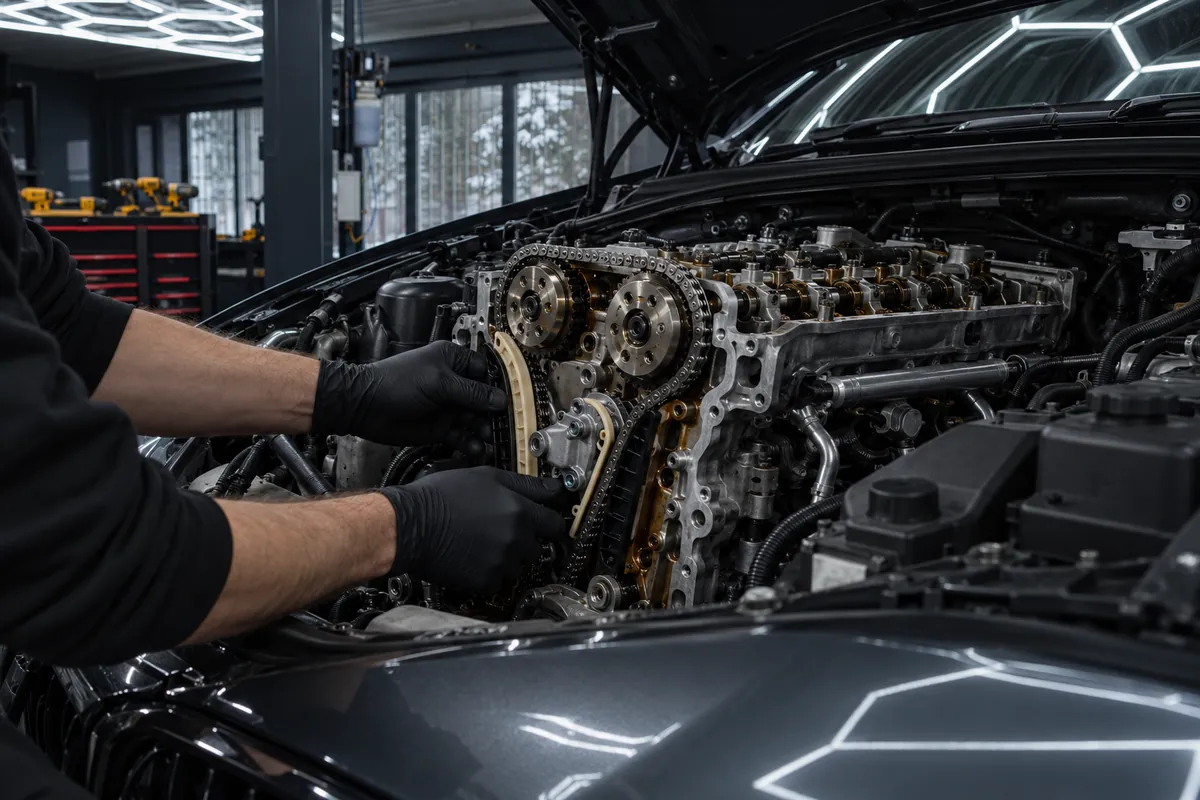
Every combustion engine uses some oil — a small amount always gets into the combustion chamber and burns together with the fuel. A healthy, well-maintained engine usually uses so little that you need to top up a few hundred millilitres at most between changes, and often nothing. Many manufacturers state an acceptable consumption of around 0.5 l per 1000 km in their documentation, and some even more — but that is the upper limit at which the manufacturer will not yet treat it as a fault, not the norm for a healthy engine.
If you are adding a litre of oil every 1000–2000 km, bluish smoke appears from the exhaust or the level drops faster and faster, it is worth finding the cause before the catalytic converter, the DPF or the engine itself suffers. Below we explain how to measure consumption correctly, how to tell a leak from burning, what the most common causes are, what can be fixed and what a diagnosis costs in Warsaw.
Manufacturer limits vs reality — when oil consumption is too high
| Consumption per 1000 km (approximate) | Assessment | What to do |
|---|---|---|
| Practically zero to approx. 0.1 l | Typical for a healthy engine | Check the level every few fill-ups |
| Approx. 0.1–0.3 l | Usually normal, especially in turbo engines, with motorway or spirited driving | Monitor, measure regularly under the same conditions |
| Approx. 0.3–0.5 l | Elevated — often still within the manufacturer’s limit, but worth knowing the cause | Check for leaks and the crankcase ventilation, consider a diagnosis |
| Over 0.5 l | Too much for most engines | Diagnosis: leaks, PCV, turbo, compression, endoscopy |
| 1 l or more | Serious problem, high risk to the catalytic converter or DPF | Urgent diagnosis, frequent level checks until repaired |
These are approximate values for passenger cars — the acceptable consumption for your engine is in the owner’s manual or service data. The trend matters too: an engine that used 0.1 l for years and suddenly started using 0.5 l has a problem, even if it is formally within spec.
Higher consumption is normal in a new engine while running in (usually the first few thousand km) and after an overhaul, as well as during long periods at high revs. Conversely, an engine that “uses nothing” may have oil diluted with fuel — more on that below.
How to measure oil consumption correctly
- 1Park the car on level ground. Warm the engine up to operating temperature, switch it off and wait approx. 5–10 minutes (or as long as the manual says) for the oil to drain back into the sump.
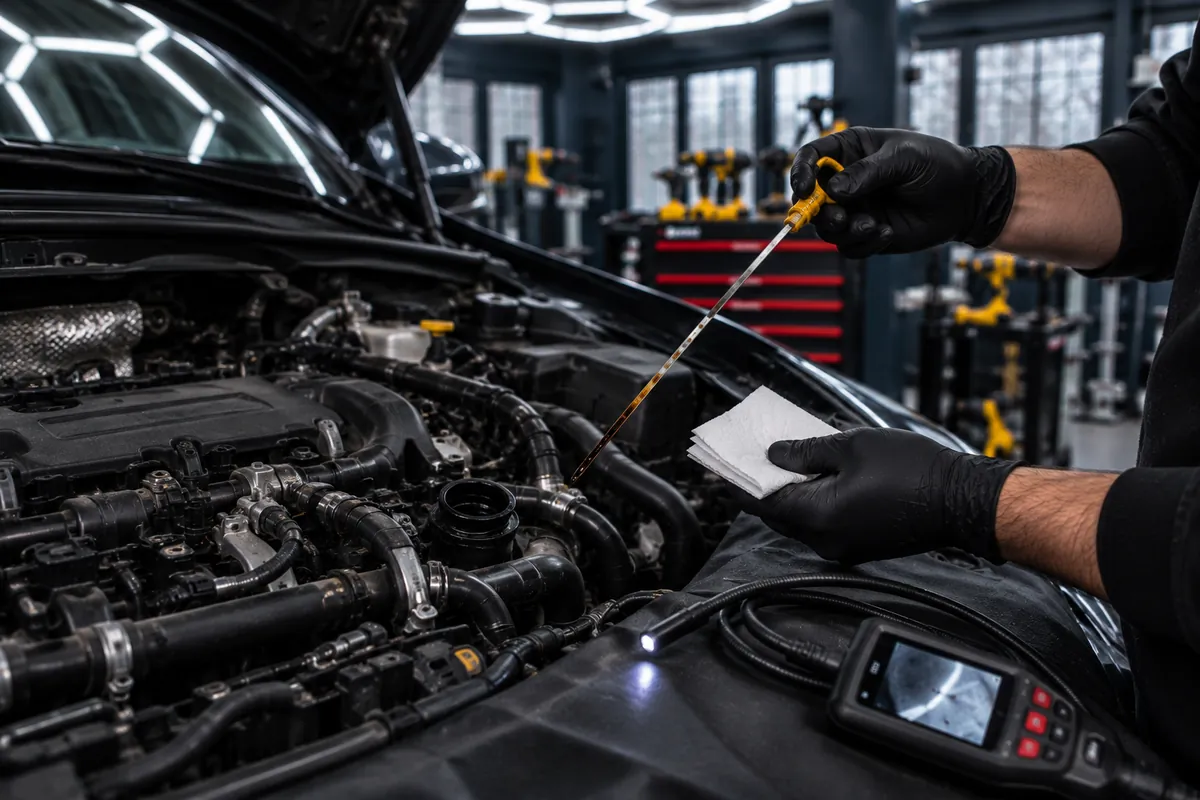
- 2Pull out the dipstick, wipe it, push it fully back in and pull it out again. In cars without a dipstick, read the level from the on-board computer as described in the manual.
- 3Top up to the MAX mark with the same oil that is in the engine and note the mileage.
- 4Drive 1000–2000 km in your usual conditions. Check the level at every fill-up so it never drops below MIN.
- 5Measure the level under exactly the same conditions and top up to MAX with a measured amount of oil (using a measuring jug). Divide the amount added by the distance driven and multiply by 1000.
- 6Repeat the measurement at least once — a single result is easily skewed by sloping ground or too short a drain-back time.
The difference between the MIN and MAX marks on the dipstick is approx. 1 litre in many engines, but it can be smaller or larger — the manufacturer gives the exact figure. So “dropping half the scale” does not always mean half a litre.
Watch out with DPF-equipped diesels and cars used mainly for short trips: the oil can be diluted with fuel, so the level seemingly does not drop or even rises. A rising oil level is also a reason to get it checked — especially if the oil looks milky, which can mean coolant in the oil.
Leak or burning — how to tell the difference
- Spots under the car after an overnight stop, an oily engine undertray or sump — that is a leak (see leak under the car).
- A smell of burning oil after driving, smoke from under the bonnet — oil dripping onto the hot manifold or exhaust.
- Oily areas around the valve cover, oil filter housing, oil cooler or the engine-to-gearbox joint — typical leak points.
- No sign of a leak, yet oil disappears — the oil is most likely burning in the engine.
- Bluish exhaust smoke, an oily tailpipe tip, sooty spark plugs — also point to burning.
- Oil in the intake pipes and intercooler — a sign that oil reaches the intake via the crankcase ventilation or the turbocharger.
Oil can disappear in two ways: leak out or burn in the cylinders. Before suspecting the piston rings, check the simpler causes — a leak is usually far cheaper to fix than an engine that burns oil.
The most common causes of oil burning
- Stuck or worn piston rings — especially the oil control rings. Carbon builds up with extended oil change intervals and short-trip driving. Some engines are known for this (e.g. some older 1.8/2.0 TSI versions of the EA888 family), but the problem can affect any engine.
- Hardened valve stem seals or worn valve guides — oil runs down the valve stems into the cylinders, especially when parked and during engine braking.
- A faulty crankcase ventilation system (PCV valve, oil separator) — oil is drawn into the intake, and excess crankcase pressure pushes it out past the seals.
- Turbocharger — worn seals or shaft play. Often the cause is not the turbo itself but a restricted oil return or excessive crankcase pressure.
- Oil of the wrong viscosity or specification — oil that is too thin or does not meet the manufacturer’s requirements can evaporate more easily and get into the combustion chamber.
- Overfilling above MAX — the crankshaft can whip the oil into foam, and the excess reaches the intake through the crankcase ventilation.
- General engine wear — worn cylinder bores at high mileage.
Less often the cause is a damaged head gasket — in that case oil more often mixes with the coolant than burns in the cylinder. In direct-injection engines, oil from the crankcase ventilation also speeds up carbon build-up on the intake valves — more in our guide to intake cleaning.
Blue exhaust smoke — what it says about the cause
| When the smoke appears | Likely cause |
|---|---|
| Briefly after a cold start, then disappears | Valve stem seals, valve guides |
| After a downhill run or prolonged engine braking, when accelerating after idling | Valve stem seals, less often piston rings |
| Constantly, worse when accelerating and under load | Piston rings, worn cylinders |
| Under hard acceleration in a turbo car, oil in the intercooler | Turbocharger or crankcase ventilation |
| White, thick smoke with a sweet smell and coolant loss | Not oil — possibly the head gasket |
| Black smoke | Usually excess fuel, not oil burning |
Exhaust smoke is an important clue but not proof. With slight oil burning there is often no visible smoke at all, and the catalytic converter and DPF can “hide” it. Read more about smoke colours in our guide to exhaust smoke.
The risks of driving an engine that burns oil
Burnt oil leaves ash from its additives (including phosphorus and zinc compounds). In petrol engines it builds up in the catalytic converter and on the oxygen sensors — the converter loses efficiency, the check engine light comes on, and replacing the converter is expensive. In diesels the ash ends up in the DPF. Soot burns off during regeneration, but ash does not — it stays in the filter permanently and shortens its life.
Oil burning also means fouled spark plugs and misfires, and carbon deposits in the combustion chamber and on the valves. The biggest danger, though, is a low oil level: lubrication weakens, and the bearings, turbocharger and hydraulic timing chain tensioner suffer. If the oil pressure warning light comes on, stop the car immediately and switch off the engine (see oil warning light).
In a diesel, a major oil leak from the turbocharger into the intake can, in extreme cases, cause engine runaway — the engine starts running on oil and does not respond to lifting off the throttle. It is rare but dangerous, so symptoms of a leaking turbo should not be ignored.
Until the repair, check the oil level at every fill-up and carry a bottle of the correct oil. Use oil of the specification required by the manufacturer — in cars with a DPF and catalytic converter this is usually a low-ash (Low SAPS) oil.
How we diagnose excessive oil consumption
- 1Interview and car history: how much oil is lost and over what period, what oil is used and how often it was changed, when smoke appears.
- 2Inspection on the lift: valve cover, sump, crankshaft seals, oil filter housing and oil cooler, turbocharger oil lines.
- 3Computer diagnostics: reading fault codes, misfires and fuel trims; checking the crankcase ventilation, intake pipes and intercooler for oil; assessing the spark plugs.
- 4If needed, a compression test (dry and with a little oil added to the cylinder) or a cylinder leak-down test — it helps tell rings from valves.
- 5Engine endoscopy: with a camera through the spark plug or injector hole we inspect the cylinder bores, piston crowns and valves — without dismantling the engine.
- 6We present the result and a quote for approval — from the cheapest repairs that make sense up to an overhaul if it is necessary.
Diagnosis starts with the simplest and cheapest causes. Replacing a PCV valve or a valve cover gasket costs a fraction of an overhaul and can noticeably reduce oil loss.
What can be fixed and what it costs
| Service | Price (labour) | When it is needed |
|---|---|---|
| Oil and oil filter change | from 120 zł | Wrong oil, overdue interval, after a repair |
| Computer diagnostics | 100 zł | Fault codes, misfires, assessing engine operation |
| Engine endoscopy | 300 zł | Assessing cylinders, pistons and valves before deciding on a repair |
| Turbocharger replacement | from 600 zł | Oil in the intake and intercooler, turbo shaft play |
| Leak repair, crankcase ventilation repair | price after diagnosis | Leaking gaskets, faulty PCV valve or separator |
| Valve stem seals, cylinder head or engine overhaul | price after diagnosis | Oil burning via valves, rings or cylinders |
| Engine replacement | from 2000 zł | When an overhaul is not worth it |
Leaks and a faulty crankcase ventilation are usually fixed quickly and relatively cheaply. On some engines the valve stem seals can be replaced without removing the cylinder head, on others the head has to come off. Stuck (but not worn) rings can sometimes be freed with a decarbonising treatment, but success is not guaranteed. No additive will fix worn rings and cylinders — that needs an engine overhaul or a replacement engine.
Thicker oil or “sealing” additives may reduce oil loss for a while, but they only mask the problem, and oil that does not meet the manufacturer’s specification can harm the catalytic converter, DPF or turbocharger. Parts and oil are priced separately in the quote, and you approve the quote before work starts. The full price list is on the Pulsecar price list page, and more about the service on the oil change page.
Oil consumption diagnosis in Warsaw, Bielany — Pulsecar, ul. Arkuszowa 176
Pulsecar is located at ul. Arkuszowa 176 in Warsaw’s Bielany district, close to Żoliborz, Bemowo and Łomianki. We are open Monday to Friday 09:00–18:00 and Saturdays 09:00–15:00.
Call +48 571 058 591 or book a visit online. Have ready how much oil you add and how often — we will find the cause and present a quote before any work begins. We give a 6-month warranty on labour.