4x4 drivetrain — Haldex, xDrive and quattro oil: when to change it
Drivetrain oil rarely appears in the service schedule, yet the coupling, transfer case and differentials depend on it. We explain how Haldex, xDrive and quattro work, how to spot a neglected drivetrain and what servicing costs depend on.
9 min read · Pulsecar team · updated:
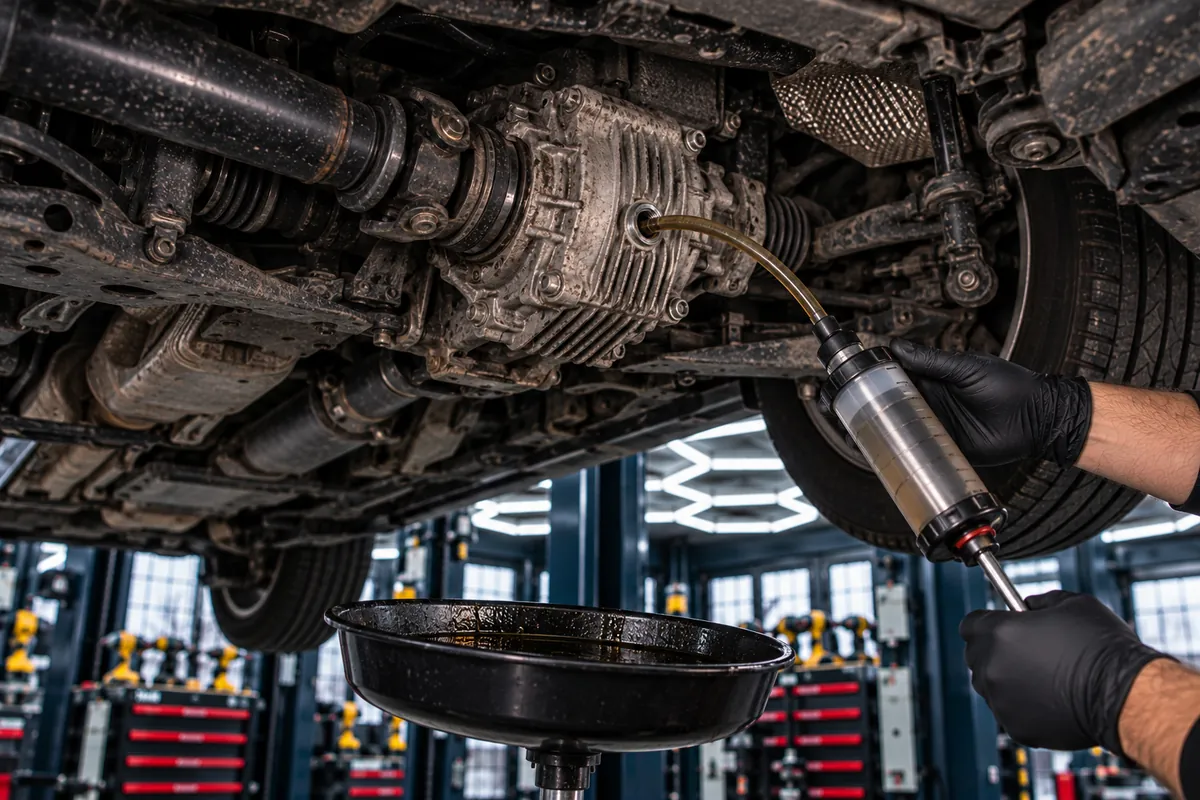
4x4 drivetrain — which fluids need changing? Short answer
| Unit | Where it is used | What is serviced | Typical recommendation (approximate) |
|---|---|---|---|
| Haldex coupling | VW 4Motion, Skoda 4x4, Seat and Cupra, transverse-engine Audi (A3, TT, Q3), Volvo AWD, Land Rover Freelander 2 | Coupling oil; on older generations also the filter, on Gen4 cleaning the pump strainer | Often every few years — per the service schedule for that generation |
| Transfer case | BMW xDrive, Mercedes 4MATIC (some versions), SUVs and off-roaders | Transfer case oil | Often “lifetime”; a preventive change is considered at higher mileage |
| Centre differential | Longitudinal-engine Audi quattro (Torsen or crown-gear differential) | Gear oil — depending on the gearbox shared with the front differential or separate | Per gearbox manufacturer; often no fixed interval |
| Front and rear differential | Practically every 4x4 drivetrain | Gear oil (for a limited-slip differential — with the right additives) | Often “lifetime” or per manufacturer; shorter for towing and off-road use |
| Power take-off unit (PTU) | Transverse-engine AWD cars, e.g. Volvo, VW | Gear oil | Often no interval — worth checking for leaks and oil condition |
A four-wheel-drive car usually has several units with their own oil that are easy to forget: a coupling that engages the second axle (e.g. Haldex) or a transfer case (e.g. on BMW xDrive), front and rear differentials, and on cars with a transverse engine also a power take-off unit (angle gear). Each has a different oil and different manufacturer recommendations.
Manufacturers describe many of these oils as “lifetime” or leave them out of the service schedule altogether. In practice the Haldex coupling oil is usually changed every few years, and the oils in the transfer case and differentials are worth at least checking and changing preventively at higher mileage. The table shows typical cases, not the standard for a specific car — even within one brand there are different drivetrain generations with other oils, quantities and procedures, so we identify the system by VIN.
“Lifetime” oil in a 4x4 drivetrain — why you still need to think about it
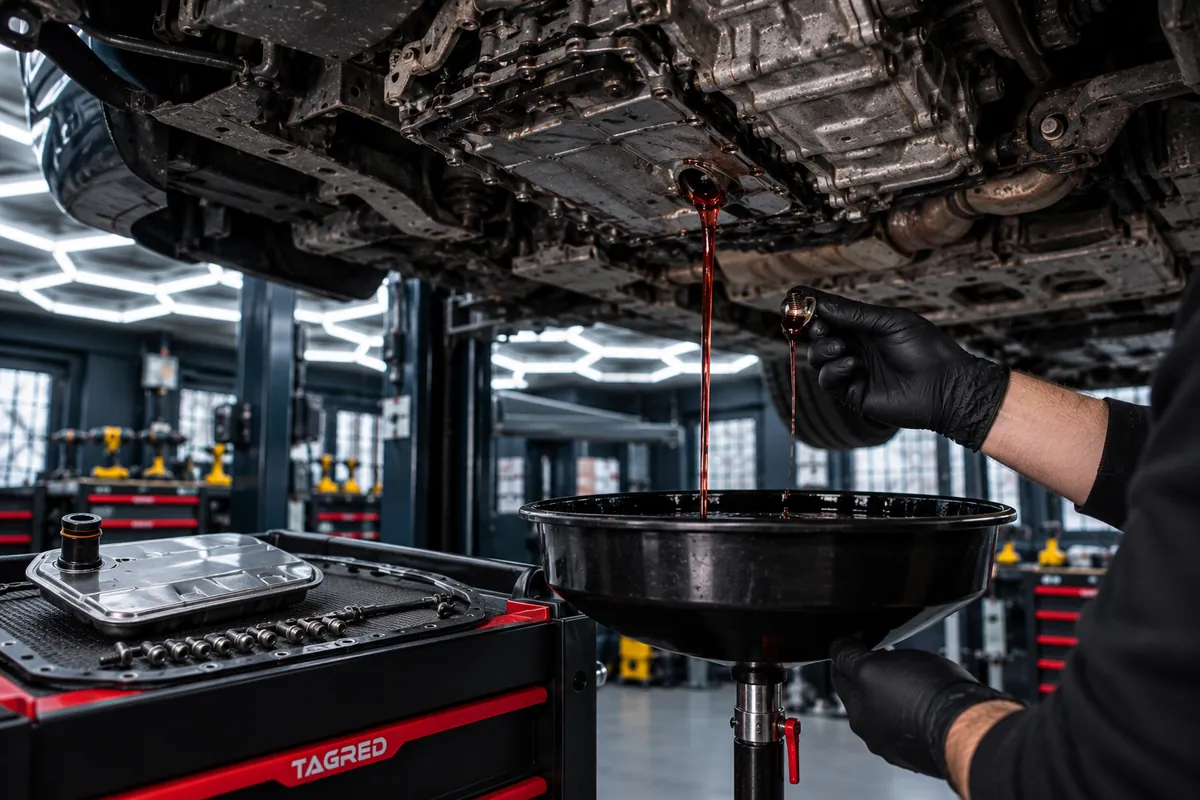
“Lifetime” usually means the period the manufacturer used in its durability and running-cost calculations, not several hundred thousand kilometres with subsequent owners. Oil in 4x4 drivetrain units works under heavy load: it lubricates gear teeth and bearings, and in multi-plate clutches it is also responsible for the correct friction between the plates.
Over time the oil oxidises, loses its anti-wear additives and friction modifiers, and in clutches it collects particles of friction material and metal. In a Haldex coupling contamination can block the pump strainer or filter, in a transfer case it can impair the electrically actuated clutch, and in a differential it speeds up wear of bearings and gears. An oil change costs a fraction of repairing any of these units.
Drivetrain oils deserve particular attention after buying a used car with no documented history, at mileages in the hundreds of thousands of kilometres, and on cars that tow a trailer or go off-road.
Haldex — how it works and why the oil and filter matter so much
| Generation (approximate) | Example cars | What to watch for during servicing |
|---|---|---|
| Gen1–Gen3 (approx. 1998–2008) | VW Golf IV and V 4Motion, older Audi A3 and TT quattro, older Volvo AWD | Oil change together with a separate filter |
| Gen4 (approx. 2007–2013) | VW Tiguan I, Golf VI 4Motion, Passat B7 4Motion, Volvo XC60 I, Land Rover Freelander 2 | No replaceable filter; the pump strainer is worth cleaning at the oil change |
| Gen5 (from approx. 2012) | MQB-platform models, e.g. Golf VII, Octavia III 4x4, Audi A3 8V, Tiguan II | No separate filter; oil change per the service schedule |
Haldex is an electronically controlled multi-plate clutch mounted ahead of the rear differential. In everyday driving most of the torque goes to the front axle, and when the control unit decides more traction is needed — e.g. when pulling away or when the front wheels slip — a pump builds oil pressure that clamps the plate pack and engages the rear axle. Today these couplings are made by BorgWarner, but workshops still call them Haldex.
The same oil lubricates and controls the coupling, so its condition directly affects how the drivetrain works. Wear particles from the plates settle on the pump strainer or filter, pressure drops, and the rear axle engages late or not at all. Pump failure is another common result of neglect. The years and models in the table are approximate — the generation is determined for the specific car.
The oil change interval depends on the generation and the car maker — in many VAG models the service schedule specifies it every few years, regardless of mileage. We cover Volvo in detail in our article on Volvo AWD Haldex.
A Haldex coupling needs oil to the coupling manufacturer’s specification — not the same fluid as in the gearbox or differential. Mixing them up can impair the hydraulics and the plates.
BMW xDrive — the transfer case and its oil
On BMWs with xDrive, torque is split by a transfer case mounted behind the gearbox. Inside it a multi-plate clutch is clamped by an electric servo motor — the control unit continuously varies how much torque goes to the front axle. Drive to the front is carried by a chain or gears, depending on the version.
BMW treats the transfer case oil as a “lifetime” fill. Even so, in workshop practice a preventive change is often considered at somewhere between several tens of thousands and about 100,000 km, and it comes first when there are symptoms. Worn oil changes the friction characteristics of the plates, which shows up as jerking and “hopping” when turning tightly in a car park: the transfer case does not let the wheels turn freely at different speeds. After an oil change the clutch adaptation values are usually reset with a diagnostic tool.
The other typical source of problems is the servo motor and its gear — when it fails, a 4x4 drivetrain message may appear, together with the ABS or DSC warning lights. Tyres matter on xDrive too: a difference in rolling circumference between the axles (different sizes, different models or very uneven wear) constantly loads the transfer case clutch. Read more about typical faults on our BMW at Pulsecar page.
Audi quattro — Torsen, crown-gear differential and quattro ultra
The quattro name covers several different designs. On transverse-engine Audis — A3, S3, TT or Q3 — quattro is in practice a Haldex coupling, serviced as described above. On longitudinal-engine models (including A4, A5, A6, A8, Q5, Q7) a Torsen centre differential was used for years, and on some newer versions a self-locking crown-gear centre differential.
A centre differential of this kind works all the time and splits torque mechanically. It usually sits in the gearbox housing, and its oil — depending on the gearbox type — may be shared with the front differential gear oil and separate from the ATF or S tronic fluid. This is a common source of confusion: an automatic transmission fluid change on a quattro does not always include changing the oil in the final drive and centre differential.
Since around 2016 some models (including the A4, A5 and Q5 with selected engines) use quattro ultra. In everyday driving the car is front-wheel drive, and the rear axle is engaged by a multi-plate clutch at the gearbox output and disconnected in the rear differential. These units have their own oils. What to service and how often we determine from the gearbox and drivetrain code — recommendations vary between versions. More on the group’s brands on our VAG at Pulsecar page.
Differentials and the PTU — the oils people forget
- Leaks and “sweating” on the differential or PTU housing — see leak under the car.
- Whining or droning that rises with speed — often worn differential bearings or gears.
- Clunks when pulling away and on load changes — backlash in the gears or worn mounts.
- A smell of overheated gear oil after a longer drive.
Every 4x4 drivetrain has at least two differentials — front and rear. On transverse-engine cars the front one usually sits in the gearbox and shares its oil, while the rear one is a separate unit with its own gear oil. In hypoid gears the teeth slide against each other under high pressure, so oil of the right quality class and viscosity is needed.
Limited-slip differentials with friction plates often require oil with a friction modifier or an additive — without it they can clunk and judder when turning. The power take-off unit (PTU), which on transverse-engine cars sends drive to the propshaft for the rear axle, holds little oil and works close to the hot exhaust, so the oil in it can degrade faster.
Do you tow a trailer or drive off-road? These are conditions in which manufacturers usually recommend shorter drivetrain oil change intervals — check the “severe operating conditions” recommendations in the service book.
Signs of a neglected 4x4 drivetrain
- Jerking, “hopping” or the car braking itself when turning tightly, e.g. in a car park.
- A 4x4/AWD message or warning light, often together with the ABS or ESP lights — see ESP warning light.
- The rear axle not engaging — the front wheels spin when pulling away on a slippery surface.
- Whining, droning or humming that changes with speed.
- Clunks and knocks when pulling away, changing direction or applying throttle.
- Vibration under the floor when accelerating — this can also involve the propshaft, as on the Porsche Cayenne.
- Traces of oil on the transfer case, Haldex coupling or differential housings.
The same symptoms can have other causes. Clicking when turning is often a CV joint, vibration can be unbalanced wheels or a propshaft support bearing, and jerking can come from the gearbox or engine (see car jerking). That is why we start with computer diagnostics and an inspection before replacing anything.
Tyres matter a great deal too. A 4x4 drivetrain assumes all wheels have almost the same rolling circumference. Different sizes, different models or a large difference in tread wear between the axles mean the coupling or transfer case is constantly compensating and wears faster. On 4x4 cars tyres are best replaced as a full set — read more about seasonal changes in our guide on when to change tyres.
If the car clearly jerks when turning or you hear metallic clunks, keep driving to a minimum and book a diagnosis. Driving for a long time with a binding drivetrain can damage the transfer case, differential or driveshafts.
How we service a 4x4 drivetrain
- 1We identify the system by VIN: drivetrain type, coupling or transfer case generation, transmission codes.
- 2We run computer diagnostics — reading fault codes from the drivetrain, ABS/ESP and gearbox control units.
- 3We inspect the drivetrain units on the lift: leaks, play, CV boots and the propshaft support.
- 4We check the oil level and condition wherever the design allows it.
- 5We present a quote with oils of the correct specification, filters and seals for approval — only then do we start work.
- 6We change the oils according to the manufacturer’s procedure; on a Haldex we also replace the filter or clean the pump strainer if that generation calls for it.
- 7Where the procedure requires it, we run an adaptation with the diagnostic tool, followed by a test drive.
We don’t use a single “universal” oil for every unit — the Haldex coupling, transfer case, differential and gearbox usually have different requirements. If diagnostics reveal mechanical damage, we handle the repair as part of our gearbox repair service.
How much does 4x4 drivetrain servicing cost in Warsaw?
| Service | Price (labour) | Notes |
|---|---|---|
| Computer diagnostics | 100 zł | Reading 4x4, ABS/ESP and gearbox fault codes |
| Haldex coupling oil change | after diagnosis | Depends on generation; filter or strainer per design |
| Transfer case oil change (e.g. xDrive) | after diagnosis | Depends on version and procedure |
| Differential or PTU oil change | after diagnosis | Priced once the unit is identified |
| Automatic transmission fluid change | from 400 zł | A separate service — does not include Haldex or differentials |
| Manual gearbox oil change | 200 zł | Per manufacturer recommendations |
| Driveshaft (CV axle) replacement | 250 zł | When the clicking on turns comes from a CV joint |
| Suspension diagnostics | 100 zł | Clunks and play in the chassis |
The prices shown are for labour; oils, filters and seals are priced separately, because their type and quantity depend on the specific unit. Haldex, transfer case and differential servicing is priced once the system has been identified. Before work starts you receive a quote for approval, and we give a 6-month warranty on labour.
Read more about transmission servicing in our guide on automatic transmission fluid change and on the ATF fluid change service page. See the full price list.
Planning an automatic transmission fluid change on a 4x4? Ask about the drivetrain oils at the same time — checking them in one visit is more convenient than coming back separately.
4x4 drivetrain servicing in Warsaw Bielany — Pulsecar, ul. Arkuszowa 176
We service 4x4 and AWD drivetrains of various makes at the Pulsecar workshop at ul. Arkuszowa 176 in Warsaw’s Bielany district — convenient for drivers from Żoliborz, Bemowo and Łomianki. We are open Monday to Friday 09:00–18:00 and Saturdays 09:00–15:00.
Call +48 571 058 591 or book a visit online. Give us the model, year, mileage and VIN — we will check which drivetrain your car has and which oils it requires. Directions are on the contact page.