Mercedes-Benz — common faults and weak spots in engines, gearboxes and chassis
Mercedes has solid bodies and a comfortable ride, but known weak spots too: the chain and injectors in the 2.1 CDI, the V6 CDI oil cooler, 1.8 Kompressor timing, the 7G-Tronic control unit and Airmatic. We cover them engine by engine and model by model.
18 min read · Pulsecar team · updated:
Mercedes faults — the short answer
Most Mercedes-Benz cars from the last 15–20 years are durable, but almost every engine and every gearbox has its known weak spots. Among the diesels, the 2.1 CDI (OM651) is the one most often talked about: early Delphi piezo injectors and the timing chain at the gearbox end. The V6 3.0 CDI (OM642) is notorious for leaking oil cooler seals and intake manifold problems. In the petrol engines the main topic is the timing chain: in the 1.8 Kompressor (M271), in the V6 M272 (the balance shaft sprocket) and in early M276 units. On top of that come the 7G-Tronic gearbox control unit, Airmatic air suspension, the AdBlue system and, in older models, corrosion and SBC brakes.
Most of these faults give warning signs early on: rattling after a cold start, camshaft position fault codes, a smell of burning oil, gearbox limp mode, a car sinking while parked or an AdBlue message. Below you will find an engine table, a description of the engines, gearboxes and chassis, a summary table, a pre-purchase checklist and prices from our price list.
Which engine / model do you have
| Engine | Type | Models and years, approximate |
|---|---|---|
| OM646 (2.2 CDI) | diesel, 4 cylinders | C 200/220 CDI W203, E 200/220 CDI W211, C 220 CDI W204, Sprinter W906 (c. 2002–2009) |
| OM651 (1.8 / 2.1 CDI) | diesel, 4 cylinders | C W204/W205, E W212, A/B/CLA 200–220 CDI, GLC 220d/250d, Vito W639/W447, Sprinter W906 (c. 2008–2019) |
| OM642 (3.0 V6 CDI) | diesel, V6 | E 280–350 CDI W211/W212, ML W164/W166, GL, S W221, C 320/350 CDI W204, Sprinter (from c. 2005) |
| OM654 (2.0 d) | diesel, 4 cylinders | E 220d W213 (from 2016), facelifted C W205, GLC, some Sprinter W907 versions |
| OM607 / OM608 (1.5 CDI / d) | diesel, 4 cylinders, Renault design | A, B, CLA, GLA 160/180 CDI and d (from 2012) |
| OM626 / OM622 (1.6 CDI / d) | diesel, 4 cylinders, Renault design | C 180d/200d W205 (c. 2014–2018), Vito 109/111 CDI W447 |
| M271 (1.8 Kompressor / CGI) | petrol, 4 cylinders, supercharger or turbo | C W203/W204, E W211/W212, CLK, SLK (c. 2002–2015) |
| M274 / M270 (1.6 / 2.0) | petrol, 4 cylinders, turbo | M274: C W205, E W212 from 2013, E W213, GLC; M270: A, B, CLA, GLA (from 2012) |
| M282 (1.33) | petrol, 4 cylinders, turbo, shared with Renault-Nissan | A, B, CLA, GLA, GLB (from c. 2018) |
| M272 / M276 | petrol, V6 | M272: C, E, CLK, ML, SLK (c. 2004–2011); M276: E W212/W213, GLC 43 and others (from c. 2011) |
Years and models are approximate — the same model could have different engines depending on model year, power output and market. You can find the exact engine code in the car's data via the VIN (see VIN check), from the number on the engine block or during computer diagnostics.
Mercedes in our workshop — what the data show
Based on jobs completed at Pulsecar from January to October 2026: Mercedes-Benz accounts for about 7.5% of the cars we serviced and is the fifth most common make in our workshop — roughly one in every thirteen cars that come to us.
The items that recur most often on Mercedes jobs are: computer diagnostics (c. 36% of Mercedes jobs), oil service (c. 20%), wheel alignment (c. 13%), tyres (c. 8%) and brake pads and discs (c. 8%). One job can include several kinds of work, so the figures do not add up to 100%.
This shows the nature of the brand well: a Mercedes has many control units, and many faults — from valve timing to the gearbox and Airmatic — first leave a trace in the fault memory. Heavy cars, wide tyres and multi-link suspension, in turn, mean that alignment, tyres and brakes come back regularly.
OM651 (2.1 CDI) — injectors, timing chain and intake flaps
The OM651 is Mercedes' most popular diesel of recent years — in the C, E, A, B and CLA-Class, the GLC, the Vito and the Sprinter. It offers good performance and low fuel consumption, but has a few well-known weak spots.
Injectors: early units (from 2008) had Delphi piezo injectors that proved faulty — failures appeared at as little as around 50,000 km. Symptoms include rough running, jerking, hard starting and limp mode. Most of the faulty injectors were replaced under service campaigns, and around 2011 they were superseded in most versions by solenoid injectors. On an older car it is worth checking the injector corrections during diagnostics.
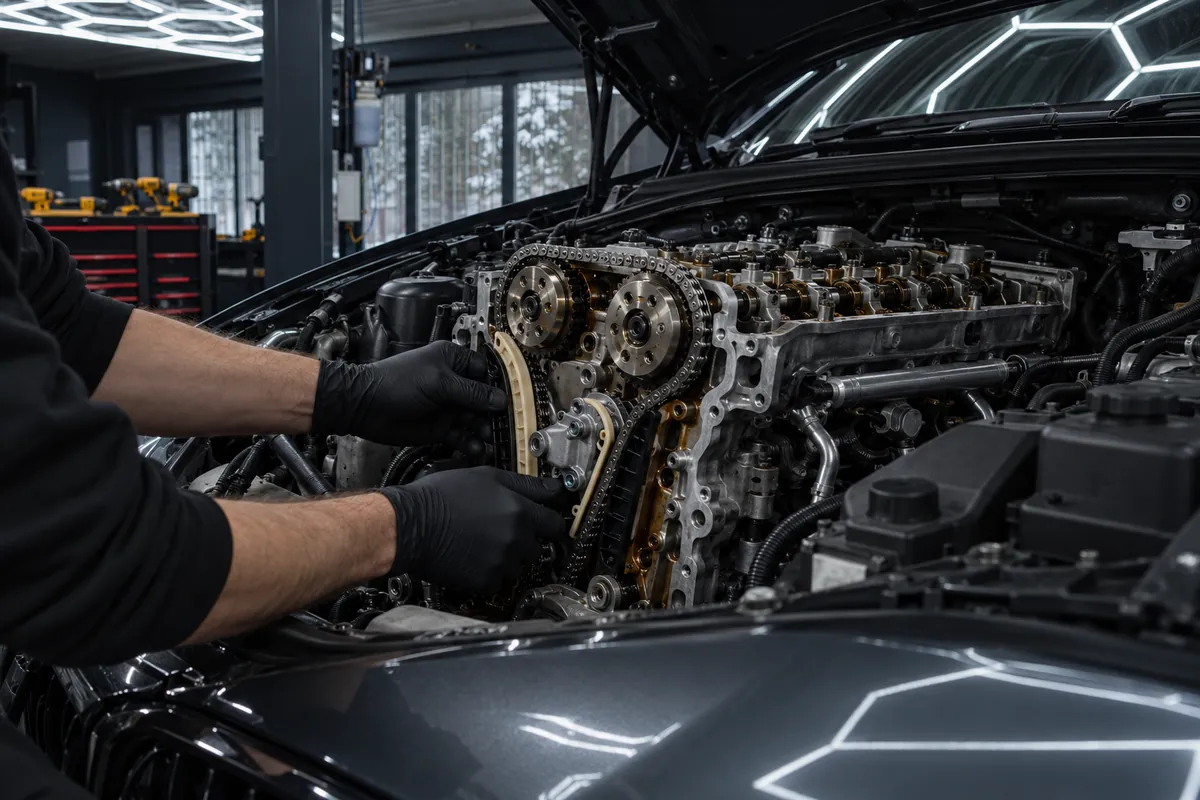
Timing chain: the OM651 has a single chain at the back of the engine, at the gearbox end. Chain stretch and wear of the variable valve timing sprockets have been reported — in some units after just a few tens of thousands of kilometres. Symptoms are a rattle for a few seconds after a cold start and camshaft-to-crankshaft correlation fault codes. The repair often requires taking the engine out.
Other typical problem areas are the intake manifold flaps, which can warp and break (loss of power; the whole manifold is often replaced), coolant leaks at the water pump, the thermostat, the alternator pulley clutch and, at high mileage, the EGR, DPF and dual-mass flywheel. The A-Class with the OM651 built from February to November 2014 had a campaign for an oil leak at the chain tensioner, and many cars with the OM651 had their engine software updated under a service campaign — check this by VIN at an authorised dealer.
A rattle after a cold start in the 2.1 CDI is not a normal characteristic of this engine. It is a signal to check the timing and read the camshaft correlation values before the chain jumps a tooth.
OM642 (3.0 V6 CDI) — oil cooler, intake manifold and EKAS
The V6 diesel OM642 is used in the E 280–350 CDI, the ML and GL, the S-Class, the C 320/350 CDI and the Sprinter. It is powerful and refined, but has several known ailments, expensive mainly in terms of labour.
Oil cooler seals: the cooler sits in the V of the engine, and its seals harden and crack over time. Oil collects between the cylinder heads and runs down to the back of the engine, and the smell of burning oil can reach the cabin. It most often affects cars from around 2005–2009; later Mercedes changed the seal material and the fault occurs less often. The fault does not light up a warning lamp, and the repair requires taking off the intake manifold and ancillaries.
Intake manifold and flaps: the flaps in the intake ports are moved by a small motor (the EKAS actuator). Soot from the EGR jams the flaps and their shafts, and the overloaded motor eventually fails. Symptoms are limp mode, rough running and poor throttle response, usually with fault codes P2004–P2007. Replacing just the motor without cleaning the intake often ends with the fault coming back.
Other reported issues: leaking copper washers under the injectors (black soot around the injector), a cracked exhaust manifold, the EGR, premature crankshaft bearing wear in some early units (up to c. 2010) and, in BlueTEC versions, NOx sensors and AdBlue.
A smell of burning oil after a drive in an ML or E-Class with the V6 CDI is a signal for diagnosis. Oil on hot ancillaries and the turbocharger risks bigger damage.
OM646 and OM654 — the older and the newer four-cylinder diesel
The OM646 (2.2 CDI) is the older diesel from the C W203, E W211, early C W204 and the Sprinter W906 up to c. 2009. With regular servicing it is regarded as very durable. Given the age of these cars, typical problems are leaking injector washers and leak-off pipes (diesel smell, smoke, hard starting), a clogged EGR and DPF with city driving, glow plugs and, at very high mileage, a stretched timing chain. More in the article injectors — symptoms.
The OM654 (2.0 d, from 2016) is fitted to, among others, the E W213, the facelifted C W205, the GLC and some Sprinter W907 versions. It has a good reputation, but in some early units valvetrain components (rocker arms, cam lobes, hydraulic lifters) wore prematurely — symptoms are a noisy valvetrain and an uneven idle. According to German sources, the rocker arms were changed at the end of June 2018. There was also a recall concerning the timing chain (wear of pins or links) on OM654 engines produced from January 2016 to February 2021 — check by VIN at an authorised dealer whether the car was covered and whether the work was done.
Newer BlueTEC and d diesels have an SCR system with AdBlue. Typical faults are a burnt-out heater in the tank, urea crystallising in the injector and pump (especially on short trips), incorrect level readings and failed NOx sensors. The message about a limited number of engine starts does not go away just by topping up the fluid if a fault has been stored in the control unit — it has to be diagnosed and repaired. More in the article DPF and AdBlue in Euro 6.
M271 (1.8 Kompressor and CGI) — timing chain and cam phaser solenoids
The M271 is the petrol 1.8 with a supercharger (C 180/200 Kompressor, E 200 Kompressor, CLK, SLK) and the newer turbocharged EVO version, in CGI variants with direct injection (from c. 2009, C W204, E W212). The best-known problem of the early versions is the timing: the chain stretches, and with it the camshaft sprockets and tensioner wear. Symptoms are a rattle for a few seconds after a cold start, the engine warning light and camshaft position fault codes. If neglected, the chain can jump and damage the valves. The repair usually covers the full set: chain, sprockets, tensioner and guides.
The second typical fault is leaking camshaft adjustment solenoids. Oil gets through the connector into the wiring loom and can travel all the way to the engine control unit. During an inspection it is worth unplugging the solenoid connectors and checking them for oil.
Supercharged versions can suffer from supercharger clutch faults, and CGI engines from carbon deposits on the intake valves with short trips. Chain and camshaft sprocket problems are also reported in newer versions (e.g. in the E W212 up to 2013), so a rattle on a cold engine needs checking on any M271.
Own a Mercedes-Benz and something worries you?
We check the engine, gearbox, suspension and the fault memory of all control units. Computer diagnostics costs 100 zł, and you get a written quote to approve before any repair.
When buying a car with the 1.8 Kompressor, ask whether the timing has been replaced and listen to the engine after it has stood overnight. A rattle that disappears after a few seconds is the typical first sign of a stretched chain.
M274, M270 and M282 — newer four-cylinder petrol engines
The M274 (longitudinal engine in the C W205, the E W212 from 2013, the E W213 and the GLC) and the M270 (transverse, in the A, B, CLA and GLA) are in practice the same 1.6 and 2.0 turbo family, rated better than the M271. Reported issues: a rattle after a cold start related to the tensioner and cam phasers (codes such as P0016), leaking camshaft solenoids, oil leaks from the turbocharger lines and, in some two-litre units from early production, cases of cylinder seizure. Some M270 engines in the A-Class were subject to a campaign to replace the camshafts because of a faulty weld — check by VIN whether the car was covered.
The M282 is a petrol 1.33 turbo developed jointly with the Renault-Nissan alliance and fitted from c. 2018 to the A, B, CLA, GLA and GLB. Cases of the plastic thermostat housing cracking or leaking have been reported — coolant loss risks overheating, so keep an eye on the level. More about engines from this alliance in the article Renault — common faults and weak spots.
V6 M272 and M276 — balance shaft sprocket and chain tensioner
The petrol V6 M272 engines (C 230–350, E 280/350, CLK, ML, SLK, c. 2004–2011) have a known defect in the balance shaft sprocket, which runs with the timing chain. It mostly affects early engines (mainly from around 2005–2007): the sprocket teeth wear prematurely and the control unit stores camshaft position codes for the right-hand cylinder bank (P0016, P0017). According to American sources, engines from serial number 2729..30 468993 onwards already have the improved sprocket and the fault is less common in them, although not ruled out. The engine number is stamped on the block and usually appears in the car's data. The repair usually requires taking the engine out, so the cost can be comparable to the value of an older car.
The M272 can also suffer from a broken intake manifold flap mechanism (loss of power) and oil leaks. The newer M276 (from c. 2011, including the E W212, W213 and GLC 43), in units built up to roughly the end of 2014, had a chain tensioner with insufficient oil supply — the warning sign was a rattle after a cold start and at idle. In later model years the problem is rarely reported.
On a V6 M272, check the engine number and the fault memory before buying. The P0016/P0017 codes alone do not prove a sprocket fault, but they always need explaining before you sign the contract.
Renault diesels — 1.5 CDI and 1.6 CDI in the A, B, CLA, C and Vito
For its smallest diesels Mercedes used engines from the Renault-Nissan alliance. The 1.5 CDI / d (OM607, later OM608) in the A, B, CLA and GLA 160/180 is a development of the Renault 1.5 dCi (K9K) with a different control unit and ancillaries. It has a timing belt to be replaced according to the service schedule, and the reported faults are the injectors, EGR, DPF, glow plugs and turbocharger. With neglected oil changes, bearing shell wear occurs.
The 1.6 CDI / d (OM626 in the C 180d and C 200d W205 from c. 2014–2018, OM622 in the Vito 109 and 111 CDI W447) is the Renault 1.6 dCi design. Opinions on it are divided; the most frequently reported problems concern ancillaries: EGR, DPF and turbocharger with city driving. We cover these engines in detail in the sister article about Renault.
Gearboxes — 7G-Tronic, 9G-Tronic and 7G-DCT
- 7G-Tronic (722.9, from 2004) — the automatic in the C, E, ML, GL, Vito and Sprinter. The typical fault is the control plate with speed sensors inside the gearbox: harsh or delayed gear changes, delayed engagement of D or R, or limp mode in one gear, with speed sensor fault codes (e.g. P0717, P0718). A new plate has to be programmed to the car, and restarting the engine helps only temporarily.
- 7G-Tronic — oil: sources for this gearbox recommend changing it every c. 50,000–60,000 km. Older gearboxes also tend to leak oil.
- 9G-Tronic (from c. 2014, including the C W205, E W213, GLC, Sprinter) — jerky gear changes are reported, more often in 4MATIC versions. A software update and adaptation often help.
- 7G-DCT (A, B, CLA, GLA) — a dual-clutch gearbox. A software update often helps with jerking, and the clutches wear faster in traffic jams and when towing. See DSG gearbox — symptoms.
With each of these gearboxes we start by reading the fault codes and control unit parameters, and only then decide on an oil change, adaptation or repair. More in the article automatic gearbox jerking.
Models — what to watch for in the C, E, A/B/CLA, GLC, ML and vans
- C-Class W204 (2007–2014): corrosion of the rear subframe and of the boot lid by the opening button, power steering fluid leaks on early cars, rear suspension wear at around 100,000–150,000 km.
- C-Class W205 (2014–2021): fast wear of pads and discs, moisture in the driver-assistance radars, blocked sunroof drains (wet headlining), and on some petrol cars oil leaks from the turbocharger lines.
- E-Class W211 (2002–2009): SBC up to the 2006 facelift, Airmatic, the SAM module and electronics in early model years, propshaft flexible couplings, especially in the more powerful versions (humming at higher speeds).
- E-Class W212 (2009–2016): corrosion of the rear axle beam progressing from the inside, Airmatic, the auxiliary battery. E W213 (from 2016): OM654, faults in the multimedia and driver-assistance systems, several recalls.
- A, B, CLA (W176, W246, C117): thermostat and coolant expansion tank, humming rear wheel bearings, knocking anti-roll bar links, 7G-DCT.
- GLC X253 and ML/GLE (W164, W166): diesel engine service campaigns (software updates, OM654 chain), air suspension; on the W164, the 7G-Tronic control unit and leaks, plus moisture in the rear SAM module; on 4MATIC models it is worth changing the transfer case oil.
- Vito and Sprinter (W639/W447, W906/W907), very common in Warsaw as company vehicles: the chain in the OM651, injector seals, EGR and DPF, AdBlue in newer versions and corrosion of the wheel arches, sills, lower door edges and front of the body on the Sprinter W906. The W907 is clearly better protected, but the underside is still worth inspecting.
Many of these issues are normal wear and tear, which comes sooner in heavy cars than in compacts — which is why regular suspension and brake checks pay off.
Airmatic, SBC and corrosion — chassis and bodywork of older Mercedes models
Airmatic air suspension (E W211 and W212, S, ML/GLE, GL and, as the Air Body Control option, also the GLC and E W213 among others) usually fails predictably. The rubber air springs crack, the valves in the valve block start to leak, and the compressor, which runs almost non-stop when there is a leak, overheats and wears out. Symptoms are the car sinking overnight on one corner or axle, a suspension fault message, a harsh or bouncy ride. Sometimes the culprit is just the compressor relay or a height sensor. Before replacing the compressor, the leak has to be found.
SBC (Sensotronic Brake Control) is an electro-hydraulic braking system used in, among others, the E W211 up to the 2006 facelift, the CLS W219 and the SL R230. Cars built from 2002 to the end of 2004 were covered by a recall because of a possible pump motor control fault in the SBC control unit. If it fails, the system switches to back-up mode — the car still brakes, but the pedal needs much more force and the braking distance increases. Such a message is a reason for immediate diagnostics.
Corrosion mainly affects older models: the E W210 rusted very badly, and the C W203 and older Vito vans can be corroded to the point where repair is not worth it. On the W204 check the rear subframe and boot lid, on the W212 the rear axle beam, and on the Sprinter and Vito the wheel arches, sills, lower door edges and underside. We do not do bodywork, but on the lift we will show you what the underside looks like.
If a Mercedes with Airmatic sits lower on one side in the morning, don't wait until it stops rising. Replacing one air spring is cheaper than an air spring plus a burnt-out compressor.
Summary table — engine/model, weak spot, symptom, what to do
| Engine / model | Weak spot | Symptom | What to do |
|---|---|---|---|
| OM651 (2.1 CDI) | Delphi injectors (early) | Rough running, jerking, limp mode | Injector correction diagnostics, injector replacement |
| OM651 (2.1 CDI) | Timing chain, phaser sprockets | Rattle after a cold start, correlation codes | Timing check and replacement |
| OM642 (3.0 V6 CDI) | Oil cooler seals | Oil in the V of the engine, smell of burning oil | Replacing the cooler seals |
| OM642 (3.0 V6 CDI) | Intake manifold, flaps, actuator | Limp mode, codes P2004–P2007 | Intake cleaning, flap drive repair |
| OM654 (2.0 d) | Valvetrain, chain campaign | Valvetrain noise, uneven idle | Diagnostics, campaign check by VIN |
| M271 (1.8 Kompressor/CGI) | Chain, camshaft sprockets, solenoids | Rattle, oil in connectors, timing codes | Timing and solenoid replacement |
| M274 / M270 | Tensioner, cam phasers | Rattle after a cold start, P0016 | Diagnostics, timing repair |
| M272 (V6) | Balance shaft sprocket | P0016/P0017, rattle | Engine number check, repair |
| M282 (1.33) | Thermostat housing | Coolant loss | Housing replacement, cooling system check |
| 7G-Tronic | Control plate, speed sensors | Limp mode, harsh gear changes | Fault code reading, plate replacement and programming |
| BlueTEC / d diesels | AdBlue heater, NOx sensors | Engine start countdown | SCR diagnostics, fault repair |
| E, S, ML with Airmatic | Air springs, valve block, compressor | Car sinks when parked | Leak test, air spring replacement |
| W203, W210, W212, Sprinter | Corrosion | Rust on subframes, beams, wheel arches | Inspection on a lift |
The same symptoms can have different causes — a rattle after a cold start is not always the chain, and gearbox limp mode does not always mean the control plate. That is why it is worth doing diagnostics before buying parts.
Recognise any of these symptoms?
Don't wait until a small fault turns into an expensive repair. Come to our workshop in Bielany — we will tell you what is urgent and what can wait.
How to look after a Mercedes
- Change the oil more often than the computer says: every c. 10,000–15,000 km or once a year, to the Mercedes specification in the owner's manual. For timing chains (M271, OM651, M276) and cam phaser solenoids this is the basis of durability.
- Change the automatic gearbox oil — on the 7G-Tronic roughly every 50,000–60,000 km, with the correct fluid for the gearbox in question.
- Listen to the cold start. A few seconds of rattling is the earliest sign of chain problems.
- Check the coolant and look for traces of oil at every service — on the OM642 especially in the V of the engine.
- Take a diesel on a longer run now and then. Short trips clog the EGR and DPF and encourage AdBlue crystallisation.
- Look after the battery — low voltage can trigger a series of random fault codes, including in the gearbox.
- Have the alignment done after replacing suspension parts — heavy cars with wide tyres wear them out quickly with incorrect settings.
Buying a used Mercedes — checklist
- 1Identify the engine and gearbox by VIN — that determines what to look at.
- 2Check the service history: engine and gearbox oil changes, any timing replacement.
- 3Listen to a cold start — a rattle for a few seconds is a signal to check the chain.
- 4Read the fault memory of all control units, including previously stored codes (valve timing, injectors, gearbox, Airmatic, AdBlue, SBC).
- 5Inspect the engine: oil in the V of the engine on the OM642, oil in the solenoid connectors on the M271, traces of coolant.
- 6On the test drive, check that D and R engage smoothly and that there are no harsh gear changes.
- 7With Airmatic, leave the car for a few hours and check that it does not sink.
- 8On a lift, check for corrosion of the subframes, axle beams, sills and wheel arches, and the condition of the suspension and brakes.
- 9Check with an authorised dealer by VIN whether service campaigns have been carried out.
We carry out this check as part of our pre-purchase inspection.
How we check a Mercedes at Pulsecar
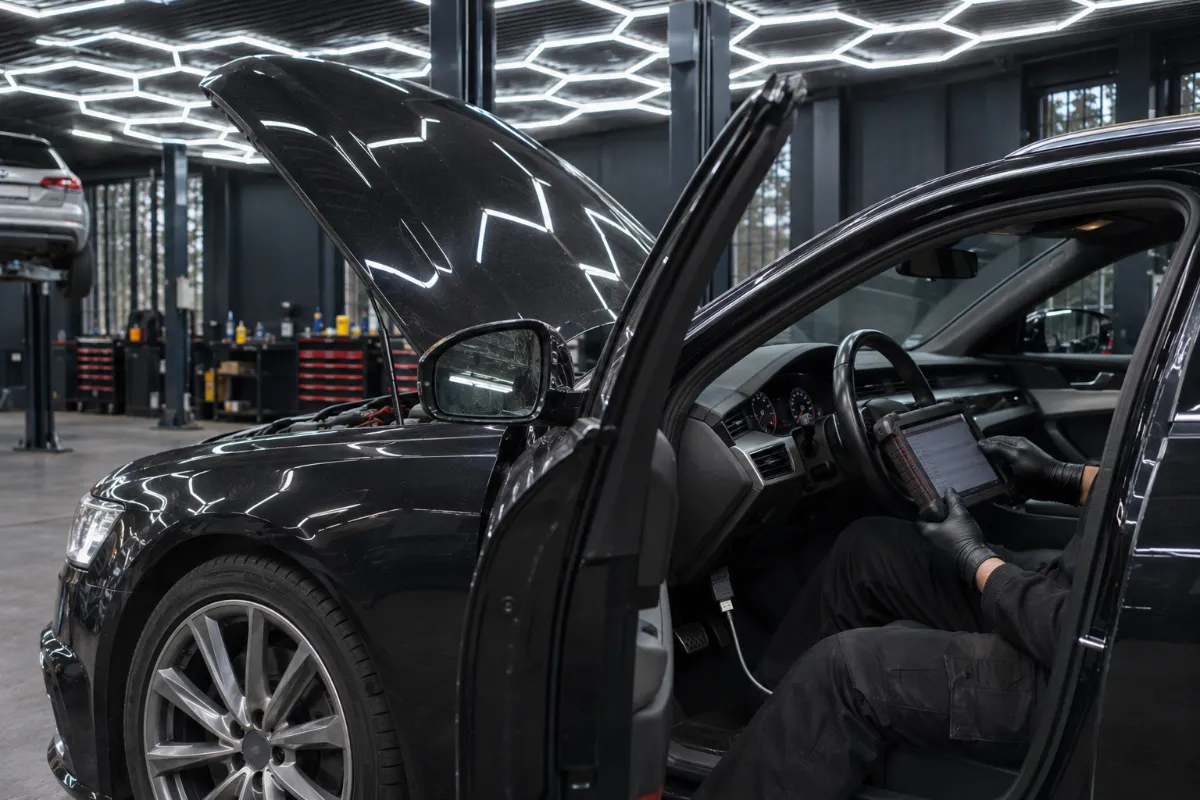
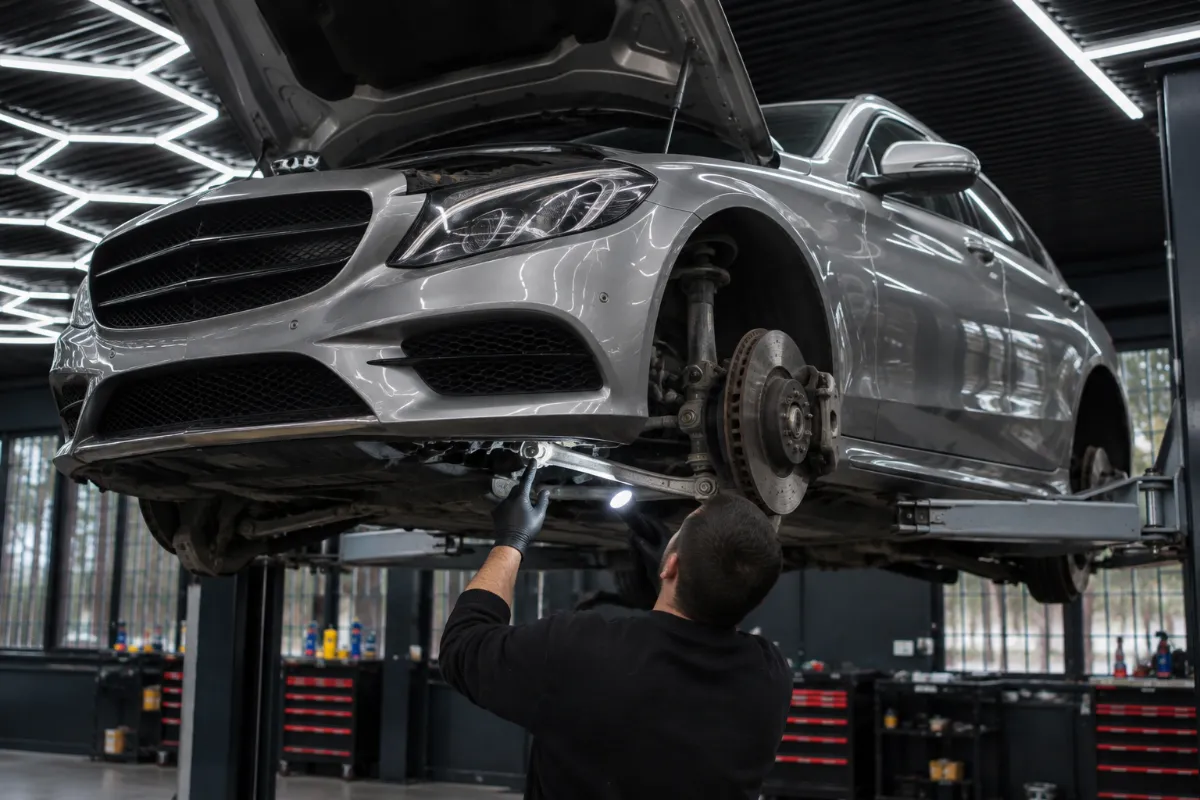
We start with a conversation and computer diagnostics of all control units: we read current and stored fault codes, camshaft correlation, injector corrections, gearbox parameters, DPF and AdBlue status, Airmatic levels and battery voltage. Then we inspect the car on a lift — leaks, suspension, brakes and underside. If needed, we carry out a cylinder endoscopy.
After the diagnosis you receive a written quote, and we start work only once you have approved it. We show you photos of what we found, and for bigger repairs, such as timing work, you can get access to an online camera. Warranty: 6 months on labour; on new parts according to the manufacturer's terms (usually 12–24 months); we give no workshop warranty on parts supplied by the customer. We serve customers in Polish, Ukrainian, Russian, English and Belarusian. You can book a visit online or call: +48 571 058 591.
How much Mercedes diagnostics and repairs cost
| Service | Price |
|---|---|
| Computer diagnostics | 100 zł |
| Suspension diagnostics | 100 zł |
| Oil and filter change | 120 zł |
| Wheel alignment (2 axles) | 300 zł |
| Front pads and discs | from 300 zł |
| Engine endoscopy | from 300 zł |
| Pre-purchase inspection | 300 zł |
| Automatic gearbox oil change | from 400 zł |
| Timing belt replacement | from 600 zł |
| Turbocharger replacement | from 600 zł |
| Timing chain replacement | from 1000 zł |
These are starting prices from our price list. On a Mercedes the cost depends heavily on the engine: the chain at the gearbox end of the OM651 or the timing on the V6 M272 takes many more labour hours than on a simpler engine. Repairs to the 7G-Tronic control plate, the OM642 oil cooler, the intake manifold, Airmatic or AdBlue are priced after diagnosis — the exact amount is always in the quote before work begins. We replace timing components as part of our timing replacement service.