DSG gearbox — fault symptoms, causes and diagnosis
Judder when pulling away, a knock between first and second, PRNDS flashing on the dash? We explain how the dry DQ200 differs from the wet DQ250 and DQ381, what fails most often, when to change the oil and how we diagnose the gearbox.
8 min read · Pulsecar team · updated:
DSG gearbox — the short answer
The most common DSG fault symptoms are judder or shudder when pulling away, knocks on the 1–2 shift (and on the 2–1 downshift just before stopping), a delay after selecting D or R, a gearbox fault message, and flashing PRNDS letters with the gearbox dropping into limp mode. Most of these come down to three things: worn clutches, the mechatronics unit (control unit plus hydraulics) and, in wet gearboxes, old oil.
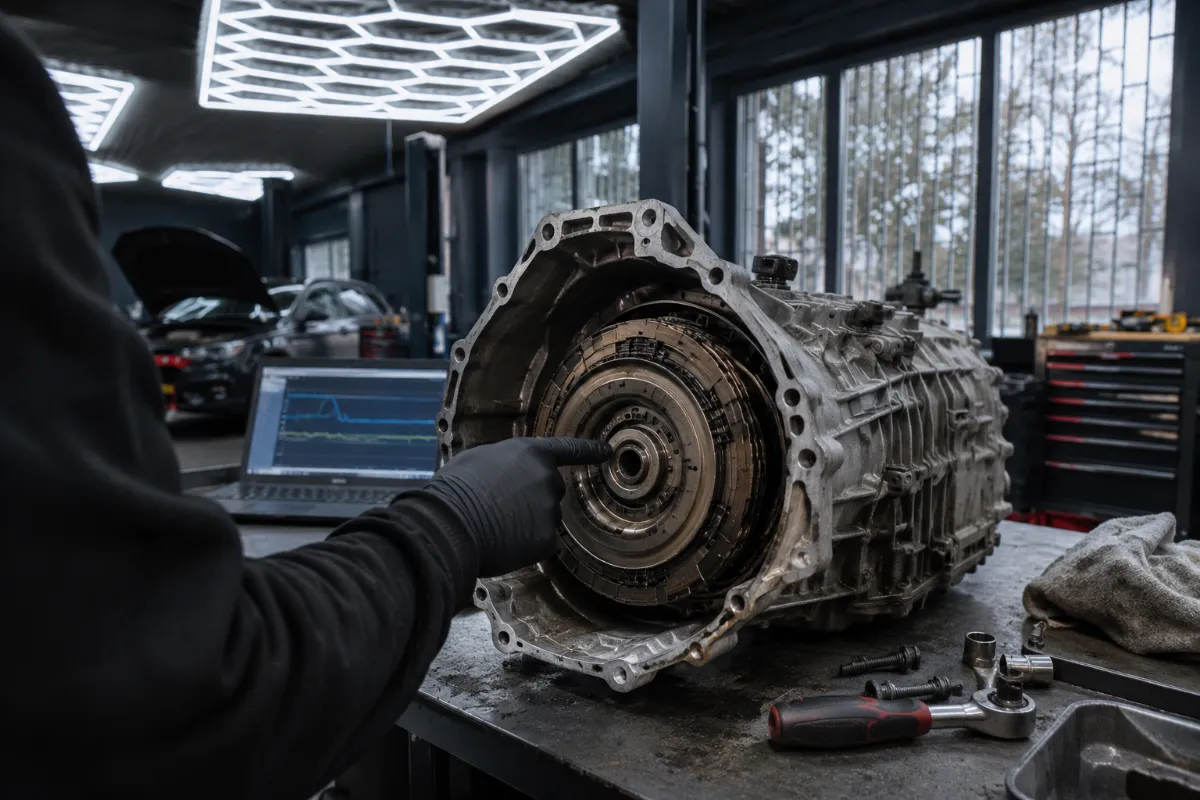
A lot depends on which DSG you have. The dry seven-speed DQ200 has different typical faults from the wet DQ250, DQ381 or DQ500, and only the wet gearboxes have scheduled oil changes. Below we show how to identify the gearbox type, what each symptom means, when it is still OK to drive and what diagnosis at the workshop looks like.
Dry or wet DSG — which one do you have?
| Gearbox | Clutches and gears | Where it is fitted | Oil |
|---|---|---|---|
| DQ200 (0AM, 0CW) | 2 dry clutches, 7 gears | Smaller, lower-torque engines, e.g. 1.0–1.5 TSI and 1.6 TDI in VW, Skoda, SEAT and Audi | Gear oil plus a separate mechatronics fluid, no scheduled change in the service plan |
| DQ250 (02E) | 2 wet clutches, 6 gears | Stronger engines, e.g. 2.0 TDI and 2.0 TSI, also 4x4 cars | Shared oil for clutches and mechatronics, changed with the filter at intervals |
| DQ381 (0GC) | 2 wet clutches, 7 gears | Successor to the DQ250 in newer cars with stronger engines | Oil and filter changed at intervals |
| DQ500 (0BH, 0BT) | 2 wet clutches, 7 gears | High-torque and heavier vehicles, including vans and performance models | Oil and filter changed at intervals |
The easiest way to identify the gearbox is the gearbox code on the service sticker or in the VIN data — Audi calls the same design S tronic. As a rule of thumb: a small TSI petrol or 1.6 TDI with seven gears is very often a DQ200; a more powerful 2.0 TDI or a 4x4 car usually has a wet gearbox. A diagnostic scan gives the definitive answer.
The most common DSG fault symptoms
- Shudder and judder when pulling away, especially when cold, uphill or creeping in traffic.
- A knock or jerk on the 1→2 shift and on the 2→1 downshift just before stopping.
- A delay after selecting D or R — the car only moves after a second or two, sometimes with a noticeable clunk.
- High revs when pulling away without matching acceleration — a sign of a slipping clutch.
- Flashing PRNDS letters, a gearbox fault message, limp mode: the car only drives in some gears or will not move at all.
- A clutch overheating message (DQ200) after long periods in traffic or manoeuvring uphill.
- Knocks and metallic noises on gear changes, a speed-dependent hum — sometimes bearings, sometimes the dual-mass flywheel.
- Oil leaks around the gearbox or mechatronics unit.
Before assuming the worst, check the battery. The mechatronics unit is sensitive to voltage, and a weak battery can cause gearbox fault codes, odd shifts and even limp mode. With DSG faults, testing the battery is one of the first steps of diagnosis.
Judder when pulling away and between 1st and 2nd
In a dry DQ200, judder when pulling away is most often a worn dual clutch or adaptation values that have drifted. A dry clutch works much like one in a manual gearbox, except that the mechatronics unit operates it instead of your foot. As the linings wear and the release mechanism develops more play, the control unit finds it harder to keep the take-off smooth. Symptoms get worse in traffic and on hills, because that is when the clutch slips the longest and gets hottest.
Jerks between first and second and on the downshift just before stopping can come from drifted adaptations, a worn clutch or pressure problems in the mechatronics. Sometimes simply running the adaptation with a diagnostic tool helps, but if the clutch is already worn the effect is short-lived. In wet gearboxes, old degraded oil produces similar symptoms — so with a DQ250 or DQ381 we first check the oil change history.
You also need to rule out other components. Shudder when pulling away and knocks at idle are often caused by a worn dual-mass flywheel, and high revs without acceleration are the classic picture of clutch slip, which we cover in more detail in the article on a slipping clutch. Misfires and worn engine mounts can also cause jerking that feels like a gearbox fault.
Flashing PRNDS, limp mode and the mechatronics unit
The mechatronics unit is the gearbox control unit combined with a hydraulic block: valves, sensors and — in the DQ200 — its own pump with a pressure accumulator. It decides when and how firmly the clutches engage and which gear is selected. When the control unit detects a fault it cannot work around, it switches to limp mode and the PRNDS letters flash on the dash or a gearbox fault message appears.
Typical DQ200 mechatronics faults are a loss of hydraulic pressure (a cracked pressure accumulator housing, a worn pump), faulty valves and position sensors, and failures of the electronics itself. In wet gearboxes, problems with sensors, control valves and the control unit are more common, and the condition of the oil directly affects how the hydraulics work. Not every mechatronics fault means replacing the unit — some fault codes come from voltage, connectors, adaptations or worn clutches, so we decide only after a full diagnosis.
If PRNDS is flashing and the car only drives in some gears or will not move, keep driving to a minimum. A short trip is sometimes possible, but driving further in limp mode can make the damage worse. Note when the fault appeared and whether it clears after restarting — this helps a lot with diagnosis.
Symptom → likely cause → what to do
| Symptom | Likely cause | What to do |
|---|---|---|
| Shudder when pulling away (DQ200) | Worn clutch, adaptations, sometimes the dual-mass flywheel | Diagnosis and clutch wear check in live data |
| Jerk on 1→2 or on the 2→1 downshift | Adaptations, worn clutch, mechatronics pressure | Fault code scan, adaptations, test drive |
| Jerking in a wet DSG, oil not changed for a long time | Degraded oil, clogged filter | Oil and filter change, then adaptations |
| High revs without acceleration | Clutch slip | Limit driving, clutch diagnosis |
| PRNDS flashing, limp mode | Mechatronics, sensors, hydraulic pressure, voltage | Do not drive further than necessary, fault code scan |
| Clutch overheating message | Long periods of clutch slip, worn clutch | Stop, let the gearbox cool, check wear |
| Knocks at idle, vibration at low revs | Dual-mass flywheel | Check the flywheel before deciding on the clutch |
| Oil marks under the gearbox | Gearbox or mechatronics leak | Locate the leak, check the level |
The table is a starting point, not a diagnosis. The same symptoms can have several causes at once — for example a worn clutch and a tired dual-mass flywheel — so we always confirm them with a diagnostic scan and a test drive.
DSG oil — when to change it
In wet DSGs (DQ250, DQ381, DQ500) the oil cools and lubricates the clutch packs and is also the working fluid for the mechatronics. Over time it loses its properties and collects wear particles from the clutch linings, leading to jerking and uneven operation. The manufacturer specifies periodic oil changes together with the filter — the exact interval depends on the gearbox and model year, so check your car’s service plan. In practice, with city driving, towing or more powerful engines it makes sense not to stretch the change beyond the recommendation, and rather to do it earlier.
In the dry DQ200 the service plan does not include a scheduled change of the gear oil or the mechatronics fluid. The oil is checked and changed during repairs or when there are specific symptoms. After an oil change or a gearbox repair we run the clutch adaptations with a diagnostic tool. The procedure is described in our guide to automatic gearbox oil changes, and you will find the service itself on the ATF oil change page.
A DSG needs oil to the specification the manufacturer lists for that particular gearbox. A universal “automatic transmission” oil is not a good idea — wet clutches are sensitive to the oil’s friction properties.
How we check it at Pulsecar
- 1A conversation with you: when the symptoms appear, cold or warm, at what speed and in which gear, and whether there was a message on the dash.
- 2Battery and charging voltage test — a weak supply can cause mechatronics fault codes.
- 3Reading gearbox and engine fault codes and live data: clutch wear, adaptation values, temperature and hydraulic pressures.
- 4A test drive with the diagnostic tool connected, logging parameters during take-off and gear changes.
- 5Checking for leaks, the oil level and condition (in wet gearboxes) and the engine and gearbox mounts.
- 6Where justified — adaptations or basic settings and another test drive.
- 7A written quote explaining what we found, and work only after you approve it.
Computer diagnostics costs 100 zł. We show you photos and readings, and during major repairs you may get access to an online camera. We speak Polish, Ukrainian, Russian, English and Belarusian. Gearbox repairs are described on the gearbox repair page.
How to drive so a DSG lasts longer
- In traffic, do not creep along on the throttle — wait on the brake and move off decisively when there is room.
- When stopped on a hill, hold the car on the brake, not the throttle; that way the clutch does not heat up.
- During longer stops with the engine running, use Auto Hold or P.
- Do not pull away hard on a cold gearbox and do not tow beyond the permitted limits.
- Change the oil in wet gearboxes according to the service plan, or earlier under heavy use.
- Do not ignore the first symptoms — drifted adaptations and old oil are cheaper to fix than a burnt-out clutch.
How much DSG diagnosis and repair costs
Computer diagnostics at Pulsecar costs 100 zł, and an automatic gearbox oil change — including wet DSGs — starts from 400 zł. The final price of the oil change depends on the gearbox, the amount of oil and the filter.
The cost of new clutches, repairing or replacing the mechatronics unit or a dual-mass flywheel depends heavily on the gearbox model, the engine and the extent of the damage. That is why we give it in the written quote after diagnosis, and we do not start work without your approval. We give a 6-month warranty on labour; new parts carry the manufacturer’s warranty, usually 12–24 months. You will find us at ul. Arkuszowa 176 in Bielany, Mon–Fri 09:00–18:00, Sat 09:00–15:00, phone +48 571 058 591.