Higher fuel consumption — causes, measurement and diagnosis
Higher consumption can be normal in winter and on short trips, but it often signals a fault: a dragging brake, worn spark plugs, a lambda sensor or the thermostat. We show how to measure consumption correctly and how we find the cause.
10 min read · Pulsecar team · updated:
Higher fuel consumption — the short answer
If your car has started using noticeably more fuel, the cause is most often something simple: low tyre pressure, a dragging brake, bad wheel alignment, winter and short trips, or a change in driving style. Among engine faults the most common are worn spark plugs or ignition coils, a faulty lambda (oxygen) sensor, a dirty mass air flow sensor, a thermostat that stays open and does not let the engine warm up, and leaking injectors. Less often the cause is a slipping clutch or — in a diesel — frequent DPF regeneration.
Before you start looking for a fault, make sure consumption has really gone up. The trip computer is only an estimate, and a single tank driven in traffic jams and frost proves nothing. Below we show how to measure fuel consumption correctly, which causes are normal and which need a repair, and what diagnosis in the workshop looks like.
How to measure fuel consumption correctly
- Fill up to full — to the first automatic click of the nozzle, without topping up.
- Reset the trip meter.
- Drive normally, preferably for most of the tank, at least a few hundred kilometres.
- Fill up again to the first click, ideally at the same station and the same pump.
- Divide the litres you put in by the kilometres driven and multiply by 100 — that is consumption in l/100 km.
- Repeat the measurement 2–3 times and compare results from similar conditions: the same season, similar routes.
The most reliable method is “full tank to full tank”. It takes a few fill-ups, but gives a result you can compare with earlier ones and with other periods.
The trip computer calculates consumption from injector opening time and can differ from reality by a few percent either way. It shows trends well, but to judge whether the car “uses too much”, the full-to-full method is better. Also remember that wheels with a different circumference from the factory ones change the odometer reading, and therefore the result.
When higher consumption is normal — winter, route, driving style
- Winter: a cold engine takes longer to warm up and the control unit enriches the mixture in the meantime. Add winter tyres, heated windows, seats and mirrors, and sometimes warming the car up at a standstill. On short trips in frost consumption can rise by over ten percent, and on very short runs even more.
- Short trips and traffic jams: the engine often does not reach operating temperature, and in a jam the car burns fuel while standing still.
- Speed: air resistance grows very quickly with speed, which is why the difference between 120 and 140 km/h on the motorway is clearly visible in consumption.
- A roof rack, roof box, bikes on the roof, a trailer or a fully loaded car.
- Air conditioning — especially in hot weather and city traffic.
- An aggressive driving style: hard acceleration, late gear changes, frequent braking.
- Driving on LPG — in litres the car usually burns clearly more gas than petrol, which is normal given the different energy content of the fuel.
The warning sign is an increase that the conditions do not explain: the same route and season, yet a clearly higher result than before. Especially when it comes with other symptoms — loss of power, rough running, a smell of fuel, the engine warning light or the car pulling to one side.
Most common causes of higher fuel consumption — table
| Cause | What else you will notice | How to check it |
|---|---|---|
| Low tyre pressure | The car rolls less freely, tyres wear on the edges, sometimes the tyre pressure light | Measuring with a gauge on cold tyres, values from the sticker on the door pillar or fuel flap |
| Dragging brake (caliper, parking brake) | One wheel clearly warmer after driving, smell of hot brakes, the car coasts poorly in neutral | Checking that the wheels turn freely and the calipers work on the lift |
| Bad wheel alignment | Pulling, off-centre steering wheel, uneven tyre wear | Alignment measurement |
| Worn spark plugs or a faulty ignition coil (petrol) | Jerking, rough running, loss of power, flashing engine light | Reading fault codes and misfire counters, inspecting the plugs |
| Lambda sensor, mass air flow sensor, coolant temperature sensor | Engine light (not always), loss of power, sometimes black smoke in a diesel | Live data: fuel trims, lambda signal, MAF reading, coolant temperature |
| Thermostat stuck open | The engine takes long to warm up, weak heating, temperature gauge low | Coolant temperature in live data, typical fault code P0128 |
| Leaking or dirty injectors | Rough running, smoke, smell of fuel, harder starting | Fuel trims; in a diesel, measuring leak-off and injector corrections |
| Slipping clutch | Revs rise but the car does not accelerate in proportion | Test drive, test in a high gear |
| Frequent DPF regeneration (diesel) | Fan runs after switching off, raised idle, DPF light | Live data: filter load, number and course of regenerations |
| Clogged air filter | In newer cars mainly a loss of power; the effect on consumption is usually smaller than in older engines | Inspecting the filter, comparing with mileage since the last change |
The table helps narrow down the search. Many of these faults give additional symptoms that are worth noting before visiting the workshop.
Tyres, brakes and alignment — higher rolling resistance
The cheapest causes of high fuel consumption to fix lie outside the engine. An under-inflated tyre deforms more, has higher rolling resistance and heats up — the engine has to overcome that resistance every kilometre. Check the pressure once a month and before a long trip, on cold tyres. The tyre type also matters: wide wheels and an aggressive winter tread usually increase consumption compared with narrower summer tyres.
A dragging brake is a common and sneaky cause. A seized caliper piston or slide pin, or a parking brake that does not fully release, makes the pad rub against the disc all the time. The car drives as if the brake were lightly applied: consumption rises, the disc overheats and the pads wear faster. Typical signs are one wheel clearly warmer after driving, a smell of hot brakes and pulling. More about brake repairs is on the brakes page.
Incorrect toe means the tyres are constantly being dragged slightly sideways across the asphalt. That mainly means faster tyre wear, but also higher rolling resistance. When to do an alignment is covered in our guide wheel alignment — when, and pulling to one side in the article car pulls to one side.
A simple test for a dragging brake: after a calm drive without hard braking, go to the wheels and, from a safe distance, bring your hand close to the rims without touching the discs. If one rim is clearly warmer than the others, the brake on that wheel is worth checking.
Ignition, sensors and injectors — when the engine meters fuel incorrectly
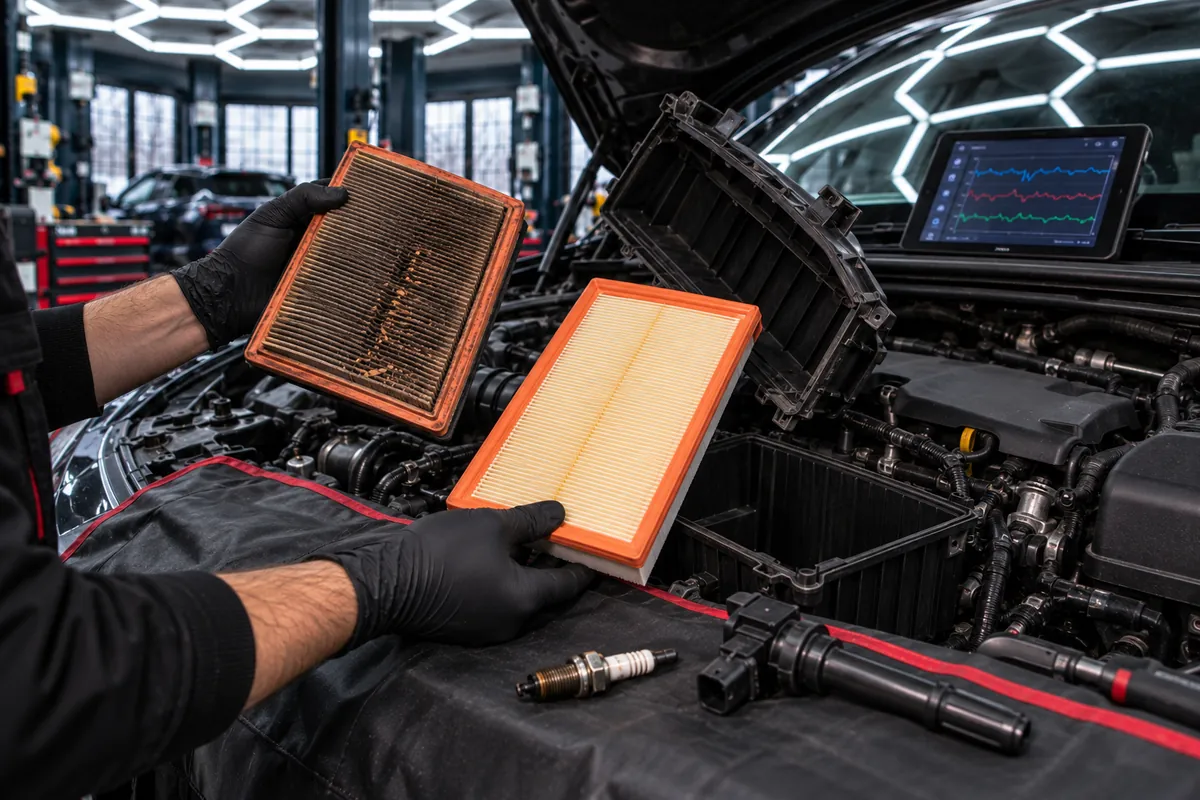
- Spark plugs and ignition coils: a worn plug or faulty coil causes misfires — the fuel in that cylinder does not burn properly. Power drops, consumption rises, and unburnt fuel can damage the catalytic converter. A flashing engine light means you should limit driving.
- Lambda sensor: an ageing sensor reacts more slowly, and a failed one can make the control unit switch to a limp mode with a richer mixture.
- Mass air flow sensor: when dirty or faulty it under- or over-reads the air. The result can be loss of power, jerking and higher consumption.
- Coolant temperature sensor: if it says the engine is cold while it is warm, the control unit keeps enriching the mixture as during a cold start.
- Injectors: a leaking injector drips instead of atomising fuel, and a dirty one gives a poor spray. In diesels worn injectors may have excessive leak-off.
- Leaks in the intake or boost system, the EGR valve, carbon on the intake valves — they disturb the amount of air and combustion, and the driver, feeling the lack of power, presses the accelerator harder.
Many of these faults turn on the check engine light, but not all — the control unit stores a fault only after certain thresholds are exceeded. That is why, with suspicious consumption, diagnostics are worth doing even when the light is off. In diesels and turbo engines also see our guides EGR valve and turbocharger failure symptoms, and for direct-injection engines the article intake cleaning.
Thermostat, clutch and DPF — less obvious causes
A thermostat stuck open sends coolant through the radiator straight away. The engine takes a very long time to warm up, and in winter on the road it may never reach operating temperature at all. The control unit treats it as cold and adds more fuel. Signs: the temperature gauge lower than usual, weak cabin heating, sometimes fault code P0128. Replacing a thermostat usually means partly draining and refilling the coolant. If, on the other hand, the engine overheats, read the article engine overheating.
A slipping clutch does not transfer all the power to the wheels — the revs rise, but the car accelerates less. Part of the energy turns into heat on the clutch disc, so consumption rises and the clutch wears ever faster. How to recognise it is covered in our guide slipping clutch. In automatics a similar effect can come from incorrect operation of the torque converter lock-up clutch or worn fluid — more in the article automatic transmission oil change.
In diesels with a particulate filter the control unit periodically burns off the soot by injecting extra fuel. When driving mainly short distances, regenerations can be frequent and interrupted, which raises consumption and speeds up dilution of the oil with fuel. If the filter light is on, see the article DPF warning light.
How we diagnose high fuel consumption
- 1A talk with the driver: how much consumption has risen, how it was measured, since when, whether after a fill-up, a repair or a tyre change, and which routes dominate.
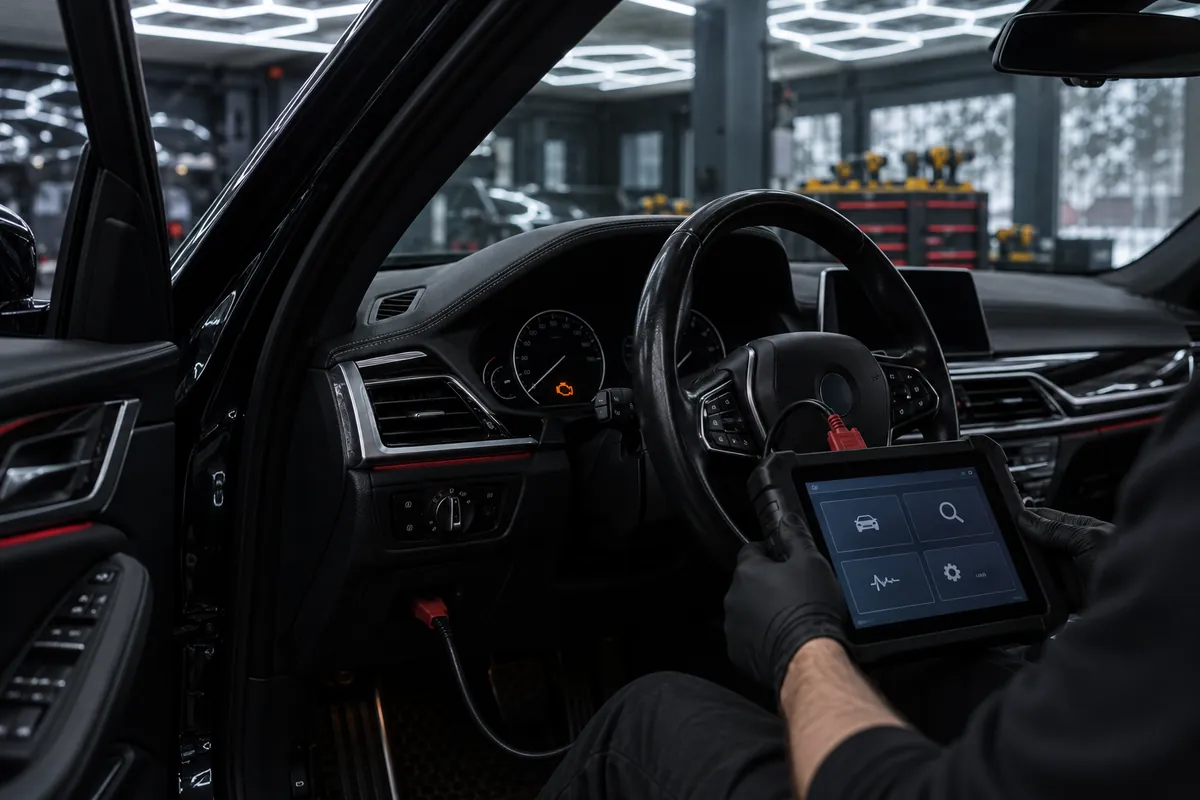
- 2Computer diagnostics: reading fault codes from the engine control unit and, if the car has them, the gearbox and other modules.
- 3Live data analysis: whether the engine reaches operating temperature, short- and long-term fuel trims, lambda sensor operation, MAF reading, misfire counters, and in a diesel the DPF condition and regeneration history.
- 4A test drive: we check whether the clutch slips, whether the automatic gearbox shifts correctly and whether the car coasts freely in neutral.
- 5On the lift: free rotation of the wheels and brake operation, tyre condition and pressure, signs of uneven wear, fuel leaks, air filter condition.
- 6If needed, a detailed check of the indicated component: plugs and coils, intake tightness, injectors or thermostat.
- 7Presenting the result and a quote for approval — only then do we order parts and start work.
Live data tells the most. For example, clearly positive long-term fuel trims mean the control unit has to add fuel because it “sees” a lean mixture — more often with an intake leak or an under-reading MAF. Clearly negative trims mean there is too much fuel — e.g. because of a leaking injector. A coolant temperature that does not reach the typical value on a warm engine points to the thermostat. Interpretation always depends on the specific engine, so we combine the result with a test drive and inspection.
How much does diagnosing and fixing high fuel consumption cost in Warsaw
| Service | Price (labour) |
|---|---|
| Computer diagnostics (fault codes and live data) | 100 zł |
| Air filter replacement | 40 zł |
| Fuel filter replacement | 40 zł |
| Pads and discs replacement — front / rear | 300 zł / 350 zł |
| Wheel alignment — 1 axle / 2 axles | 150 zł / 300 zł |
| Coolant replacement | 200 zł |
| Clutch replacement | from 600 zł |
| Spark plugs, coils, lambda sensor, MAF, thermostat, injectors, caliper repair | quoted after diagnosis |
Prices are for labour at Pulsecar; parts are quoted separately depending on the model. The cost of the repair depends on what diagnosis reveals — which is why we start with computer diagnostics for 100 zł, and before work starts you receive a quote for approval. We give a 6-month warranty on labour. The full list is in our price list.
More about electronics and sensor diagnostics is on the auto electrician page, and about mechanical repairs on the general repair page.
High fuel consumption in Warsaw Bielany — Pulsecar, ul. Arkuszowa 176
Has your car suddenly started using more fuel? We will find the cause at the Pulsecar workshop at ul. Arkuszowa 176 in Warsaw’s Bielany district, convenient for drivers from Żoliborz, Bemowo and Łomianki. We are open Monday to Friday 09:00–18:00 and Saturdays 09:00–15:00.
The easiest way is to book online or call +48 571 058 591. Note how much consumption has risen, how it was measured and whether other symptoms appeared — that speeds up the diagnosis. Directions and contact details are on the contacts page.