Turbo Failure Symptoms — How to Recognise a Bad Turbocharger
Power loss, whistling or smoke do not always mean a broken turbo — often a hose, actuator or sensor is to blame. We explain how to spot a real turbo failure, why turbos fail and what replacement costs.
9 min read · Pulsecar team · updated:
Signs of a failing turbo — short answer
The most common symptoms of a failing turbocharger are a noticeable loss of power (often with the engine going into limp mode), a loud whistle or whine that rises with revs, blue or black smoke from the exhaust, quickly disappearing engine oil and oil in the intake and intercooler. Usually a check engine light with a boost pressure fault comes on as well.
Important: the same symptoms are very often caused by something other than the turbo itself — a split intercooler hose, sticking variable-geometry vanes, a faulty actuator, control valve or sensor. That is why a turbo should never be replaced on symptoms alone. Below we explain how to tell a turbo failure from faults in the surrounding system, why turbos fail and what turbo replacement costs in Warsaw.
How a turbocharger works and what goes wrong
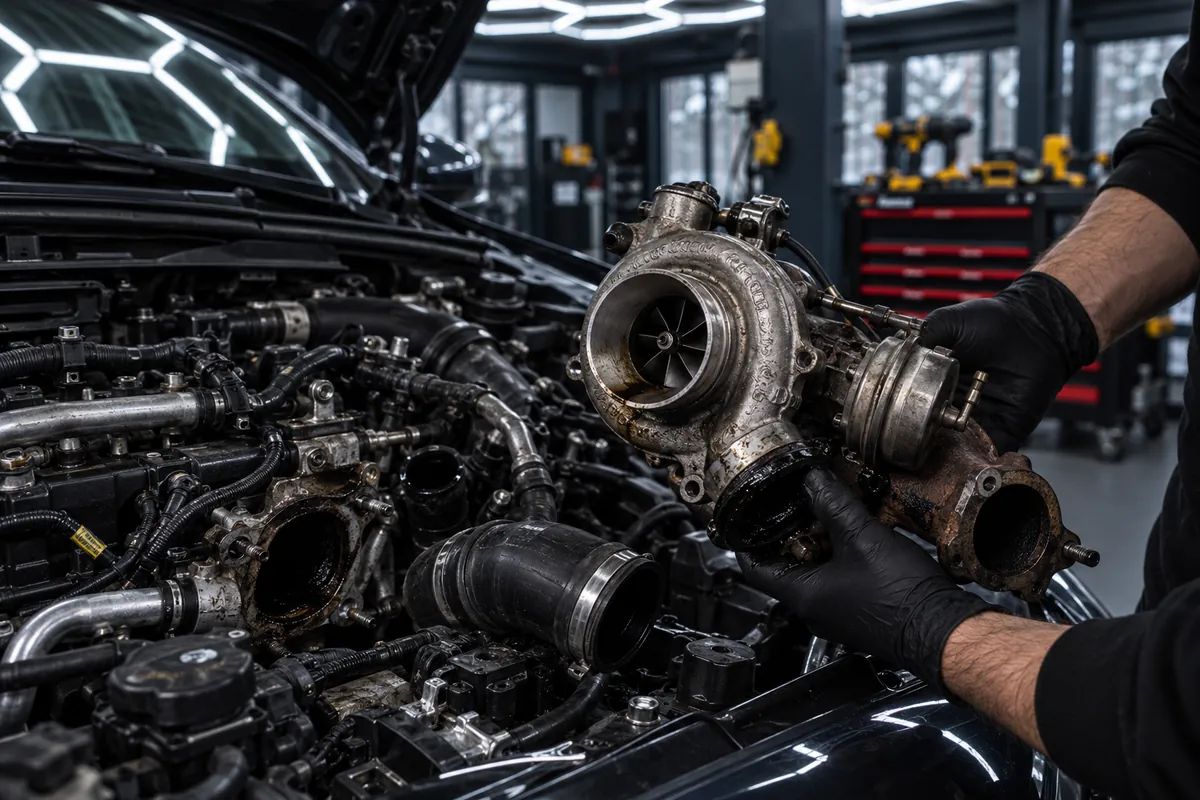
A turbocharger consists of two wheels on a common shaft. Hot exhaust gas drives the turbine wheel, which spins the compressor wheel that pushes compressed air into the engine. This lets a smaller engine produce the power of a larger naturally aspirated one. The shaft spins extremely fast — in small turbos often over 150,000–200,000 rpm — and the exhaust side runs at several hundred degrees Celsius.
The shaft bearings are lubricated and cooled by engine oil, and in many newer designs also by coolant. That is why a turbo is so sensitive to oil quality and supply: a few seconds without lubrication is enough to damage the bearings.
Boost pressure is controlled by a wastegate in petrol engines or by variable vane geometry (VNT/VGT) in most diesels. They are moved by actuators — vacuum ones with a solenoid valve, or electronic ones. The engine ECU compares target and actual pressure measured by a sensor, and when the difference is too large it stores a fault code and limits power.
In practice three groups of components fail: the mechanical part of the turbo (bearings, shaft seals, wheels), the control system (VNT vanes, wastegate, actuator, control valve) and the turbo’s surroundings (hoses, intercooler, sensors, mass air flow meter, DPF). Only the first group always means repairing the turbo itself.
7 signs of turbo failure
- Loss of power and weak acceleration, especially from mid revs — the car no longer “pulls” like before.
- Limp mode: the engine suddenly loses power, will not rev, and after switching off and restarting it briefly returns to normal (see also car jerking and losing power).
- A whistle, whine or “siren” rising with revs, or metallic grinding from the turbo area.
- Blue or bluish-grey smoke from the exhaust, especially after idling for a while or when accelerating (exhaust smoke — what the colour means).
- Black smoke from a diesel under acceleration — the engine gets too little air for the amount of fuel.
- Rapid oil consumption without visible leaks under the car.
- Oil in the boost hoses, intercooler or throttle body — more than a thin oily film.
A single symptom rarely proves the turbo has failed. The combination most typical of worn bearings is a whine rising with revs, oil consumption and blue smoke. Loss of power with a boost fault on its own more often turns out to be a control fault or a leak.
If a sudden metallic grinding comes from the engine and thick blue smoke pours from the exhaust, do not keep driving. The wheel may be rubbing on the housing and fragments can enter the engine. In a diesel, oil from a failed turbo can also fuel so-called engine runaway — a rare but very dangerous situation where the engine revs up by itself and does not respond to the key.
Warning light on and the car lost power? Do not clear the fault yourself and do not drive long distances in limp mode. The stored fault with data from the moment it occurred (freeze frame) helps the diagnosis a lot.
Turbo or something else? The most common mix-ups
| Symptom | When it really is the turbo | More common cause outside the turbo |
|---|---|---|
| Loss of power, limp mode, underboost fault | Damaged vanes or wheels, excessive shaft play | Split intercooler hose, loose clamp, leaking intercooler, control valve, actuator, blocked DPF |
| Limp mode under hard acceleration, overboost fault | Seized VNT vanes or wastegate | Faulty solenoid valve, pressure sensor, leaking vacuum lines |
| Whistling or hissing | Whine rising with revs, grinding, wheel rubbing | Leak on the boost side or on the exhaust side before the turbo (e.g. manifold, gasket) |
| Blue smoke, oil consumption | Worn shaft seals, blocked turbo oil return | Valve stem seals, piston rings, faulty crankcase ventilation (PCV) |
| Black smoke (diesel) | Turbo does not build pressure | Intake leak, EGR valve, mass air flow meter, injectors |
| Oil in the intercooler | Leaking through the compressor-side seals | Crankcase ventilation and a worn engine — oil mist returns to the intake |
The table shows typical relationships, not a rule for every engine. The conclusion is simple: before you replace a turbo costing several thousand złoty, check the hoses, actuator, controls and sensors. Replacing a healthy turbo will not cure the problem, and a new one can quickly fail for the same reason as the old one.
In diesels one of the most common “false alarms” is sticking variable-geometry vanes. They get clogged with soot during short trips and low-rev driving, and then the ECU sees too little pressure one moment and too much the next. Some of these cases can be solved by cleaning, without replacing the whole turbo — as long as the mechanism is not worn.
Oil in the intercooler — when it is normal and when it is a warning
A thin oily film in the boost hoses and intercooler is normal in most engines. It comes from the crankcase ventilation system, which routes blow-by gases carrying oil mist back into the intake. A slightly “sweaty” hose does not mean a broken turbo.
A warning sign is oil that collects in a puddle, drips from a disconnected hose or floods the throttle body. Then the source must be found: worn turbo seals, a blocked turbo oil return line (the oil cannot drain and is pushed past the seals), excessive crankcase pressure in a worn engine, or a blocked breather.
A large amount of oil in the intercooler must not be ignored — especially in a diesel. Under hard acceleration the accumulated oil can be sucked into the cylinders. After a turbo replacement the intercooler and hoses must always be cleaned, otherwise remnants of old oil and debris will end up in the new turbo or the engine.
Why turbos fail
- Oil starvation — low oil level, a blocked turbo oil feed line, a failing oil pump, or starting the engine after a turbo replacement without priming it with oil.
- Poor oil quality — extended change intervals, oil not meeting the manufacturer’s specification, fuel dilution from frequent DPF regenerations. Contaminated oil acts on the bearings like grinding paste.
- Switching off a hot engine straight after hard driving — oil in the bearings overheats and cokes, clogging the oil passages.
- Foreign objects — a piece of air filter, a clamp, a nut or a damaged engine part hits the wheel.
- Turbo overspeed — with an intake leak, a clogged air filter or DPF the turbo spins faster to maintain the target pressure.
- A blocked oil return or high crankcase pressure — oil leaks past the seals.
- Unprofessional modifications (e.g. raising boost beyond what the turbo can handle) and driving with faulty controls.
A turbo rarely “dies of old age”. In the vast majority of cases it is the victim of a problem with oil, air supply or exhaust back pressure. That is why with every replacement we look for the cause of the failure — otherwise the new turbo may end the same way.
Be careful with the popular advice “always wait a few minutes after every drive”. In normal, calm driving this is not needed, and many newer water-cooled turbos have an auxiliary coolant pump that runs after the engine is switched off. Cooling down matters after hard driving: simply drive the last few kilometres gently or let the engine idle for a few dozen seconds before switching off.
The cheapest turbo protection is a regular oil and filter change with oil meeting the manufacturer’s specification. If you drive mainly in the city, do not stretch “long life” intervals to the maximum.
How we diagnose a turbocharger
- 1Talking about symptoms: when the loss of power happens, at what revs, whether the car uses oil and how it smokes.
- 2Computer diagnostics: reading fault codes with freeze-frame data and comparing target and actual boost pressure, mass air flow readings and actuator operation — also during a test drive.
- 3Checking intake tightness: hoses, clamps, intercooler and, if needed, a boost system leak test.
- 4Checking the actuator and controls: actuator rod movement, vacuum lines, control valve, variable-geometry vanes or wastegate.
- 5Inspecting the turbo: shaft play (axial and radial within the normal range for the bearing type), signs of wheel rubbing, damaged blades, oil on the compressor and exhaust side.
- 6Checking root causes: oil condition, feed and return lines, crankcase pressure, DPF and air filter restriction.
- 7We present the result and a quote for approval — only then do we start work.
A fault code such as “boost pressure too low” only says that the pressure differs from what was expected — it does not identify the faulty part. That is why turbo diagnosis combines a computer readout with measurements and inspection. A note on play: a small, noticeable shaft play in turbos with journal bearings is normal; the problem is the wheel touching the housing and play beyond specification.
Rebuilt or new turbo — which to choose
When the turbo really is damaged, there are usually three routes: a new turbo (original or a good-quality aftermarket unit), a remanufactured turbo, or replacing only the core cartridge (shaft with wheels and bearings in the centre housing) while keeping the healthy outer housings. Which option is available and makes sense depends on the engine model.
A proper rebuild includes new bearings and seals, balancing the core on a machine, and setting and checking the variable geometry. A cheap “rebuild” without balancing and calibration risks a quick repeat failure. In the quote we present the available parts options with prices, and the decision is yours.
If the only problem is sticking VNT vanes or a faulty actuator, cleaning them or replacing just the actuator is sometimes enough. This is not possible on every turbo — on some designs the electronic actuator is factory-calibrated together with the turbo.
What to replace together with the turbo
- Engine oil and oil filter — always, because the old oil may contain debris and carbon.
- The turbo oil feed line, or at least checking and flushing it; on many engines also the banjo bolts with filter screens.
- Gaskets for the manifold, turbo connections and oil lines — old ones do not guarantee a seal.
- The air filter, plus cleaning the intake, hoses and intercooler of oil and any wheel fragments.
- Checking the oil return line, crankcase ventilation and — in a diesel — DPF restriction.
Before the first start a new turbo is filled with oil, and after starting the engine idles for a moment until oil reaches the bearings. Skipping this step can destroy a new turbo within seconds.
If the engine burns a lot of oil for a reason other than the turbo, it is worth assessing its condition before buying an expensive part. An engine endoscopy helps here — a camera inspection of the cylinders without dismantling the engine.
Turbo replacement cost in Warsaw
| Service | Price | When it is needed |
|---|---|---|
| Computer diagnostics | 100 zł | Reading fault codes and boost parameters — the starting point of diagnosis |
| Turbocharger replacement | from 600 zł (labour) | Confirmed mechanical failure of the turbo |
| Oil and filter change | 120 zł (labour) | Always with a turbo replacement |
| Air filter replacement | 40 zł | With a turbo replacement or when the filter is dirty |
| Engine endoscopy | 300 zł | To check whether oil is being lost through a worn engine |
| Intercooler cleaning, actuator, hoses | after diagnosis | Scope depends on the cause of the failure |
The cost of a turbo replacement depends above all on the specific engine and access to the turbo (on some cars a lot of ancillaries must be removed, sometimes the subframe or manifold too), the price of the turbocharger itself and what has to be replaced along with it. Parts are priced separately in the quote, and the full list of services is on the Pulsecar price list.
Before work starts you receive a quote for approval, and we give a 6-month warranty on labour. You can read more about the service on the turbocharger replacement at Pulsecar page.
Turbo repair in Bielany — Pulsecar, ul. Arkuszowa 176
Pulsecar is located at ul. Arkuszowa 176 in Warsaw’s Bielany district, convenient for drivers from Żoliborz, Bemowo and Łomianki. We are open Monday to Friday 09:00–18:00 and Saturdays 09:00–15:00.
Call +48 571 058 591 or book a visit online. Describe the symptoms — loss of power, whistling, smoke or oil consumption. We will first establish whether the turbo or its surrounding system is to blame, and present a quote before any work begins.