Slipping clutch — symptoms, a simple test and repair
The engine revs up but the car does not speed up? That is the classic sign of a slipping clutch. We show how to check it, what causes it and why the repair should not be put off.
8 min read · Pulsecar team · updated:
Slipping clutch — short answer
A clutch is slipping when the engine revs rise as you press the accelerator but the car does not speed up accordingly — most noticeably in a high gear, uphill, when overtaking or with a loaded car. It is often accompanied by a burning smell and a clutch that bites very high. The most common cause is a worn clutch disc, but it can also be oil on the linings or a hydraulic fault.
A slipping clutch will not fix itself, and it gets worse faster with every kilometre. Below we show how to recognise it, how to do a simple test, what happens if you keep driving, and how long the repair takes and what it costs in Warsaw.
Why a clutch slips — how it works
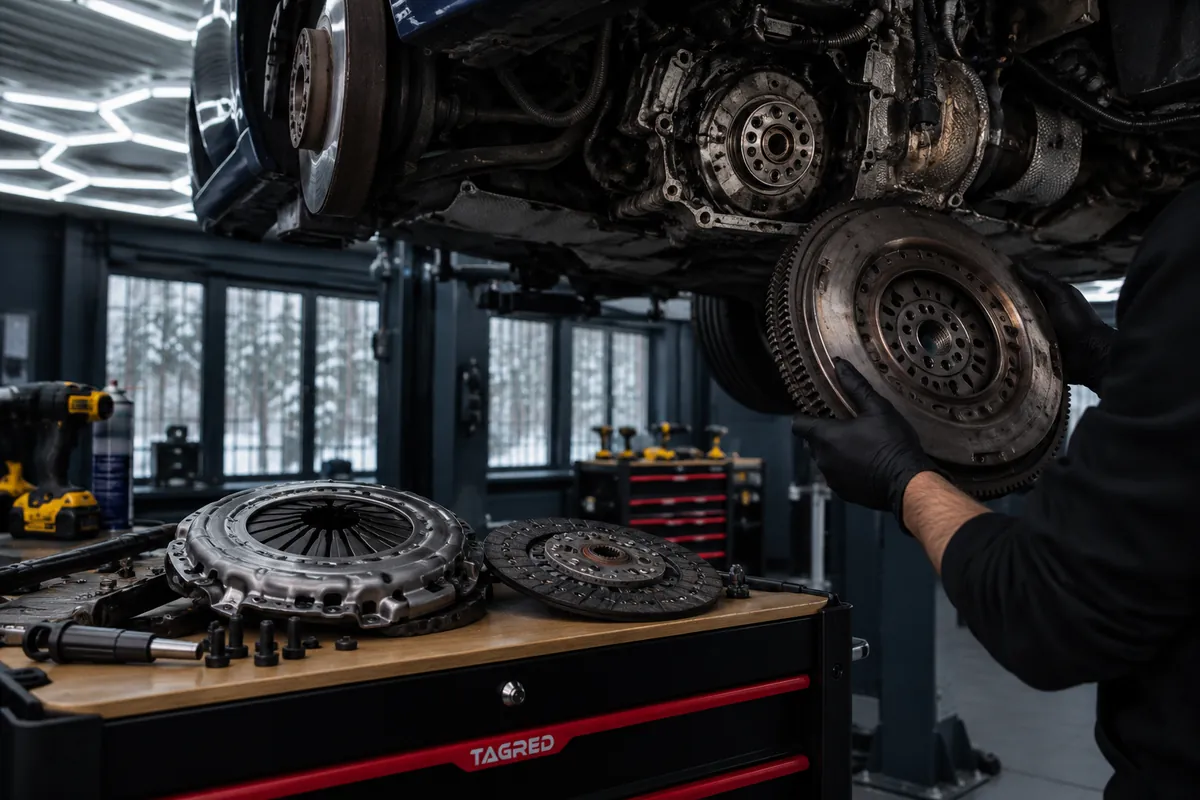
In a manual gearbox the clutch connects the engine to the gearbox. The clutch disc with its friction linings is clamped by the pressure plate (diaphragm spring) against the flywheel. Torque is transmitted by friction — as long as the clamping force and the grip of the linings are sufficient, the disc turns together with the engine.
Slip occurs when engine torque exceeds what the clutch can transmit. This happens when the linings are thin, glazed or oil-contaminated, when the pressure plate has weakened, or when something prevents the clutch from fully engaging — e.g. a slave cylinder that does not return. That is why slipping usually starts under the highest load: in high gears and at full throttle from low and medium revs.
This guide covers the clutch in a manual gearbox. Slipping in an automatic transmission has different causes — more on that under automatic transmission oil change and gearbox warning light.
7 signs of a slipping clutch
- Revs rise when you accelerate but speed rises much more slowly — the rev counter needle “jumps” up when overtaking or uphill.
- The problem appears first in high gears (4th, 5th, 6th) and under heavy load, later in lower gears too.
- A smell of burnt linings, similar to overheated brakes — after a climb, towing or in traffic.
- The clutch bites very high — the car moves off only when the pedal is almost fully released.
- The car accelerates noticeably worse and uses more fuel, even though the engine runs smoothly.
- Symptoms get worse when the clutch is hot, e.g. after several hill starts.
- In powerful diesels and cars with increased power — slip at full throttle in the rev range where the engine has peak torque.
Early slipping can be barely noticeable — the driver just feels the car has become “sluggish”. If you are not sure whether the engine is losing power or the clutch is slipping, watch the rev counter: with a weak engine, revs and speed rise slowly but together; with a slipping clutch, revs rise clearly faster than speed.
A high biting point on its own does not always mean the clutch is finished, but combined with revs that “run away”, it is an almost certain sign of a worn disc.
Simple test: is the clutch slipping?
- 1Choose an empty, straight stretch of road where you can safely accelerate within the law.
- 2With the engine warm, drive in a high gear (e.g. 4th or 5th) at low speed, around 1500–2000 rpm.
- 3Press the accelerator fully without touching the clutch pedal.
- 4Watch the rev counter and the speedometer: with a healthy clutch, revs and speed rise evenly. If the revs suddenly jump while the speed barely changes — the clutch is slipping.
- 5Do not repeat the test many times in a row — every slip heats and wears the linings further.
You can also find a stationary test online, with the handbrake on and a high gear engaged. We do not recommend it: it puts heavy load on the clutch, the brake and the engine mounts, and with a moment’s inattention the car can move. It is safer to check while driving or to leave the diagnosis to a workshop.
Causes of a slipping clutch
| Cause | Typical symptoms | What needs to be done |
|---|---|---|
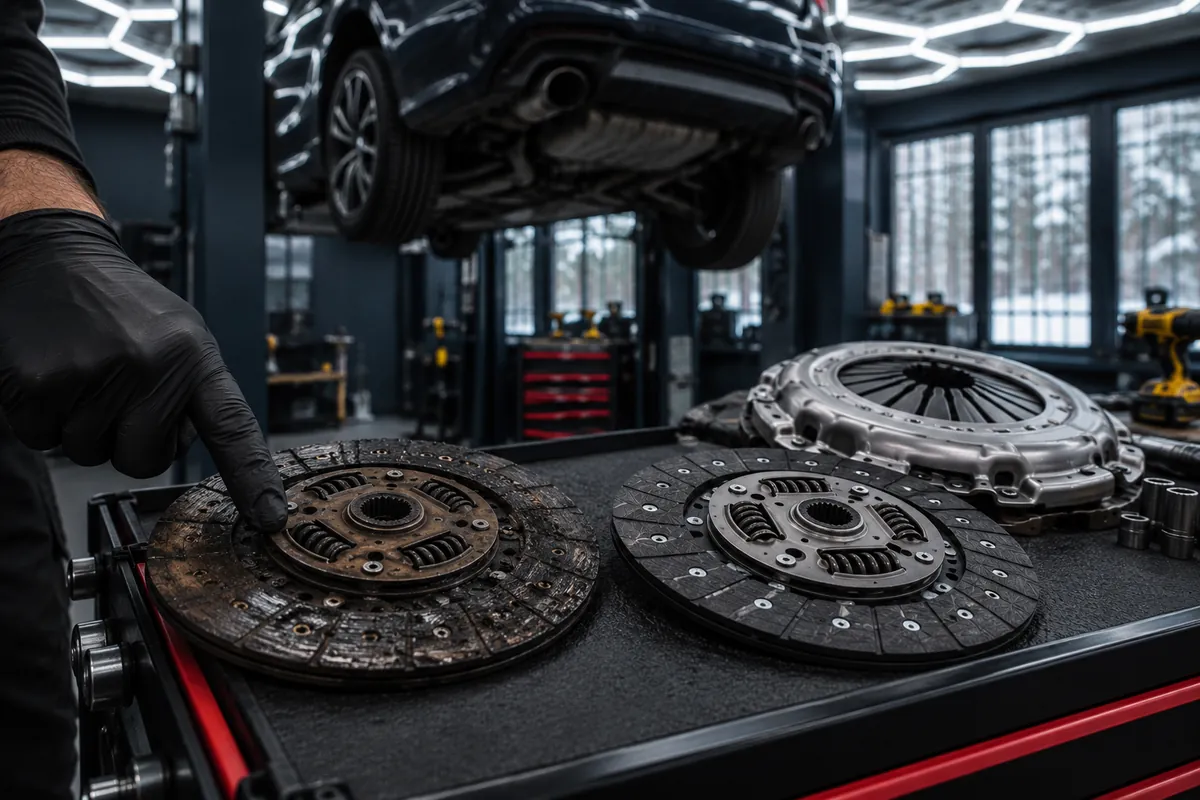
| Worn clutch disc linings | Gradually increasing slip, biting point getting higher | Replace the complete clutch: disc, pressure plate, bearing |
| Oil or grease on the linings | Slip and judder when pulling away, often appearing suddenly; oil traces between engine and gearbox | Fix the leak (crankshaft or gearbox seal) and replace the disc — an oily disc cannot be cleaned effectively |
| Overheated, glazed linings or a weakened pressure plate | Slip after hard driving, burning smell | Clutch replacement and assessment of the flywheel or DMF |
| Clutch hydraulic fault | Clutch does not fully engage, varying biting point, soft or sinking pedal | Check fluid, master and slave cylinder; bleed or replace the part |
| Sticking cable or self-adjuster (older cars) | Pedal feels heavy or uneven, slip despite modest mileage | Adjust or replace the cable and mechanism |
| Engine torque higher than the clutch is rated for (e.g. after chip tuning) | Slip at full throttle in the mid-rev range | A clutch of adequate capacity or a return to factory settings |
Most often slipping is simply the result of wear — the disc linings are a consumable, just like brake pads. How long they last depends heavily on driving style: lots of pulling away in traffic, holding the car on a hill with the clutch and launching at high revs shorten their life considerably.
In many cars the clutch hydraulics share a reservoir with the brake system. A dropping fluid level and dampness near the pedal or gearbox are a signal to check both systems — see also brake warning light. Oil spots under the car near the engine–gearbox joint are covered in leak under the car.
To make a new clutch last longer: do not rest your foot on the pedal while driving, hold the car on a hill with the brake rather than the clutch, and pull away at moderate revs.
Slipping clutch vs dual-mass flywheel and gearbox
Slipping is a symptom of the clutch itself — a worn dual-mass flywheel usually does not cause it. A DMF gives different signals: knocks when switching the engine off and starting it, vibration at idle, droning at low revs. However, the two parts work together, and an overheating, slipping clutch harms the DMF too. We cover this in detail in dual-mass flywheel — signs of wear.
If the problem is not slip but difficulty engaging gears, grinding or a whining gearbox, the cause may lie in the gearbox itself or in the clutch not fully disengaging — see gearbox problems.
What happens if you keep driving with a slipping clutch
- The slip quickly gets worse: every slip heats the linings, and hot linings slip even more easily.
- The flywheel or DMF overheats — discoloration, cracks and uneven surfaces appear, and then the flywheel has to be replaced along with the clutch.
- The pressure plate and release bearing can suffer, and if an oil leak is not fixed — every new disc as well.
- The car loses its ability to accelerate — overtaking or joining traffic becomes dangerous.
- Eventually the clutch stops transmitting drive: the engine runs but the car does not move, often in the least convenient place.
- Fuel consumption rises, because part of the energy turns into heat in the clutch.
The sooner you get to a workshop, the better the chance that the job ends with replacing just the clutch kit — without extra parts.
Until the repair, drive gently: pull away smoothly, avoid full throttle in high gears, towing and long climbs. It will not fix the clutch, but it limits the risk of further damage.
How we diagnose a slipping clutch
- 1We talk through the symptoms: since when it slips, in which gears, whether the car has had a power increase, when the clutch was last replaced.
- 2A test drive under load, assessing the biting point and pedal operation.
- 3Checking the hydraulic fluid, leaks at the master and slave cylinder and oil traces between the engine and gearbox.
- 4If needed, computer diagnostics (100 zł) — to rule out an engine-side loss of power and read fault codes, e.g. for the clutch pedal sensor.
- 5A quote for approval, and with the gearbox removed an assessment of the disc, pressure plate, bearing, flywheel or DMF and seals.
If after removal it turns out that extra parts are needed — e.g. a dual-mass flywheel or a crankshaft seal — we let you know and wait for your approval before ordering them.
Slipping clutch repair — time and cost in Warsaw
| Service | Price (labour) | When it is needed |
|---|---|---|
| Clutch replacement | from 600 zł | Worn, overheated or oil-contaminated disc, weakened pressure plate |
| Dual-mass flywheel | quoted after assessment | When after removal it shows excessive play, grease leak or overheating |
| Manual gearbox oil change | from 200 zł | If justified by the scope of the repair or the oil condition (oil extra) |
| Computer diagnostics | 100 zł | Ruling out engine-side problems, reading fault codes |
The repair cost depends on the model: the price of the clutch kit, whether the car has a dual-mass flywheel and access to the gearbox. Parts are priced separately in the quote, and the full list of services is on the Pulsecar price list. You approve the quote before work starts, and we give a 6-month warranty on labour.
Repair time depends on the car’s design and parts availability. In many front-wheel-drive cars a clutch replacement fits into one working day; with 4x4 drive or difficult gearbox access it may take longer. We give the exact timeframe together with the quote. More about the service: clutch replacement at Pulsecar.
Slipping clutch in Warsaw Bielany — Pulsecar, ul. Arkuszowa 176
Pulsecar is located at ul. Arkuszowa 176 in Warsaw’s Bielany district, convenient for drivers from Żoliborz, Bemowo and Łomianki. We are open Monday to Friday 09:00–18:00 and Saturdays 09:00–15:00.
Call +48 571 058 591 or book a visit online. Tell us when the clutch slips — we will find the cause and prepare a quote before any work begins.