Starter motor — failure symptoms, diagnosis, remanufacture or replace
A click instead of a start does not always mean a dead starter — a weak battery or a corroded earth behaves the same way. We explain how to find the real cause and when remanufacturing pays off.
9 min read · Pulsecar team · updated:
Symptoms of a failing starter motor — short answer
The most common symptoms of a worn or faulty starter motor are a single click when you turn the key (or press START) without the engine turning over, slow and laboured cranking despite a healthy battery, grinding or whining during cranking, a starter that spins “in the air” without turning the engine, and no reaction at all even though the warning lights and headlights work normally. Often the first sign is intermittent behaviour — the car starts only on the second or third attempt.
However, a weak battery, corroded terminals or a bad earth connection produce very similar symptoms. Replacing the starter “just in case” is a common and costly mistake, so below we explain how to tell these faults apart, what you can safely check yourself, how diagnosis works and when remanufacturing pays off versus replacement.
How a starter motor works and what wears out
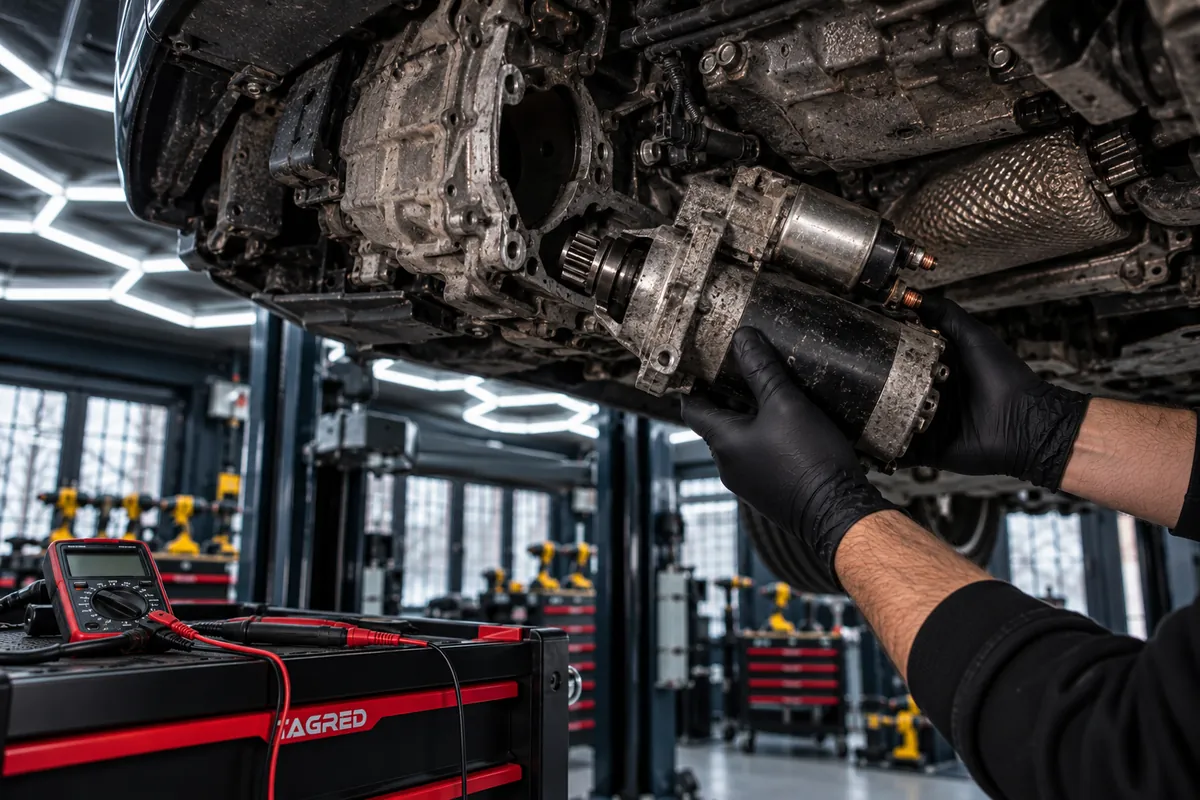
The starter is a DC electric motor fed directly from the battery through a thick cable. On its housing sits a solenoid, which does two things at once when you turn the key: it pushes the pinion with its drive mechanism (the bendix) forward so it meshes with the flywheel ring gear, and it closes the contacts that let a current of several hundred amps flow into the starter motor.
Once the engine fires, a one-way (overrunning) clutch in the bendix lets the pinion spin faster than the armature, and when you release the key a spring retracts the pinion. Many modern starters also have a planetary reduction gear, which lets a small, light motor deliver high torque.
The main wear items are the brushes and commutator, the solenoid contacts, the armature bushings or bearings and the bendix itself. In cars with start-stop the starter works many times more often, which is why manufacturers fit reinforced units. Durability depends heavily on operating conditions: short trips, frequent cold starts, a weak battery and oil dripping from a leaking engine all shorten its life.
7 signs of a failing starter motor
- A single loud click and then silence — the solenoid has engaged, but the starter motor does not turn (burnt contacts, worn brushes, a “dead spot” on the commutator). Note: a weak battery or a poor terminal contact can do the same.
- Rapid repeated clicking (“machine-gun” chatter) — usually voltage too low: the solenoid pulls in and drops out. The battery or connections are most often to blame, the starter itself less often.
- Slow, laboured cranking that does not improve after charging the battery — worn bushings, a rubbing armature or a short in the windings.
- Grinding or a metallic noise when cranking — the pinion does not mesh properly with the ring gear, or ring gear teeth are chipped.
- The starter whines but the engine does not turn — the bendix one-way clutch is slipping or the pinion is not moving out.
- No reaction, although the warning lights and headlights work normally — a break in the control circuit (fuse, relay, clutch pedal or P/N position switch, immobiliser) or a faulty solenoid.
- The starter keeps running after the engine has started, or whines after you release the key — sticking contacts or bendix. This symptom must not be ignored.
An intermittent symptom — the car sometimes starts normally and sometimes only clicks — is typical of worn brushes and contacts. The problem may “disappear” for a few days, but it usually returns more and more often, preferably on a frosty morning.
If the starter does not switch off after the engine starts, you smell burning or see smoke from the engine bay, switch off the ignition immediately. A starter running continuously overheats very quickly, and overheated cables are a fire risk — do not keep trying; have the car checked.
Before your visit, note down: exactly what you hear (one click, chatter, grinding, silence), whether the dashboard lights dim at that moment, and whether the problem occurs with a cold or a warm engine. These are the three most useful clues for the technician.
Starter, battery or earth — how to tell the symptoms apart
| Symptom | More likely cause | How to recognise it |
|---|---|---|
| Rapid chatter, dashboard lights dim strongly or go out | Discharged or worn battery | After charging or a jump start the engine cranks normally |
| One click, lights do not dim | Starter (contacts, brushes) or a break in the main cable | Battery is fine, but current does not reach the starter motor |
| One click, lights dim strongly | Weak battery, corroded terminal, bad earth — or a seized or shorted starter | Measuring voltage drops across the cables during cranking |
| Slow cranking only in frost | Battery with reduced capacity, oil too thick | Battery load test; the problem disappears in summer |
| Slow cranking in summer too, with a good battery | Worn starter or high resistance in connections | The starter draws excessive current or the voltage at it drops heavily |
| Grinding, whining, spinning “in the air” | Bendix or flywheel ring gear | Inspecting the pinion and ring gear with the starter removed |
| Silence, no click, lights work | Control circuit: fuse, relay, clutch or P/N switch, immobiliser, ignition switch | Reading fault codes and checking the signal at the control terminal |
| Silence and a completely dark dashboard | Fully discharged battery or a loose or broken terminal | No voltage at the terminals or poor contact |
If the car starts fine with jump leads or after charging, and the next day the same thing happens again, the culprit is most often the battery, the charging system or a parasitic drain while parked — not the starter. Read more in battery warning light, and for a general guide to causes see car won’t start.
Engine cranks normally but will not fire? Then the starter is usually fine, and the cause lies in the fuel supply, ignition, sensors or — in a diesel — the glow plugs (see glow plug warning light).
What you can safely check yourself
- Watch the warning lights when you try to start: strong dimming or the dashboard going dark points rather to the battery or connections.
- If you have a multimeter: a charged, healthy battery after a few hours’ rest usually reads about 12.6–12.7 V; readings around 12.2 V and below mean it is clearly discharged.
- Look at the battery terminals: white or greenish deposits, a loose clamp or melted cable insulation are common causes of “starter symptoms”.
- With a manual gearbox press the clutch pedal fully; with an automatic try in P, then in N — a faulty clutch pedal or gear selector switch blocks starting.
- Check whether the immobiliser light is flashing and try the spare key — a key or immobiliser problem also shows up as no start.
- Pause between attempts: crank for no more than about 10 seconds, then wait at least half a minute to let the starter and battery cool down.
Do not bridge the starter terminals with a screwdriver or “hot-wire” the car — with some faults the car can move off in gear, and shorting the main cable to earth risks burns and fire. Jump-start according to the vehicle handbook (many cars have dedicated connection points), and pushing a car with an automatic gearbox will not work. If in doubt, it is better to have the car towed to a workshop.
How we diagnose a starter motor
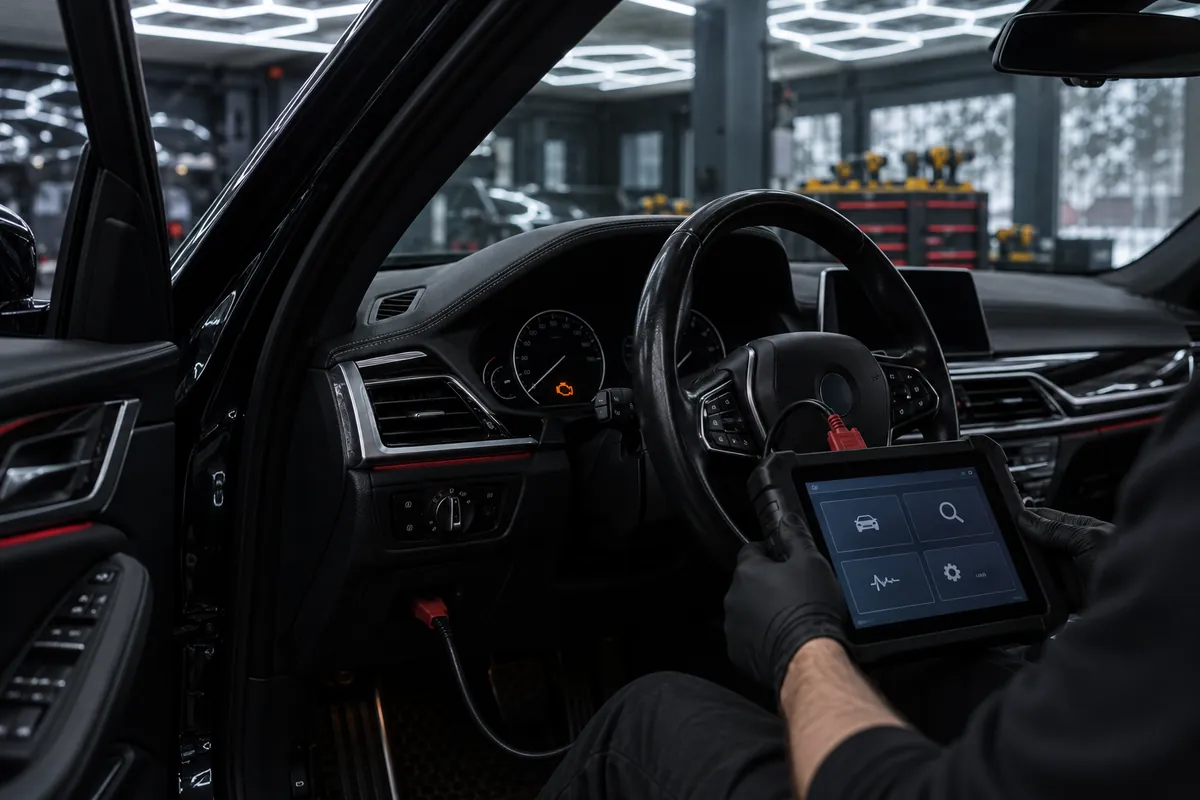
- 1We talk through the symptoms: what you hear when cranking, since when, whether it happens with a cold or warm engine and whether the car has start-stop.
- 2We check the battery: resting voltage, a load test and the condition and tightness of the terminals. We never judge a starter on a weak battery.
- 3We measure voltage drops during cranking — on the positive cable and on the engine and body earth straps. Even cables that look fine can have corroded ends that choke the current.
- 4Computer diagnostics (100 zł): reading faults from the immobiliser, keyless entry, start-stop, clutch and gear position sensors — in newer cars it is the control unit that decides whether to send the signal to the starter at all.
- 5We check whether the control signal reaches the solenoid and whether the starter receives full supply voltage.
- 6If supply and control are fine — we remove the starter and assess the bendix, the pinion and the condition of the flywheel ring gear.
- 7We present the result and a quote for approval: remanufacturing, a new starter or a repair of the cables or earth — only then do we start work.
This order makes sense because the symptoms of a “dead starter” are very often caused by the battery, a terminal or an earth strap — and fixing those is much cheaper than replacing the starter.
Remanufacture or replace the starter?
| Option | When it makes sense | What to watch out for |
|---|---|---|
| Remanufacturing your own starter | Worn brushes, bushings, contacts or bendix with an undamaged housing and armature | The car waits for the part to return; not every fault (e.g. burnt windings) is worth repairing |
| Remanufactured exchange starter | When time matters and the unit comes from a trusted supplier | Quality varies between suppliers; the old starter is often required as a core |
| New starter | Serious damage, cars with a reinforced start-stop starter, uneconomical remanufacturing | Usually the most expensive option; must match the engine and gearbox version |
| Used, from a breaker | Really only as an emergency solution | Unknown condition and mileage — risk of doing the job twice |
A starter is a component that can usually be remanufactured well. Remanufacturing means dismantling and cleaning it and replacing worn parts — most often the brushes (or the whole brush holder), bushings or bearings, the bendix and the solenoid contacts — followed by a test under load. The alternatives are a new starter (genuine or a reputable aftermarket brand) or a factory-remanufactured exchange unit.
In start-stop cars the starter is often a special, reinforced version — fitting a standard equivalent may shorten its life. It is worth checking the supply cables and earth at the same time — corroded connections shorten the life of a new starter too.
During replacement the flywheel ring gear is checked: chipped teeth will quickly destroy a new bendix. In many cars the ring gear is part of the flywheel, so damage to it means a much bigger repair — with a dual-mass flywheel usually replacing the whole flywheel (more in our guide dual-mass flywheel — symptoms).
A new starter will not fix a corroded earth or a weak battery. If the trouble was caused by too little current, the new part will soon behave just like the old one.
Starter motor repair cost in Warsaw
| Service | Price | Notes |
|---|---|---|
| Computer diagnostics | 100 zł | Reading control unit faults, including immobiliser and start-stop; usually up to 1 hour |
| Starter replacement | quoted after diagnosis | Depends on starter access in the given model |
| Starter remanufacturing | quoted after diagnosis | Scope depends on the worn parts |
| Repair of cables, earth, terminals | quoted after diagnosis | Often a cheaper alternative to replacing the starter |
The repair cost depends mainly on two things: the price of the part (new, exchange remanufactured or remanufacturing your own unit) and access. In some cars the starter is easy to reach, in others covers, the intake manifold or a drive shaft have to come off, or the work is done from underneath — and labour differs noticeably. That is why we give the final amount after identifying the car and diagnosing it; the full price list is on the price list page.
Before work starts you receive a quote for approval, and we give a 6-month warranty on labour. Read more about electrical repairs on the auto electrician at Pulsecar page.
How to make a starter motor last longer
- Crank briefly — up to about 10 seconds — and pause between attempts.
- Look after the battery and keep the terminals clean — low voltage speeds up burning of the solenoid contacts.
- Never turn the key to start while the engine is already running.
- Do not ignore hard starting — long cranking wears the starter. In a diesel check the glow plugs, in a petrol car the ignition.
- Fix oil leaks around the gearbox and engine — oil and dirt on the starter speed up its wear.
- At the first symptoms — clicking, grinding — get a diagnosis. A grinding bendix can damage the flywheel ring gear.
Starter motor repair in Warsaw Bielany — Pulsecar, ul. Arkuszowa 176
Pulsecar is located at ul. Arkuszowa 176 in Warsaw’s Bielany district, convenient for drivers from Żoliborz, Bemowo and Łomianki. We are open Monday to Friday 09:00–18:00 and Saturdays 09:00–15:00.
Call +48 571 058 591 or book a visit online. Tell us what you hear when starting — we will check the battery, cables and starter and give you a quote for approval before any repair. Directions and contact details are on the contact page.