Toyota — common faults and weak spots of engines, gearboxes and chassis
Toyota is rightly seen as a durable make, but it too has known weak spots: oil consumption in older VVT-i engines, the head gasket and oil in the 2.0 and 2.2 D-4D, the MMT gearbox and weak 12 V batteries. We cover them engine by engine and model by model.
17 min read · Pulsecar team · updated:
Toyota faults at a glance
Toyota is one of the most durable makes on Polish roads, and with normal servicing most of its petrol engines and hybrids cover very high mileages without major repairs. That does not mean it has no weak spots, though. The main ones are: increased oil consumption in older ZZ-series VVT-i petrol engines (1.4, 1.6, 1.8 in the Corolla E12 and Avensis T25) and in early 1.33 Dual VVT-i units, oil consumption and head gasket failures in the 2.0 and 2.2 D-4D diesels from around 2005–2009, expensive injectors in the older 2.0 D-4D, the MMT automated gearbox in the Yaris, Auris and Corolla, and ignition coils in early 1.2 Turbo engines.
In newer models — the Yaris, Corolla, C-HR and RAV4 — what most often lets you down is not the engine but the 12 V battery, and on the chassis side it is worth remembering the service campaigns for the rear suspension arms on the RAV4 and Avensis. Below you will find a table of engines, a description of each group, a summary table, a checklist for buying a used Toyota and prices from our price list.
Which engine / model do you have
| Engine | Type | Models and years, approximate |
|---|---|---|
| 1.4 / 1.6 / 1.8 VVT-i (4ZZ-FE, 3ZZ-FE, 1ZZ-FE) | petrol, timing chain | Corolla E12, Avensis T25, RAV4 II, early Auris (approx. 2000–2009) |
| 2.0 / 2.4 VVT-i (1AZ, 2AZ) | petrol, timing chain | RAV4 II–III, Avensis T25 (approx. 2000–2008) |
| 1.33 Dual VVT-i (1NR-FE) | petrol, timing chain | Yaris II–III, Auris E15–E18, Verso-S (approx. 2009–2018) |
| 1.6 Dual VVT-i / Valvematic (1ZR) | petrol, timing chain | Auris, Corolla, Avensis T27, Verso (approx. 2007–2019) |
| 1.2 Turbo (8NR-FTS) | petrol, turbo, direct injection | Auris E18, C-HR, Corolla (approx. 2015–2020) |
| 1.5 / 1.8 / 2.0 / 2.5 Hybrid (incl. 2ZR-FXE) | petrol hybrid, eCVT transmission | Prius, Yaris, Auris, C-HR, Corolla, RAV4 (from approx. 2000) |
| 1.4 D-4D (1ND-TV) | diesel, timing chain | Yaris, Corolla, Auris, Verso, Urban Cruiser (from 2001) |
| 2.0 D-4D (1CD-FTV) | diesel, timing belt | Avensis T22–T25, Corolla E12, RAV4 II (approx. 1999–2006) |
| 2.0 / 2.2 D-4D (1AD-FTV, 2AD-FTV/FHV) | diesel, aluminium block, chain | Avensis T25–T27, Auris, Corolla Verso/Verso, RAV4 III–IV (from approx. 2005) |
| 1.6 / 2.0 D-4D (1WW, 2WW — BMW design) | diesel, timing chain | Verso, Auris, Avensis, RAV4 (approx. 2014–2018) |
The years are approximate — they depend on the market, version and facelift. You can find the exact engine code in the VIN data (see checking a car by VIN), on the plate in the engine bay or during computer diagnostics. This matters, because the same name, e.g. “2.0 D-4D”, covers three completely different engines.
Toyota in our workshop — what the data shows
Based on jobs completed at Pulsecar from January to October 2026: Toyota accounts for about 7.7% of the cars we served and is the fourth most common make in our workshop.
The most frequent Toyota jobs are: wheel alignment (about 32% of Toyota jobs), computer diagnostics (about 28%), oil and filter changes (about 13%), air conditioning (about 11%) and tyre changes (about 10%). One job can include several tasks, so the figures do not add up to 100%.
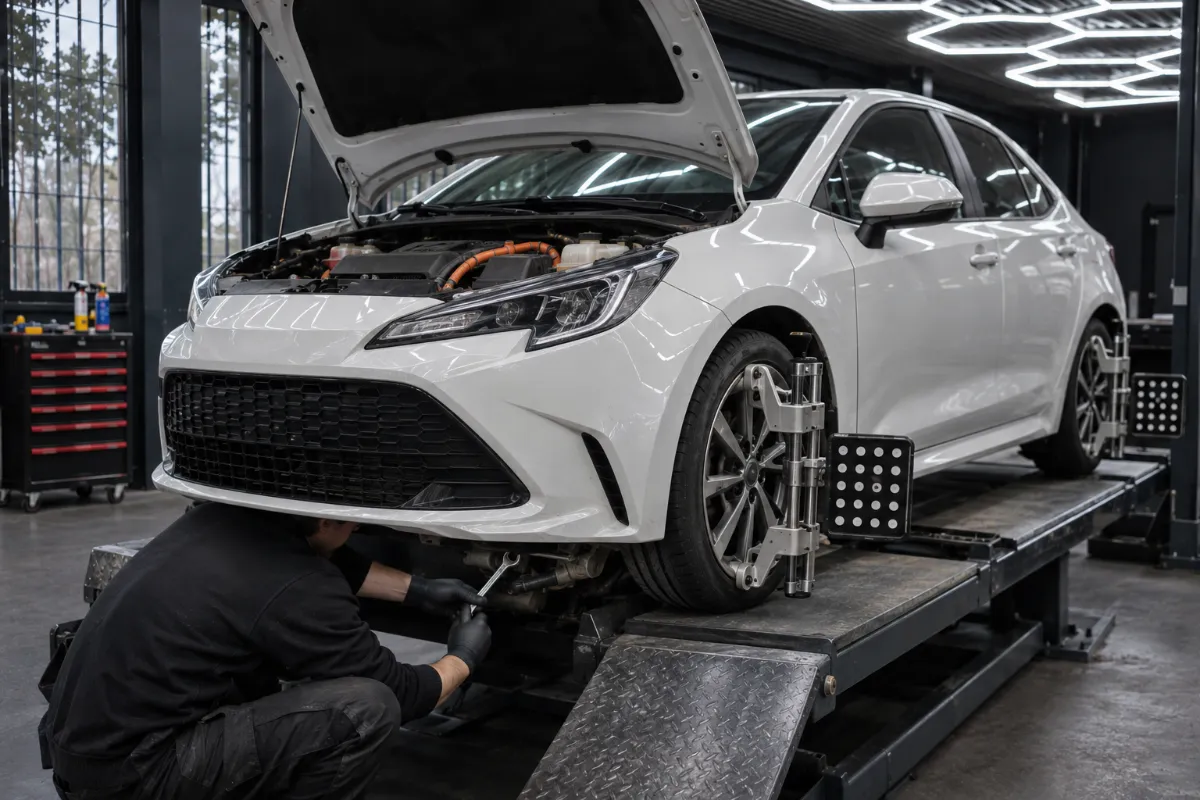
So the top of the list is routine maintenance and adjustment work, not engine repairs — which fits Toyota's reputation as a durable car. The large number of alignments is also a reminder that after replacing control arms, tie rods or tyres it is worth checking the wheel alignment, and on the RAV4 and Avensis paying attention to the condition of the rear suspension adjusting bolts. We explain when to have the alignment done in the article wheel alignment — when.
ZZ and AZ series VVT-i petrol engines — oil consumption
The 1.4, 1.6 and 1.8 VVT-i ZZ-series petrol engines (4ZZ-FE, 3ZZ-FE, 1ZZ-FE) are light engines with an aluminium block and timing chain, fitted to the Corolla E12, Avensis T25, RAV4 II and the first Auris, among others. Their known flaw is oil consumption in some examples — cases of up to around 1 litre per 1000 km have been reported. The most commonly cited cause is piston rings that clog with carbon and stop sealing; some sources also mention the pistons and cylinder bores. In the Avensis T25 the problem mainly affects the 1.8 and, according to British sources, also early 2.0 VVT-i engines — mostly older model years. Toyota extended the warranty to cover it and replaced selected engines. Units built from July 2005 onwards should be largely free of it.
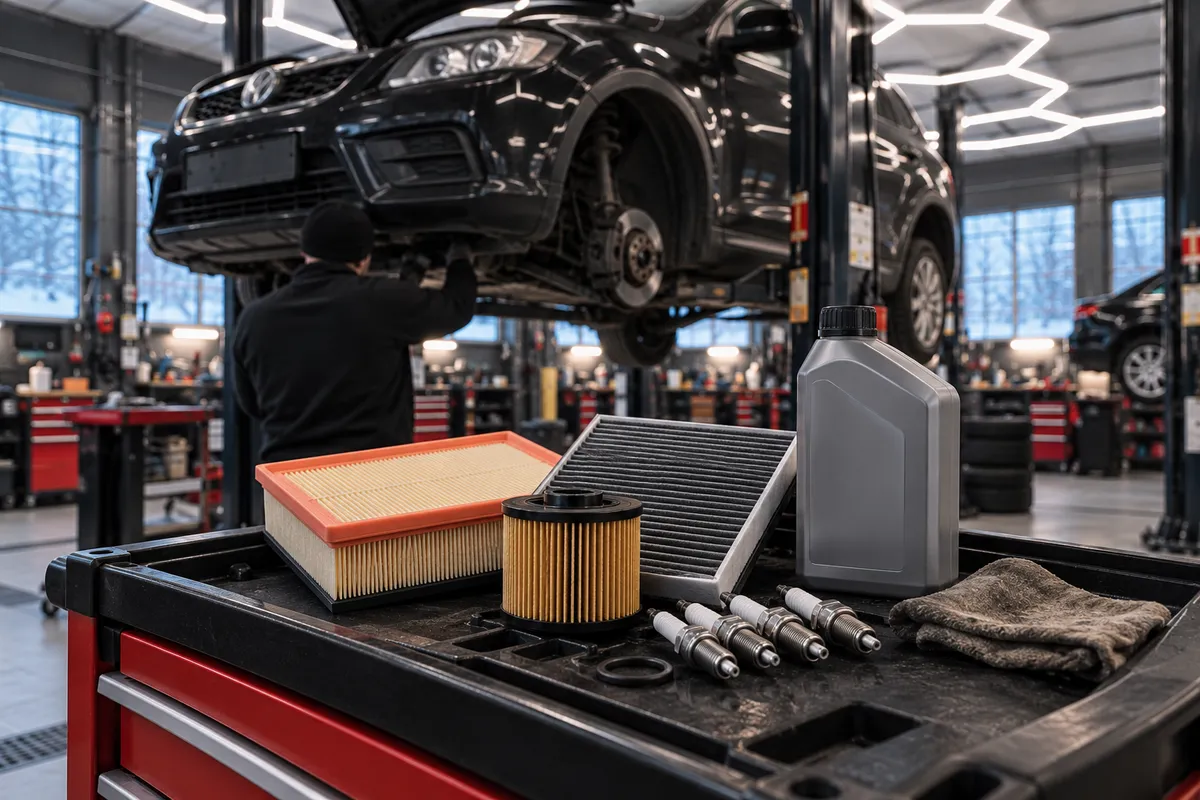
Neglected oil consumption has side effects: burnt oil damages the catalytic converter and lambda sensors, and driving with a low oil level speeds up wear of the timing chain and bearing shells. The symptoms are frequent topping up, bluish smoke when accelerating after the car has been standing, and oily spark plugs. A “permanent” fix requires new rings or a replacement engine, which on an old car is often not worth it — then regular level checks are key. You can read more about the causes in the article oil consumption — causes.
The larger 2.0 and 2.4 VVT-i petrol engines (AZ series) from the RAV4 and Avensis generally have a better reputation, although the early 2.0 in the Avensis was also sometimes listed among oil-burning engines. With the 2.4 (2AZ), however, it is worth knowing that in North America Toyota ran a service programme for excessive oil consumption in cars from 2006–2011, linked to the piston ring design. In Europe this engine is rare, but when buying it is still worth checking how much oil is lost between changes.
In an older petrol Toyota, check the oil every few fill-ups. Consumption of a few hundred millilitres per 1000 km is a signal for diagnostics before the catalytic converter suffers.
1.33 and 1.6 Dual VVT-i, Valvematic and 1.2 Turbo
The 1.33 Dual VVT-i (1NR-FE) is a small engine with a timing chain, fitted from 2009 to the Yaris, Auris, Verso-S and iQ. It is generally durable, but early examples tend to consume oil — the rings clog with carbon and stop sealing. Toyota confirmed the problem in a service bulletin and at the beginning of 2013 changed the pistons and rings, which according to available reports clearly reduced it. Carbon build-up was also linked to starting problems in some cars. Using oil of the viscosity given in the owner's manual (usually 0W-20) is key — oil that is too thick encourages carbon deposits.
The 1.6 Dual VVT-i and 1.6 Valvematic (ZR family, incl. the Auris, Corolla, Avensis T27 and Verso) also have a timing chain and a reputation for durability. Service bulletins from around 2009–2010 mentioned water pump leaks and noise and a knocking variable valve timing gear. At high mileage the chain can stretch — it is then replaced together with the tensioner, guides and sprockets. Knocking from the top of the engine is also reported in Valvematic versions.
The 1.2 Turbo (8NR-FTS, from 2015 in the Auris E18, later also in the C-HR and Corolla) is more modern: turbo and direct injection. In second-generation Auris cars built up to around mid-2018, ignition coil failures caused by a manufacturing defect were reported — the symptoms are jerking and misfires. At high mileage, as in any direct-injection engine, carbon can build up on the intake valves.
1.5, 1.8, 2.0 and 2.5 hybrids — what to know
Toyota hybrids — the Prius, Yaris, Auris, C-HR, Corolla and RAV4 — are among the most durable drivetrains on the market. They have no conventional starter motor, clutch or belt-type gearbox, and the brake pads wear very slowly. Their typical issues differ from those of an ordinary car: seizing brakes and rusting rear discs, a dirty cooling fan for the high-voltage battery, coolant in a separate inverter cooling circuit and a weak 12 V battery. We describe them in detail in the article Toyota hybrid servicing — we will not repeat that here.
With working cooling, the high-voltage battery usually lasts a very long time. At Pulsecar we service hybrids: oil, brakes, cooling, the 12 V battery and computer diagnostics, during which we can read the condition of the HV battery. We do not repair high-voltage batteries — serious repairs to the HV system are done by an authorised dealer or a specialist workshop.
A separate issue is catalytic converter theft. Toyota in the UK itself warned that thieves particularly favour the second- and third-generation Prius and the second-generation Auris Hybrid — the catalytic converters of older cars contain a lot of precious metals. A sudden, very loud exhaust after the car has been parked is a signal to check underneath. The risk can be reduced with catalytic converter guards and mechanical locks and by parking in well-lit places.
2.0 D-4D diesel (1CD-FTV) — injectors, dual-mass flywheel and turbo
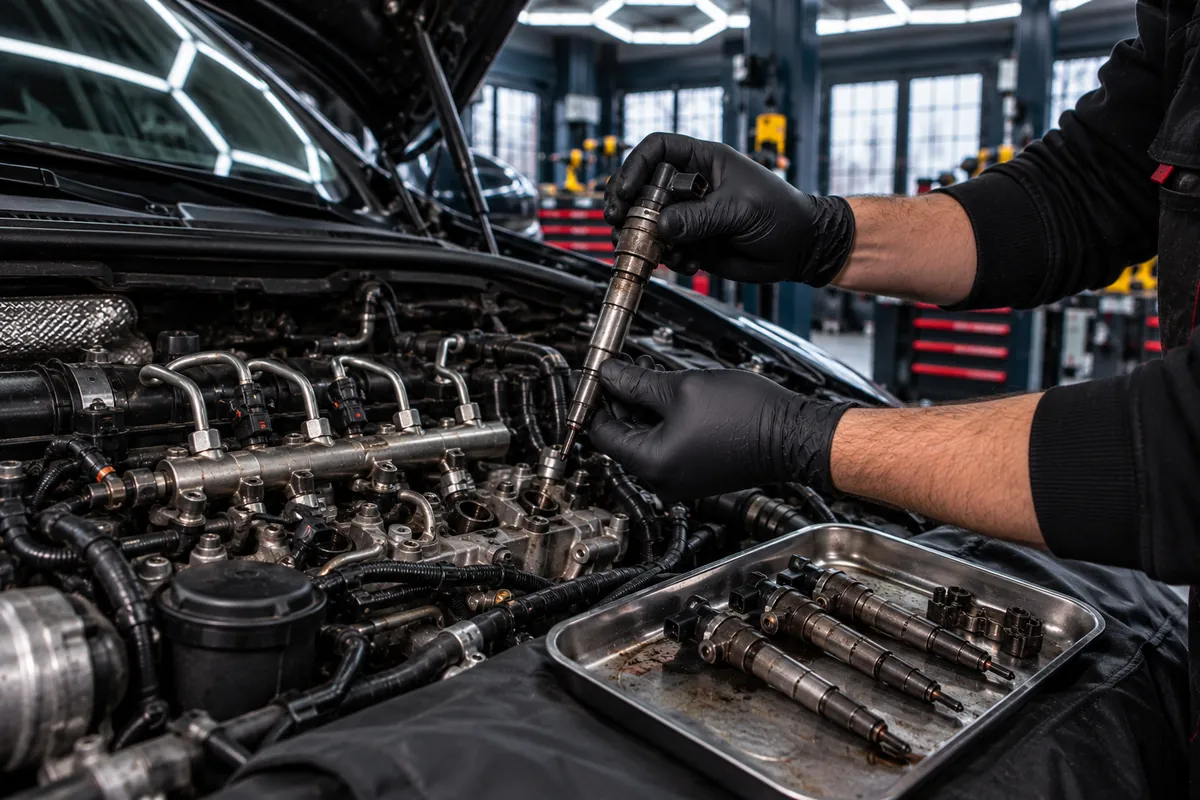
The older 2.0 D-4D (1CD-FTV, from 1999, 90–116 hp) is a cast-iron diesel with a timing belt, known from the Avensis, Corolla E12 and RAV4 II. The engine itself is tough, but its ancillaries can be expensive. The injectors are what people mention most: the Denso units do not lend themselves to cheap reconditioning, and the piezo injectors in the 116 hp version from around 2003–2004 are considered the least reliable. Symptoms of worn injectors are hard starting, rough running, smoke and higher fuel consumption — more in the article injectors — symptoms.
On top of that come the dual-mass flywheel in heavier cars (Avensis, RAV4 — the less powerful 90 hp Corolla does not have one), the variable-geometry turbocharger, an EGR valve clogged with soot and the timing belt (e.g. in the Corolla replacement is recommended every 7 years or 105,000 km, whichever comes first), always replaced together with the water pump — a pump failure was sometimes the cause of overheating and head gasket damage. The engine does not tolerate biodiesel well.
Own a Toyota and something worries you?
We check the engine, gearbox, suspension and the fault memory of all control units. Computer diagnostics costs 100 zł, and you get a written quote to approve before any repair.
If your belt-driven 2.0 D-4D has no proof of a timing belt and water pump change, have it done straight after buying — a snapped belt means serious engine damage.
2.0 and 2.2 D-4D (1AD, 2AD) — oil, head gasket and D-CAT
Its successor, the 2.0 D-4D (1AD-FTV, 126 hp) and 2.2 D-4D (2AD-FTV and the more powerful 2AD-FHV), has an aluminium block and timing chain. This is Toyota's most discussed weak spot. In cars from around 2005–2009 some engines used a lot of oil, and carbon on the pistons and in the EGR system led to overheating and head gasket failures. Micro-cracks in the cylinder head were also reported in the 2.2, and in versions with the D-CAT exhaust after-treatment system — failures of the fifth injector, which doses fuel to burn off the filter. Filter regeneration problems could lead to excessive fuel dosing and ring wear.
Toyota acknowledged the problem: European service guidelines for cars out of warranty covered, among others, the Avensis (production 04.2005–02.2009), RAV4 (07.2005–12.2008), Auris (09.2006–09.2009) and Verso (04.2005–11.2008) and provided for replacing most of the engine (the so-called ¾ engine) where oil consumption exceeded 0.5 l per 1000 km or the head gasket had failed — on cars up to 7 years old and 180,000 km (whichever came first), with documented servicing. Today these cars are outside that programme, but some of them have had the engine replaced, and it is worth establishing this from the service history. In later-built examples serious failures are much rarer.
Symptoms you must react to: coolant loss with no visible leak, darkening coolant, rising temperature under load, oil loss, frequent filter regeneration and limp mode. You can read more about the gasket itself in the article head gasket — symptoms.
2.0 and 2.2 D-4D — what to check
- Oil level between changes — note how much is lost per 1000 km.
- Coolant level and colour; loss with no puddle under the car is a signal for a pressure test and diagnostics.
- ECU fault memory: EGR, boost pressure, injectors, filter regeneration, temperature.
- Condition of the EGR valve and intake manifold — thick carbon is a sign that the engine has done a lot of short trips.
- In the D-CAT version — the fifth injector and how filter regeneration proceeds.
- History: whether the engine was replaced under Toyota's programme and when the oil was changed.
1.4 D-4D and the BMW diesels (1.6 and 2.0 D-4D after 2014)
The 1.4 D-4D (1ND-TV) is a small diesel with a timing chain and no dual-mass flywheel, known from the Yaris, Corolla, Auris and Verso. It is considered one of Toyota's most durable diesels. Versions from before around 2008 have simpler ancillaries and injectors that are cheaper to repair. The Euro 5 update added piezo injectors, a variable-geometry turbocharger and a DPF — the car is cleaner, but repairs to the ancillaries are noticeably more expensive. If you drive only in town, keep an eye on the EGR valve and the DPF.
From 2014 the Verso, Auris, Avensis and RAV4 received the 1.6 D-4D (1WW, 112 hp) and 2.0 D-4D (2WW, 143 hp) diesels based on the BMW N47. This is a different design from the earlier D-4D: as in the N47, the timing chain sits at the gearbox end, and the typical issues are the EGR valve and cooler and DPF regeneration. No widespread chain failures have been reported in these Toyotas, but rattling after a cold start must be taken seriously. We write more about engines of this family in the article BMW engines — weak spots.
Gearboxes — MMT, manual and automatic
- MMT (Multimode) is an automated manual gearbox with a clutch actuator and a gear selector actuator, fitted to the Yaris, Auris, Corolla and Corolla Verso, among others. Typical failure symptoms are being unable to engage a gear, a flashing letter N on the display and clutch actuator faults. The actuator is often to blame, and after repairing or replacing the clutch an adaptation procedure is required. When buying a car with an MMT, a test drive and a fault code read are a must.
- Manual gearboxes are usually durable, but rapid clutch wear is reported in the second-generation Auris, and in the Avensis there have been reports of noisy gearbox bearings.
- Conventional automatics and continuously variable transmissions in combustion-engined cars last longer if the oil is changed according to schedule, or more often under heavy use.
- The eCVT transmission in hybrids has no belt or clutches and is very durable — it mainly needs oil checks.
Suspension, wheel alignment and underbody corrosion
- RAV4 (production 11.2005–08.2010) and Avensis T27 (11.2008–01.2010): a 2012 service campaign for the rear suspension arms (described among others by Toyota Ireland; whether it covers a given car can be checked by VIN at an authorised dealer) — with incorrectly tightened toe adjustment nuts the suspension could knock and, in extreme cases, parts of the arm could separate. In the USA, corrosion of the threads on these arms was also found. When doing the alignment on these cars, we check the condition and tightness of the adjusting parts.
- RAV4 built 25.09–25.10.2019: a campaign in Poland concerning possible cracks in the lower control arms, replaced at an authorised dealer.
- Corolla E12 and Avensis T25 (from approx. 2005–2006): a campaign concerning the rear links, which could work loose due to incorrect tightening torque.
- Rear brakes: on the Corolla E12 they often seize, and on hybrids the rear discs rust, including on the inner side. It is worth cleaning and greasing the slide pins every year.
- Body corrosion is usually not Toyota's main problem — more often it is underbody parts and the exhaust system that rust, and on older Auris cars the exhaust is sometimes leaky.
- Typical wear: anti-roll bar links, control arm bushes, tie-rod ends and shock absorbers at high mileage.
Electrics, 12 V battery, air conditioning and service campaigns
- 12 V battery: in the ADAC report for 2026 Toyota did poorly precisely because of batteries — the C-HR, RAV4, Yaris, Yaris Cross and, in part, the Corolla had high failure rates. Toyota is introducing larger batteries (Yaris and Yaris Cross from November 2024, Corolla and C-HR from February 2026) and software updates that reduce current draw when parked, already available for the RAV4.
- Driver's window switch: a campaign for the RAV4, Auris, Yaris and Corolla built 09.2006–12.2008 — over time the switch could operate unevenly and stick. It should not be lubricated with commercially available products, as this risks the switch overheating or melting.
- Takata airbags: service campaigns covered many Toyotas from 1999–2017, including the Yaris, Corolla, Auris, Avensis and RAV4. Check by VIN at an authorised dealer whether the car has had the replacement.
- Avensis T25: melting headlamp bulb holders; Auris I: the alternator as a more frequent weak spot in petrol versions.
- Air conditioning: in hybrids the compressor is electric and runs on a special ester oil. Ordinary PAG oil or leak-detection dye can damage the winding insulation, so A/C servicing on a hybrid requires the right oil and procedure.
Summary table — engine/model, weak spot, symptom, what to do
| Engine / model | Weak spot | Symptom | What to do |
|---|---|---|---|
| 1.4 / 1.6 / 1.8 VVT-i (ZZ) | Piston rings, oil consumption | Frequent topping up, smoke, oily spark plugs | Level checks, diagnostics, assess whether repair is worth it |
| 1.33 Dual VVT-i (early) | Carbon on the rings | Oil loss, hard starting | Oil of the viscosity in the manual, monitor consumption |
| 1.6 Dual VVT-i / Valvematic | Water pump, chain, valve timing | Coolant leak, knocking, rattling | Diagnostics, water pump or timing chain replacement |
| 1.2 Turbo (approx. 2015–2018) | Ignition coils | Jerking, misfires | Fault code read, coil replacement |
| Hybrids | Brakes, battery cooling, 12 V | Scraping, loud fan, no READY | Hybrid service, battery test |
| Prius II–III, Auris Hybrid II | Catalytic converter theft | Suddenly very loud exhaust | Catalytic converter protection, check underneath |
| 2.0 D-4D (1CD-FTV) | Injectors, dual-mass flywheel, belt with pump | Hard starting, vibration, smoke | Injection diagnostics, timing belt with pump on time |
| 2.0 / 2.2 D-4D (2005–2009) | Oil, head gasket, EGR | Oil and coolant loss, overheating | Urgent diagnostics, pressure test |
| 2.0 / 2.2 D-4D D-CAT | Fifth injector, filter regeneration | Limp mode, frequent regeneration | Diagnostics, cleaning or replacement |
| 1.4 D-4D after 2008 | Piezo injectors, DPF, turbo | Loss of power, filter faults | Diagnostics, longer motorway runs |
| Yaris, Auris, Corolla (MMT) | Clutch actuator | Flashing N, no gear | Fault code read, actuator repair, adaptation |
| RAV4, Avensis T27 | Rear suspension arms (campaign) | Knocking at the rear, wrong alignment | Check campaign by VIN, wheel alignment |
| Yaris, C-HR, Corolla, RAV4 (newer) | 12 V battery | Car will not go into READY | Battery test, update at authorised dealer |
The same symptom can have several causes, so it is always worth having diagnostics done before buying parts — it saves money and time.
Recognise any of these symptoms?
Don't wait until a small fault turns into an expensive repair. Come to our workshop in Bielany — we will tell you what is urgent and what can wait.
How to look after a Toyota
- Oil of the viscosity and specification in the manual, changed every year or according to mileage — in older VVT-i engines and the 1.33 this is the best protection against carbon on the rings.
- Check the oil level every few fill-ups, especially in ZZ petrol engines, the 1.33 and the 2.0/2.2 D-4D diesels.
- In belt-driven diesels, replace the timing belt on time, always with the water pump.
- Take a diesel on longer runs now and then so the EGR and the particulate filter do not clog with soot.
- Look after the 12 V battery — in newer Toyotas and hybrids it is a common reason for the car being immobilised. Have it tested before winter.
- Once a year, a brake inspection with cleaning of the slide pins, especially on hybrids.
- After replacing suspension parts, or if the tyres are wearing unevenly, have the wheel alignment done.
Buying a used Toyota — checklist
- 1Establish the engine code and model year by VIN — that determines what to look for (ZZ before 2006, early 1.33, 2.0/2.2 D-4D from 2005–2009).
- 2Check the history: oil change intervals, timing belt replacement in belt-driven diesels, any engine replacement under Toyota's programme.
- 3Ask about oil consumption and check the spark plugs, exhaust and signs of topping up.
- 4Read the fault memory of all control units, including previously stored faults — engine, MMT gearbox, hybrid system, ABS.
- 5Check the coolant: level, colour, no oil and no smell of exhaust gases in the expansion tank.
- 6On a hybrid, read the HV battery condition, check the battery cooling fan, the rear discs and that the catalytic converter is present.
- 7On a lift, inspect the suspension, rear arms, exhaust system and tyre wear.
- 8Check by VIN at an authorised dealer whether the service campaigns have been carried out (Takata, rear arms, window switch).
- 9Test drive: smooth gear changes in the MMT and automatic, stable temperature, no smoke.
We carry out this kind of check as part of a pre-purchase inspection — ideally before you sign the contract.
How we check a Toyota at Pulsecar
We start with a conversation and computer diagnostics of all control units: we read current and stored faults, engine parameters, EGR operation and particulate filter condition in diesels, and on hybrids the hybrid system data and HV battery condition. Then we inspect the car on a lift: oil and coolant leaks, brakes, suspension, exhaust system. If we suspect oil consumption or a failed head gasket, we carry out a cylinder endoscopy where necessary.
After the diagnosis you receive a written quote, and we only start work once you have approved it. We show you photos of what we found, and for larger repairs you can get access to an online camera. Warranty: 6 months on labour, on new parts according to the manufacturer's terms (usually 12–24 months); we give no workshop warranty on parts supplied by the customer. We serve customers in Polish, Ukrainian, Russian, English and Belarusian. You can book a visit online or call: +48 571 058 591.
How much Toyota diagnostics and repairs cost
| Service | Price |
|---|---|
| Computer diagnostics | 100 zł |
| Suspension diagnostics | 100 zł |
| Wheel alignment — 1 axle / 2 axles | 150 zł / 300 zł |
| Oil and filter change | 120 zł |
| A/C recharge with vacuum test | from 199 zł |
| Control arm replacement | from 200 zł |
| Rear brake pads and discs replacement | from 350 zł |
| Engine endoscopy | from 300 zł |
| Pre-purchase inspection | 300 zł |
| Timing belt replacement | from 600 zł |
| Clutch replacement | from 600 zł |
| Timing chain replacement | from 1000 zł |
| Head gasket replacement | from 1000 zł |
These are starting prices from our price list. The final amount depends on the engine and parts — e.g. a head gasket on the 2.2 D-4D is more work than on a small petrol engine. Injector repairs, MMT gearbox actuator repairs and piston ring replacement are priced after diagnosis — the exact amount is always in the quote before work begins. We carry out mechanical repairs on Toyotas as part of our general repairs service.