BMW engines — weak points of the B38, B48, B58, N20, N55, N63 and the B47, N57, B57 diesels
Every BMW engine has its typical weak spots: on the B58 it is the cooling system and the plastic oil pump, on the N63 overheating and oil consumption, on the N20 the timing chain guides. We have collected them engine by engine — with symptoms, causes and what to check.
17 min read · Pulsecar team · updated:
BMW engine weak points — the short answer
Modern BMW engines are strong and well engineered, but almost every one has a few known weak points. On the B48 and B58 petrol engines, the most common failures are in the cooling system (plastic connectors, hoses, the water pump) and the plastic oil filter housing, and on early B58s also the oil pump. On the N63 V8 the biggest problem is heat: overheating, coolant leaks between the cylinder heads, and oil consumption through valve stem seals and injectors. The older N20 is notorious for its timing chain guides, and the N55 for oil leaks and the electric water pump. On the B47, N57 and B57 diesels, the main things to watch are the EGR cooler, the DPF and the timing chain when oil change intervals are long.
The good news: most of these faults give warning signs early — falling coolant level, traces of oil, messages from the on-board computer, a metallic noise on a cold engine. If you know which engine is under your bonnet and what to look for, you can act in time, before a small leak turns into an engine rebuild. Below we describe each engine separately, and at the end you will find a summary table, a buyer's checklist and prices from our price list.
Which engine does your BMW have
| Engine | Type | Example models (years) |
|---|---|---|
| B38 | 1.5 petrol, 3 cylinders, turbo | 116i/118i, 218i, 318i, X1/X2 sDrive18i (from approx. 2015) |
| B48 | 2.0 petrol, 4 cylinders, turbo | 120i, 220i, 320i/330i, 520i/530i, X1, X3 20i/30i (from approx. 2015) |
| B58 | 3.0 petrol, 6 cylinders, turbo | M140i, M240i, 340i, M340i, 440i, 540i, 740i, X3/X4 M40i, X5/X7 40i (from approx. 2015) |
| N20 | 2.0 petrol, 4 cylinders, turbo | 125i, 220i, 320i/328i, 420i/428i, 520i/528i, X1 (E84), X3 (F25), Z4 (approx. 2011–2017) |
| N55 | 3.0 petrol, 6 cylinders, turbo | 135i/M135i, 335i, 435i, 535i, 640i, X3/X4 35i, X5/X6 35i (approx. 2009–2018) |
| N63 / N63TU | 4.4 petrol, V8, twin-turbo | 550i, 650i, 750i, X5/X6 50i, later M550i, X5 M50i (from 2008) |
| N47 | 2.0 diesel, 4 cylinders | 116d–123d, 316d–320d, 520d, X1, X3 (approx. 2007–2015) |
| B47 | 2.0 diesel, 4 cylinders | 116d–120d, 318d/320d, 520d, X1, X3 18d/20d (from approx. 2014) |
| N57 | 3.0 diesel, 6 cylinders | 330d/335d, 530d/535d, 730d, X3/X5/X6 30d/40d (approx. 2008–2018) |
| B57 | 3.0 diesel, 6 cylinders | 330d, 530d, 730d, X3/X4/X5 30d, M340d (from approx. 2015) |
Years and models are approximate — the same model could have different engines depending on the model year and market. You can read the exact engine code from the car's data using the VIN (see our guide checking a car by VIN), from the plate under the bonnet or during computer diagnostics.
The letter B denotes the newer, modular engine family (from approx. 2014–2015), the letter N the older generation. There are big design differences between them, so advice for the N20 does not always apply to the B48 and vice versa.
BMWs in our workshop — what the data says
Based on jobs completed at Pulsecar from January to October 2026: BMW is the most common make in our workshop — about 17% of the cars we serviced, or roughly one car in six. Volkswagen, in second place, accounts for about 9%, so we see BMWs almost twice as often.
The most frequent BMW jobs are: computer diagnostics (approx. 31% of BMW jobs), wheel alignment (approx. 26%), oil and filter change (approx. 19%), control arms and bushes (approx. 9%) and brake pads and discs (approx. 7%). One job can include several tasks, so the figures do not add up to 100%.
These numbers show what is specific to BMWs: many faults leave a trace in the control units' memory, so a repair starts with diagnostics, while rear-wheel drive, negative camber and heavily loaded suspension bushes mean that alignment and front suspension parts come back regularly. You can read more about typical chassis and body faults in the article BMW — most common faults.
B58 (3.0 straight-six) — cooling, oil filter housing and oil pump
The B58 is considered one of the best BMW engines of recent years: it has a robust bottom end, a closed-deck block and copes well with high mileage. Its weak points are not the crankshaft or pistons but the ancillaries — especially the plastic parts of the cooling and lubrication systems, which age under heat.
Cooling: the most common symptom is a slow loss of coolant and a low coolant level warning. Typical sources are the plastic quick-release hose connector at the thermal management module (thermostat), which cracks over time, the hoses and the expansion tank, an expansion tank cap that no longer holds pressure, and the water pump — look for dried coolant traces around it. The B58 also has a separate intercooler cooling circuit with its own expansion tank. After every repair the system must be bled thoroughly, because air pockets produce symptoms similar to a leak.
Oil filter housing: it is plastic, and both hot oil and coolant flow through it. With age the plastic becomes brittle and can crack, and the seals start to let oil through. An additional risk is overtightening the filter cap during an oil change — the torque is specified for a dry seal, and with an oiled seal the same torque produces a higher clamping force. The crack often only shows up at the next service.
Oil pump: on early B58s, up to roughly the 2019–2020 model years, some engines had an oil pump with plastic rotor housing parts. Reported symptoms are oil pressure faults, a whine from the bottom of the engine and intermittent oil level readings in the on-board computer. BMW introduced a revised pump. Replacement is labour-intensive — the pump is driven from the timing side at the back of the engine, and access requires lowering the subframe and the sump. Not every early B58 has this problem, but every oil pressure fault must be taken seriously.
Other typical spots are the valve cover with integrated crankcase ventilation (PCV) — a torn diaphragm causes smoke on start-up, rough running and higher oil consumption — and the two VANOS solenoids at the back of the engine, which at higher mileages can cause jerking, loss of power and limp mode.
On a B58, check the coolant level every few weeks, and at every oil change look at the condition of the filter housing. Any oil pressure message is a reason for immediate diagnostics, not for topping up the oil and driving on.
B48, B46 and B38 — oil filter housing and water pump
The four-cylinder B48 (and its B46 variant) shares many solutions with the B58, and therefore also its weak points. The best known is the cracking plastic oil filter housing — usually at around 80,000–160,000 km. A crack can cause an oil or coolant leak and, in worse cases, the two fluids mixing. The housing sits under the intake manifold, so replacing it requires a fair amount of dismantling.
The second group is the water pump and the cooling hoses, including the return hose to the expansion tank. Pump failure often comes without earlier symptoms and ends with an overheating warning and reduced power. Add to this the valve cover with crankcase ventilation and the ignition coils and spark plugs.
The three-cylinder B38 (1.5) is considered durable — it has no widely known crankshaft or block faults. The most common issues are the electric water pump and thermostat, carbon deposits on the intake valves when driving short distances, coils and spark plugs, and the turbocharger wastegate rattling at low revs, which is usually more annoying than dangerous.
B48 and B38 — what to check at a service
- Look for traces of oil and coolant under the intake manifold and on the gearbox.
- Check for an oily film in the coolant expansion tank and for light-coloured emulsion under the oil filler cap.
- Pay attention to engine temperature warnings and to the fan running at full speed after a short drive.
N20 (2.0 four-cylinder) — timing chain guides
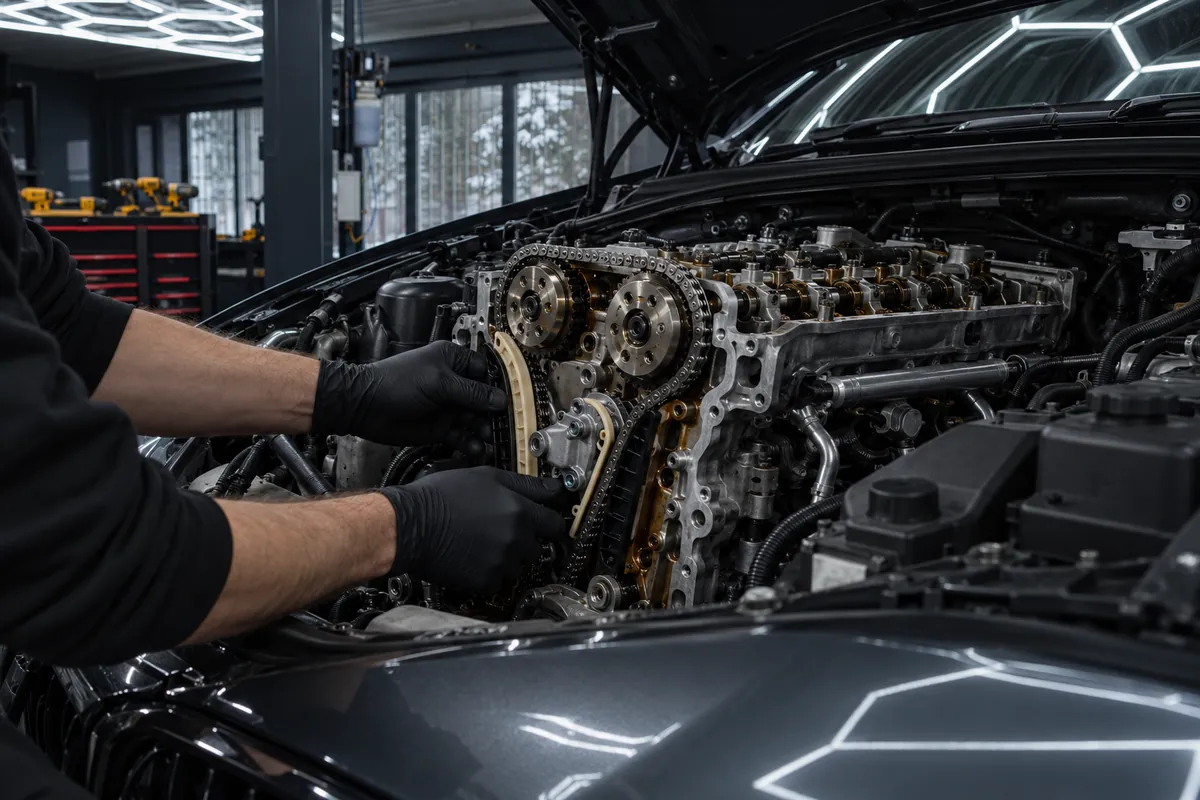
The N20 is now a common engine on the used car market (1, 3, 4, 5 Series, X1, X3, Z4 from approx. 2011–2017). Its most famous flaw is the plastic timing chain guides, which crumble over time. The chain develops slack, strikes other components and in the worst case can jump teeth — the valves then hit the pistons and the engine is seriously damaged.
The problem mainly affects engines built before 2015 — BMW was already modifying timing components from around 2013, and in early 2015 it introduced redesigned parts. The symptom is a characteristic whine or whistle from the front of the engine that rises with revs, followed later by a metallic rattle, especially on a cold engine. Some owners notice nothing until it fails, which is why checking the timing chain is essential when buying an N20.
Apart from the timing chain, the N20 has the typical set of faults of BMW petrol engines of this generation: the electric water pump, leaks from the oil filter housing gasket and the valve cover, VANOS solenoids, and cracking boost and vacuum hoses. We write more about the symptoms of a worn timing chain in the article timing replacement — symptoms and cost.
If you are buying a BMW with an N20, listen to the engine from cold, before anyone has started it ahead of your arrival. A documented replacement of the chain and guides is a big plus in the car's history.
N55 (3.0 straight-six) and the older N54 — oil leaks and water pump
The N55 is the successor to the N54, with a single twin-scroll turbocharger. It is less temperamental than its predecessor but has several recurring faults. Top of the list are oil leaks: the oil filter housing gasket, the valve cover gasket and the sump gasket. Oil dripping onto a hot exhaust means not only a burning smell but a real fire risk. Oil from a leaking filter housing also ruins the auxiliary drive belt — a delaminated belt can be drawn in behind the crankshaft pulley and damage the crankshaft seal.
The second typical problem is the electric water pump, which can fail suddenly, and the thermostat. Then there are cracking intake pipes (especially the plastic pipe from the intercooler to the throttle body), a rattling turbocharger wastegate, the PCV diaphragm in the valve cover, the injectors and the high-pressure fuel pump (more often on early cars), as well as carbon build-up on the intake valves — typical of direct-injection engines.
The older N54 (twin-turbo, e.g. 135i, 335i) has similar leaks and water pump issues, plus less reliable injectors, high-pressure fuel pump and turbocharger wastegates. It is an engine for an informed owner with a budget for servicing.
N63 and N63TU (4.4 V8) — overheating, oil and injectors
The N63 is the engine where the phrase “weak point” comes up most often. The main reason is its design: both turbochargers sit inside the V, between the cylinder heads, right above the block. This area gets extremely hot, and the heat speeds up the ageing of rubber, seals and plastics. That is why cooling is the weakest link here.
Cooling: leaks are typical in the bleed hoses and plastic connectors inside the V, in the turbocharger coolant lines and around the water pump and thermostat. Coolant runs down the block towards the back and drips from the bell housing, so the leak point is easy to misjudge. The turbochargers have their own electric coolant pump, which also runs after the engine is switched off — air in the system can trigger fault codes and longer cranking on a warm engine. Every overheating of the V8 puts the head gasket at risk, so a temperature warning means stopping immediately.
Oil: the N63, especially in its first versions (approx. 2008–2013), uses a lot of oil. The culprits include the valve stem seals, which harden at high temperature — the symptom is exhaust smoke on start-up after the car has been standing — and the piston rings. Replacing the valve stem seals is very labour-intensive. Many cars have no dipstick, and the oil level is checked via the on-board computer, so a drop is easy to miss.
Injectors and ignition: the piezo injectors work under very high pressure and can fail — misfires, rough running, black exhaust tips. Before replacing an injector, coils and spark plugs must be ruled out, because the symptoms are similar. Add to this the timing chains on earlier versions (approx. 2008–2014), vacuum hoses and a heavy load on the battery.
The N63TU versions (from approx. 2012–2013) and later have many improvements, including to cooling and the timing gear, and are clearly more durable. They still, however, need more frequent oil changes and regular checks of coolant and leaks than six-cylinder BMWs.
N63 — how to look after the engine
- 1Change the oil every approx. 10,000 km or once a year instead of waiting for the on-board indicator.
- 2Once a month, check the coolant and oil levels in the car's menu.
- 3At every service, inspect the gearbox area and the inside of the V for traces of coolant.
- 4Replace spark plugs and coils as recommended — worn spark plugs cause misfires, which damage the catalytic converters.
- 5Do not switch the engine off straight after hard driving — give the turbochargers a moment to cool down.
Driving a BMW with one of these engines?
We check the cooling system, oil leaks, the timing drive and the fault memory of all control units. Computer diagnostics costs 100 zł, and you get a written quote to approve before any repair.
N47, B47, N57 and B57 diesels — EGR cooler, DPF and timing chain
The N47 (2.0 diesel, approx. 2007–2015) has its timing chain at the gearbox end, and the chain stretches — this is the best-known BMW diesel fault, described in detail in the article BMW — most common faults.
The B47 (2.0 diesel, from approx. 2014) also has its timing chain at the back, but the chain is much more durable than on the N47. Problems appear mainly at very high mileages and with long oil change intervals — soot in old oil speeds up chain wear. A rattle for a few seconds after a cold start is a signal to have it checked. The second issue is the EGR cooler: if it cracks, coolant is lost with no visible leak, and a mixture of coolant and soot in the intake is dangerous. In 2018 BMW ran a service campaign on EGR coolers in some diesels built between 2010 and 2017 — it is worth checking with a BMW dealer by VIN whether the car has had it done. The third issue is the DPF, which does not cope well with purely urban driving.
The N57 (3.0 diesel, approx. 2008–2018) is considered one of the most durable BMW diesels, and its timing chain rarely fails, usually only at very high mileages. Typical issues are the EGR cooler, the swirl flaps in the intake manifold and their actuation, leaks from the oil filter housing and oil cooler gasket — the oil then tends to run onto the alternator — and the alternator pulley and belt tensioner. On the triple-turbo versions, the turbocharger actuators are added to the list.
The B57 (3.0 diesel, from approx. 2015) is the successor to the N57 and so far has few recurring faults. The part most often replaced is a leaking EGR cooler (slow coolant loss), and with city driving — DPF regeneration problems. We write about the costs and operation of filters in modern diesels in the article DPF and AdBlue in Euro 6.
In a BMW diesel, coolant loss with no puddle under the car is a signal to check the EGR cooler — do not keep topping up the coolant indefinitely.
Summary table — engine, weak point, symptom
| Engine | Weak point | Symptom | What to do |
|---|---|---|---|
| B58 | Cooling connectors and hoses, water pump, expansion tank cap | Coolant loss, low level warning | Pressure test, part replacement, bleeding |
| B58 (early) | Oil pump | Oil pressure fault, whine from the bottom of the engine | Immediate diagnostics, do not drive with the fault |
| B58 / B48 | Plastic oil filter housing | Oil or coolant leak, emulsion | Replace the housing and seals |
| B48 / B38 | Water pump, thermostat | Overheating, limp mode | Diagnostics, pump replacement |
| N20 | Timing chain guides (up to approx. 2015) | Whine, rattle on a cold engine | Inspect and replace the timing chain |
| N55 / N54 | Filter housing, valve cover and sump gaskets | Smell of burning oil, oil spots | Replace gaskets, clean |
| N55 / N20 | Electric water pump, intake pipes | Overheating, loss of power | Diagnostics, part replacement |
| N63 | Cooling inside the V, turbochargers | Coolant loss, overheating, coolant from the gearbox area | Locate the leak, replace hoses |
| N63 | Valve stem seals, piston rings | High oil consumption, smoke on start-up | Consumption test, endoscopy, quote |
| N63 | Injectors, coils, spark plugs | Misfires, rough running | Cylinder diagnostics, replacement |
| N47 | Timing chain at the back of the engine | Rattle from the gearbox end | Timing chain replacement |
| B47 / N57 / B57 | EGR cooler | Coolant loss without a leak | Test, check for the service campaign |
| B47 / B57 | DPF | Frequent regenerations, limp mode | Diagnostics, change of driving style |
The table shows the most common cases. The same symptoms can have other causes, so it is worth running diagnostics before buying parts.
Recognise any of these symptoms?
Don't wait until a small leak turns into an overheated engine. Come to our workshop in Bielany — we will tell you what is urgent and what can wait.
What modern BMW engines have in common — rules that pay off
- Oil more often than the computer says. Long Life intervals (up to 25,000–30,000 km) are calculated for ideal conditions. For city driving and short trips we recommend changing it every approx. 10,000–15,000 km or once a year, using oil with the BMW approval appropriate for the engine. More in the guide how often to change engine oil.
- Coolant is not a lifetime fluid. Use coolant that meets the BMW specification, check its level and condition, and bleed the system thoroughly after replacing parts.
- Plastic ages. Filter housings, connectors, expansion tanks and valve covers become brittle after 8–10 years and many heat cycles. A small leak fixed straight away costs a fraction of a repair after overheating.
- Electric water pumps give no warning. A temperature message is a signal to stop the car, not to drive another few dozen kilometres.
- Direct injection means carbon build-up on the intake valves. If you have loss of power and rough running on a cold engine, also look at intake cleaning.
- The battery must be registered to the car. A new battery that is not registered is charged incorrectly and wears out faster.
Buying a used BMW — checklist
- 1Establish the engine code and model year by VIN — this determines what to look for (e.g. a pre-2015 N20, an early B58, a pre-TU N63).
- 2Check the service history: oil change intervals, timing chain, water pump and oil filter housing replacements.
- 3Listen to a cold start — a rattle for a few seconds can mean the timing chain or the tensioner.
- 4Inspect the engine from underneath: oil traces on the gearbox and sump, dried coolant around the water pump and bell housing.
- 5Check the coolant and oil: level, colour, no emulsion and no oily film.
- 6Read the fault memory of all control units — including stored faults, e.g. oil pressure, temperature, VANOS, ignition.
- 7On an N63 with high mileage, consider a cylinder endoscopy.
- 8Test drive: smooth acceleration, no jerking, stable temperature even in traffic.
We carry out this inspection as part of a pre-purchase car check — it is worth doing before signing the contract, not after.
How we check BMW engines at Pulsecar
We start with a conversation and computer diagnostics of all control units, not just the engine. We check current and stored faults, live data, boost pressure, fuel trims and cooling system data. Then we inspect the engine on the lift: we look for traces of oil and coolant and check the hoses, connectors, oil filter housing and the condition of the belt. If needed, we carry out a cooling system pressure test and a cylinder endoscopy.
After the diagnosis you get a written quote, and we start work only after you approve it. We show you photos of what we found, and for bigger repairs, e.g. on the timing chain, you can get access to an online camera. Warranty: 6 months on labour, and on new parts according to the manufacturer's terms (usually 12–24 months); we give no workshop warranty on parts supplied by the customer. We serve customers in Polish, Ukrainian, Russian, English and Belarusian. You can book a visit online or call: +48 571 058 591.
How much do BMW engine diagnostics and repair cost
| Service | Price |
|---|---|
| Computer diagnostics | 100 zł |
| Oil and filter change | 120 zł |
| Coolant change | from 200 zł |
| Engine endoscopy | from 300 zł |
| Pre-purchase car check | 300 zł |
| Turbocharger replacement | from 600 zł |
| Timing chain replacement | from 1000 zł |
| Head gasket replacement | from 1000 zł |
| Engine repair / overhaul | from 2000 zł |
These are starting prices from our price list. On a BMW the cost depends heavily on the engine: replacing a timing chain at the back of the engine (e.g. N47, B47, B48, B58) or work inside the V on an N63 takes many more hours than the same job on a simpler car. Repairs to the oil filter housing, water pump, oil pump or EGR cooler are priced after diagnosis — the exact amount is always in the quote before work begins. Coolant changes and cooling system repairs are carried out as part of our cooling system service.