Blown head gasket — symptoms, tests, causes and replacement cost
Coolant disappearing without any visible leak, sweet-smelling white smoke or oil in the expansion tank can all point to a blown head gasket. We explain how to tell it from condensation, how to confirm it with tests and why you should not keep driving.
8 min read · Pulsecar team · updated:
Head gasket — the short answer
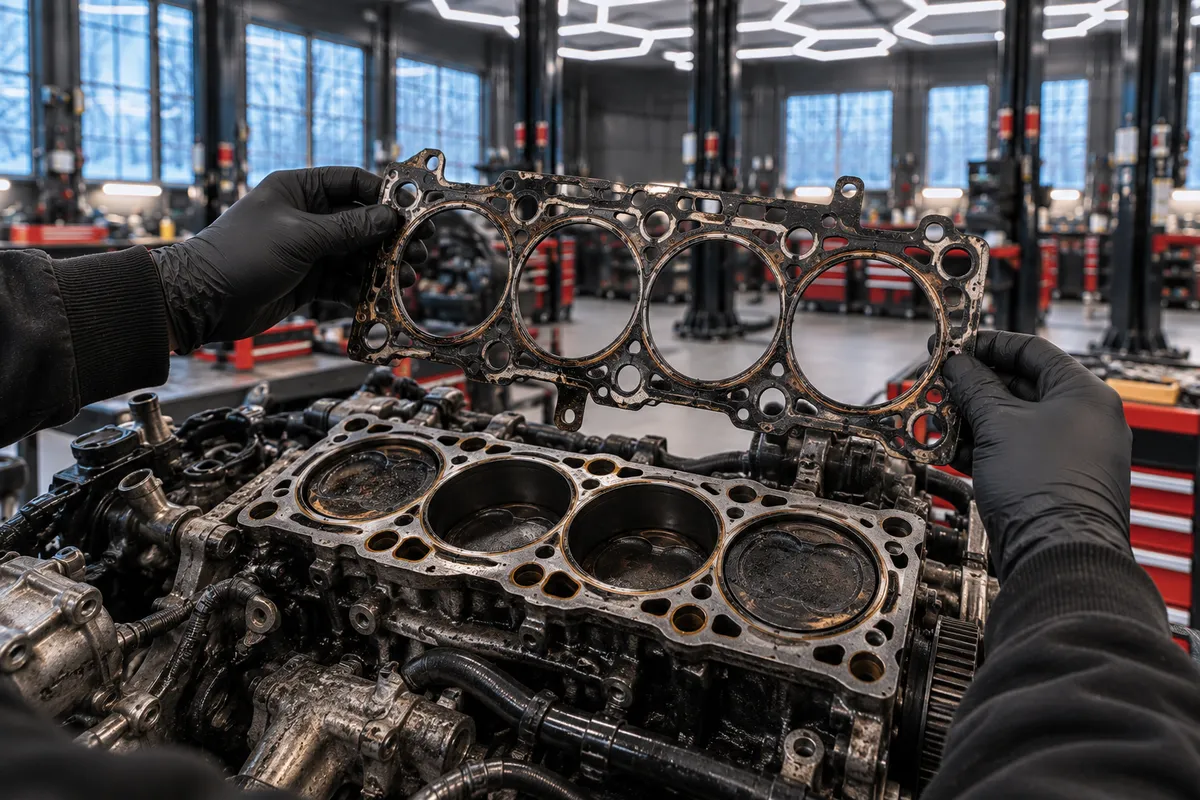
The head gasket separates three worlds: the combustion chambers, the coolant passages and the oil galleries. When it burns through or loses its seal, these start to mix. Typical symptoms are coolant loss without a visible leak, white sweet-smelling smoke from the exhaust, oil in the coolant, bubbles in the expansion tank, engine overheating and excessive pressure in the cooling system — rock-hard hoses and coolant being pushed out of the tank.
None of these symptoms on its own settles the diagnosis. “Mayonnaise” under the oil filler cap after short winter trips is most often plain condensation, and oil in the coolant can come from a leaking oil cooler. That is why a head gasket failure is confirmed with tests: a chemical CO2 test of the coolant, a cylinder leak-down test, a cooling system pressure test and endoscopy. If the gasket has failed, you do not keep driving — putting it off can end in a full engine rebuild.
Symptoms of a blown head gasket
- Coolant loss without traces of a leak under the car, on the engine or in the cabin — the coolant is burnt in the cylinder or pushed out by combustion gases.
- Thick white smoke with a sweet smell that does not disappear once the engine is warm. Light steam on a cold, damp day for the first few minutes is normal.
- A light brown emulsion (“mayonnaise”) under the oil filler cap or on the dipstick — but beware of condensation, see below.
- Oil in the coolant: a greasy film or brown sludge in the expansion tank.
- Bubbles in the expansion tank with the engine running, sometimes gurgling coolant and a smell of exhaust above the tank.
- Engine overheating, especially under load, on the motorway or uphill, and a jumping temperature gauge.
- Excessive pressure in the system: upper hoses rock-hard shortly after starting, coolant forced out through the tank cap.
- Rough running when cold, a misfire on one cylinder after standing, sometimes hard starting.
- Oil or coolant leaking at the joint between the head and the block, or audible puffs of gas escaping outside.
- Intermittently cold air from the vents despite a warm engine — a pocket of gas in the cooling system blocks flow through the heater core.
The symptoms depend on where the gasket has failed. A breach between a cylinder and a water jacket gives bubbles, pressure and coolant loss. A breach between an oil gallery and a water passage mixes oil and coolant. A breach between two cylinders causes low compression and rough running, often without any coolant loss. A breach to the outside causes a leak or hissing at the head. If the cabin stays cold with the engine running, also read our guide heater not working — it is more often the thermostat or air in the system than the gasket.
“Mayonnaise” under the oil cap — when it is just condensation
White or light brown sludge under the oil filler cap is one of the most common reasons drivers suspect the head gasket. Yet in winter, with short trips, it is very often just condensation. Warm, moist crankcase gases condense on the cold cap and in the breather, and an engine that never fully warms up cannot evaporate that water. Water mixes with oil and forms an emulsion — usually only under the cap and in the breather hoses, not in the whole sump.
Condensation is more likely when the car mainly does trips of a few kilometres, the coolant level stays the same, the oil on the dipstick looks normal and the deposit shrinks after a longer motorway run. A head gasket is more likely when coolant keeps disappearing, the emulsion is on the dipstick too, the oil level rises and bubbles or a greasy film appear in the tank. When oil consumption is still normal is explained in our guide engine oil consumption.
A simple test at home: note the coolant level on a cold engine and check it every few days under the same conditions. A steady level with mayonnaise under the cap is a strong hint that it is condensation, not the gasket. If coolant is disappearing and you cannot see a leak, book diagnostics.
Symptom → possible cause → what to do
| Symptom | What it may mean | What to do |
|---|---|---|
| Coolant loss, no leak | Head gasket, cracked head, leaking heater core (damp cabin, misting windows) | Pressure test, CO2 test, check the carpets and heater core |
| White sweet smoke when warm | Coolant burnt in the cylinder: gasket or cracked head | CO2 test, leak-down test, endoscopy |
| Mayonnaise under the cap, coolant level steady | Most often condensation after short trips | A longer drive, watch the coolant level, check the breather |
| Oil in the coolant | Head gasket or a leaking oil cooler (heat exchanger) | Pressure test, check the oil cooler, flush the system |
| Bubbles in the tank, hard hoses | Combustion gases forced into the cooling system | CO2 test of the coolant, leak-down test |
| Overheating under load | Head gasket, but also thermostat, water pump, fan, clogged radiator | Cooling system diagnostics, CO2 test |
| Rough running when cold, one cylinder | Coolant in the cylinder or a breach between cylinders | Compression test, leak-down test, endoscopy |
The table shows why one symptom is not enough. Overheating can be the cause of gasket failure but also its result, and oil in the coolant does not always come from under the head. Only a combination of several symptoms and test results gives a reliable diagnosis.
Tests that confirm a head gasket failure
- CO2 test of the coolant (block tester): air is drawn from above the open expansion tank of a running engine through a test fluid. If there are combustion gases in the cooling system, the fluid changes colour. It is a quick and cheap way to detect contact between the combustion chamber and the coolant.
- Cylinder leak-down test: compressed air is fed into a cylinder at top dead centre and the leakage is measured. Bubbles in the tank point to a breach into the cooling system, hissing at the neighbouring plug hole to a breach between cylinders, and air in the breather or exhaust to rings or valves.
- Compression test: supporting evidence when we suspect a breach between cylinders — two neighbouring cylinders with similarly low readings are the typical picture.
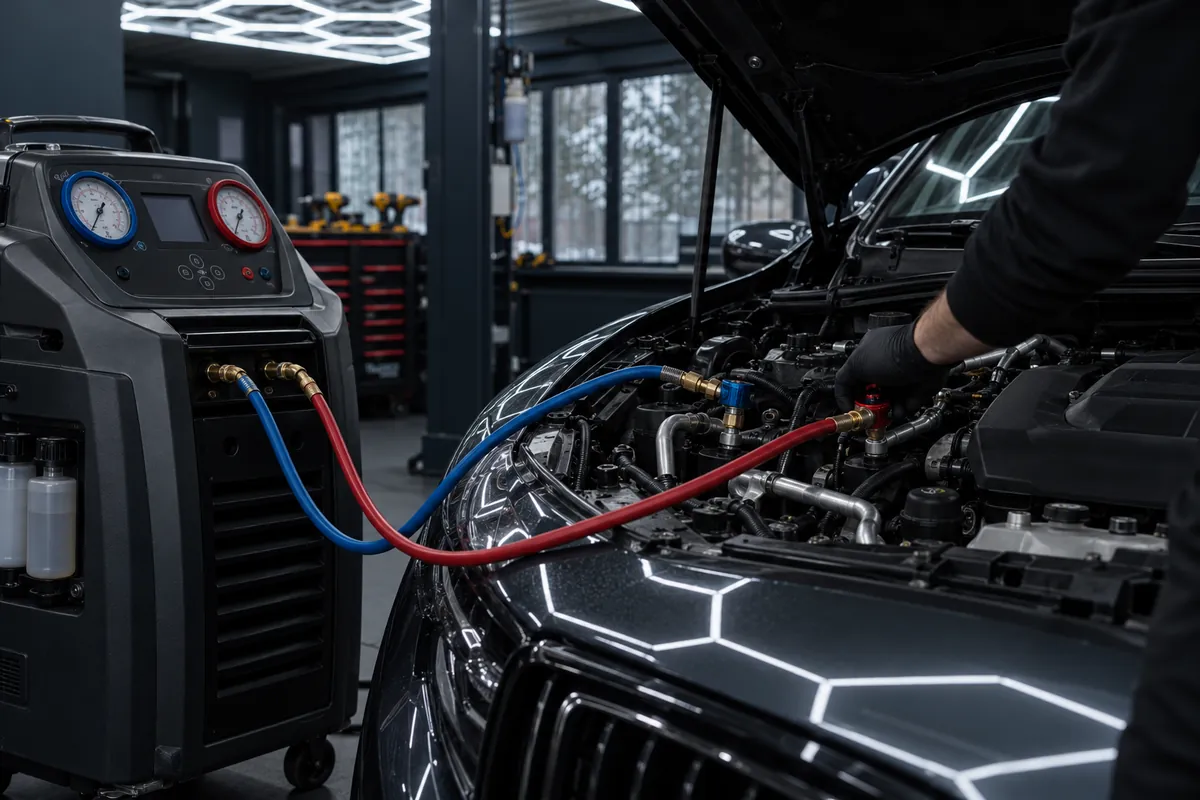
- Cooling system pressure test: the system is pressurised to working pressure and we watch whether the pressure drops. A drop without a visible leak suggests an internal leak — into a cylinder or into the oil.
- Endoscopy: a camera inserted through the spark plug or injector hole shows the piston crown and cylinder walls. A clearly cleaner, “steam-cleaned” crown on one piston or traces of coolant are a strong hint as to which cylinder is affected.
In practice we combine two or three tests. The CO2 test tells us there are gases in the coolant, and the leak-down test and endoscopy tell us where. That shows whether a gasket is enough or whether a cracked head or damaged cylinder liner must be taken into account.
Why head gaskets fail
- Engine overheating — the number one cause. The head, especially an aluminium one, expands and warps, the gasket loses its clamping force and burns through.
- Lack of coolant: a leaking hose, radiator or water pump, or driving with a coolant loss and just topping up.
- A faulty thermostat, water pump or radiator fan, or a clogged radiator.
- Old coolant that has never been changed, or mixing incompatible coolants — corrosion and deposits in the passages reduce cooling. Which coolant to choose is covered in our guide which coolant to use.
- Knocking (detonation) and excessive combustion temperatures, e.g. with a badly set fuel system.
- Mistakes during a previous repair: reused head bolts, wrong torque or tightening sequence, a head that was not skimmed.
A very common scenario looks like this: a small coolant leak, the driver tops up with water, until one day on the road the temperature gauge climbs. If the engine keeps running then, even a few minutes may be enough to warp the head. When the temperature rises above normal, pull over and switch the engine off.
What else we check when replacing the head gasket
- Head flatness — measured with a straight edge and feeler gauges. If the head is warped, we send it for skimming; a new gasket on a warped head will soon fail.
- Cracks in the head and valve seats, and if needed a pressure test of the head.
- The block deck and piston protrusion (in diesels this determines the gasket thickness).
- Head bolts — in most engines they are single-use and are replaced with new ones.
- Thermostat and water pump — if overheating was the cause, it has to be fixed at the source, and access is best with the engine apart.
- Radiator, fan, expansion tank cap and hoses.
- Oil and oil filter — after contact with coolant they must be changed, and with heavy contamination flushed as well.
- Coolant — we flush the system, refill it with new coolant to the manufacturer's specification and bleed it thoroughly.
The gasket itself is only part of the repair. If the cause of overheating is not found and fixed, the new gasket may go the same way as the old one.
Can you drive with a blown head gasket?
No. Even if the coolant loss is small today, the damage progresses. Coolant in a cylinder can cause hydrolock and a bent connecting rod, coolant in the oil destroys lubrication and the bearings, and combustion gases in the cooling system cause more and more frequent overheating, which warps the head further. On top of that, coolant burnt in the cylinder harms the catalytic converter and, in a diesel, the particulate filter.
If you suspect the head gasket, keep driving to a minimum and watch the temperature. If the car overheats, has oil in the coolant or smokes heavily, it is better to bring it in on a tow truck. Replacing the gasket and possibly skimming the head is cheaper than rebuilding the whole engine later.
Never open the expansion tank cap on a hot engine — pressurised coolant can scald you. Wait until the engine has cooled down.
How we check it at Pulsecar
- 1A talk with you: since when coolant has been disappearing, how much you top up, whether the car has overheated, which routes dominate, whether there was mayonnaise under the cap.
- 2Inspection on a cold engine: level and appearance of coolant and oil, hoses, radiator, pump, heater core, leak traces at the head joint.
- 3Computer diagnostics: fault codes, coolant temperature in live data, thermostat and fan operation, misfire counters.
- 4CO2 test of the coolant and a cooling system pressure test.
- 5If needed, a cylinder leak-down test, compression test and endoscopy of the cylinders.
- 6The result with photos or endoscope footage and a written quote for approval — only then do we order parts and start work.
During a major repair such as a head gasket replacement you may get access to an online camera and see what is happening to your car as it goes. More about this service is on the head gasket page.
How much does a head gasket replacement cost in Warsaw
| Service | Price (labour) |
|---|---|
| Computer diagnostics | 100 zł |
| Engine endoscopy | from 300 zł |
| Coolant change | from 200 zł |
| Head gasket replacement | from 1000 zł |
| Head skimming, thermostat, water pump, radiator | priced in the quote after diagnosis |
Prices are for labour at Pulsecar; parts (gasket, head bolts, seals, coolant, oil) are quoted separately depending on the engine. The final cost depends on the engine design, access to the head and the condition we find once it is off — that is why diagnosis comes first, followed by a quote for your approval. We give a 6-month warranty on labour and the manufacturer's warranty on new parts. The full list is in our price list.
We are at ul. Arkuszowa 176 in Bielany, open Monday to Friday 09:00–18:00 and Saturdays 09:00–15:00. You can book online or call +48 571 058 591.