Toyota hybrid service — what to check, how often and what it costs
A Toyota hybrid is durable, but it has its weak spots: seized brakes, a dusty battery cooling fan, a weak 12 V battery and an often forgotten inverter coolant. We explain what to check and how often on the Prius, Corolla, C-HR, RAV4 and Yaris.
8 min read · Pulsecar team · updated:
Toyota hybrid service — the short answer
A Toyota hybrid — Prius, Auris, Corolla, C-HR, RAV4 or Yaris Hybrid — is serviced much like an ordinary car, but with a few important differences. At every service (usually once a year or at the mileage in the service schedule) you change the low-viscosity oil — 0W-16 or 0W-20, exactly as the owner’s manual specifies — and the filters. On top of that come hybrid-specific items: checking the coolant in the separate inverter cooling circuit, cleaning the high-voltage battery cooling fan and filter, inspecting brakes that in a hybrid seize more often than they wear, and checking the 12 V battery.
The high-voltage (HV) battery and the hybrid drive are usually very durable if the car is serviced regularly and the battery cooling works. At Pulsecar we service hybrids: oil, brakes, cooling, the 12 V battery and computer diagnostics, during which we can read the HV battery’s condition. Serious repairs to the high-voltage system are a job for a specialist hybrid workshop or the main dealer.
How servicing a hybrid differs from a conventional car
In a Toyota hybrid the petrol engine often switches off and on, and the electric motor does a lot of the work when pulling away and braking. That is good news for many parts: there is no conventional starter motor or clutch, and the eCVT gearbox has no belt or clutch packs. Brake pads wear slowly because most braking is done by energy recovery.
There is another side to it, though. On short trips and in town the engine runs intermittently and takes longer to warm up, so the oil has a harder life. Brakes that are rarely used rust and seize. The inverter and HV battery need working cooling, and a weak 12 V battery can immobilise the whole car even when the HV battery is charged. That is why hybrid servicing is not just “oil and filters”.
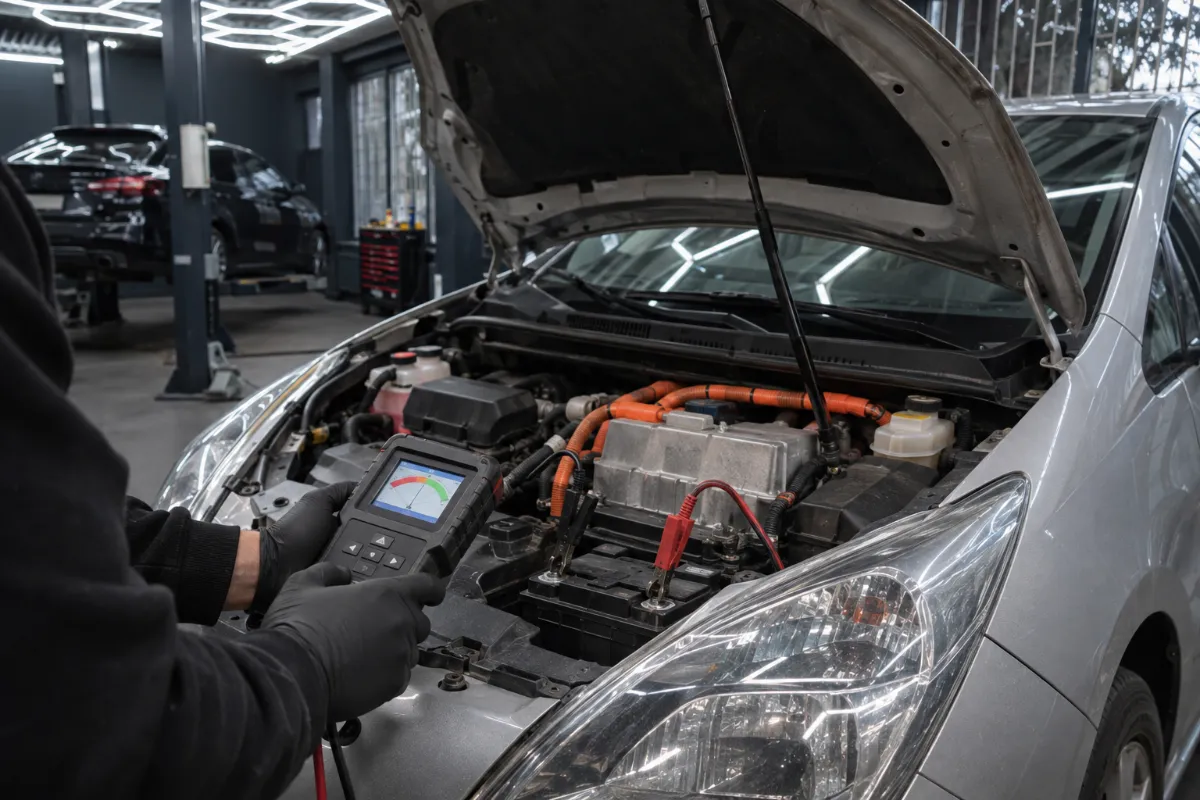
Orange cables and housings in a hybrid are the high-voltage system. Never disconnect or open them yourself — routine servicing (oil, brakes, filters, the 12 V battery) does not require touching that system.
What to check on a Toyota hybrid and how often
| Item | What we do | How often (roughly) |
|---|---|---|
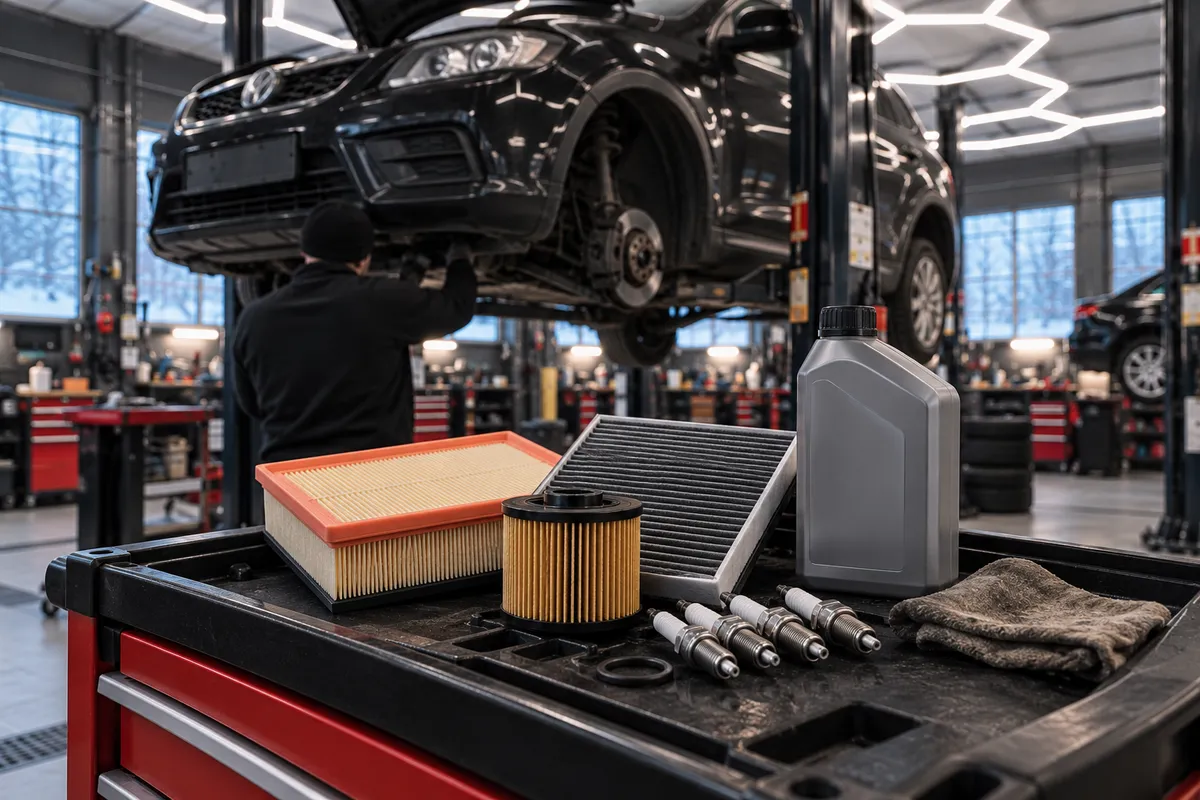
| Engine oil and filter | Change to 0W-16 or 0W-20 oil as per the manual | Per the service schedule; with town driving and short trips, do not exceed the interval |
| Air and cabin filters | Check and replace | Cabin filter usually yearly, air filter per schedule or condition |
| Engine and inverter coolant | Check level and condition in both circuits, check the inverter pump works | Check at every service, replace per the model’s schedule |
| HV battery cooling fan and filter | Clean the intake grille, filter (if fitted) and fan | Every service, more often with pets in the car or in dusty conditions |
| Brakes | Check pads and discs, clean and grease caliper slide pins | Yearly, ideally before winter |
| Brake fluid | Replace using the procedure for an electronically controlled brake system | Per the service schedule, usually every 2 years |
| 12 V battery | Battery and charging voltage test | Every service and before winter |
| eCVT transmission fluid | Check condition, replace at high mileage | Per the service schedule and fluid condition |
Engine oil — why 0W-16 or 0W-20
Toyota hybrid engines are designed for very low-viscosity oils. Depending on the model and year, the manual usually specifies 0W-20 or 0W-16, sometimes with a particular standard. Such oil reaches the bearings faster during frequent engine starts and reduces friction, which affects fuel consumption. Putting in a thicker oil “just in case”, such as 5W-30 or 5W-40, is not a good idea — always follow the manual or the data for your specific engine.
The change interval is set by the service schedule, but in a hybrid driven mostly around town it is worth not stretching it. An engine that keeps switching off takes longer to reach operating temperature, and moisture and fuel build up in the oil more easily. When changing the oil we also look at how much the level dropped between changes and at the condition under the filler cap. Read more about intervals in engine oil change — how often, and the service itself is described on our oil change page.
Inverter cooling — the separate circuit people forget
Toyota hybrids usually have two cooling circuits: one for the petrol engine and a second — with its own reservoir and an electric pump — for the inverter and the electric drive components. The inverter converts current from the HV battery for the electric motors and gets very hot in the process. If the coolant is low or the pump stops working, the car may show a hybrid system warning and limit power.
At a service we check the level and appearance of the coolant in both reservoirs and whether the inverter pump is running — with the car in READY mode the coolant in the reservoir usually visibly circulates. The coolant is replaced per the model’s service schedule, with the fluid recommended by the manufacturer, and the system is bled.
HV battery cooling fan and filter
- The high-voltage battery is cooled by air drawn from the cabin through a grille, usually next to or under the rear seat.
- Dust, pet hair and small debris clog the grille and, on some models, an additional filter in front of the fan.
- A blocked intake means a hotter battery: the fan runs louder and longer, and the system may limit electric operation.
- Running the battery hot for long periods speeds up its ageing.
- Do not block the grille with bags, a child seat or a floor mat.
Cleaning the intake, filter and fan is a simple job that genuinely protects the HV battery. We do it at the service, and on cars that carry pets or are driven a lot on dusty roads it is worth doing more often.
If you hear a fan at the back of the cabin getting louder, especially in summer or after a long drive, it is a common sign that the battery air intake is dirty.
Brakes on a hybrid — regenerative braking, rust and seized calipers
- Pads wear slowly because energy recovery does most of the braking.
- Discs, especially the rear ones, get covered in rust because they are rarely used hard — causing grinding, uneven braking and judder.
- Caliper slide pins and pistons seize, so pads do not retract or do not press evenly.
- Symptoms: one wheel hotter after a drive, a smell of hot brakes, squealing, uneven pad wear between sides.
That is why on a hybrid it is not enough to look at pad thickness. Once a year, ideally before winter, it is worth taking the pads out, cleaning and greasing the slide pins and checking the discs. Brake fluid is replaced per the service schedule, and in many Toyota hybrids the brake system is electronically controlled — work on it, and bleeding in particular, follows the manufacturer’s procedure, often with a diagnostic tester. Read more about brake wear in brake pads and discs — when to replace.
The 12 V battery and the eCVT transmission
Besides the HV battery, a Toyota hybrid has a small 12 V battery. It “wakes up” the electronics when you press the start button — when it is weak, the car will not go into READY mode even though the HV battery is charged. Typical symptoms are dark or flickering instruments, warnings from various systems and no response to the button. The 12 V battery is charged from the HV battery via a DC-DC converter only while the car is in READY mode, so long periods parked and short trips drain it quickly. Depending on the model it sits under the bonnet, in the boot or under the rear seat. Read more about winter battery trouble in car battery in winter — symptoms.
The eCVT in a Toyota hybrid is a planetary gearset combined with electric motors — with no belt or clutches as in a conventional CVT. It is very durable, and on many models the service schedule mainly calls for checking the fluid. At high mileage, replacing it with the fluid recommended by the manufacturer is sensible prevention; we decide after checking the fluid condition and the service schedule.
How we check it at Pulsecar
- 1A conversation with you: mileage, how and where you drive, recent service work and any warnings on the dashboard.
- 2Computer diagnostics: reading fault codes from all systems and live data, including the HV battery’s condition and module voltages, temperatures and fan operation.
- 3Oil and filter change to the engine specification.
- 4Checking both cooling circuits and the inverter pump.
- 5Cleaning the HV battery cooling air intake, filter and fan.
- 6Brake inspection with cleaning and greasing of caliper slide pins, brake fluid check.
- 712 V battery test, plus suspension, tyre and lighting checks.
- 8A written quote with photos for any extra work — we only do it once you approve.
If diagnostics shows a problem with the HV battery or another part of the high-voltage system, we will explain what the readings mean and refer you to a specialist hybrid workshop or the main dealer. If your car is covered by the manufacturer’s warranty or an extended battery cover programme, check its terms — some require services at the main dealer.
How much does a Toyota hybrid service cost
| Service | Price at Pulsecar |
|---|---|
| Computer diagnostics (including HV battery condition read-out) | 100 zł |
| Oil and oil filter change | 120 zł |
| Air / cabin filter | 40 zł each |
| Extended inspection | 250 zł |
| Brake fluid change | from 200 zł |
| Coolant change | from 200 zł |
| Front pads / front pads and discs | from 200 zł / from 300 zł |
| HV battery cooling clean, eCVT fluid | price in the quote — depends on the model |
Prices are for labour; the cost of oil, filters and parts depends on the model. We give the exact amount in a written quote before work starts, and the full list of services is in our price list. Labour carries a 6-month warranty. We speak Polish, Ukrainian, Russian, English and Belarusian.