DPF and AdBlue in a Euro 6 Diesel — Fault Symptoms and How to Cut Costs
A Euro 6 diesel means a DPF, an SCR catalyst and AdBlue — systems that can get expensive if the car is used the wrong way. We explain how they work, how to spot a fault and what to do to avoid overpaying.
9 min read · Pulsecar team · updated:
DPF and AdBlue in a Euro 6 diesel — short answer
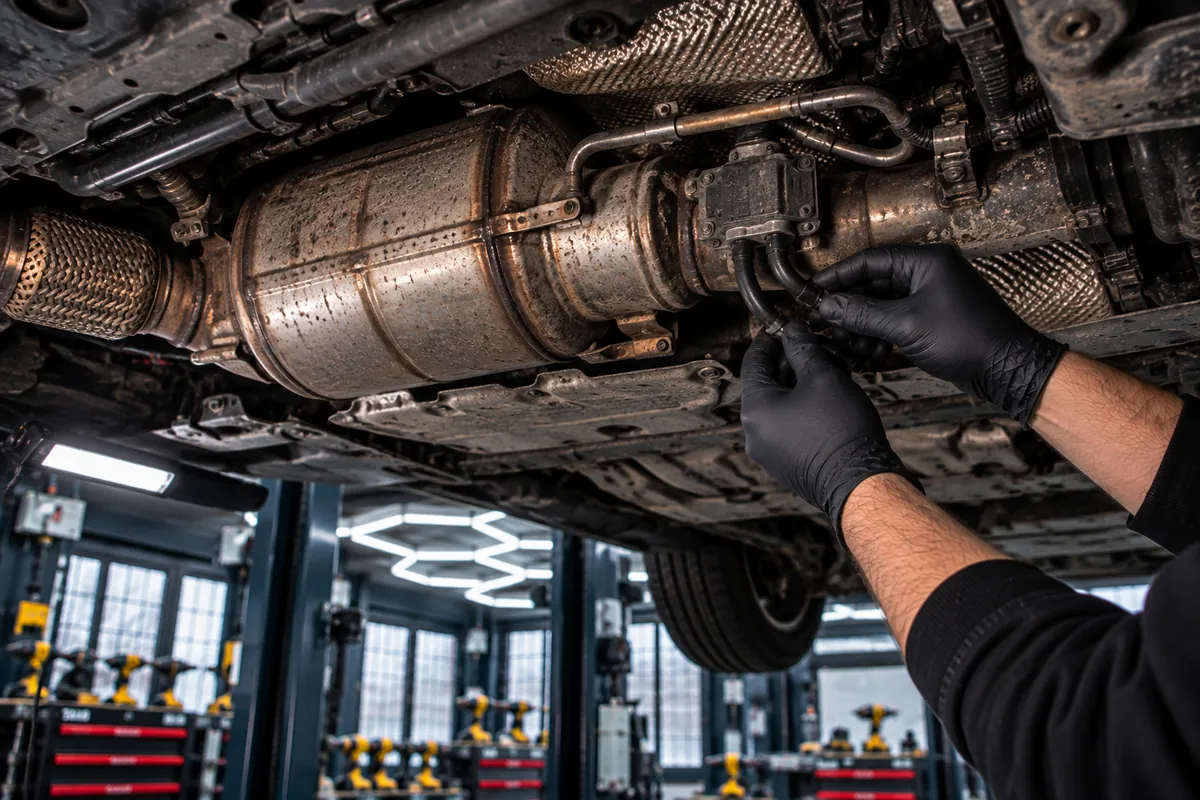
A diesel meeting the Euro 6 standard usually has several exhaust aftertreatment systems: an oxidation catalyst, a diesel particulate filter (DPF) that traps soot and — in most cars — an SCR catalyst into which AdBlue is injected to reduce nitrogen oxides. They work well when the car regularly covers longer distances and the engine is healthy. Expensive problems usually start with almost exclusively city driving, neglected oil and ignoring the first warnings.
The most common signs are the DPF warning light, limp mode with loss of power, frequent regenerations and a rising oil level, and on the AdBlue side — an emission system fault message and a countdown of kilometres until the engine will no longer start. Below we explain how these systems work, what fails in them, when a regeneration is enough and when a repair is needed — and how to keep costs down.
What cleans the exhaust in a Euro 6 diesel and how DPF regeneration works
| Component | What it does | Typical problems |
|---|---|---|
| Diesel oxidation catalyst (DOC) | Oxidises CO and hydrocarbons, heats the exhaust ahead of the DPF during regeneration | Clogging with soot or oil, overheating from fuel delivered by dripping injectors |
| Diesel particulate filter (DPF/FAP) | Traps soot and periodically burns it off | Soot blockage, ash build-up, cracked substrate, faulty differential pressure sensor |
| SCR catalyst + AdBlue | Converts nitrogen oxides (NOx) into nitrogen and water vapour using ammonia from AdBlue | Urea crystallisation, failed pump, heater, AdBlue injector or NOx sensors |
| EGR valve | Returns part of the exhaust to the intake, lowering combustion temperature and NOx | Carbon build-up and sticking — more soot goes into the DPF |
Not every Euro 6 diesel has all these components in the same form. Some earlier designs used a NOx storage catalyst instead of SCR (without AdBlue), while newer versions (Euro 6d) often have a more elaborate SCR system, sometimes with two dosing points. In everyday use one thing matters: these systems work together, so a fault in one component puts a load on the others. Read more about EGR in our guide EGR valve — symptoms.
A DPF is a ceramic substrate with channels blocked alternately at each end. The exhaust passes through the porous walls and soot particles stay inside. The filter is cleaned by burning off the soot — regeneration. Passive regeneration happens on its own during longer drives when the exhaust is hot enough. When that is not enough, the ECU starts an active regeneration: using extra fuel injections it raises the temperature ahead of the filter to around 600°C and burns off the soot over roughly ten to twenty minutes.
The ECU estimates how full the filter is using a calculation model and a differential pressure sensor before and after the DPF. Burning soot leaves a small amount of ash (mainly from oil additives) that cannot be burnt off — it accumulates in the filter over its whole service life. On some cars (e.g. certain PSA and Ford designs) regeneration is assisted by an additive fluid from a separate reservoir that has to be topped up periodically.
Why city driving clogs the DPF — symptoms
- The DPF light is on or a message says the filter is full.
- Loss of power and limp mode, often together with the check engine light.
- Frequent regenerations: raised idle speed, the cooling fan running after switch-off, start-stop disabled, a hot smell from under the car.
- Higher fuel consumption for no obvious reason.
- A rising oil level on the dipstick — fuel from interrupted regenerations gets into the oil.
- Black soot at the tailpipe of a car with a DPF — may mean a cracked filter substrate (exhaust smoke).
Active regeneration needs ten to twenty minutes of driving at a steady speed with a warm engine. In the city these conditions are rarely met: short trips, traffic jams, frequent engine shut-offs. A regeneration starts, gets interrupted, starts again — and soot builds up faster than it is burnt. Every interrupted attempt also means a dose of fuel that can run down the cylinder walls into the oil.
Clogging is accelerated by engine faults that increase soot: a faulty EGR valve, dripping injectors, an intake leak, a blocked air filter, a turbo sending oil into the exhaust (signs of a failing turbo) or a thermostat that keeps the engine from reaching operating temperature. In such cases a regeneration alone brings only a temporary improvement.
See signs of a regeneration in progress (raised idle, fan running)? If possible, do not switch off the engine — finish the drive calmly outside the city. When the DPF light comes on, many owner’s manuals recommend exactly that: ten to twenty minutes at a steady speed — check the guidance for your model.
Forced regeneration, cleaning or DPF replacement
| Solution | When it makes sense | Limitations |
|---|---|---|
| Drive outside the city | DPF light on, car drives normally, no limp mode | Will not help with a sensor fault, very high soot load or a lot of ash |
| Service regeneration (forced with a scan tool) | Soot load raised but below the manufacturer’s limit; cause of clogging removed | Not recommended at very high soot load — risk of uncontrolled burn and a cracked substrate |
| Off-car filter cleaning | Lots of ash or soot, substrate without cracks or melting | Requires removal; the result depends on the method and substrate condition |
| DPF replacement | Cracked or melted substrate, damaged housing, cleaning ineffective | Highest cost; after fitting, soot and ash values usually have to be reset in the ECU |
A service regeneration is started with a diagnostic scan tool — depending on the car, stationary or while driving. First it has to be checked whether it can be done safely at all: whether the soot load is within the manufacturer’s limit, whether the differential pressure and temperature sensors read correctly, whether the oil level is right and whether there are other engine faults stored. Forcing a regeneration on a heavily clogged filter can end with a cracked substrate.
Chemical products added to the fuel or introduced into the filter can sometimes help with light soot clogging, but they do not remove ash and do not fix the cause. Ash is only removed by off-car cleaning or replacement. Whatever route is chosen, the problem will come back unless the cause of excess soot is fixed.
AdBlue and SCR — how it works and how much a car uses
AdBlue is a 32.5% solution of urea in water, made to the ISO 22241 standard. An injector doses it into the exhaust ahead of the SCR catalyst; in the hot exhaust the urea breaks down into ammonia, which reacts with nitrogen oxides in the catalyst to form nitrogen and water vapour. The ECU sets the dosing based on readings from the NOx and exhaust temperature sensors.
Consumption depends on the car, load and driving style. In passenger cars it is most often from about 1 to several litres per 1,000 km — more in large SUVs, when towing and during fast motorway driving. A sudden, clear increase in consumption, or a top-up warning shortly after refilling, is a signal to check the system.
AdBlue freezes at about −11°C, which is why the tank, pump and lines have heaters — freezing in winter is anticipated by the manufacturer and does not damage the system by itself. Crystallisation is the real problem: when the water evaporates, white urea crystals remain that can block the AdBlue injector, lines or the mixer in the exhaust. Long periods of standing, short trips and leaks encourage it.
The rules are simple: only use AdBlue marked ISO 22241 from a sealed container or pump, do not dilute it with water or add anything, do not store a canister for long in the heat, and wipe up spills — it is corrosive to some metals and electrical connectors. Never pour AdBlue into the fuel tank or fuel into the AdBlue tank.
AdBlue ended up in the diesel tank? Do not start the engine. The tank has to be drained and cleaned — running the engine on that mixture can damage the high-pressure pump and injectors.
AdBlue faults: pump, heater, NOx sensor and the no-start countdown
| Message or symptom | Possible cause | Notes |
|---|---|---|
| “Refill AdBlue” with a kilometre countdown | Low fluid level | Topping up is enough; sometimes the car needs a few litres and a short drive to recognise the refill |
| “AdBlue / emission system fault” with a countdown | Pump, heater, level sensor, AdBlue injector, lines, wiring | Topping up will not help — diagnosis is needed |
| Low SCR efficiency fault (e.g. P20EE) | NOx sensor, poor fluid quality, crystallisation, exhaust leak, worn SCR catalyst | Sensors and fluid are ruled out first, the catalyst last |
| Fault in winter, heating error | Tank or line heater, its power supply | Brief freezing is normal; a persistent fault is not |
| White crystals at the AdBlue injector or exhaust | Crystallisation, leak, blocked injector | Sometimes cleaning is enough, sometimes the part must be replaced |
| “AdBlue quality incorrect” | Contaminated or diluted fluid, but often a NOx sensor as well | Replacing the fluid does not always solve the problem |
Regulations require a car with SCR to enforce that the system is kept working. When fluid runs low or the ECU detects a fault, a range to lock-out appears on the display — depending on the manufacturer the countdown starts at, for example, around 2,400 km. Once it reaches zero, the engine cannot be restarted after being switched off. If fluid is low, topping up is enough; if there is a fault, the countdown continues even with a full tank.
The most expensive parts are often the NOx sensors (usually two: before and after the SCR catalyst) and the pump module with heater, which in many cars is integrated with the tank or level sensor and cannot always be replaced separately. That is why the failed component has to be identified before buying parts.
Do not leave an AdBlue warning until the last kilometres. Diagnosis and ordering parts can take time, and once the counter reaches zero the car may not start in the car park (car won’t start).
How to keep DPF and AdBlue costs down
- Regularly drive longer outside the city — ten to several dozen minutes at a steady speed (e.g. on the S8 or S7 expressway) helps complete a regeneration.
- Do not interrupt a regeneration in progress if you do not have to.
- Use oil meeting the manufacturer’s specification (for diesels with a DPF usually low-ash, e.g. ACEA C category) and do not stretch change intervals — less ash in the filter and a healthier turbo.
- Check the oil level: a rising level signals fuel dilution and is a reason to change the oil sooner.
- Quickly fix the causes of excess soot: EGR, injectors, intake leaks, turbo, thermostat, sensors.
- Use AdBlue to ISO 22241 and do not set off on a long trip or into winter with the tank nearly empty.
- React to the first message — early diagnosis is usually much cheaper than a repair after limp mode.
If the car is used almost only for short city trips, it is worth honestly considering at the next purchase whether a diesel with a DPF is the right choice — for that kind of driving another powertrain often works better.
Removing or disabling the DPF, SCR, AdBlue or EGR does not comply with regulations or the roadworthiness test requirements: after such interference the vehicle no longer meets the requirements under which it was approved for road use. Lasting savings come from fixing the cause of clogging or the fault.
A regular oil and filter change is the cheapest investment in the health of the DPF and the turbo. In a diesel used mainly in the city, do not stretch “long life” intervals to the maximum.
How we diagnose the DPF and AdBlue system
- 1Talking it through: which messages appeared, how and where the car is driven day to day, when the oil was last changed and whether its level is rising.
- 2Computer diagnostics of all modules: fault codes with freeze-frame data, soot and ash load, differential pressure, exhaust temperatures, history and number of regenerations (including interrupted ones).
- 3Verifying sensors: comparing differential pressure and temperature sensor readings with expected values, checking the pressure lines.
- 4Looking for the cause of excess soot: EGR, injector corrections, intake tightness, turbo, thermostat, mass air flow meter.
- 5AdBlue system: fluid level and quality, pump, heater and AdBlue injector tests (if the ECU and scan tool support them), NOx sensor readings before and after the SCR, inspection for crystals and leaks.
- 6Assessing whether a service regeneration can be done safely, or whether cleaning or replacing a component is needed.
- 7We present the result and a quote for approval — only then do we start work.
A DPF light or an AdBlue message only tells you that the ECU has noticed a problem — it does not say whether the filter, a sensor, the pump or an engine producing too much soot is to blame. That is why we establish the cause first and only then propose a regeneration, cleaning or replacement of a specific part. More on reading fault codes in our check engine light guide.
DPF and AdBlue repair cost in Warsaw
| Service | Price | When it is needed |
|---|---|---|
| Computer diagnostics | 100 zł | Reading fault codes, DPF load, regeneration history and SCR parameters — the starting point of diagnosis |
| Oil and filter change | 120 zł (labour) | When the oil is diluted with fuel after interrupted regenerations |
| Air filter replacement | 40 zł | When a dirty filter worsens combustion and increases soot |
| Fuel filter replacement | 40 zł | With injection problems that increase soot |
| Turbocharger replacement | from 600 zł (labour) | When a failed turbo sends oil into the exhaust and floods the DPF |
| Service regeneration, DPF cleaning or replacement | after diagnosis | Depends on soot load, substrate condition and model |
| AdBlue/SCR repair (pump, heater, injector, NOx sensor) | after diagnosis | Depends on the fault and the system design in the particular car |
The cost of a repair depends on what has actually failed. A service regeneration, filter cleaning, or replacing a differential pressure sensor, a NOx sensor or an AdBlue pump module are very different amounts — both for parts and for labour, which depends on access on the particular model. That is why we give the repair price after diagnosis, and parts are priced separately in the quote. The full list of services is on the Pulsecar price list.
Before work starts you receive a quote for approval, and we give a 6-month warranty on labour. You can read more about electronics diagnostics on the auto electrician at Pulsecar page.
DPF and AdBlue in Warsaw’s Bielany — Pulsecar, ul. Arkuszowa 176
Pulsecar is located at ul. Arkuszowa 176 in Warsaw’s Bielany district, convenient for drivers from Żoliborz, Bemowo and Łomianki. We are open Monday to Friday 09:00–18:00 and Saturdays 09:00–15:00.
Call +48 571 058 591 or book a visit online. Describe the dashboard messages and how you usually drive — it is an important clue when diagnosing a DPF. If an AdBlue countdown is running, tell us the remaining range. Directions and contact details are on the contact page.