Kia — common faults and weak spots of engines, gearboxes and electrics
Kia is seen as a sensible choice, but it has well-known weak spots: the chain in MPI engines, carbon build-up and bearings in GDI, CRDi diesel ancillaries, the dry 7DCT gearbox and the ICCU module in the EV6. We cover them engine by engine, model by model.
17 min read · Pulsecar team · updated:
Kia faults at a glance
Kias from the last fifteen years or so are mostly durable cars that are easy to look after, but every engine family has its typical weak spots. The ones we see most often: a stretching timing chain and valve clearance adjustment on the 1.4 and 1.6 MPI petrol engines (Ceed, Rio, Venga), damaged big-end bearings on early 1.6 GDI units and carbon build-up on the inlet valves of every direct-injection engine, a rattling turbo wastegate actuator on the 1.0 T-GDI, a clogged EGR valve and DPF plus a blocking fuel strainer on CRDi diesels, the crankshaft pulley on the 2.0 CRDi, judder from the dry dual-clutch 7DCT gearbox and the ICCU charging module on the electric EV6. Many engines are shared with Hyundai (i30, Tucson, ix20).
Most of these problems give warning signs early: rattling after a cold start, the oil pressure warning light at idle, rough running, loss of power and limp mode on a diesel, or judder when pulling away in traffic. Below we cover the engines, gearboxes, hybrids and models, the 7-year warranty, a checklist for buying and prices from our price list.
Which engine / model do you have
| Engine | Type | Models and years, approximately |
|---|---|---|
| 1.0 / 1.2 Kappa MPI | petrol, 3 or 4 cylinders, port injection, chain | Picanto, Rio, Stonic (approx. 2011–2023) |
| 1.4 / 1.6 MPI Gamma (G4FA, G4FC) | petrol, 4 cylinders, port injection, chain | Ceed I and II, Rio, Venga, Soul (approx. 2006–2019) |
| 1.6 GDI Gamma (G4FD) | petrol, direct injection, chain | Ceed II, Sportage III and IV, Carens, Niro hybrid (approx. 2010–2022) |
| 2.0 MPI / 2.0 GDI Theta II | petrol, 4 cylinders | Sportage III, Optima, Sorento (approx. 2010–2015) |
| 1.0 T-GDI Kappa (G3LC) | petrol, 3 cylinders, turbo | Ceed, XCeed, Rio, Stonic, Picanto (from approx. 2015) |
| 1.6 T-GDI Gamma (G4FJ) | petrol, 4 cylinders, turbo | Ceed GT, ProCeed GT, Sportage IV (from approx. 2013) |
| 1.4 / 1.6 CRDi (U, U2) | diesel, 4 cylinders | Ceed I–III, Rio, Venga, Sportage V, XCeed (approx. 2006–2024) |
| 1.7 CRDi (D4FD) | diesel, 4 cylinders | Sportage III and IV, Optima, Carens (approx. 2010–2018) |
| 2.0 / 2.2 CRDi R | diesel, 4 cylinders, chain | Sportage III and IV, Sorento II and III (approx. 2009–2020) |
| 1.6 GDI Hybrid / PHEV | petrol + electric motor, 6DCT gearbox | Niro I, Ceed SW PHEV, XCeed PHEV (from 2016) |
| Electric | electric motor, 400 V platform or E-GMP 800 V | e-Niro / Niro EV, e-Soul, EV6 (from approx. 2018) |
Years and model allocation are approximate — they depend on the market, power output and version, and the older Sportage II and Ceed I also had other units, e.g. the older-generation 2.0 CRDi. You can find the exact engine in the registration certificate, in the VIN data (see checking a car by VIN) or during computer diagnostics.
Kia in our workshop — what the data says
Based on jobs completed at Pulsecar from January to October 2026, Kia accounts for about 3% of the cars we serviced and is the 10th most common make in our workshop.
At that scale we do not publish a separate breakdown of Kia repairs, so the description of faults below is based on recalls and service campaigns, reports and mechanics' opinions, not on our own statistics.
1.4 and 1.6 MPI (Gamma) and 1.0 and 1.2 Kappa — chain and valves
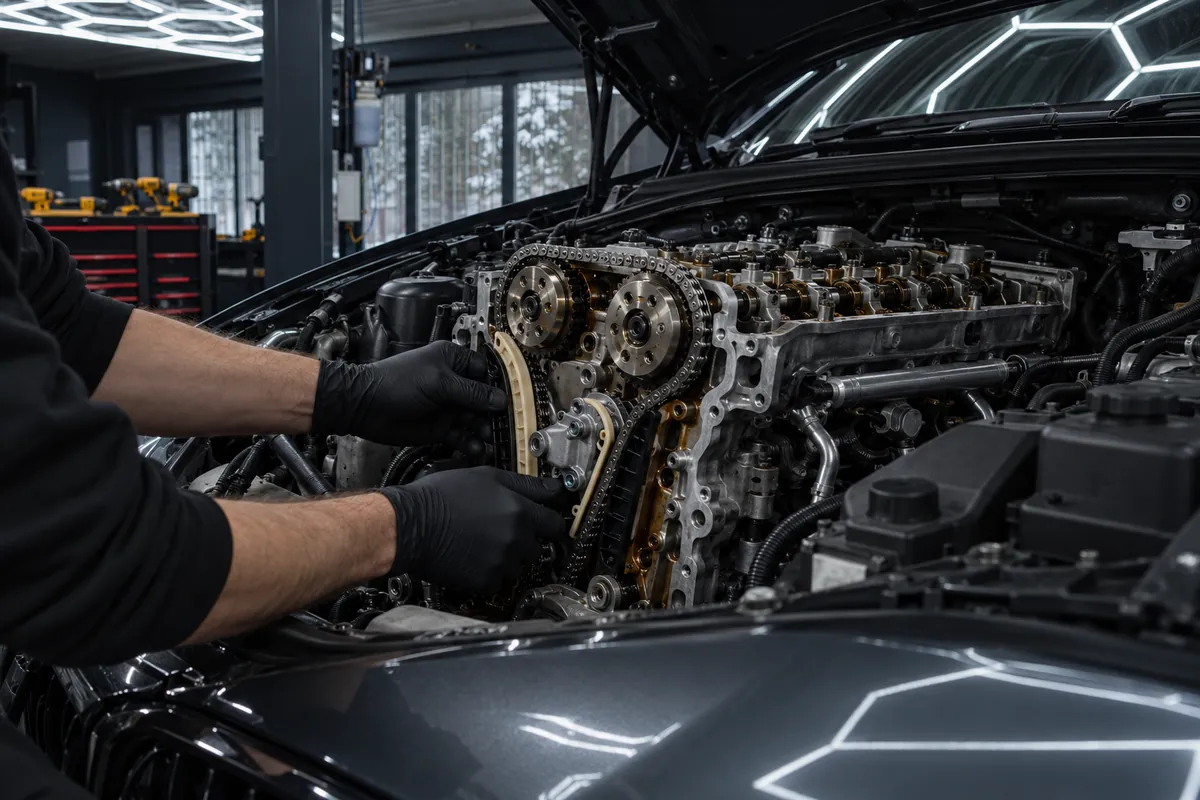
The 1.4 and 1.6 petrol engines with port injection (badged CVVT or MPI) are the most popular engines in the Ceed I and II, Rio and Venga. They are simple and cope well with an LPG conversion, but they have a few known traits. The camshafts are driven by a chain, which on the basic versions can stretch — on the Ceed I chain problems mainly affected the 2009–2010 model years. The symptom is rattling for a few seconds after a cold start, followed later by camshaft position faults. Usually the whole kit is replaced, because a worn chain also damages the sprockets.
These engines have no hydraulic lash adjusters — the valves are adjusted with shims, and a clearance check is recommended at around 100,000 km, especially with LPG. On the 1.4 CVVT in the Ceed II two things are reported: piston slap, which according to mechanics is mainly an acoustic issue, and a faulty oil pressure control valve — the symptom is the oil pressure warning light coming on at idle once the engine is warm. The latter must not be ignored. On some examples of earlier versions the ceramic core of the catalytic converter was also reported to crumble — fragments can block the exhaust and even get into the engine. If the engine loses power or feels “choked”, it is worth checking the catalytic converter with an endoscope.
The small Kappa engines in the Picanto and Rio are considered durable. The 1.0 (three cylinders) in the Picanto II sometimes had a noisy chain and tensioner, and a valve clearance check is also recommended about every 100,000 km. For the 1.2 our sources do not point to any typical engine faults.
An oil pressure warning light that flickers at idle on a warm engine is a signal for urgent diagnostics — first we check the oil level and pressure, then the control valve.
1.6 GDI and 2.0 Theta II — bearings, carbon build-up and US recalls
The 1.6 GDI (Gamma with direct injection) was fitted to the Ceed II, Sportage III and IV, Carens and the Niro hybrid. In a batch of engines from the start of production there were cases of spun big-end bearings, usually at around 100,000 km — later examples are essentially free of this problem. Higher oil consumption on some cars and leaks from the rocker cover are also reported. Mechanics recommend changing the oil every 10,000–12,000 km instead of the long intervals in the service schedule.
Like every direct-injection engine, the 1.6 GDI collects carbon deposits on the inlet valves, because the fuel does not wash over them. Symptoms usually appear after several tens of thousands of kilometres of city driving: rough idle, misfires, a slight loss of power. Intake cleaning helps — more in the article intake cleaning.
In the USA the Theta II engines made headlines: a 2017 recall covered, among others, the Optima 2011–2014 with the 2.4 GDI and 2.0 T-GDI, the Sorento 2012–2014 with the 2.4 GDI and the Sportage 2011–2013 with the 2.0 T-GDI. The cause was machining debris from the crankshaft, which restricted lubrication of the big-end bearings — the symptom was a rhythmic knocking and the oil light, and in extreme cases the engine cutting out while driving. The manufacturer inspected the engines, replaced them where necessary and installed software that detects knocking. In Poland the Sportage III sold new mostly had the 2.0 with port injection (until 2014) and the 2.0 GDI (2014–2015), for which our sources do not point to serious defects. However, if you are buying a Kia imported from the USA, e.g. an Optima or Sorento 2.4, check by VIN whether the recalls have been carried out.
A rhythmic knocking from the bottom of the engine that rises with revs is a signal not to drive any further. Switch off the engine, check the oil and have it diagnosed — carrying on may end in the engine seizing.
1.0 T-GDI and 1.6 T-GDI — turbo, chain and coils
The 1.0 T-GDI (G3LC) is a three-cylinder turbo engine with a timing chain, fitted to the Ceed, XCeed, Rio, Stonic and Picanto. The most commonly reported issue is a rattling wastegate and its electronic actuator under acceleration and after a cold start, sometimes even at low mileage. A faulty actuator causes boost problems and limp mode. On top of that there are oil leaks at the turbocharger, coolant leaks around the water pump, ignition coils and carbon build-up on the valves at higher mileage.
A short chain rattle after a cold start is typical of this engine. If it lasts longer than a few seconds, especially at higher mileage, it is worth checking the tensioner and chain — tensioner wear was reported mainly on earlier, pre-facelift versions. Stretched chains are rare, though. Newer cars have a gasoline particulate filter (GPF), which may struggle to regenerate if the car is only driven in town.
The 1.6 T-GDI (G4FJ) in the Ceed GT, ProCeed GT and Sportage IV is powerful and fairly well sorted. According to mechanics, some early engines had cracked blocks, repaired under warranty. Typical faults are carbon build-up on the inlet valves and ignition coils (jerking and boost cut under hard acceleration); a rattle from a loosening wastegate linkage is also reported.
On T-GDI engines change the oil about every 10,000–15,000 km or once a year, and take the car on a longer run now and then. This helps the turbocharger, the chain and the GPF.
1.4 and 1.6 CRDi diesels — fuel strainer, EGR, DPF and AdBlue
The 1.6 CRDi is the most common diesel in the Ceed, Rio, Venga and XCeed, and in its newer version (U2, with AdBlue) also in the Sportage V. Mechanics praise it for durability — in the Ceed II it has Bosch injection and is considered more dependable than the 1.4 CRDi with its Delphi system. Its best-known ailment is a blocking fuel pre-filter strainer in the tank: the car loses power and goes into limp mode. On early cars the problem came back every 30,000–40,000 km, and around 2019 the part was changed.
At higher mileage and with city driving a clogged EGR valve (clattering, rough running, engine warning light), a blocking DPF and differential pressure sensor faults are typical, and on Euro 6 versions with AdBlue also the NOx sensor and a crystallising AdBlue injector. The Ceed III was subject to a service campaign concerning the brake servo — you can check by VIN whether it has been done. On the 48 V mild hybrid versions belt tensioner and pulley faults are reported, so it is worth inspecting them at a service. We cover the costs of emissions systems in the article DPF and AdBlue — costs.
Own a Kia and something worries you?
We check the engine, gearbox, suspension and the fault memory of all control units. Computer diagnostics costs 100 zł, and you get a written quote to approve before any repair.
If a CRDi diesel suddenly loses power and goes into limp mode with no turbocharger faults stored, we also check the fuel supply and the strainer in the tank for blockages.
1.7 CRDi — DPF, EGR, turbo and manual gearbox
The 1.7 CRDi (D4FD) powers many Sportage III and IV models, as well as the Optima and Carens. On the Sportage III a batch of engines was reported with head gasket problems — some needed cylinder head repairs, and in isolated cases even an engine replacement. Blocked fuel pre-filter strainers also occurred, just as on the 1.6 CRDi. The timing chain is considered durable.
Typical ancillary faults are the DPF with city driving, carbon in the EGR and sticking vanes on the variable-geometry turbocharger (sudden loss of power and limp mode). At high mileage worn turbocharger seals occur (smoke, oil loss). On the Sportage IV with a manual gearbox wear of the dual-mass flywheel and clutch is reported, and on both generations weaker synchromesh on the higher gears (crunching when changing gear). Broken front suspension springs were also reported on some Sportage III cars.
2.0 and 2.2 CRDi (R) — pulley, EGR and 4x4 drive
The R-series diesels (2.0 CRDi in the Sportage III and IV, 2.2 CRDi in the Sorento II and III) are regarded as more durable than the older 2.0 CRDi from the Sportage II. The most common recurring fault is the crankshaft pulley with its vibration damper — according to mechanics, usually at around 80,000–100,000 km. Symptoms can include noise and vibration from the front of the engine and a wobbling auxiliary belt. Add to that the EGR valve, the DPF with city driving, glow plugs and sensors, and the turbocharger actuator.
The camshafts are driven by a chain, which usually lasts a very long time — stretching and tensioner wear are reported mainly at high mileage and with neglected oil. On 4x4 versions it is worth checking the splines: on the Sportage III worn driveshaft splines occurred, and on the Sorento II wear of the transfer box splines is reported — here it pays to keep up with transfer box oil changes. The older Sportage II with the 2.0 CRDi 140/150 hp sometimes had problems with the dual-mass flywheel, turbo and DPF. You can read more about the symptoms in the article EGR valve — symptoms.
Gearboxes — 6DCT, 7DCT, automatics and manuals
- 7DCT (seven-speed, dry clutches) — Ceed, XCeed, ProCeed, Stonic, Sportage IV and V. The most common symptom is judder and hesitation when pulling away and in traffic, delayed gear engagement and the clutches overheating when creeping along slowly. A software update and adaptation sometimes help, but a worn clutch has to be replaced. We describe dual-clutch gearbox symptoms in the article DSG gearbox — symptoms.
- 6DCT — e.g. Ceed II and the Niro hybrid. It is considered more durable but slower; on the Niro judder when pulling away is reported.
- Conventional torque converter automatics (e.g. the 6-speed in the Sportage III) have a better reputation than dual-clutch gearboxes, provided the oil is changed regularly — more in the article automatic gearbox jerking.
- 6-speed manuals in the Sportage III and IV — weaker synchromesh on the higher gears, leaks and bearings; on the Sportage II difficulty selecting sixth gear was reported. On diesels at higher mileage a clutch replacement is typical, and on some versions the dual-mass flywheel as well.
Hybrids, plug-ins and electric cars — Niro, e-Niro, EV6
The Niro Hybrid (from 2016) combines the 1.6 GDI with an electric motor and a 6DCT gearbox. Apart from gearbox judder, the reported issues are: coolant loss linked to the exhaust heat recovery system valve (reported mainly on 2017–2019 model years), carbon build-up on the inlet valves with short-distance driving and a flat 12 V battery when the car stands for a few days. A service campaign concerning the hydraulic clutch actuator is also reported — check by VIN whether your car was covered by it.
On the electric EV6 (E-GMP 800 V platform) the biggest issue is the ICCU — the integrated charging control unit, which also charges the 12 V battery. When the ICCU fails, the 12 V battery stops being charged: warning messages appear, power is limited and the car may come to a complete stop. The manufacturer is running service campaigns — a software update and, if necessary, replacement of the ICCU. You can check whether your car is covered by VIN at an authorised dealer. The situation is similar on the Hyundai Ioniq 5 and 6.
On hybrids we do oil servicing, brakes, cooling, the 12 V battery and diagnostics — the condition of the traction battery can be read during diagnostics, but major repairs to the high-voltage system, and on electric cars also the ICCU, are carried out by an authorised dealer or a specialist workshop. We write about hybrid servicing in general in the article hybrid servicing.
Models — Ceed, Sportage, Picanto, Rio, Venga, Stonic, XCeed
- Ceed I (2006–2012): rust around the door frames before the facelift, split CV joint boots, worn track rods; service campaigns concerned, among other things, the fuel tank mounting and ESP.
- Ceed II (2012–2018): worn rear bushes of the front wishbones (knocking, less precise handling), track rod ends at 100,000–150,000 km, fast-wearing brake discs and failed LED daytime running lights due to a faulty circuit board on cars from before 2016.
- Ceed III and XCeed (from 2018): Auto Hold function faults, knocking anti-roll bar links on some cars; service campaigns concerned seat belt pretensioners and the brake servo.
- Sportage III and IV: broken front springs on some Sportage III cars, worn driveshaft splines on 4x4 versions, weaker synchromesh in the manual; a service campaign concerning the ABS/ESP module is also reported — check by VIN. On the Sorento II look out for underbody corrosion.
- Picanto and Rio: simple and cheap to run; on the Picanto II a service campaign concerned the gear change cables. The Venga has the engines of the Ceed I and II, so the same notes apply. The Stonic shares the 1.0 T-GDI and the 7DCT gearbox with the Ceed.
7-year warranty — what you should know
New Kias sold in Poland since 2010 come with a warranty of 7 years or 150,000 km, whichever comes first, with no mileage limit for the first 3 years. The warranty transfers to the next owner if the car has been serviced regularly and correctly in line with the conditions in the warranty booklet. It does not cover normal wear or parts with a naturally limited life, e.g. tyre tread or brake discs — you will find the full list of parts with limited warranty in the warranty terms.
When buying a Kia with some warranty left, ask for a documented service history. The rules allow a car under warranty to be serviced outside an authorised dealer as long as the manufacturer's standards are met, but always check the conditions of the specific warranty in the booklet. Warranty repairs and service campaigns are carried out by an authorised dealer — you can check by VIN whether they have been done.
Summary table — engine/model, weak spot, symptom, what to do
| Engine / model | Weak spot | Symptom | What to do |
|---|---|---|---|
| 1.4 / 1.6 MPI Gamma | Timing chain | Rattling after a cold start, timing faults | Check and replace the timing kit |
| 1.4 / 1.6 MPI, 1.0 Kappa | Valve clearances (shims) | Noisy running, poorer running on LPG | Clearance check at approx. 100,000 km |
| 1.4 CVVT (Ceed II) | Oil pressure valve | Oil light on a warm engine | Urgent diagnostics, pressure test |
| 1.6 GDI (early) | Big-end bearings | Knocking from the bottom of the engine | Do not drive on, diagnostics |
| 1.6 GDI, T-GDI | Carbon on inlet valves | Rough running, misfires | Intake cleaning |
| 1.0 T-GDI | Wastegate actuator | Rattling, loss of boost | Turbo and actuator diagnostics |
| 1.6 CRDi, 1.7 CRDi | Fuel strainer in the tank | Loss of power, limp mode | Clean or replace the strainer |
| 1.6 / 1.7 / 2.0 CRDi | EGR and DPF | Warning light, limp mode, clattering | Diagnostics, cleaning or replacement |
| 1.7 CRDi (Sportage) | VGT turbo, synchromesh | Loss of power, crunching when changing gear | Turbo and gearbox diagnostics |
| 2.0 / 2.2 CRDi R | Crankshaft pulley | Vibration and noise from the front of the engine | Replace the pulley |
| 7DCT | Dry clutches | Judder in traffic, delayed pulling away | Adaptation readout, software, clutch |
| Niro Hybrid | Heat recovery valve, 12 V | Coolant loss, car will not start | Cooling and battery diagnostics |
| EV6 | ICCU module | Messages, flat 12 V, loss of power | Check campaigns by VIN at an authorised dealer |
| Ceed II | Wishbone bushes, track rod ends | Knocking, less precise handling | Suspension diagnostics |
The same symptoms can have different causes, so it is always worth having diagnostics done before buying parts.
Recognise any of these symptoms?
Don't wait until a small fault turns into an expensive repair. Come to our workshop in Bielany — we will tell you what is urgent and what can wait.
How to look after a Kia
- Change the oil more often than the maximum service schedule: about every 10,000–15,000 km or once a year, always to the specification in the handbook. On the 1.6 GDI and turbo engines it is the cheapest protection for the bearings, chain and turbocharger.
- Listen to the cold start. Rattling for longer than a few seconds is a signal to check the timing drive before the chain damages the sprockets and tensioner.
- On MPI and Kappa engines check the valve clearances about every 100,000 km, and be especially careful about this with LPG.
- Take a diesel on a longer run now and then. Short trips clog the EGR and DPF, and on cars with AdBlue the dosing system as well.
- With the 7DCT avoid holding the car on the brake and creeping uphill on a slipping clutch in traffic — dry clutches do not like heat. At the first sign of judder have it diagnosed.
- Look after the 12 V battery, especially on hybrids and electric cars that stand for long periods. A weak battery can trigger a series of random electronic and infotainment faults.
- Check by VIN for service campaigns — Kia has had several that matter for safety.
Buying a used Kia — checklist
- 1Identify the engine, gearbox and model year by VIN — that determines what to look for (1.6 GDI, 1.0 T-GDI, 1.7 CRDi, 7DCT).
- 2Check the service history: oil change intervals, any repairs to the timing drive, gearbox and turbocharger, and whether any of the 7-year warranty is left.
- 3Listen to a cold start — chain or turbo actuator rattle, knocking from the bottom of the engine.
- 4Read the fault memory of all control units, including previously stored codes (timing, boost, EGR, DPF, AdBlue, gearbox, ABS).
- 5On a diesel check the condition and regeneration history of the DPF, and on a car with AdBlue — SCR system faults.
- 6With the 7DCT and 6DCT do a test drive in town: pulling away, manoeuvring, traffic. Judder or delays are a warning sign.
- 7On a lift inspect the wishbones and bushes, springs, anti-roll bar links, CV joint boots and underbody corrosion.
- 8Check by VIN at an authorised dealer whether the service campaigns have been carried out — especially on the Sportage, Niro and EV6, and on cars from the USA also on the Optima and Sorento.
We carry out this check as part of our pre-purchase inspection.
How we check a Kia at Pulsecar
We start with a conversation and computer diagnostics of all control units: we read current and stored faults, valve timing parameters, boost pressure, the condition of the DPF, the AdBlue system and the gearbox, as well as the 12 V battery voltage. Then we inspect the car on a lift — oil and coolant leaks, suspension, CV joints, corrosion. If needed we carry out a cylinder endoscopy, e.g. when we suspect carbon build-up or damage in a GDI engine.
After the diagnosis you get a written quote, and we only start work once you have approved it. We show you photos of what we found, and for bigger repairs, e.g. the timing drive, you can get access to an online camera. Warranty: 6 months on labour, new parts as per the manufacturer's terms (usually 12–24 months); we do not give a workshop warranty on parts supplied by the customer. We serve customers in Polish, Ukrainian, Russian, English and Belarusian. You can book a visit online or call: +48 571 058 591.
How much do Kia diagnostics and repairs cost
| Service | Price |
|---|---|
| Computer diagnostics | 100 zł |
| Oil and filter change | 120 zł |
| Coolant change | from 200 zł |
| Manual gearbox oil change | from 200 zł |
| Engine endoscopy | from 300 zł |
| Pre-purchase inspection | 300 zł |
| Automatic gearbox oil change | from 400 zł |
| Turbocharger replacement | from 600 zł |
| Clutch replacement | from 600 zł |
| Timing chain replacement | from 1000 zł |
These are starting prices from our price list. The final amount depends on the engine and parts — e.g. the chain on a 2.2 CRDi is more work than on a 1.4 MPI. Repairs to the 7DCT gearbox, EGR valve, DPF, AdBlue system and bearings, as well as valve clearance adjustment, are priced after diagnosis — the exact amount is always in the quote before work begins. We replace the timing drive as part of our timing chain replacement service.