Steering wheel vibration — causes at speed, when braking and at idle
When the steering wheel shakes tells you most about the cause: wheels, brake discs, play in the steering or engine mounts. We explain how to recognise it, how we diagnose vibration and what the repair costs.
9 min read · Pulsecar team · updated:
Steering wheel vibration — the short answer
The most common cause of a shaking steering wheel is an unbalanced wheel or a faulty tyre — the vibration then appears in a specific speed range, usually around 80–120 km/h, and sometimes fades above it. If the steering wheel shakes only when braking, the brake discs are most often to blame. Vibration and “shimmy” over bumps points rather to play in the steering and suspension, while vibration at a standstill points to the engine mounts or rough running of the engine.
So the key question for diagnosis is: when exactly does it shake? At a steady speed, when braking, over potholes, when accelerating or at a standstill? Each of these situations leads to a different group of components. Below we sort out the possible causes, suggest what you can check yourself, and show what diagnosis in the workshop looks like and what typical repairs cost.
When does the steering wheel shake — table of causes
| When it shakes | Most common cause | What else to check | Urgency |
|---|---|---|---|
| At about 80–120 km/h, on a smooth road | Unbalanced wheel (e.g. a lost balance weight) | Bulging or deformed tyre, bent rim, mud or ice inside the rim | Medium — worth checking within days |
| Right after a tyre or wheel change | Poorly balanced or poorly centred wheel, rust on the hub | Wheel bolt torque, centring rings on aftermarket rims | Medium — go back to the tyre shop |
| Only when braking, the pedal pulses | Uneven thickness or runout of the brake discs | Seized caliper, wheel bearing play, unevenly tightened bolts | High — it concerns the brakes |
| Over bumps, the wheel “shimmies” side to side | Play in a tie rod end or inner tie rod | Ball joint, bushings, steering rack mounting, shock absorbers | High — play in the steering |
| When accelerating, gone when you lift off | Worn CV joint (especially the inner one) | Engine and gearbox mounts | Medium |
| At a standstill, at idle | Worn engine mounts | Rough running (misfire), dual-mass flywheel in a diesel | Depends on the cause; high if the engine light flashes |
| All the time, stronger with speed, with a hum | Damaged wheel bearing | Tyres with uneven tread | Medium to high |
The table is a starting point, not a diagnosis. In practice two faults sometimes overlap — e.g. an unbalanced wheel plus play in a tie rod end that amplifies the vibration.
Vibration at a certain speed — wheels, tyres and rims
- A lost balance weight — it is enough for one to come off on a pothole or in a car wash.
- A damaged tyre: a bulge on the sidewall, a shifted or separated belt, uneven tread wear, a “flat spot” after braking with a locked wheel.
- A rim bent after hitting a pothole or kerb — sometimes the deformation is invisible to the naked eye and only shows up on the balancing machine.
- Mud, snow or ice stuck inside the rim — in winter a common, though harmless, cause.
- Aftermarket rims without centring rings, or a wheel fitted on a rusty hub — the wheel is not perfectly centred.
- Unevenly or over-tightened wheel bolts, e.g. with an impact wrench without torque control.
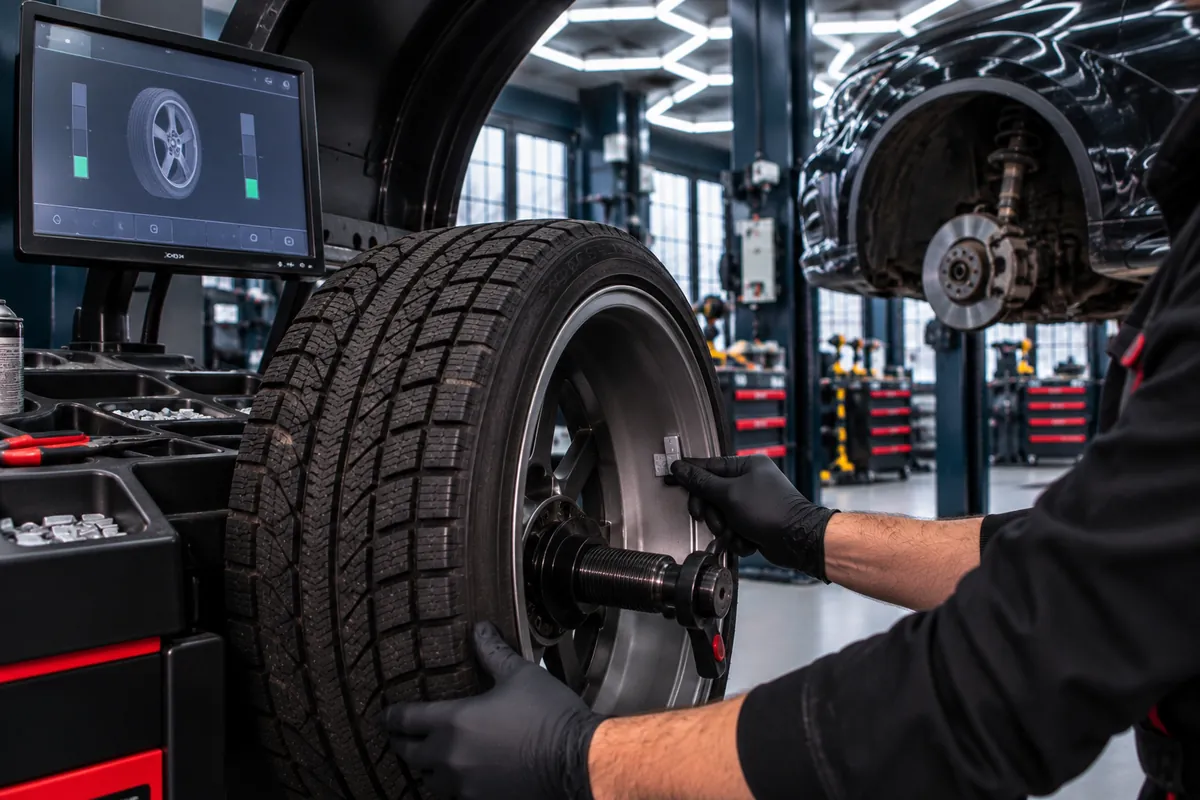
A wheel whose mass is not evenly distributed around its axis of rotation starts to resonate with the suspension at a certain speed. Hence the typical pattern: calm up to about 70–80 km/h, then clear vibration in the steering wheel, and at even higher speed sometimes less of it. If it is mainly the steering wheel that shakes, the problem usually concerns the front axle; an unbalanced rear wheel is more often felt in the seat, the floor and the whole body.
The most common causes in this group:
Did the vibration appear right after a seasonal tyre change? First go back to the shop that did it and ask for the wheels to be rebalanced and checked for proper seating on the hubs. Tyres that have stood in one position for a long time can also temporarily “remember” a flat spot — such vibration usually disappears after a few to a dozen or so kilometres.
Steering wheel shakes when braking — discs and calipers
If the steering wheel shakes only when braking and the brake pedal clearly pulses, the front discs are most often the cause. People talk about “warped discs”, but usually it is uneven disc thickness around the circumference or lateral runout. Causes include uneven pad material deposits, overheating (e.g. long downhill braking, holding the brake pedal after hard braking), an unevenly tightened wheel or rust between the disc and the hub.
When the vibration is felt mainly in the pedal and the body, and less in the steering wheel, the problem may be at the rear axle. Also remember that a clear “rattling” of the pedal during hard braking on a slippery surface is normal ABS operation, not a fault.
Discs are replaced in pairs on an axle, usually together with the pads. It is also worth checking that the calipers move freely — a seized slide pin or piston overheats the disc and quickly brings the problem back. If your brakes squeal or grind rather than vibrate, see our guide squeaking brakes, and for a spongy pedal the article soft brake pedal. More about repairs is on the brakes page.
Skimming the discs only helps if the thickness after machining stays above the manufacturer’s minimum. On many modern cars the discs are thin enough that replacement is the more sensible option.
Vibration over bumps — play in the steering and suspension
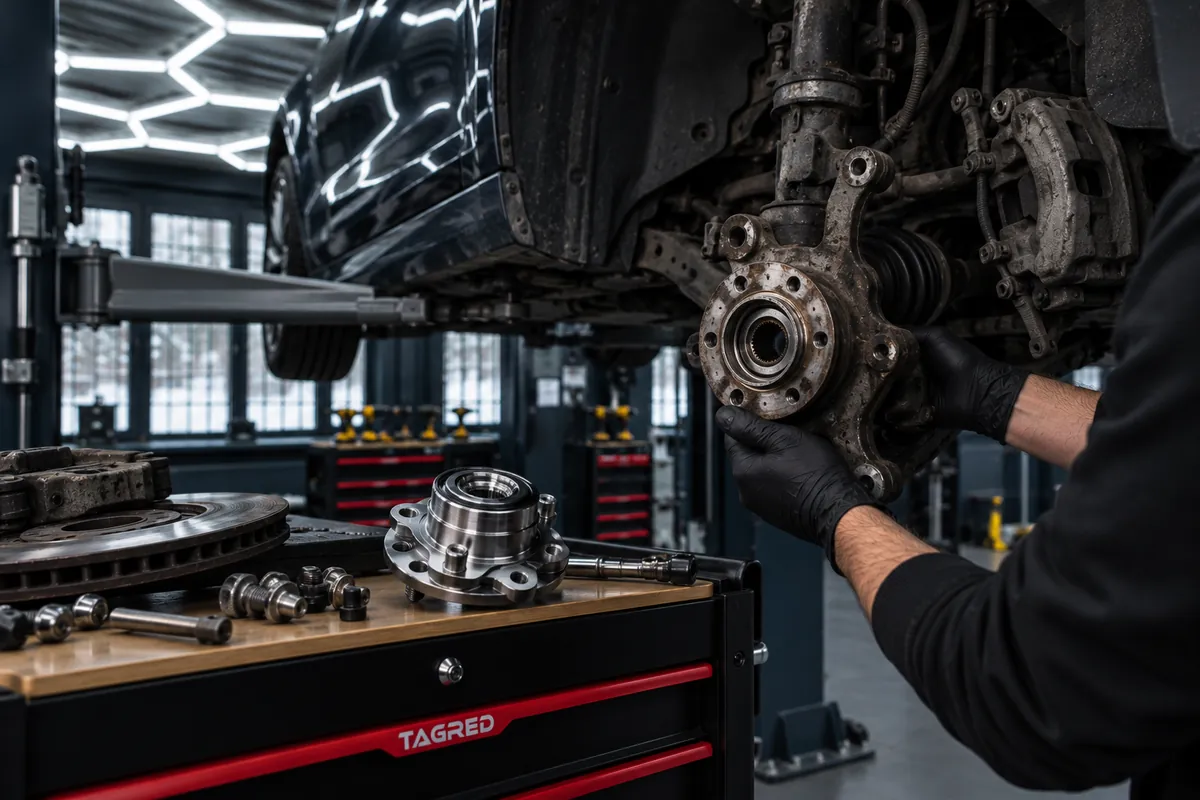
- Tie rod ends and the inner tie rods (axial joints at the steering rack).
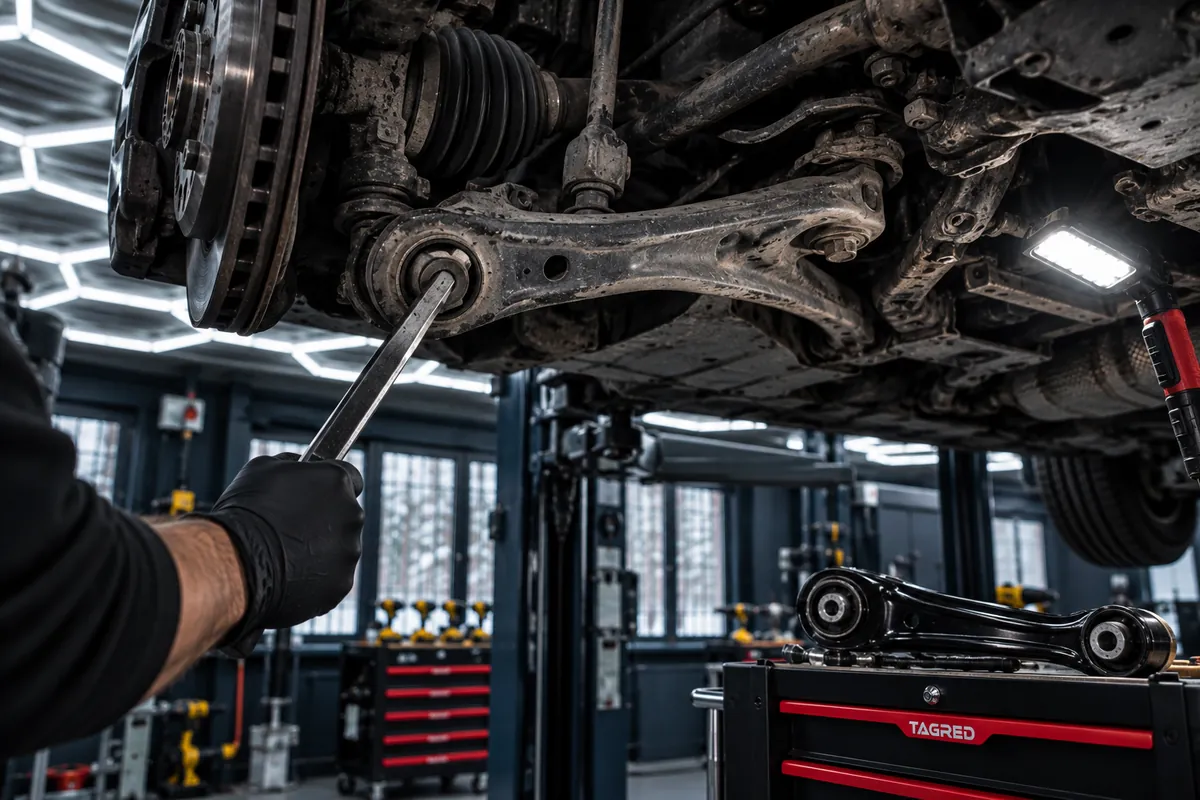
- Control arm ball joints and the rubber-metal control arm bushings.
- The steering rack mounting to the body, or play inside the rack.
- Worn shock absorbers that do not damp the wheel’s movement after an impact.
- Anti-roll bar links — they knock more often than they cause vibration, but can be part of the puzzle.
Play in the steering is not just a comfort issue. It reduces steering precision, amplifies vibration from the wheels and speeds up uneven tyre wear. After replacing a tie rod end or tie rod, a wheel alignment is necessary because the toe changes.
How to tell a worn control arm from worn bushings is covered in our guide control arm or bushings, and knocks over potholes in the article suspension knocking.
Vibration at a standstill and when accelerating — engine, mounts, CV axles
When the steering wheel vibrates at a standstill with the engine running, the wheels have nothing to do with it. Engine and gearbox mounts damp the vibration of the powertrain; when the rubber separates or a hydraulic mount loses its fluid, vibration passes into the body and the steering column. Typical signs are stronger vibration after switching on the air conditioning, in “D” in an automatic with your foot on the brake, and a jolt or knock when pulling away and changing direction.
Vibration at a standstill can also come from rough running of the engine itself: misfires (spark plugs, coils, injectors), intake leaks or EGR valve problems. The check engine light then often comes on or flashes. In diesels with a dual-mass flywheel, a worn flywheel causes vibration and knocks especially at low revs and when switching the engine off — more in our guide dual-mass flywheel.
A separate case is vibration that appears only when accelerating, especially hard, and disappears when you lift off. A worn inner CV joint is often responsible, less often an engine or gearbox mount. If the car also jerks, see the article car jerking.
Can you drive with a shaking steering wheel?
Slight vibration from an unbalanced wheel does not call for a tow truck, but it is not worth ignoring. A vibrating wheel loads the bearings, tie rod ends and bushings, and the tyre wears unevenly. A problem that costs a wheel balance today may mean new tyres and suspension parts after a few thousand kilometres.
Act urgently when the vibration is strong, appeared suddenly after hitting a pothole or kerb, or comes with knocking, pulling, noticeable steering play or a visible tyre bulge. The same applies to vibration when braking combined with a longer stopping distance. In such a situation it is better to slow down, keep driving to a minimum and come in for diagnosis as soon as possible.
A bulge on the sidewall of a tyre means its structure is damaged. Such a tyre cannot be repaired — it has to be replaced regardless of tread depth. How to assess tyres is covered in our guide when to replace tyres.
How we diagnose steering wheel vibration
- 1A talk with the driver: at what speed and in what situation it shakes, since when, whether tyres, wheels or brakes were changed recently and whether there was a pothole impact.
- 2A test drive — we check the vibration at a steady speed, when braking, over bumps, when accelerating and while coasting in neutral (this separates the wheels from the engine).
- 3Inspection of the wheels: tyre condition and wear, bulges, rim damage, a balance check on the balancing machine and a check of rim and tyre runout.
- 4Brake check: condition and thickness of the discs and pads, signs of overheating, free movement of the calipers.
- 5Checking the suspension and steering on the play detector: tie rod ends and tie rods, ball joints, bushings, wheel bearings, shock absorbers, CV joints.
- 6With vibration at a standstill — assessment of the engine mounts and, if needed, computer diagnostics and a reading of the misfire counters.
- 7Presenting the result and a quote for approval — only then do we order parts and start work.
The order matters: we start with the simplest and cheapest causes, i.e. the wheels and tyres. There is no point replacing tie rod ends if the vibration comes from a lost balance weight. On the other hand, balancing alone will not help if the wheel vibrates because of play in the steering — which is why we check the suspension as a whole when there is vibration.
How much does fixing steering wheel vibration cost in Warsaw
| Service | Price (labour) |
|---|---|
| Suspension diagnostics | 100 zł |
| Computer diagnostics (vibration at idle, misfires) | 100 zł |
| Tyre change with balancing (R14–R21, full set) | 180–320 zł |
| Wheel balancing only, without a tyre change | quoted after diagnosis |
| Pads and discs replacement — front | 300 zł |
| Pads and discs replacement — rear | 350 zł |
| Tie rod end replacement | 150 zł |
| Control arm replacement | 200 zł |
| Engine mount replacement | 150 zł |
| CV axle replacement | 250 zł |
| Wheel alignment — 1 axle / 2 axles | 150 zł / 300 zł |
Prices are for labour at Pulsecar; parts, if needed, are quoted separately depending on the model. The tyre change price depends on the rim size and includes wheel balancing. Before work starts you receive a quote for approval, and we give a 6-month warranty on labour. The full list is in our price list.
If a tie rod end or control arm needs replacing as well, we do the alignment after the repair so that it only has to be done once. More about chassis repairs is on the suspension repair page, and about alignment on the wheel alignment page.
Steering wheel vibration in Warsaw Bielany — Pulsecar, ul. Arkuszowa 176
The steering wheel shakes at speed, when braking or at a standstill — we will find the cause at the Pulsecar workshop at ul. Arkuszowa 176 in Warsaw’s Bielany district, convenient for drivers from Żoliborz, Bemowo and Łomianki. We are open Monday to Friday 09:00–18:00 and Saturdays 09:00–15:00.
The easiest way is to book online or call +48 571 058 591. Tell us at what speed and in what situation the vibration appears — that speeds up the diagnosis. Directions and contact details are on the contacts page.