Wheel bearing — symptoms, diagnosis and when to replace it
Wheel bearing noise is easily mistaken for tyre noise, and a neglected bearing can seize. We explain how to recognise the symptoms, how we diagnose it and what the cost of replacement depends on.
9 min read · Pulsecar team · updated:
Wheel bearing — symptoms in brief
The most typical symptom of a bad wheel bearing is a steady hum or drone that grows with road speed (usually noticeable from about 40–60 km/h) and changes when the car leans in a bend. Over time play may develop in the wheel, the steering wheel may vibrate, and in cars where the ABS sensor works with the bearing, the ABS warning light may come on.
A wheel bearing rarely fails overnight. It usually hums louder and louder for weeks, while drivers get used to the noise or blame the tyres. The problem is that a neglected bearing heats up, its play increases and in extreme cases it can seize. Below we explain how to tell bearing noise from tyre noise, what diagnosis on the lift looks like and what the cost of replacement depends on.
How a wheel bearing works and why it wears out
- Hard hits on potholes and kerbs — the balls dent the races.
- Water and grit getting in through a damaged seal (e.g. after a deep puddle or pressure-washing too close).
- Fitting mistakes: pressing the bearing in through the wrong race, tightening the hub nut with an impact wrench or to the wrong torque.
- Wheels with a different offset (ET) or wider than the manufacturer intended — longer levers and higher loads on the bearing.
- Heavy loads, towing a trailer and simply mileage.
A wheel bearing lets the wheel turn with minimal resistance while carrying the full weight of the car and the side forces in corners and under braking. In newer cars it is usually a double-row ball or tapered roller bearing, greased for life and closed with seals — it needs no maintenance, but it also cannot be “re-greased” or adjusted.
Wear is accelerated by anything that damages the races or the seal:
Symptoms of a bad wheel bearing
- A hum, drone or “howl” that grows with speed, similar to the sound of aggressive tyres.
- The noise changes (gets louder or quieter) in a long bend or when changing lanes.
- The noise does not change when you press or lift off the accelerator or shift into neutral.
- Vibration felt through the steering wheel or the floor, increasing with speed.
- Play in the wheel — it can be rocked when gripped at the top and bottom.
- ABS or ESP warning light on, sometimes with cruise control not working.
- At an advanced stage grinding, rumbling and even pulling to one side.
Characteristically, bearing noise depends mainly on road speed, not on engine revs. If at 80 km/h the car hums the same in fourth gear, in fifth and in neutral, the source is most likely something that turns with the wheel: the bearing, a tyre or a brake component.
Bearing play can also make the brakes work unevenly — the disc runs out, the pedal pulses and the pads wear unevenly. If you hear more of a squeal or scrape when braking, see our guide squeaking brakes.
A humming bearing is not a failure that needs a tow truck, but it is not worth driving on it for months. The longer a damaged bearing runs, the hotter it gets and the greater the risk of damaging the hub, the ABS sensor or the steering knuckle.
Bearing or tyres? How to tell the noise apart
| Observation | Wheel bearing | Tyres | CV joint |
|---|---|---|---|
| Type of sound | Steady hum, drone, “howl” | Roar or drumming, often rhythmic with uneven wear | Clicking, cracking |
| Depends on speed | Grows with speed | Grows with speed | Heard mainly when pulling away on full lock |
| In a bend | Clearly changes (bearing load) | Changes only slightly | Louder with the wheels turned hard |
| Change of road surface | Depends little on the surface | Depends clearly — different noise on smooth and rough asphalt | Unrelated |
| After swapping wheels front–rear | Noise stays in the same place | Noise “moves” with the tyres | No change |
| On the lift | Play or roughness when spinning the wheel | Feathered or unevenly worn tread | Damaged boot, play in the joint |
The tread itself also gives the tyre away: if you feel “steps” or dips when running your hand around it, the noise may come from uneven wear, which in turn often results from bad alignment or worn shock absorbers. We cover assessing tyres in our guide when to replace tyres.
A simple test: if you have a second set of wheels, swap them, or move the wheels front to rear and drive the same route. If the noise stays in the same spot on the car, the tyres are probably not to blame.
Noise changes in a bend — which bearing is bad?
In a long bend the car’s weight shifts onto the outer wheels. In a left-hand bend the right-side bearings are loaded more, and in a right-hand bend the left-side ones. If the noise gets clearly louder turning left and quieter turning right, the right bearing is usually the suspect (and vice versa).
That is only a hint, not a verdict. Sound travels through the body, and it is hard to tell “by ear” whether it comes from the front or the rear. Sometimes two bearings are worn at the same time. That is why we always confirm the diagnosis on the lift before ordering parts — replacing the wrong bearing is wasted time and money.
Wheel bearing and the ABS light
In many modern cars the bearing works together with the wheel speed sensor. The bearing seal (or the hub) contains a magnetic ring, the so-called encoder, and the ABS sensor reads pulses from it. The control unit compares the speeds of all wheels — ABS, ESP, traction control and in some cars the tyre pressure monitoring system rely on this.
When the bearing has play, the encoder is damaged or covered in metal particles, or the bearing was fitted the wrong way round, the signal becomes irregular or disappears. The result is an ABS and ESP warning light and a wheel speed sensor fault stored in the control unit. The sensor itself may be fine — the bearing is to blame.
It can be the other way round too: the ABS light comes on because of a damaged wire, connector or the sensor itself, while the bearing is fine. That is why we start by reading fault codes and viewing live wheel speeds. Other causes are covered in our guide ABS warning light.
How we diagnose a wheel bearing
- 1A talk with the driver: from what speed the noise is heard, whether it changes in bends and whether tyres or suspension parts were replaced recently.
- 2A test drive with the driver or a mechanic — we check how the noise reacts to speed, bends, throttle and neutral.
- 3Reading ABS/ESP fault codes and viewing individual wheel speeds if the warning light is on.
- 4On the lift: checking for play — gripping the wheel at the top and bottom (bearing play) and at the sides (for comparison, tie rod end play).
- 5Spinning the wheel by hand and listening for roughness; if needed, listening with a workshop stethoscope or running the driven wheels on the lift.
- 6Checking the tyres, brakes, CV joints and other suspension parts on the play detector to rule out other noise sources.
- 7Presenting the result and a quote for approval — only then do we order parts and start work.
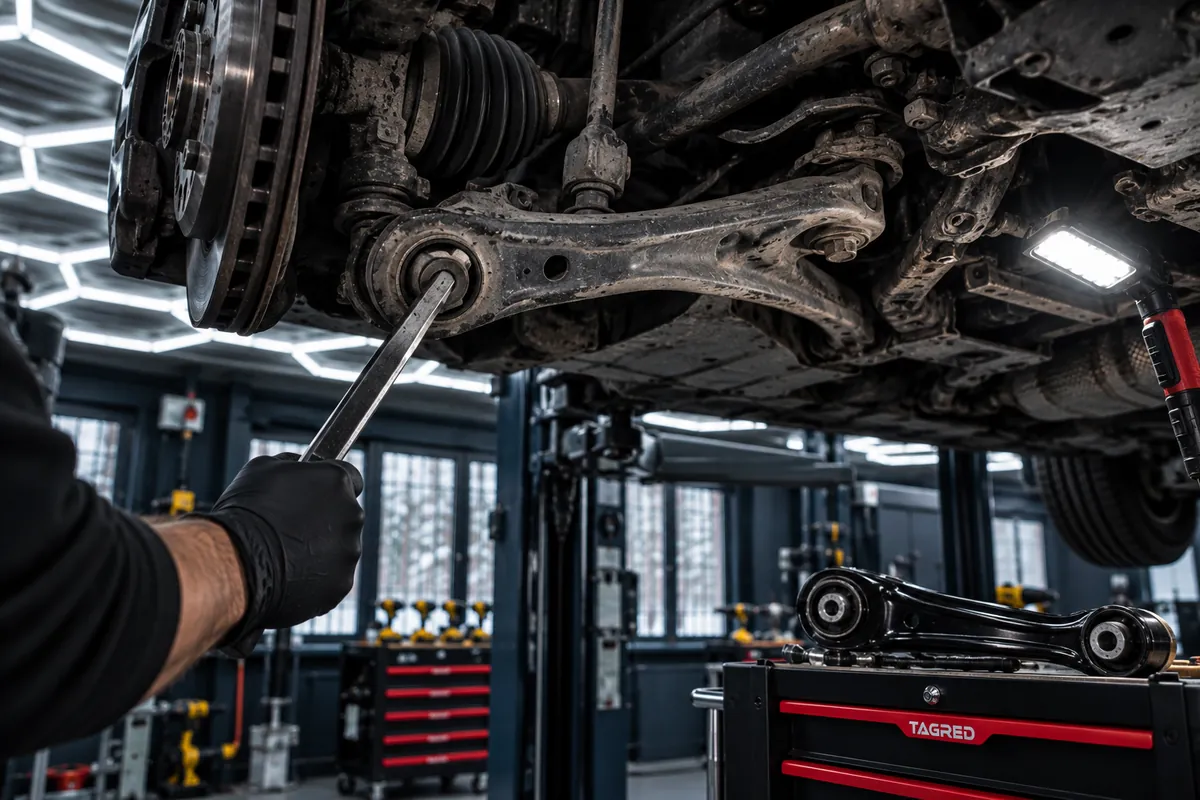
Play felt when gripping the wheel at the top and bottom can come not only from the bearing but also from the control arm ball joint. The mechanic tells them apart by watching where the movement happens — with a bearing the hub moves relative to the knuckle, with a ball joint the knuckle moves relative to the arm. Control arm play is covered in our guide control arm or bushings.
Hub assembly or pressed-in bearing — the types
| Type | How it is built | What replacement involves |
|---|---|---|
| Bearing pressed into the knuckle | The bearing alone is press-fitted into the steering knuckle and held by a circlip; the hub is pressed into the bearing | Usually requires removing the knuckle and working on a press; more labour |
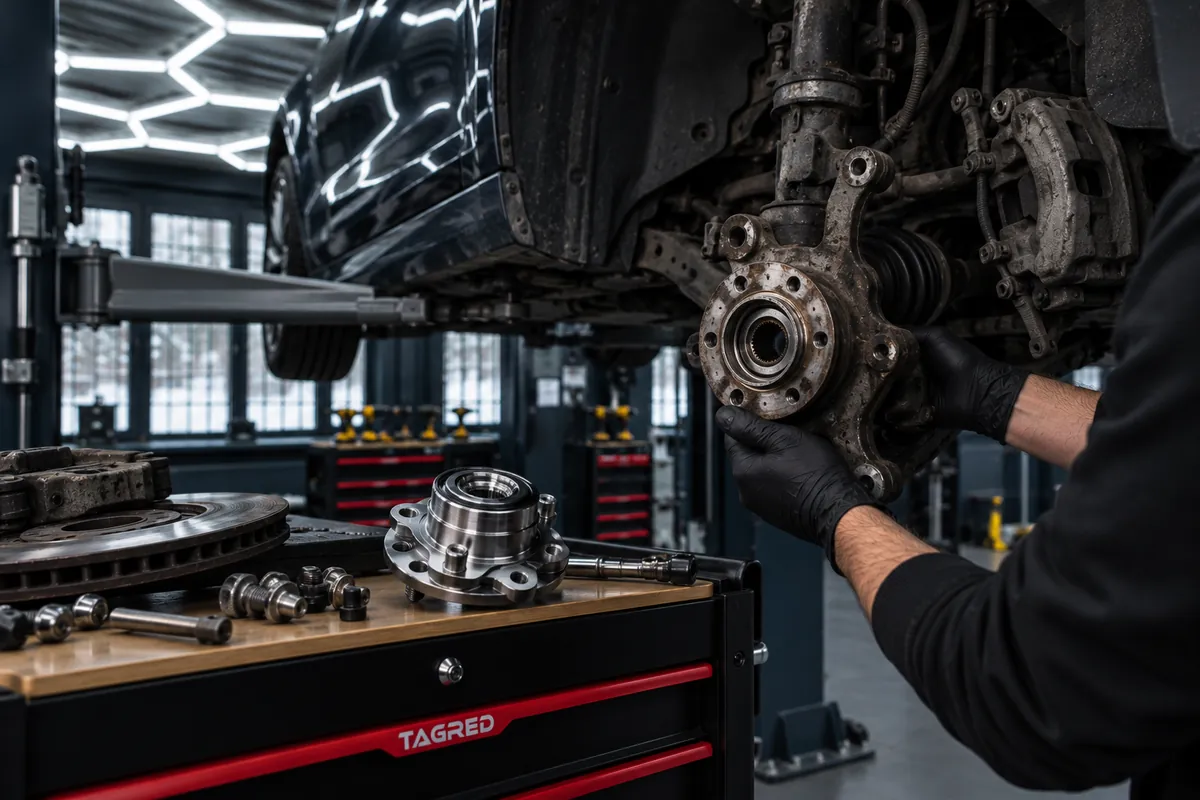
| Hub assembly (bolt-on unit) | Bearing integrated with the hub into one unit, bolted to the knuckle or axle beam | The whole unit is replaced; usually quicker, parts more expensive |
| Bearing in a drum or rear hub | Common at the rear of older or simpler cars with drum brakes | Replaced with the drum/hub or separately — depending on the model |
A hub assembly often already has an integrated encoder and sometimes an ABS sensor too. With a pressed-in bearing it is important to press it through the correct ring (never through the balls) and to face the encoder side towards the sensor.
In both cases the hub nut or bolt is tightened to the manufacturer’s torque, and on many cars it is single-use. If the knuckle had to be separated from the strut during the job, it is worth checking the wheel alignment afterwards.
Should wheel bearings be replaced in pairs?
There is no such requirement. Bearings do not wear in pairs like brake pads or shock absorbers — often only one hums, e.g. on the side that more often drops into potholes along the kerb. A healthy bearing on the other side of the axle can keep running for a long time.
We consider replacing both bearings on an axle when the car has high mileage, the second bearing already shows slight roughness or starts to hum, and both have the same age and history. Then one visit instead of two may simply pay off. We always leave the decision to the customer — we tell you what we found on the lift and quote both options.
Can you drive with a humming wheel bearing?
At the beginning, when the bearing only hums slightly and has no play, you can usually drive to the workshop calmly. But do not treat it as an “until further notice” condition. A damaged bearing heats up, the grease loses its properties and play increases ever faster.
Act urgently when the hum turns into grinding or rumbling, clear play, vibration or pulling appears, or the ABS light comes on. Advanced damage can lead to a seized bearing, a destroyed hub spindle or knuckle and, in extreme cases, loss of wheel stability. Then it is better to slow down and come in for diagnosis as soon as possible.
Touching the hub or rim after a drive to check whether the bearing is hot is not a good idea — the hot brake discs are right there. The conclusions of such a “test” can be misleading, and it is easy to get burned.
How much does wheel bearing replacement cost in Warsaw
| Service | Price (labour) |
|---|---|
| Suspension diagnostics | 100 zł |
| Computer diagnostics (ABS/ESP fault codes) | 100 zł |
| Wheel bearing or hub replacement | quoted after diagnosis |
| CV axle replacement | 250 zł |
| Wheel alignment — 1 axle | 150 zł |
| Wheel alignment — 2 axles | 300 zł |
The cost of wheel bearing replacement depends heavily on the design: a bolt-on hub assembly is usually quicker to replace but more expensive to buy, while a pressed-in bearing is cheaper but needs more work on the knuckle and the press. It also matters whether it is a front or rear wheel, driven or not, and the condition of the bolts and nuts. That is why we give the price after diagnosis and identifying the car, and parts are quoted separately.
Before work starts you receive a quote for approval, and we give a 6-month warranty on labour. The full list is in our price list, and more about chassis repairs is on the suspension repair page.
Wheel bearing replacement in Warsaw Bielany — Pulsecar, ul. Arkuszowa 176
Bearing hum, play in the wheel or the ABS light — we will find the cause at the Pulsecar workshop at ul. Arkuszowa 176 in Warsaw’s Bielany district, convenient for drivers from Żoliborz, Bemowo and Łomianki. We are open Monday to Friday 09:00–18:00 and Saturdays 09:00–15:00.
The easiest way is to book online or call +48 571 058 591. Tell us from what speed you hear the noise and whether it changes in bends — that speeds up the diagnosis. Directions and contact details are on the contacts page.