Soft Brake Pedal — Causes, What to Do and Repair Cost
A spongy or sinking brake pedal means the hydraulic system is losing effectiveness. We explain where it comes from, what to do right away and why brake fluid is changed every 2 years.
9 min read · Pulsecar team · updated:
Soft brake pedal — short answer
A soft, spongy or sinking brake pedal usually means there is something in the hydraulic system that can be compressed — most often air or water vapour from moisture-laden fluid — or that fluid is escaping through a leak or internally inside the brake master cylinder. Less often the cause is pistons pushed back after a pad change or old, ballooning flexible hoses.
This fault directly affects safety. If the pedal clearly travels further than usual, goes to the floor or has to be “pumped” for the car to stop — do not keep driving; arrange transport to a workshop. Below we explain where a soft pedal comes from, what to do right away, why brake fluid is changed about every 2 years and what the repair costs in Warsaw.
Why the brake pedal goes soft — how the hydraulics work
The braking system works because brake fluid is practically incompressible. Pressing the pedal (assisted by the brake booster) creates pressure in the master cylinder, which travels through the lines to the calipers and wheel cylinders. The pistons press the pads against the discs, and after a short travel the pedal becomes firm and “solid”.
Gas — air or vapour — unlike fluid, compresses easily. Every bubble in the system means part of the pedal movement goes into squeezing it instead of clamping the pads. Hence the spongy feel and longer pedal travel. If fluid escapes (externally, or internally in the master cylinder past worn seals), the pedal slowly sinks under steady pressure.
It is worth telling a soft pedal from a hard one. A very hard pedal that needs a lot of force points to a problem with the power assistance (booster, vacuum supply, vacuum pump on a diesel), not with the hydraulics. A normal pedal with weak braking is more often overheated or glazed pads and discs.
Spongy, sinking or long pedal — what the symptom means
| Symptom | Most common cause | What to do |
|---|---|---|
| Pedal spongy and springy, but the car brakes | Air in the system, moisture-laden fluid, old flexible hoses | Limit driving, get a diagnosis and a bleed or fluid change as soon as possible |
| Pedal slowly sinks under steady pressure (e.g. at traffic lights) | A leak in the system or worn seals in the master cylinder | Do not drive — check the fluid level and signs of a leak, get a diagnosis |
| Pedal goes to the floor, has to be pumped | Major leak, no fluid, severe air in the system | Stop the car immediately in a safe place, tow it |
| Pedal soft after a long descent or hard braking, then returns to normal | Old fluid boiling (vapour in the system) | Slow down, let the brakes cool, change the fluid |
| Pedal drops on the first press after a pad change | Pistons pushed back during fitting, pedal not pumped up | Press the pedal several times until firm before moving off |
| Pedal hard, needs a lot of force | Brake assist fault (booster, vacuum) | Diagnosis — this is a different problem from a soft pedal |
The table helps with a first assessment but does not replace a diagnosis. Several faults can occur at once, e.g. a leak plus air drawn in after topping up.
If a red brake warning light comes on along with a soft pedal, in many cars it means low fluid in the reservoir. That signals a leak or very worn pads — do not top up “by eye” and do not keep driving without finding the cause.
The most common causes of a soft brake pedal
- Air in the system — after brake work, replacing a hose, caliper or master cylinder without proper bleeding, or when the fluid level dropped so low that the master cylinder drew air from the reservoir.
- Old, moisture-laden brake fluid — it absorbs water from the environment, which lowers its boiling point. Under hard braking the water turns to vapour and the pedal goes soft.
- Fluid leak — corroded metal lines, cracked or chafed flexible hoses, leaking caliper piston seals or drum brake wheel cylinders, a loose fitting. Look for wet traces near the wheels and under the car (see also leak under the car).
- Worn master cylinder — seals inside the cylinder let fluid bypass from one chamber to the other. There is no external leak, but the pedal slowly sinks under steady pressure.
- Old flexible hoses — tired rubber “balloons” slightly under pressure, so part of the pedal travel goes into expanding the hoses.
- Air in the ABS unit — after replacing or draining the pump or module, or when the system was air-locked for a long time, bubbles can stay trapped in the ABS valves. A standard bleed at the wheels sometimes is not enough.
- Out-of-adjustment rear drum brakes or play in a wheel bearing — the pistons have to travel further, so the pedal is long.
In many manual-gearbox cars the hydraulic clutch shares the reservoir with the brakes. A leak in the clutch system also lowers the fluid level, and a brake fluid change should include the clutch circuit too if the manufacturer specifies it.
Pedal drops after replacing pads or a caliper
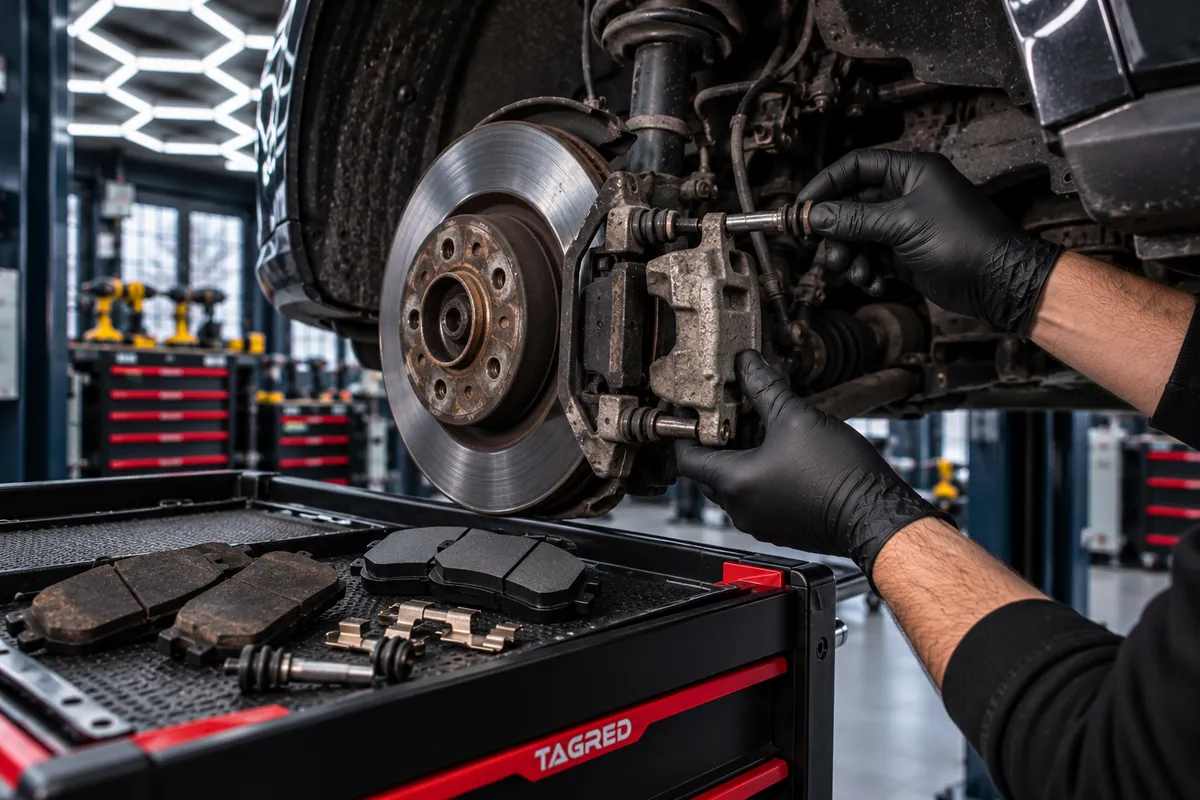
When replacing pads, the mechanic pushes the caliper pistons back so the new, thicker pads fit. After fitting, the pistons must come back out to the pads — that is why the pedal has to be pressed several times before driving off, until it becomes firm. If the driver sets off without doing this, the first press may meet “nothing”. A reputable workshop does this before handing the car back, but it is worth remembering if the brakes were serviced elsewhere.
If, however, the pedal stays soft after several presses and a test drive, the cause is usually air in the system — e.g. after replacing a caliper or hose, or when the reservoir ran empty during the work. Then the system must be bled again. New pads and discs also need from several dozen to a few hundred kilometres of gentle bedding-in, but bedding-in affects braking performance, not a spongy pedal.
After a pad change, do not move off until the pedal is firm. For the first few kilometres brake gently and keep a larger following distance.
Brake fluid every 2 years — why it matters so much
| Fluid type | Min. boiling point — fresh | Min. boiling point — wet | Notes |
|---|---|---|---|
| DOT 3 | 205°C | 140°C | Older designs; glycol-based |
| DOT 4 | 230°C | 155°C | Most common in passenger cars; glycol-based |
| DOT 5.1 | 260°C | 180°C | Glycol-based, higher performance |
| DOT 5 | 260°C | 180°C | Silicone-based — do not mix with glycol fluids |
Common brake fluids (DOT 3, DOT 4, DOT 5.1) are hygroscopic, meaning they absorb moisture from the air — through the reservoir, flexible hoses and seals. Even a few percent of water significantly lowers the boiling point. Fresh DOT 4 fluid must boil at no less than 230°C, while moisture-laden fluid (the so-called “wet” boiling point) only at 155°C — and in practice old fluid can be even worse.
During hard or prolonged braking (mountain descents, towing a trailer, several hard stops from motorway speed) the calipers get very hot. If the fluid boils, vapour bubbles form in the system and the pedal suddenly goes soft or drops deep — exactly when the brakes are needed most. Water also speeds up corrosion of calipers, lines and ABS module components.
That is why most manufacturers recommend changing brake fluid about every 2 years regardless of mileage (the exact interval is in the service book). The fluid does not “get used up” in the reservoir — its level tells you nothing about the water content, and its colour is only a rough indication.
Always use fluid that matches the manufacturer’s specification (marked on the reservoir cap or in the manual). Silicone DOT 5 fluid must not be mixed with DOT 3/4/5.1.
What to do right away when the brake pedal is soft
- 1If the pedal dropped while driving: lift off the throttle, pump the pedal quickly several times, shift down to use engine braking and apply the parking brake gradually. Pull over somewhere safe and switch on the hazard lights.
- 2With the car parked and the engine off, check the fluid level in the reservoir (between MIN and MAX). A low level indicates a leak or very worn pads.
- 3Look at the inside of the wheels, the tyres and the ground under the car — brake fluid is oily, clear to brown and usually almost odourless.
- 4Simple test: with the engine running, press the pedal and hold it with steady force for 10–20 seconds. If it slowly sinks, the system is losing pressure — the car is not fit to drive.
- 5Do not top up and “try it out”. Topping up does not remove the cause, and the master cylinder may draw in air again. Arrange towing or a recovery truck to the workshop.
You must not drive with a soft, sinking brake pedal — not even “just to the workshop round the corner”. Stopping distance can grow suddenly and without warning. Call a recovery truck or call us and we will help arrange transport.
How we diagnose and bleed the brake system
- 1A conversation with the driver: when the pedal went soft, whether the brakes were recently serviced, whether the brake or ABS warning lights are on.
- 2Checking fluid level and condition, inspecting rigid and flexible lines, calipers, wheel cylinders and the master cylinder for leaks and corrosion.
- 3Pedal test with the engine running and off — we distinguish air in the system from a leaking master cylinder and a brake assist problem.
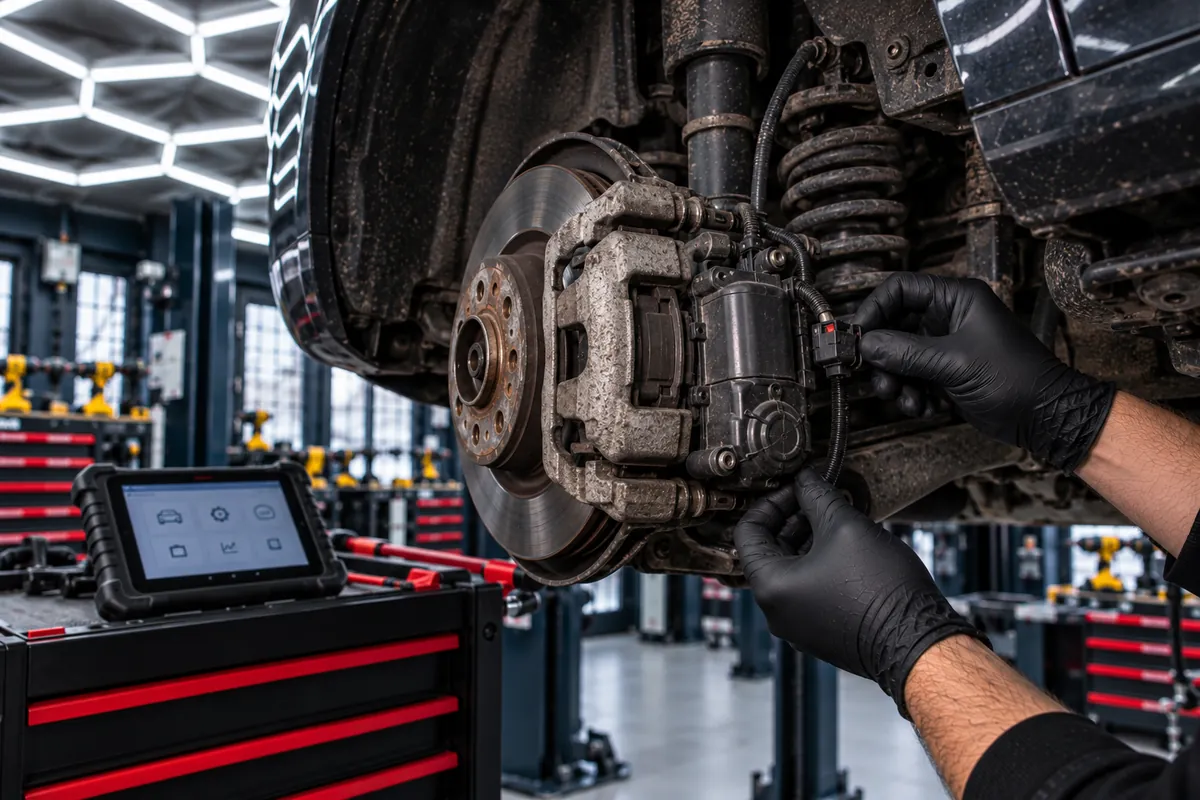
- 4Computer diagnostics when the ABS warning light is on or the system requires bleeding the ABS unit with a scan tool.
- 5A quote for approval: fixing the leak or replacing damaged parts, fluid change and bleeding according to the manufacturer’s procedure.
- 6After the repair we check pedal height and firmness and system tightness, and do a test drive.
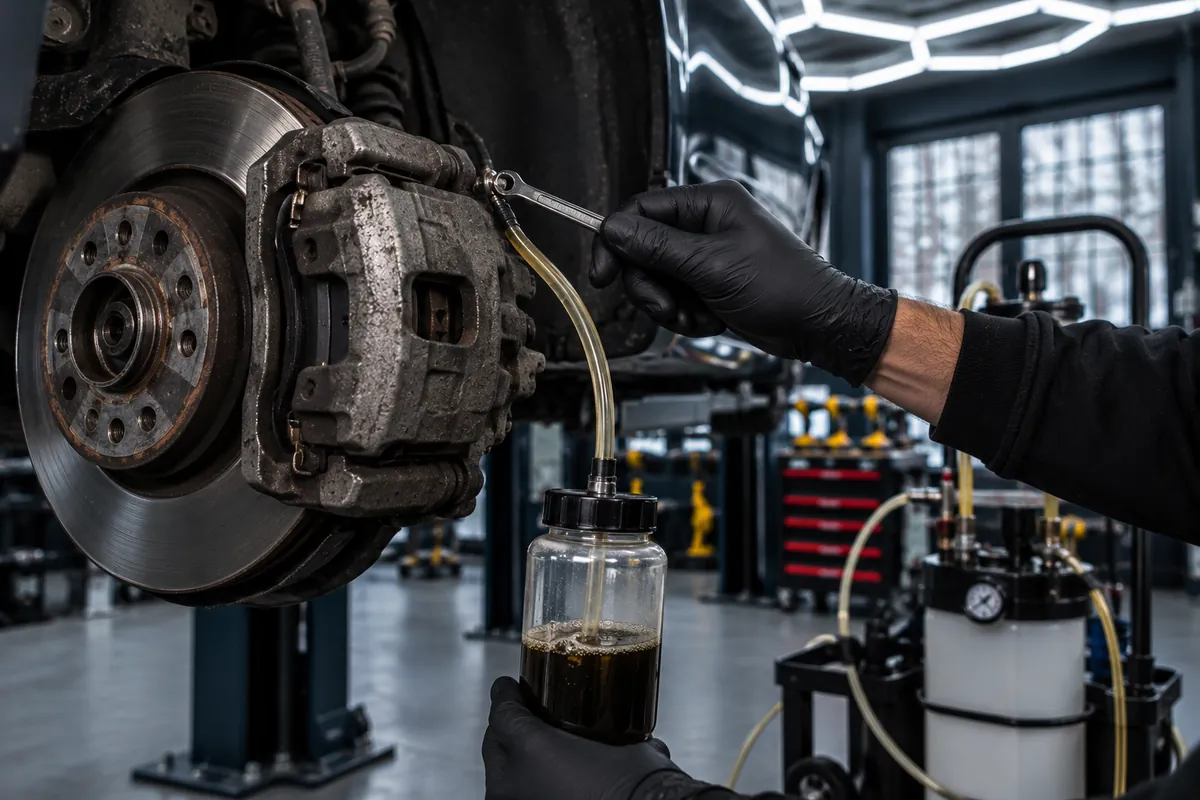
Bleeding means pushing air and old fluid out of the system through the bleed valves at the wheels, in the order specified by the manufacturer. In newer cars with advanced ABS/ESP, part of the procedure requires a diagnostic tool that runs the module’s pump and valves to clear air from inside it. During a full fluid change, the system is flushed until clean, fresh fluid without bubbles comes out of every valve.
That is why we do not recommend “DIY” bleeding on cars with ABS unless you have the right knowledge and tools — a badly bled system can brake worse than before the repair.
Soft brake pedal — repair cost in Warsaw
| Service | Price (labour) | When it is needed |
|---|---|---|
| Brake fluid change with bleeding | from 200 zł | About every 2 years, moisture-laden fluid, spongy pedal |
| Brake pad replacement — front | from 200 zł | Worn pads, low fluid level in the reservoir |
| Brake pad replacement — rear | from 250 zł | Worn rear pads |
| Pads and discs replacement — front | from 300 zł | Worn or overheated discs |
| Pads and discs replacement — rear | from 350 zł | Worn rear discs |
| Computer diagnostics | 100 zł | ABS warning light, bleeding the module with a scan tool |
| Leak repair, master cylinder, line or caliper replacement | price after diagnosis | Leak, sinking pedal, corroded lines |
Brake fluid and parts are priced separately in the quote. The cost of fixing a leak or replacing a master cylinder depends on the specific car and access to the parts, so we give it after diagnosis — you approve the quote before we start. The full price list is on the Pulsecar price list page.
We give a 6-month warranty on labour. You can read more about the scope of work on the brake repair at Pulsecar page. If the brakes also squeal, see our guide to squealing brakes.
Brake repair in Warsaw, Bielany — Pulsecar, ul. Arkuszowa 176
Pulsecar is located at ul. Arkuszowa 176 in Warsaw’s Bielany district, close to Żoliborz, Bemowo and Łomianki. We are open Monday to Friday 09:00–18:00 and Saturdays 09:00–15:00.
Call +48 571 058 591 or book a visit online. If the brake pedal goes to the floor, do not drive the car to us — call us and we will agree how to get the car here safely. You always receive a quote for approval before the repair starts.