When to Switch to Winter and Summer Tyres
In Poland there is no legal requirement to use winter tyres, but the difference in braking distance on cold roads is huge. We explain when to switch tyres and how to judge their condition.
8 min read · Pulsecar team · updated:
When should you switch to winter tyres?
Fit winter tyres once the average daily temperature stays below about 7°C for several days in a row — in Warsaw that is usually the second half of October or early November. Switch back to summer tyres when the daily average is consistently above 7°C, most often in April.
Don’t wait for the first snow. When it comes, workshops get queues, and for days you drive on tyres that grip noticeably worse on cold asphalt. It is best to book your tyre change in Warsaw one or two weeks in advance.
The 7°C rule — where does it come from?
Summer tyre compound is designed for warm conditions. Below about 7°C it hardens, conforms less to the micro-texture of the asphalt and loses grip — even on a dry road with no snow. A winter tyre has a softer compound and dense sipes (lamellae) that bite into snow and slush.
It works the other way too: in warm weather winter rubber wears quickly, the car handles worse in corners and braking distances on dry, warm asphalt get longer. Driving all summer on winter tyres wastes money and safety.
7°C is a rule of thumb, not a strict limit. Watch the morning and evening temperatures — that is when most people commute and when it is coldest.
If you often drive out of Warsaw or into the mountains, change your tyres earlier — frost and snow arrive there sooner than in the city.
Are winter tyres mandatory in Poland?
Under the rules in force when this guide was published (October 2026), Poland has no general requirement to drive on winter tyres. Draft changes appear from time to time, so it is worth checking the current law before the season. There are, however, requirements on tyre condition: tread may not be shallower than 1.6 mm, and tyres on one axle must have the same size, construction and tread pattern — so you cannot mix a winter and a summer tyre on the same axle.
Driving on worn or damaged tyres can earn you a fine, and the police may retain the vehicle registration certificate. Tyre condition may also matter when the circumstances of a collision are assessed — details depend on the specific case and your policy terms.
Abroad it can be different. In many countries, including Germany, Czechia, Austria and Slovakia, winter tyres are required in winter road conditions or during certain months. In Germany only tyres with the snowflake-on-mountain symbol (3PMSF) now count as winter tyres — the M+S marking alone is no longer enough. Check the rules of your destination country before you travel.
What is the minimum tread depth?
- 1Buy a simple tread depth gauge or ask for a measurement at the workshop during the tyre change.
- 2Measure in the main grooves, at several points around the tyre and across its width — inner edge, centre and outer edge.
- 3Find the TWI wear indicators — small bars at the bottom of the grooves. When the tread is level with them, about 1.6 mm is left and the tyre needs replacing.
- 4Compare the readings between wheels. If one edge is clearly more worn, have the alignment checked.
| Tyre type | Legal minimum in Poland | Recommended minimum |
|---|---|---|
| Winter | 1.6 mm | approx. 4 mm |
| Summer | 1.6 mm | approx. 3 mm |
| All-season | 1.6 mm | approx. 4 mm before winter |
A winter tyre with less than about 4 mm of tread clears water and slush less effectively — it is still legal, but on snow it behaves more and more like a summer tyre. If you have 4–5 mm left before the season, consider whether it will last the whole winter.
Age, damage and uneven wear — what else to check
- Production date — the four-digit DOT code on the sidewall shows the week and year (e.g. 3821 means week 38 of 2021). Older rubber hardens even with deep tread, so tyres older than about 6 years deserve a careful look before every season.
- Cracks and a network of fine lines on the sidewall and in the tread grooves.
- Sidewall bulges — they mean the carcass is damaged, e.g. after hitting a pothole or kerb. Such a tyre can only be replaced.
- Cuts, missing chunks of rubber and embedded objects.
- Uneven wear — one worn edge usually means poor alignment, wear in the centre means pressure too high, wear on both edges means pressure too low.
Uneven wear is a sign that the problem is in the car, not the tyre. If the car also pulls, read why a car pulls to one side and book a wheel alignment — otherwise a new set will wear out just as fast.
At the seasonal change it is worth swapping wheels between axles — the front ones usually wear faster, especially on front-wheel-drive cars. Fit the tyres in better condition on the rear axle, as it is responsible for stability when braking in a corner.
All-season tyres — are they worth it?
| Criterion | All-season tyres | Two seasonal sets |
|---|---|---|
| Upfront cost | One set | Two sets of tyres (often two sets of rims too) |
| Seasonal change | Not needed | Twice a year |
| Storage | Not needed | Second set must be stored |
| Snow and frost | Decent | Winter tyre clearly better |
| Heat and fast summer driving | Faster wear, longer braking distance | Summer tyre clearly better |
| Durability | Work all year round | Each set works only half a year |
| Best for | City, low mileage, garaged car | High mileage, long trips, mountains, more powerful cars |
An all-season tyre is a compromise: in winter it grips better than a summer tyre, in summer better than a winter one, but in neither season does it match a good seasonal tyre. Choose models with the 3PMSF symbol (snowflake on a mountain) — M+S alone does not guarantee winter performance.
For a car driven mostly around Warsaw with low annual mileage, all-season tyres can be a sensible choice. If you cover many motorway kilometres, drive to the mountains or have a powerful car on wide tyres, two seasonal sets will serve you better.
How a tyre change at the workshop works
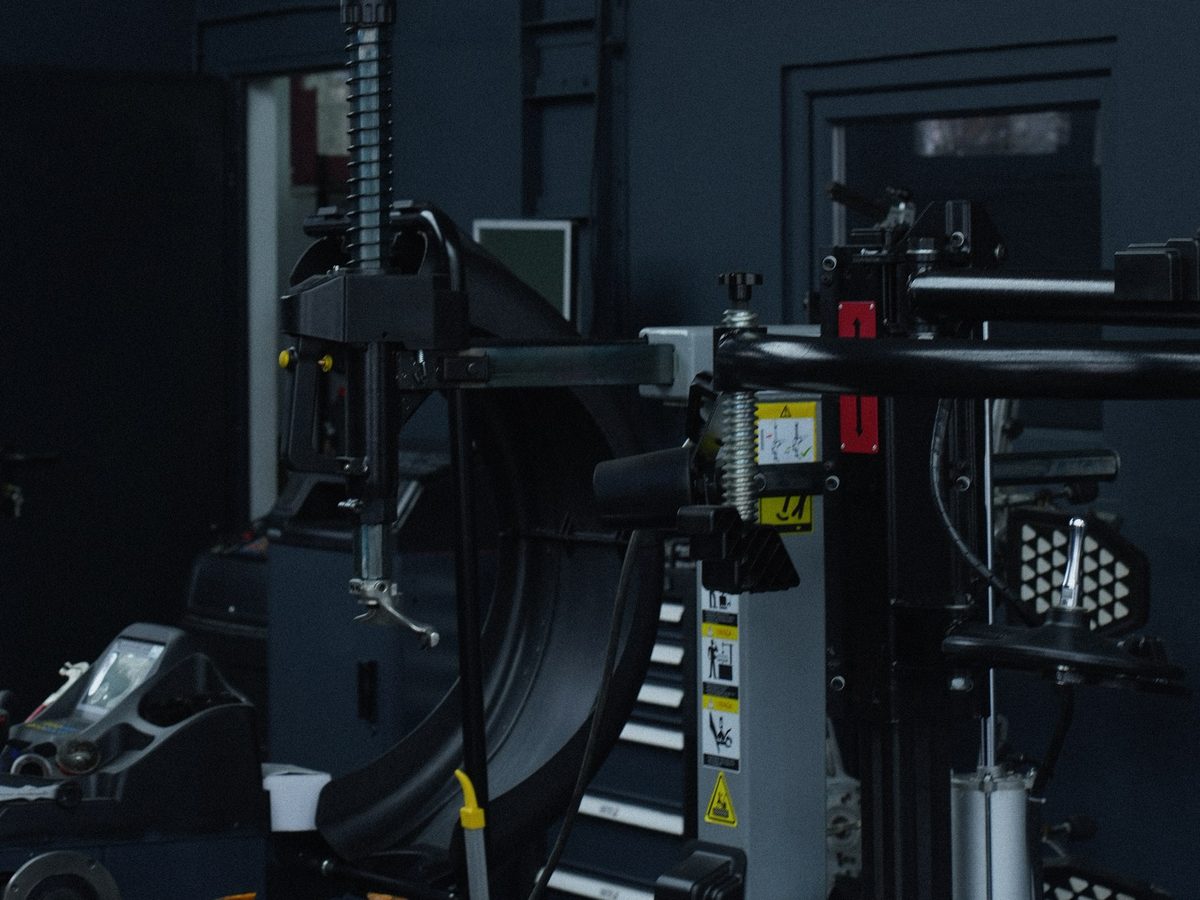
- 1Removing the wheels and assessing the tyres — we check the tread, sidewalls and evenness of wear.
- 2Swapping tyres on the rims (if you have one set of rims) or swapping complete wheel sets.
- 3Balancing each wheel on a balancing machine.
- 4Fitting the wheels and tightening the bolts to the correct torque.
- 5Setting the pressure to the car maker’s specification (sticker on the door pillar or fuel filler flap).
A complete tyre change with balancing takes about 1 hr 20 min with us. Balancing is included and is worth doing even with sets on rims: the mass distribution of a wheel changes as the tyre wears, and weights can fall off. An unbalanced wheel means steering wheel vibration at higher speeds and faster, uneven wear of tyres and suspension.
After about 50–100 km it is worth checking the bolt tightness and tyre pressures.
TPMS pressure sensors — what to remember
Since November 2014 every new passenger car registered in the EU must have a tyre pressure monitoring system (TPMS). There are two types: an indirect system compares wheel speeds using the ABS sensors, while a direct system has a sensor in each wheel, usually built into the valve.
With an indirect system you usually have to reset (calibrate) the TPMS from the car menu after changing tyres and setting the pressure — otherwise the warning light may come on a few days later. With a direct system your winter wheels need sensors too; without them the light will stay on all season. New sensors sometimes have to be paired with the car.
When booking, let us know whether your car has pressure sensors in the wheels — it makes planning the visit easier. If the pressure warning light comes on after the change, don’t ignore it: first check the pressure in all wheels.
How much does a tyre change cost in Warsaw?
| Rim size | Tyre change with balancing |
|---|---|
| R14 | 180 zł |
| R15 | 200 zł |
| R16 | 220 zł |
| R17 | 240 zł |
| R18 | 260 zł |
| R19 | 280 zł |
| R20 | 300 zł |
| R21 | 320 zł |
| Tyre storage (1 season) | 200 zł |
At Pulsecar the price depends on the rim size and covers a complete change with balancing. You always get a quote to approve before work starts, and we give a 6-month warranty on labour.
Wheel alignment costs 150 zł for one axle and 300 zł for two axles — especially worth it when fitting a new set of tyres. See the full price list on our prices page.
Tyre storage in Warsaw — 200 zł per season
- Tyres on rims — in a low stack or hung on a rack.
- Tyres without rims — standing upright, rotated every few weeks so they don’t deform.
- Before storing, wash the tyres and mark which position they came from (e.g. FL, FR, RL, RR).
A second set of tyres takes up a lot of space, and it is easily damaged in a basement or on a balcony. At Pulsecar we store your tyres for the whole season for 200 zł — next season you just come in for the change, without carrying wheels in your boot.
If you prefer to store tyres at home, keep them in a cool, dry and dark place, away from radiators, sunlight and chemicals (fuel, oils, solvents).
Storage is easy to combine with the change: e.g. for R15 rims it is 200 zł for the change and 200 zł for a season in storage.
Tyre change in Bielany — book a slot
Pulsecar is a workshop at ul. Arkuszowa 176 in Bielany — easy to reach from Żoliborz, Bemowo and Łomianki. We are open Monday to Friday 9:00–18:00 and Saturday 9:00–15:00, so you can change your tyres at the weekend too.
The best way to get a slot is online booking — you arrive at a set time without queuing in the seasonal rush. You can also set a tyre change reminder so you don’t miss the next season. Phone: +48 571 058 591.