Control arm or bushings — signs of wear and what is worth replacing
You don’t always need a whole new control arm — sometimes new bushings are enough. We explain how to recognise worn rubber and ball joints, how we diagnose them and what the repair costs.
9 min read · Pulsecar team · updated:
Control arm or just the bushings? The short answer
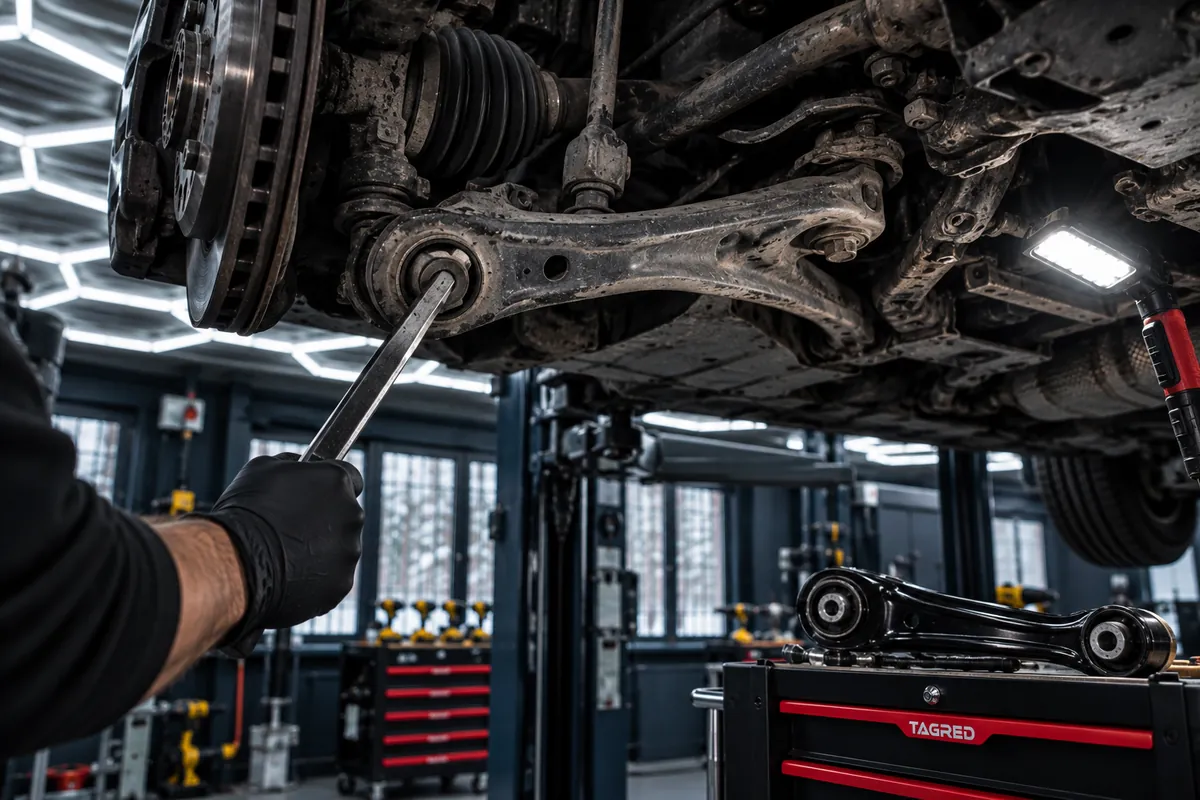
Replacing only the bushings is enough when the control arm body is straight and free of corrosion, the ball joint is sound (or can be replaced separately) and the bushings are available as separate parts. The whole arm is replaced when the ball joint is integrated into it and has play, the arm is bent or rusted through, or the bushings and the ball joint are worn at the same time — then a complete arm usually makes more sense than pressing out several parts.
Typical symptoms of a worn control arm or bushings are knocking over bumps, the car “wandering” at higher speeds, a clunk when braking and pulling away, and uneven tyre wear. After any of these repairs the wheel alignment must be set. Below we explain how to tell worn rubber from a worn ball joint, how diagnosis works and what it costs.
What a control arm is made of
| Part | What it does | How it wears | Typical symptom |
|---|---|---|---|
| Bushings (silent blocks) | Rubber-and-metal mounts attaching the arm to the body; damp vibration and let it pivot | Rubber cracks, separates from the metal, hardens; hydraulic bushings leak | Dull knocks, wandering, clunk when braking, instability |
| Ball joint | Connects the arm to the knuckle, letting the wheel steer and move | Play from wear, corrosion after the boot tears and grease is lost | Sharp knocks over bumps, wheel play, creaking |
| Arm body | Rigid steel or aluminium link carrying the forces | Bent by an impact, corrosion (steel), cracks | Pulling, crooked steering wheel, alignment out of tolerance |
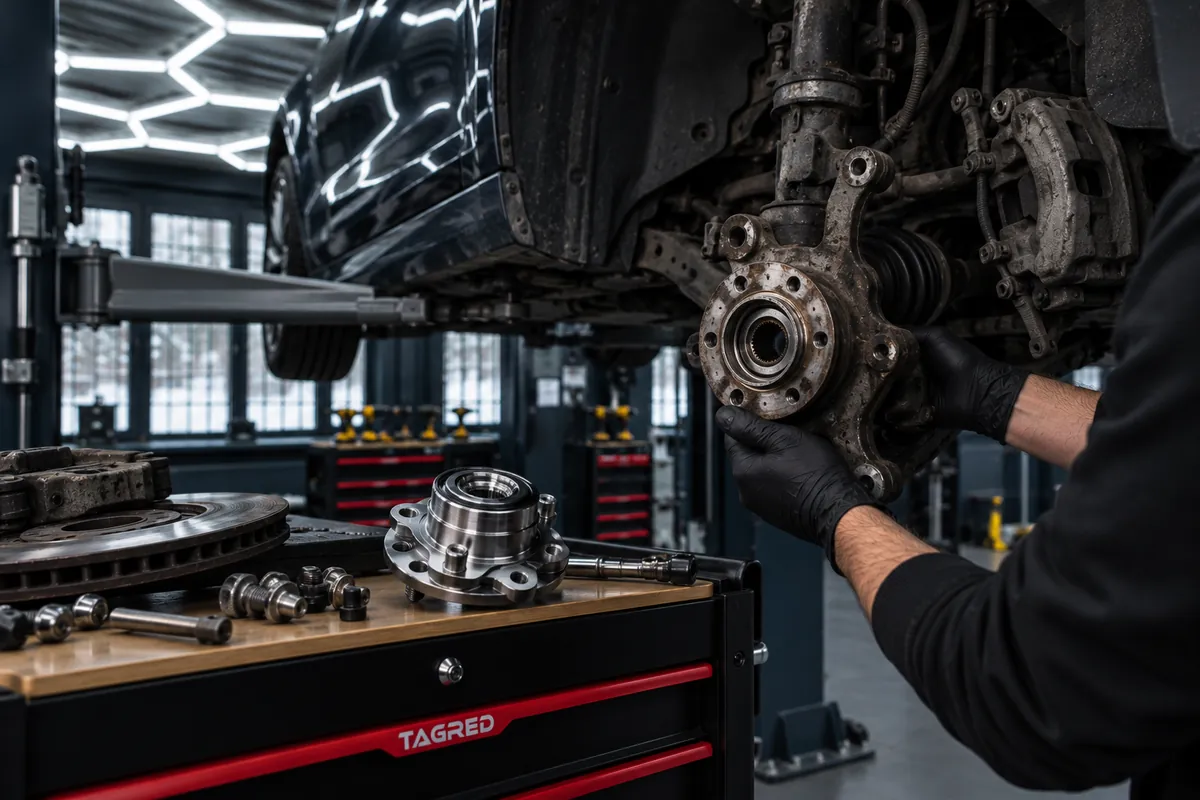
The control arm (wishbone) connects the steering knuckle (the part the wheel turns on) to the body or subframe and defines the path the wheel follows as it moves up and down. In the common MacPherson strut suspension there is one lower arm per side at the front; in multi-link suspensions (common in mid-size and premium cars) there are several arms and links per wheel.
Each control arm consists of three parts that wear independently of each other:
Symptoms of a worn control arm or control arm bushings
- Knocks or “thuds” when driving over speed bumps, manhole covers and potholes.
- A clunk when braking or pulling away, sometimes felt as a jolt in the steering wheel.
- The car “wanders” and needs constant steering corrections at higher speed or in ruts.
- Pulling to one side under braking.
- Uneven tyre wear, most often on the inner edge.
- Creaking when driving slowly over bumps and in car parks.
- Steering wheel vibration when braking from higher speed (when the discs are not the cause).
Suspension knocks have many possible sources — most often stabiliser links, tie rod ends, shock absorber mounts or the control arm bushings and ball joints themselves. A general guide to what knocks and when is in our article knocking in the suspension. Here we focus on the control arm itself and the decision about what to replace in it.
Worn bushings often don’t knock loudly but change how the car behaves: under braking and acceleration the wheel shifts forward or back, and toe changes with it. Hence wandering, pulling under braking and worn tyre edges. If the car also pulls without braking, see our guide car pulls to one side.
Clunk when braking and pulling away — the rear control arm bushing
In many cars with MacPherson suspension the front control arm has two bushings: front and rear. The rear one (often larger, hydraulic in some models) carries the longitudinal forces created when braking and pulling away. When its rubber cracks or separates from the sleeve, the arm shifts a few millimetres and knocks every time you brake — the driver hears a clunk and feels a slight jolt.
A similar symptom can, however, come from a loose brake caliper, a worn strut mount or engine mount, and in front-wheel-drive cars also from play in the drive shaft. That’s why, with a clunk that appears only when braking, we check this whole area before suggesting new bushings.
A simple car-park test: pull away and brake several times in a row at very low speed with the window open. A single dull clunk at every stop and start is a common sign of a worn rear control arm bushing.
Rubber or ball joint — which is more dangerous
Worn bushings worsen handling, speed up tyre wear and strain other suspension parts, but on their own they rarely lead to a sudden failure. A car with cracked bushings drives worse and less predictably — especially under hard braking and when swerving — so it’s not worth putting off the repair for months.
A ball joint is a different matter. As its play grows, in an extreme case the stud can pull out of its socket — the wheel then loses its location and the car becomes impossible to steer. That’s why clear ball joint play, metallic knocks from around the wheel or a torn ball joint boot with washed-out grease are a signal for an urgent repair, not for watching and waiting.
A torn rubber ball joint boot is not yet a failure, but without it water and grit get into the joint and the grease quickly washes out. If the joint has no play yet, on some designs replacing just the ball joint or the boot is enough — provided the manufacturer offers them as separate parts.
When bushings are enough and when to replace the whole arm
| Situation | What usually makes sense |
|---|---|
| Only the bushings are worn, the arm is straight, the ball joint has no play | Bushing replacement (pressing out the old ones and pressing in new ones) |
| Only a bolt-on or separately pressed-in ball joint is worn | Replacing just the ball joint |
| Ball joint integrated with the arm (riveted, non-replaceable) has play | Replacing the whole control arm |
| Bushings and ball joint worn at the same time | Usually the whole arm — less labour, all parts new |
| Arm bent by an impact or heavily corroded | Only a whole new arm — a bent arm is not straightened |
| Large hydraulic bushing (e.g. in some premium cars) on a sound arm | Often just the bushing — can be pricey, but cheaper than a complete arm |
With inexpensive arms for popular cars, a complete new arm can cost about as much as the bushings alone plus the labour of pressing them — then a new arm is the more sensible choice. With expensive aluminium arms or complex multi-link suspensions, replacing just the bushings can save a lot. Before the repair we show both options with parts prices so you can make an informed choice.
Parts quality also matters. The cheapest replacement bushings and arms can wear out within one or two seasons. On request we quote original parts and good-quality aftermarket alternatives.
How we diagnose control arms and bushings
- 1A talk with the driver: when the knock or wandering appears — over bumps, when braking, in bends — and what was repaired recently.
- 2A test drive if the symptom only appears while driving, e.g. when braking from higher speed.
- 3A check on the play detector: plates move the wheels in different directions while the mechanic watches under the car where play occurs.
- 4Inspecting the bushings: cracks, separated rubber, displaced sleeve, leaks from hydraulic bushings.
- 5Checking the ball joints: play when levering the arm, condition of the boots and traces of washed-out grease.
- 6Checking the arm body for bends and corrosion and assessing tyre wear.
- 7Presenting the results and a quote for approval — with a “bushings only” and a “whole arm” option if both make sense.
Diagnosis on the play detector pinpoints the specific part instead of replacing one part after another “just in case”. It also shows the condition of the stabiliser links, tie rod ends and strut mounts, which often cause similar symptoms.
Tightening under load and alignment after replacement
Rubber-and-metal bushings work by twisting the rubber. That’s why the bushing bolts are given their final torque only when the suspension is at ride height — with the car on its wheels or the suspension jacked up to that height. Tightening them with the wheels hanging leaves the rubber permanently twisted, which noticeably shortens the life of the new bushing.
After replacing a control arm, ball joint or bushings, the wheel position changes, so a wheel alignment is mandatory. Without it even new suspension can pull and the tyres will wear quickly. Details are in our guide wheel alignment — when to do it, and the service itself is on the wheel alignment page.
When planning control arm replacement, book the alignment for the same day. We do it after the repair, so it only has to be set once.
How much does control arm and bushing replacement cost in Warsaw
| Service | Price (labour) |
|---|---|
| Suspension diagnostics (play detector) | 100 zł |
| Control arm replacement | from 200 zł |
| Control arm bushing replacement (pressing) | quoted after diagnosis |
| Stabiliser link replacement | 100 zł |
| Tie rod end replacement | 150 zł |
| Wheel alignment — 1 axle | 150 zł |
| Wheel alignment — 2 axles | 300 zł |
Labour for control arm replacement at Pulsecar starts from 200 zł — the final amount depends on the suspension design, access to the mounts and the condition of the bolts. The cost of replacing only the bushings depends on whether the arm has to be removed and how many bushings are pressed, so we give it after diagnosis. Parts are quoted separately, and every control arm repair needs a wheel alignment on top.
Before work starts you receive a quote for approval, and we give a 6-month warranty on labour. The full list is in our price list, and more about chassis repairs is on the suspension repair page.
Should control arms be replaced in pairs?
Control arms don’t have to be replaced in pairs the way shock absorbers do. If one arm was bent by hitting a kerb and the other is in good condition, replacing one is perfectly enough.
It’s different when the bushings or ball joints have worn “naturally” with mileage. Then the other side is usually in a similar state and will start knocking before long. Replacing both sides at once means one alignment instead of two and symmetrical behaviour of the car. We advise on the other side based on what the play detector shows — the decision is the customer’s.
Control arm and bushing replacement in Warsaw Bielany — Pulsecar, ul. Arkuszowa 176
Knocks over bumps, wandering or a clunk when braking — we will check the suspension on the play detector at the Pulsecar workshop at ul. Arkuszowa 176 in Warsaw’s Bielany district, convenient for drivers from Żoliborz, Bemowo and Łomianki. We are open Monday to Friday 09:00–18:00 and Saturdays 09:00–15:00.
The easiest way is to book online or call +48 571 058 591. Directions and contact details are on the contacts page.