Brake pads and discs — when to replace them, minimum thickness, signs of wear and bedding in
Brake pads and discs wear gradually, so it is easy to miss the moment to replace them. We explain what thickness is still safe, how to read the MIN TH marking, what squealing, judder or metal grinding mean and how to bed in new brakes.
8 min read · Pulsecar team · updated:
When to replace pads and discs — the short answer
Brake pads are replaced when the friction material is thinner than about 2–3 mm, when the wear sensor warning light comes on, or when you hear the metallic squeal of the wear indicator. Discs are replaced when their thickness drops to the minimum marked on the disc as MIN TH, when they are deeply grooved or overheated, or when they cause judder under braking. There is no single mileage for all cars — in the city pads may last 20,000 km, and on the motorway twice as long.
Pads and discs are always replaced in pairs across the whole axle — left and right at the same time. Discs often last for two sets of pads, but this depends on the car and driving style. If you hear metal grinding on metal, do not wait: the pad is worn down to the backing plate, braking distance gets longer and the disc is damaged with every kilometre.
Minimum brake pad thickness
- A new pad usually has about 10–12 mm of friction material (without the backing plate) — the exact value depends on the car.
- At about 3–4 mm it is worth planning a replacement at the next opportunity, e.g. a tyre or oil change.
- At about 2 mm or less the pads must be replaced — effectiveness drops, the material overheats more easily and there is little left before metal contacts the disc.
- Inner pads often wear faster than outer ones and cannot be seen through the wheel — which is why judging “by eye” can be misleading.
- Pads with cracks, detached friction material, heavy glazing or contamination with grease need replacing regardless of thickness.
These values are approximate. Some manufacturers state their own minimum lining thickness, and it is worth following it. Uneven pad wear on one side or one wheel usually means a caliper problem — a seized piston or slide pins — and replacing the pads alone will not solve it.
Minimum disc thickness — the MIN TH marking
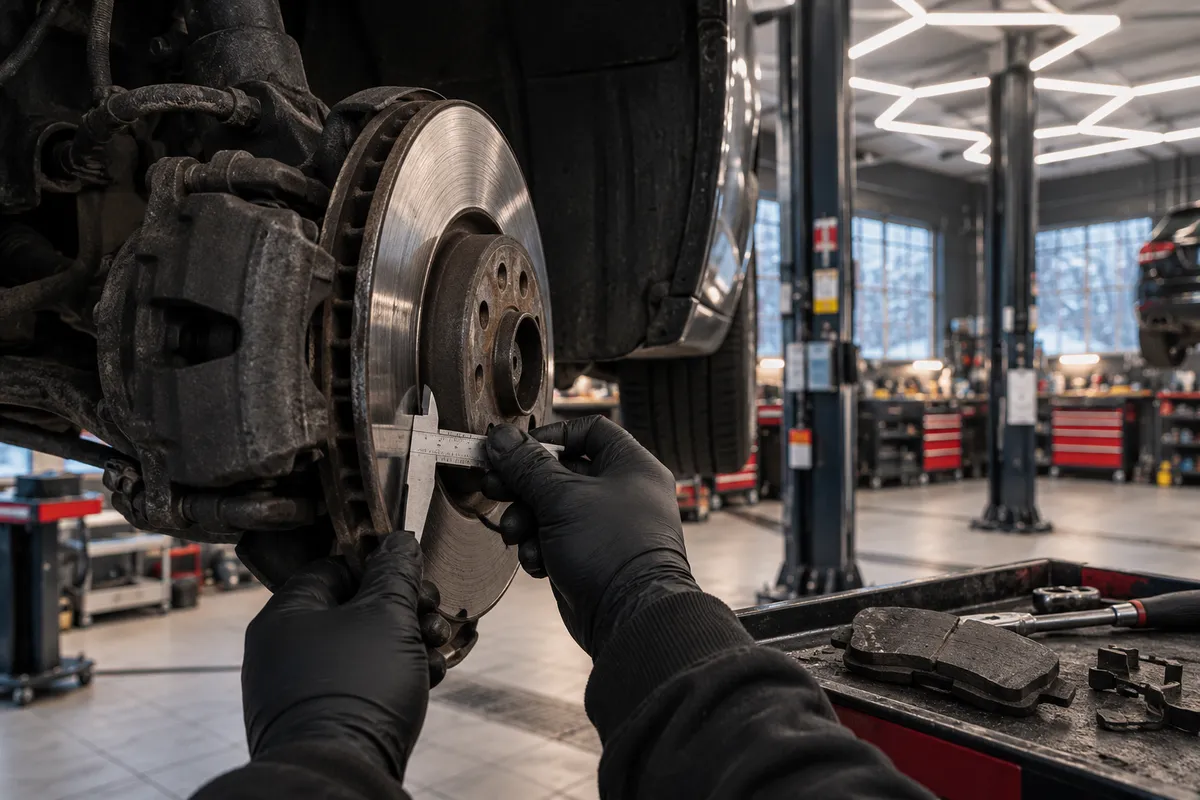
Every disc has a minimum thickness set by the manufacturer. It is usually stamped on its edge or hub as “MIN TH 22 mm” or similar (MIN THK, MIN). Thickness is measured with a micrometer at several points on the friction surface — a calliper gauge is not suitable because the lip on the outer edge gets in the way. If the disc is already at MIN TH or below, it must be replaced, even if it looks fine.
A useful clue is the lip — a step you can feel on the outer edge of the disc. The higher it is, the more the disc has worn. Deep grooves, blue discolouration from overheating, cracks around the ventilation holes and heavy corrosion also mean replacement. Light surface rust after the car has stood or been washed is normal and disappears after a few brake applications.
Replacing only the pads on discs close to MIN TH saves money only briefly: new pads will not bed properly onto the worn surface, and the disc will overheat sooner. It is better to replace pads and discs together straight away.
Signs of worn pads and discs — table
| Symptom | Most common cause | What to do |
|---|---|---|
| High-pitched metallic squeal when braking (or not braking) that goes away with firmer pedal pressure | Mechanical wear indicator — a metal tab on the pad rubs on the disc | Plan a pad replacement within the next few days |
| Grinding, metal rubbing on metal | Friction material worn down to the backing plate | Urgent — limit driving and come in for pads and discs as soon as possible |
| Pulsing pedal or steering wheel shake when braking | Uneven disc thickness, deposits on the disc, overheating | Disc and hub check, usually discs and pads replaced |
| Pad wear warning light | The electronic sensor in the pad has worn through | Replace the pads and — usually — the sensor |
| Deep grooves on the disc, high lip | High mileage, debris between pad and disc | Thickness measurement, most often disc replacement |
| Car pulls when braking, one wheel hot | Seized caliper or slide pins, uneven wear | Caliper check and repair, replace pads on the axle |
| Longer braking distance, “harder” pedal | Glazed or overheated pads, worn discs | Brake check, replacement if needed |
If you hear knocks or clunks rather than a squeal when braking, the cause may lie elsewhere — we cover this in the guide knocking when braking. When the brake pedal is soft or sinks, the problem is usually in the hydraulic system, not the pads — see the article soft brake pedal.
Pad wear sensor — how it works and when to replace it
- A mechanical indicator is a springy metal tab attached to the pad. When the lining is thin, the tab touches the disc and squeals — this is a warning signal, not a fault.
- An electronic sensor is a wire with a tip embedded in the lining. When the pad wears down, the tip wears through and breaks the circuit, and a warning light comes on in the dashboard.
- In many cars the sensor is single-use — once worn through it must be replaced together with the pads, otherwise the light stays on.
- There is often a sensor on only one wheel of the axle. No warning light does not mean the pads on the other side are fine.
- In some cars, after replacing the pads, the wear counter has to be reset in the trip computer or with a diagnostic tool.
Do not ignore the light just because the brakes “still work”. The sensor is set to leave a margin for getting to the workshop, not for thousands more kilometres.
Replacing in axle pairs, pads only or with discs
- Always in axle pairs: pads and discs are replaced on both sides of an axle at the same time so that braking force is equal and the car does not pull.
- Both axles do not need doing at once. Front brakes carry most of the braking force and usually wear faster than rear ones.
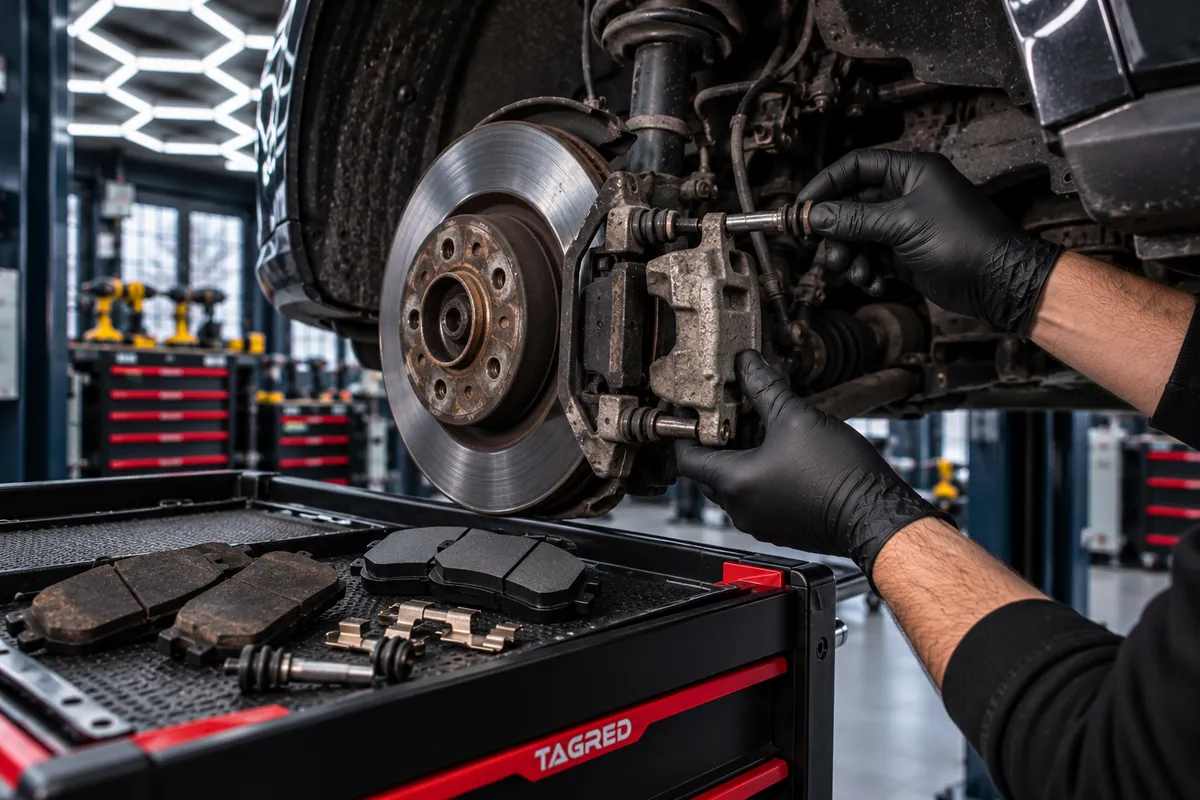
- Pads only — if the discs have thickness to spare above MIN TH and are smooth, with no lip, discolouration or judder.
- Pads with discs — when the discs are close to or below MIN TH, are grooved, have a lip, show overheating or cause judder.
- During replacement we clean and grease the caliper slide pins and check the pistons and boots — a dragging caliper will quickly ruin new parts.
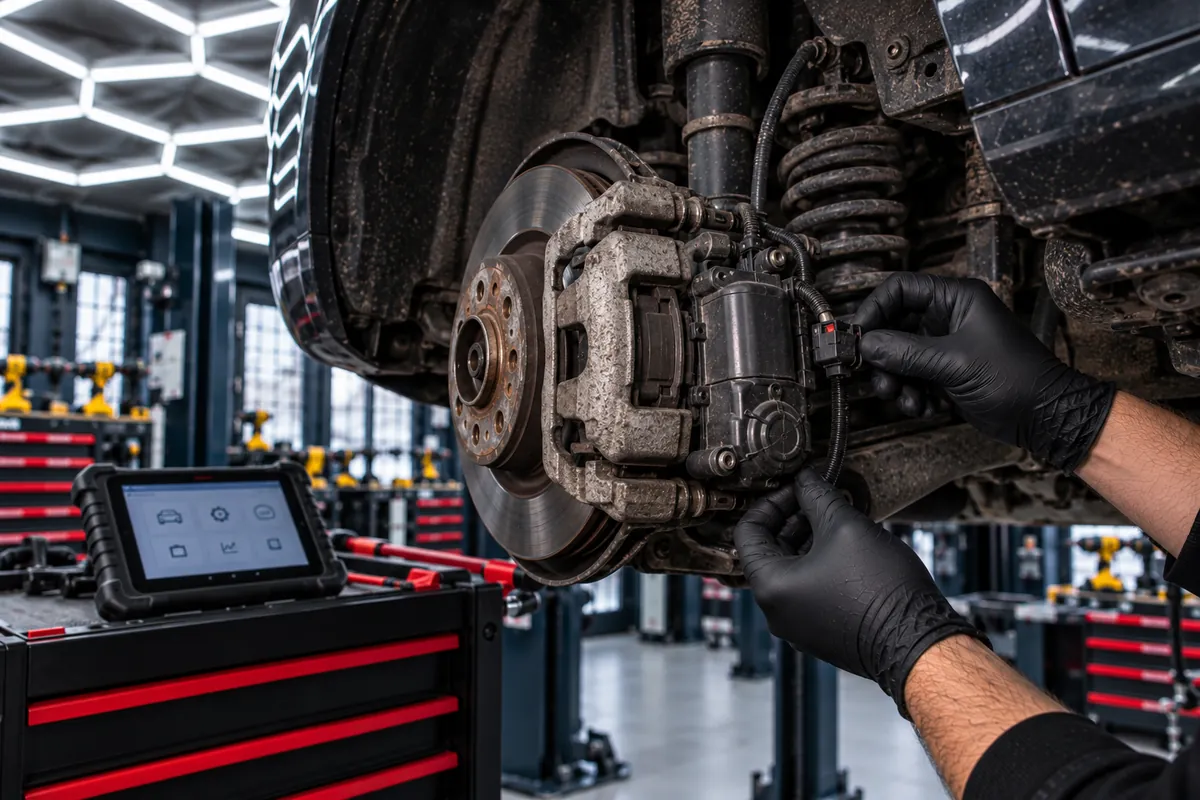
- In cars with an electric parking brake the rear pistons are retracted in service mode with a diagnostic tool — they are not forced back.
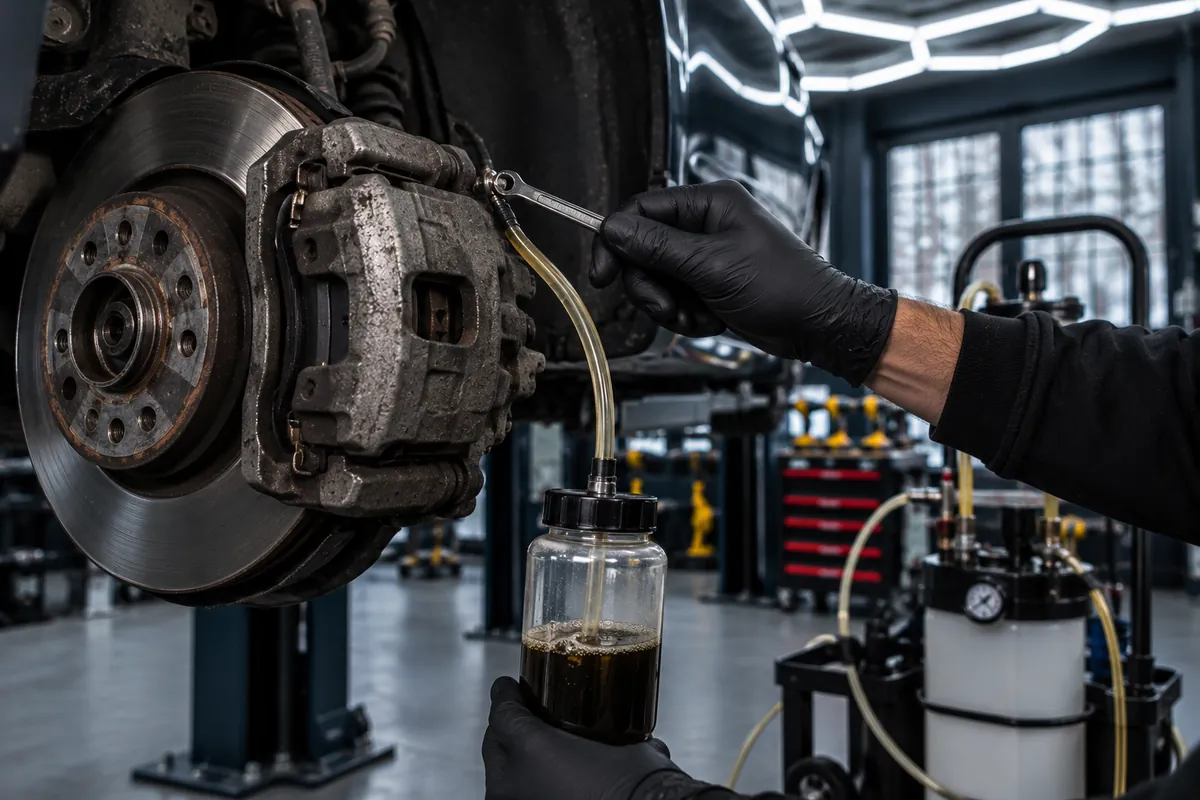
With brakes, remember the brake fluid — it absorbs moisture and loses its properties over time, so manufacturers usually recommend changing it about every 2 years. More in the guide brake fluid change. If the rear brakes work with a cable handbrake, we check it after the replacement — adjustment is covered in the article handbrake adjustment.
Bedding in new pads and discs
- 1When you collect the car, press the brake pedal a few times before driving off so the pistons push the pads against the discs.
- 2For the first 200–300 km or so, brake gently and in good time, avoiding hard stops when the traffic situation allows.
- 3On a quiet, empty road you can do several moderate stops from about 60–70 km/h down to about 20 km/h, with breaks to let the brakes cool.
- 4After hard braking, do not hold the pedal down for long at a standstill with hot brakes — pad material can imprint on the disc.
- 5If the pad manufacturer gives its own bedding-in procedure, follow it.
Only after bedding in do the pads and discs work across their whole surface and brake at full effectiveness. In the first few days the brakes may feel slightly weaker and smell a little different after harder braking — that is normal.
Bedding in is not a race. The aim is to lay an even thin layer of pad material onto the disc, not to overheat it. A few calm stops give a better result than one very hard one.
How we check brakes at Pulsecar
- 1A talk: what symptoms, since when, whether a warning light came on, when the pads, discs and fluid were last replaced.
- 2Inspection on the lift: lining thickness of the outer and inner pads on every wheel.
- 3Measuring disc thickness with a micrometer and comparing it with MIN TH, assessing the lip, grooves, discolouration and corrosion.
- 4Checking the calipers: slide pin movement, piston and boot condition, leaks, free rotation of the wheels.
- 5Checking brake lines, fluid level and condition, and if needed reading fault codes and servicing the electric parking brake.
- 6Presenting the result with photos and a quote for approval — only then do we order parts and start work.
We give a 6-month warranty on labour, and new parts carry the manufacturer’s warranty (usually 12–24 months). The workshop does not give a warranty on parts supplied by the customer. More about brake system repairs is on the brakes page.
How much pad and disc replacement costs at Pulsecar in Bielany
| Service | Price (labour) |
|---|---|
| Pad replacement — front | from 200 zł |
| Pad replacement — rear | from 250 zł |
| Pads and discs replacement — front | from 300 zł |
| Pads and discs replacement — rear | from 350 zł |
| Brake fluid change | from 200 zł |
| Caliper repair, wear sensor, parts | priced in the quote |
Prices are for labour on one axle; pads, discs and any sensors are priced separately, depending on the model and the chosen parts brand. The rear axle can cost more, partly because of the parking brake. We give the exact cost in the quote after inspection. The full list is in our price list.
Visit the Pulsecar workshop at ul. Arkuszowa 176 in Warsaw’s Bielany district — Monday to Friday 09:00–18:00 and Saturdays 09:00–15:00. The easiest way to book is online or on +48 571 058 591. If you hear metal grinding on metal, call and tell us — we will try to take the car in as soon as possible.