Engine oil change — how many km and months, choosing the oil, signs of worn oil
Oil is your engine’s cheapest protection, and changing it too late can be the most expensive mistake. We explain how often to change it in city driving, turbo and LPG engines, how to choose spec and viscosity, and what to replace too.
8 min read · Pulsecar team · updated:
How often to change oil — the short answer
For most cars driven around Warsaw, a sensible interval is an oil and filter change every 10,000–15,000 km or once a year — whichever comes first. With a turbo engine, LPG, short trips and driving in traffic jams, it is better to stick to the lower end. Long life intervals (e.g. 30,000 km or 2 years) are designed by manufacturers for ideal conditions, which are rare in the city.
More important than the brand is the right oil: one that meets the car manufacturer’s spec (e.g. VW 504.00/507.00, MB 229.51, BMW Longlife-04) and has the recommended viscosity. The oil filter is replaced with every oil change, and it is worth checking the air, cabin and fuel filters at the same time. Below we explain where these recommendations come from, how to recognise worn oil and how much a change costs at Pulsecar.
Long life versus shorter intervals — where the difference comes from
Many manufacturers have used flexible service intervals for years. The car’s computer counts mileage, time, the number of cold starts, oil temperature and engine load, and then shows the due date — often only after 25,000–30,000 km or two years. Such an interval, however, assumes long life oil of the right spec and driving in conditions where the oil often works at full temperature.
In practice oil ages faster than the indicator assumes: on short trips fuel and moisture get into the oil, in a diesel soot does too, and in a turbo engine the oil also works at very high temperatures in the turbocharger bearings. That is why many mechanics — including us — recommend a shorter interval, especially for cars used in the city. The cost of an extra change is small compared with repairing a turbo, a timing chain or the bearings.
If the car is under the manufacturer’s warranty, follow the service book and document every change. Changing more often with oil of the correct spec does not breach the manufacturer’s recommendations.
When to shorten the interval — table
| Operating conditions | Sensible interval | Why |
|---|---|---|
| Mainly long-distance, naturally aspirated engine | As per manufacturer, but at least every 2 years | The oil works at full temperature, moisture and fuel evaporate |
| City driving, traffic jams, short trips | Every 10,000 km or once a year | The engine often does not warm up, fuel and condensation collect in the oil |
| Turbo engine (petrol or diesel) | Every 10,000–15,000 km or once a year | The oil lubricates and cools the turbo bearings at high temperatures |
| LPG system | Every 10,000 km or once a year | Higher combustion temperature, the oil ages faster |
| Diesel with DPF, frequent short trips | Every 10,000–15,000 km or once a year | Interrupted DPF regeneration can dilute the oil with fuel |
| Low yearly mileage (e.g. 5,000 km) | Once a year, regardless of mileage | Oil also ages with time and moisture |
These values are our practical recommendations, not a regulation. If the manufacturer specifies a shorter interval than the table, the shorter one always applies. If the engine uses oil between changes, also read the guide engine oil consumption.
How to choose oil — the manufacturer’s spec and viscosity
- The manufacturer’s spec (approval) matters most. You will find it in the owner’s manual or service book. Examples: VW 504.00/507.00 (long life, including diesels with a DPF), VW 508.00/509.00 (newer engines, low viscosity), MB 229.5, 229.51 or 229.52, BMW Longlife-01 or Longlife-04. Exactly that spec must be listed on the oil container.
- The ACEA class (e.g. C2, C3, A3/B4) describes the general type of oil. Oils in the C group have reduced sulphated ash, phosphorus and sulphur (low SAPS) and are needed in cars with a DPF or GPF.
- Viscosity, e.g. 5W-30: the first number with the letter W refers to flow at low temperature (the lower it is, the faster the oil reaches the bearings on a cold start), the second to viscosity at engine operating temperature.
- Do not change viscosity by guesswork. Thicker oil will not “seal” the engine, and in modern engines with hydraulic tensioners and variable valve timing it can disturb how they work.
- Mixing oils of different brands with the same spec and viscosity in an emergency top-up is not dangerous, but at a change it is better to use one oil.
If you do not have the manual, we will determine the correct spec and system capacity from the VIN and engine code. The amount of oil differs between versions of the same model, so it is not worth guessing.
Signs of worn or wrong oil
- A service message, or a year has passed since the last change — the simplest and most common signal.
- Hydraulic lifter tapping or timing chain rattle for the first few seconds after a cold start.
- The oil level rises between changes — often means dilution with fuel (short trips, DPF regeneration), sometimes coolant in the oil.
- A smell of fuel on the dipstick, or oil clearly thinner than usual.
- White, creamy residue under the filler cap — water condensation on short winter trips; if it is there all the time, it is worth checking that coolant is not getting into the oil.
- The oil pressure warning light — this is an alarm, not a change reminder. Stop the car and switch off the engine.
Oil colour says little: in a diesel the oil turns black after a few hundred kilometres and that is normal. Judging “by colour” is misleading — what counts is mileage, time and operating conditions. If you notice a rising oil level or creamy residue together with coolant loss, do not put off a visit.
A red oil pressure light coming on while driving means the engine can be seriously damaged within minutes. Do not try to “make it home” — stop safely and check the oil level.
How to check the oil level between changes
- 1Park the car on level ground and switch off the engine. Wait a few minutes for the oil to drain into the sump (as per the car’s manual).
- 2Pull out the dipstick, wipe it, push it fully back in and pull it out again.
- 3The level should be between the MIN and MAX marks. The difference between them is usually about 1 litre.
- 4If oil is low, top up with the same oil or one meeting the manufacturer’s spec — in small amounts, checking the dipstick.
- 5In cars without a dipstick the level is checked in the trip computer menu — follow the manual.
It is worth checking once a month and before a long journey. Too much oil is harmful too — it can foam and load the seals, so do not fill above MAX.
What to replace at the same time as the oil
- The oil filter — always, with every oil change.
- The drain plug washer or seal — cheap, and it prevents leaks.
- The air filter — usually every second oil change or as per manufacturer; more often in the city and on dusty roads.
- The cabin filter — once a year, ideally before pollen season or before winter, when windows start fogging up.
- The fuel filter — especially important in diesels, interval as per manufacturer.
- A check of other fluids, belts, leaks and brakes — with the car on the lift it takes a moment.
If you have just bought a car and do not know its history, an oil change and all filters are the first step — more in the guide servicing after buying a used car. Remember that gearbox oil is a separate topic — in automatics changing it matters a lot, as we explain in the article automatic transmission oil change.
How an oil change works at Pulsecar
- 1We determine the spec, viscosity and system capacity for your engine — from the documentation, VIN and engine code.
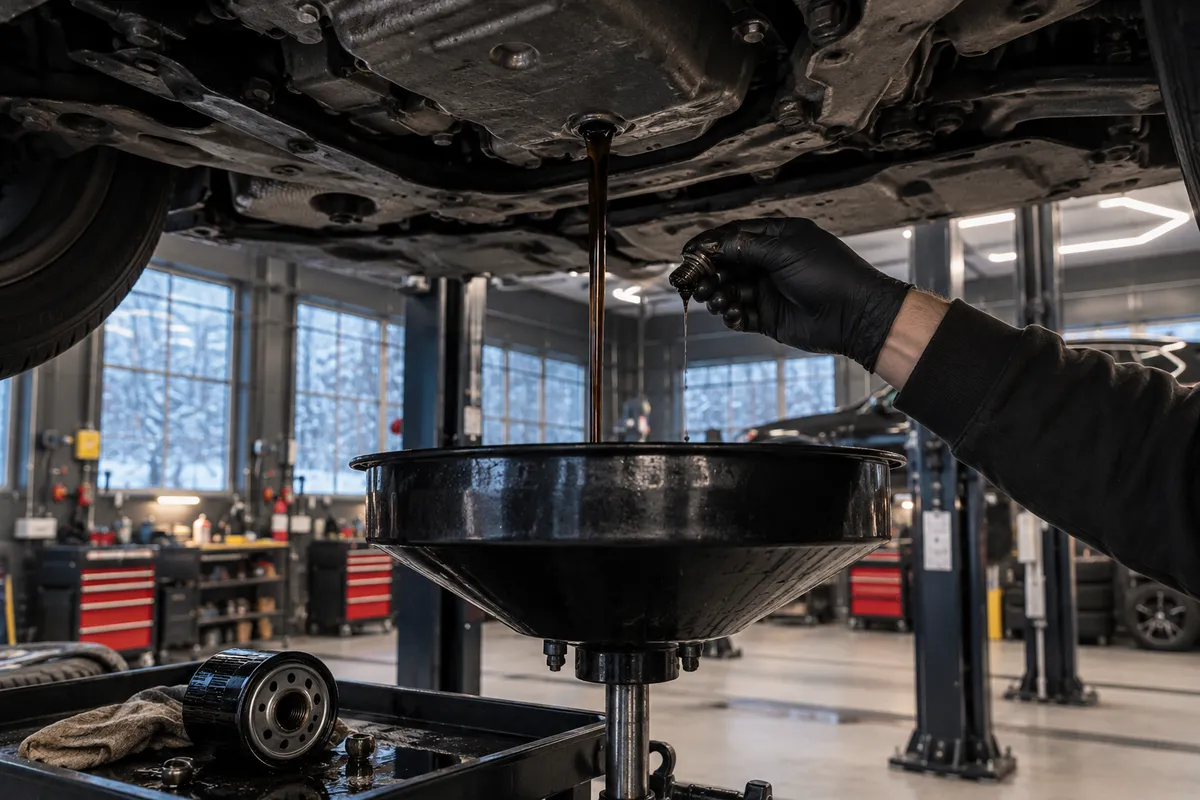
- 2We drain the warm oil, checking the sump, drain plug and engine area for leaks at the same time.
- 3We replace the oil filter and drain plug seal and, if agreed, the other filters too.
- 4We fill oil meeting the spec, start the engine, check for leaks and check the level after a wait.
- 5We reset the service indicator (if the car has one) and record the mileage and date of the change.
- 6If we notice something worrying — a leak, worn pads, play — we show it in photos. Additional work is done only after you approve the quote.
We give a 6-month warranty on labour, and new parts carry the manufacturer’s warranty. More about the service is on the oil change page.
How much an oil change costs at Pulsecar in Bielany
| Service | Price (labour) |
|---|---|
| Engine oil and oil filter change | 120 zł |
| Air filter replacement | 40 zł |
| Cabin filter replacement | 40 zł |
| Fuel filter replacement | 40 zł |
| Manual gearbox oil change | from 200 zł |
| Automatic gearbox oil change | from 400 zł |
| Engine oil and filters (parts) | depends on the car — in the quote |
On top of 120 zł for labour comes the cost of the oil and filter, which depends on system capacity, the required spec and the filter model — we state it in the quote before work starts. The full list is in our price list.
Visit the Pulsecar workshop at ul. Arkuszowa 176 in Warsaw’s Bielany district — Monday to Friday 09:00–18:00 and Saturdays 09:00–15:00. The easiest way to book is online or on +48 571 058 591. An oil change usually does not require leaving the car for the whole day.