Knocking When Braking — Causes, How to Tell Them Apart and Repair Cost
A knock when braking can come from the brakes or from the suspension. We explain how to identify the cause from the symptoms, when you must stop and how we diagnose the problem.
8 min read · Pulsecar team · updated:
Knocking when braking — short answer
A knock, clunk or rattle when braking most often comes from the brake itself — from pads with play in the caliper bracket, worn caliper guide pins or missing or tired anti-rattle clips and springs. The second big group of causes is the suspension: worn control arm bushings, a ball joint, a strut top mount or an anti-roll bar link. Under braking the whole corner of the car is heavily loaded, so any play “jumps” and makes itself heard.
Most of these knocks are not an immediate danger, but they must not be ignored. If the knock appeared suddenly, keeps getting louder, sounds metallic or started right after a brake or wheel job — stop the car, because it may be a loose caliper or loose wheel bolts. Below we explain how to tell the causes apart, what you can check yourself, how we diagnose the problem and what the repair costs in Warsaw.
Where the knock comes from — what happens at the wheel
When you brake, the pads clamp the disc and try to rotate with it. This force is taken by the caliper bracket, bolted to the steering knuckle, and then by the control arm, ball joint, bushings and strut, which connect the wheel to the body. At the same time the car’s weight shifts forward: the front “dives” and the suspension parts work under heavy load.
If there is play anywhere along this chain, two parts hit each other when the direction of force changes — hence a single knock at the start of braking or when you release the pedal. Play in the brake usually gives a short, sharp “tap” at the wheel. Play in the suspension more often sounds dull, can also be heard over bumps and may come with pulling or a “floaty” feel.
A separate category is disc runout. It is not a classic knock but a rhythmic pulsing of the brake pedal and steering wheel vibration, which drivers often describe as “knocking” when braking from higher speeds.
What the knock sounds like and when it appears — symptom table
| Symptom | Most common cause | Urgency |
|---|---|---|
| A single knock on the first brake application after changing direction (e.g. after reversing) | Pads shifting in the bracket, missing or tired springs, worn guide pins | Have it checked at the next opportunity |
| Rattling over bumps that goes quiet when the brake is lightly applied | Loose pads, missing anti-rattle shims, worn caliper guide bushings | Have it checked within a few days |
| Rhythmic pedal pulsing and steering wheel vibration when braking from higher speed | Disc runout or uneven disc thickness | Book a repair — stopping distance may grow |
| A dull knock at the front at the start or end of braking, the car pulls or dives more | Control arm bushings (especially the rear one), ball joint | Diagnosis as soon as possible |
| A knock “from above”, at the strut, also when turning the wheel while stationary | Strut top mount or its bearing | Diagnosis as soon as possible |
| One heavy “clunk” when stopping and when pulling away | Worn engine or gearbox mount | Have it checked within a few days |
| A metallic knock or grinding that appeared suddenly or after work on the wheels | Loose caliper or bracket, loose wheel bolts, pad worn down to the backing plate | Stop the car immediately — do not drive on |
The table helps with a first assessment but does not replace an inspection. Knocks “travel” through the body and it is often hard to hear which wheel they really come from — a driver may be sure it is the front, and the culprit turns out to be at the rear.
A short, rhythmic “chattering” of the pedal under hard braking on a slippery surface is usually the ABS working — that is normal. If ABS kicks in on dry tarmac or the ABS warning light is on, the system needs a diagnosis.
Causes on the brake side
- Caliper guide pins and bushings — a floating caliper slides on two pins in rubber boots. When the bushings wear, the grease dries out or a boot splits and water gets in, the caliper has play and knocks, and in extreme cases it seizes.
- Pad play in the bracket — pads should slide in the bracket with a small, controlled clearance. Corrosion in the abutments, or pads that are too narrow or poorly matched, make the pad “jump” when the direction of force changes.
- Missing or tired anti-rattle clips and springs — cheap parts that take up pad play and damp vibration. They are often skipped during a pad change, and their absence is one of the most common causes of knocks and rattles.
- Loose caliper or bracket — the mounting bolts must be tightened to the manufacturer’s torque and, in many designs, secured. A loose caliper is directly dangerous.
- Disc runout and uneven disc thickness — caused among other things by overheating, uneven pad material deposits, rust on the hub or a badly tightened wheel. The symptom is a pulsing pedal and steering wheel vibration.
- Worn pads and a lip on the disc — a pad worn to the backing plate grinds metallically, and a high rust lip on the disc edge can make new pads catch on it.
- Rear drum brakes — loose or broken shoe springs, a worn self-adjuster or a loose drum can cause a knock at the rear, usually heard at low speed.
If the knock comes with squealing or grinding, see also our guide to squealing brakes. Squeal and knock often share a source — missing retaining hardware or worn guide pins.
Causes on the suspension and mounting side
- Control arm bushings — under braking the control arm takes a large longitudinal force. Cracked or separated rubber (especially in the rear bushing of the front arm) lets the wheel move back, giving a dull knock and possibly pulling. More in the guide control arm or bushings.
- Ball joint — play in the ball joint shows up as a knock when braking, over bumps and when steering. This part holds the wheel to the suspension, so do not put off the diagnosis.
- Strut top mount and bearing — when the front dives, the strut works hard; a worn mount or bearing knocks at the top, often also when turning the steering wheel on the spot.
- Anti-roll bar link and tie rod end — a link usually rattles over bumps, a tie rod end gives play in the steering, but both can be heard when braking.
- Wheel bearing play — under braking the disc can wobble slightly and push the pistons back, giving a knock and a longer pedal. A typical sign is also a hum that rises with speed — see wheel bearing symptoms.
- Engine and gearbox mounts — under hard braking and pulling away the whole drivetrain tilts and, when the rubber is worn, “clunks” against its mounting.
- Loose wheel bolts — especially after a tyre or wheel change. The knock grows and the wheel can come loose completely. This requires stopping immediately.
If the knocks are also heard over potholes and speed bumps, not only when braking, the cause is more likely in the suspension — we cover this in more detail in the guide suspension knocks.
Brakes or suspension? How to narrow down the cause before your visit
- 1In an empty car park, drive slowly forward and brake once gently, once harder. Then do the same in reverse. A single knock on the first brake application after a change of direction usually points to the pads or caliper guide pins.
- 2Drive slowly over a bump without braking, then with the brake lightly applied. If the knock disappears with the brake on, the culprit is most often loose pads or the caliper; if it stays — more likely the suspension.
- 3Notice where you feel the symptom. Pulsing in the pedal when braking from higher speed is typically the discs, vibration in the steering wheel more often points to the front, and in the seat — to the rear.
- 4While stationary, turn the steering wheel both ways. A knock at the top of the strut when turning on the spot points to the strut top mount.
- 5Think about what was done to the car recently. A knock right after replacing pads, discs or tyres needs a quick check of the fitting.
Do these tests only in a safe place and at low speed. Do not loosen or tighten the caliper “by feel” — brake bolts have a specified tightening torque, and some of them must not be reused.
When knocking under braking is dangerous
- The knock appeared suddenly and clearly gets louder with every brake application.
- You hear metallic impacts or metal-on-metal grinding.
- The knock appeared right after replacing pads, discs, tyres or wheels.
- The car pulls hard to one side under braking or the steering wheel “tugs” in your hands.
- The brake pedal has become soft or goes down further — see the guide soft brake pedal.
- One wheel smells of overheated brakes or its rim is clearly hotter than the others.
Some faults that cause a knock when braking can quickly lead to loss of control of the car. This applies especially to a loose caliper or bracket, loose wheel bolts and major play in a ball joint. If you notice any of the signs below, do not keep driving — stop in a safe place and arrange transport to a workshop.
If in doubt, call before coming. We will help you judge whether the car can be driven safely or whether a recovery truck is the better option.
How we diagnose knocking when braking
- 1A conversation with the driver: when the knock occurs (forward/reverse, bumps, speed), since when, and whether the brakes, suspension or tyres were recently serviced.
- 2A test drive — with the driver if possible — to hear the symptom in the conditions in which it appears.
- 3On the lift: checking that the wheels, calipers and brackets are tight, the condition of pads, shims and springs, pad play in the bracket and how the caliper guide pins work.
- 4Measuring the discs: thickness at several points and runout with a dial gauge, assessing the rust lip and heat discolouration.
- 5Checking the suspension on a play detector and with a pry bar: control arm bushings and ball joints, tie rod ends, anti-roll bar links, strut top mounts, wheel bearings and engine mounts.
- 6A quote for approval — we replace parts only after you agree. After the repair we do a test drive and check that the knock is gone.
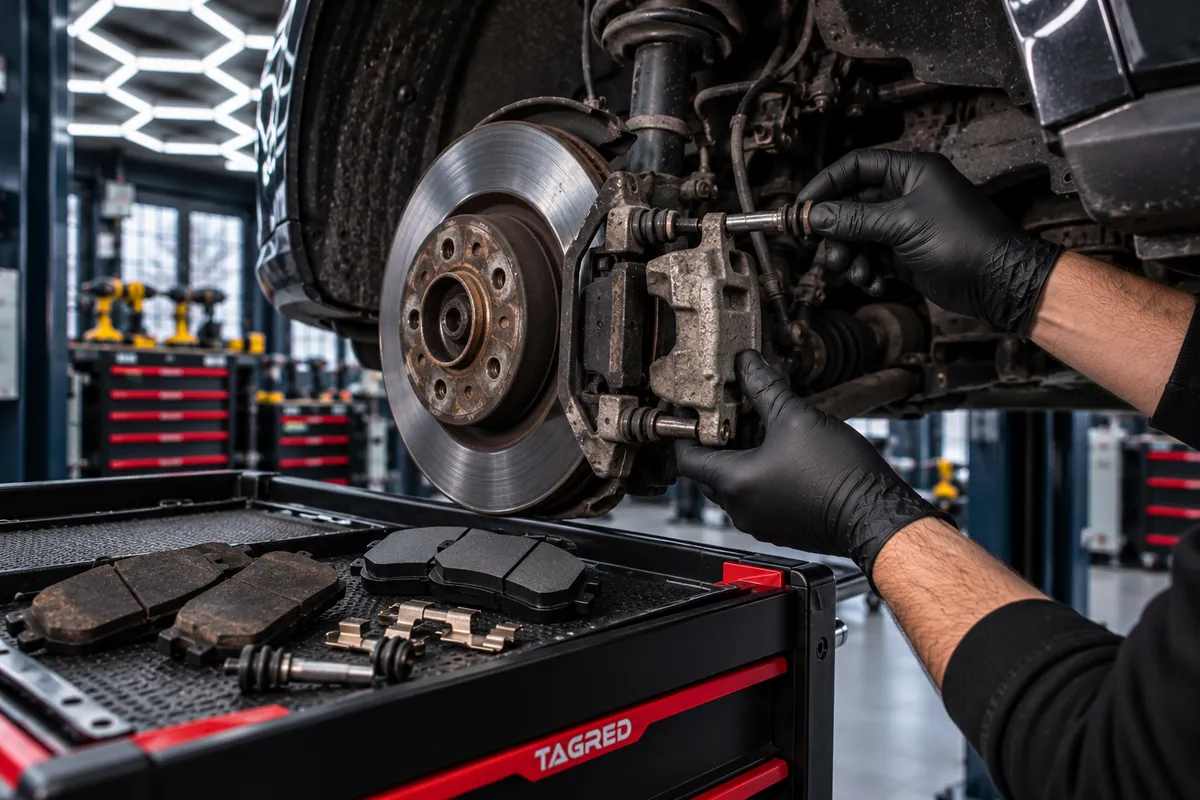
When replacing pads, we do not just slide in new friction material. A proper repair includes cleaning corrosion off the bracket, checking and greasing the guide pins with a suitable grease, fitting new retaining hardware (if the pad manufacturer provides it) and tightening the bolts to the correct torque. Skipping these steps is the most common reason for knocks after a “cheap” brake service.
If the suspension is to blame, after replacing a control arm, ball joint or tie rod end we set the wheel alignment — more in the guide wheel alignment — when.
Knocking when braking — repair cost in Warsaw
| Service | Price (labour) | When it is needed |
|---|---|---|
| Brake pad replacement — front | from 200 zł | Worn or loose pads, missing retaining hardware |
| Brake pad replacement — rear | from 250 zł | Worn or loose rear pads |
| Pads and discs replacement — front | from 300 zł | Disc runout, pulsing pedal, high lip |
| Pads and discs replacement — rear | from 350 zł | Worn or distorted rear discs |
| Suspension diagnostics | 100 zł | Knocks when braking and over bumps |
| Control arm replacement | from 200 zł | Worn control arm bushings or ball joint |
| Anti-roll bar link replacement | from 100 zł | Rattling over bumps |
| Tie rod end replacement | from 150 zł | Play in the steering |
| Engine mount replacement | from 150 zł | Clunk when braking and pulling away |
| Wheel alignment — 1 axle / 2 axles | 150 zł / 300 zł | After replacing a control arm or tie rod end |
| Guide pin overhaul or replacement, caliper replacement, strut top mount | price after diagnosis | Worn guide pins, seized caliper, knock at the strut |
The prices are for labour; parts are priced separately in the quote, depending on the model and the chosen manufacturer. The cost of work whose scope depends on the specific car is given after diagnosis — you approve the quote before we start. The full price list is on the Pulsecar price list page.
We give a 6-month warranty on labour. You can read more about the scope of work on the brake repair and suspension repair pages.
Knocking when braking in Warsaw, Bielany — Pulsecar, ul. Arkuszowa 176
Pulsecar is located at ul. Arkuszowa 176 in Warsaw’s Bielany district, close to Żoliborz, Bemowo and Łomianki. We are open Monday to Friday 09:00–18:00 and Saturdays 09:00–15:00.
Call +48 571 058 591 or book a visit online. If the knock is metallic, getting louder or appeared right after work on the wheels — do not drive to us; call and we will agree how to get the car here safely. Directions are on the contact page.