Handbrake — Adjustment, EPB Faults and Inspection Problems
A weak parking brake is not only a problem on a slope but also a common reason for failing the technical inspection. We explain when adjustment is enough and when the mechanism or EPB needs repair.
8 min read · Pulsecar team · updated:
Handbrake not holding — short answer
If the handbrake holds poorly, the lever has to be pulled higher and higher or the car rolls on a slope, the cause is usually an out-of-adjustment or seized mechanism in the rear brakes, stretched or corroded cables, worn parking brake shoes or — in cars with an electric parking brake (EPB) — a fault in the caliper motor, wiring or control unit. Simply “adjusting the cable” only helps when the rest of the system is in good order.
The parking brake is a safety component: it holds the car when parked and, if the service brake fails, it is the emergency way to slow down. It is also checked at the periodic technical inspection (przegląd techniczny) — too little efficiency means a fail. Below we explain how the different types of handbrake work, the most common faults, what to do right away, how we diagnose the problem and what the repair costs in Warsaw.
How the parking brake works — types of system
| System type | How it works | Typical faults |
|---|---|---|
| Mechanical, rear drum brakes | Cables spread the shoes inside the drum | Out of adjustment, seized self-adjuster, worn shoes, seized cables |
| Mechanical, rear discs with a lever on the caliper | The cable turns a lever on the caliper; a screw mechanism pushes the piston against the pad | Seized lever or self-adjusting mechanism in the caliper, cables, leaking caliper |
| Mechanical “drum-in-disc” | Small shoes work inside the hat of the rear disc | Corroded or worn shoes, seized expander, out of adjustment |
| Electric (EPB) with motors on the calipers | A small geared motor on each rear caliper pushes the piston | Control unit faults, failed motor, chafed wiring or connector, weak battery |
| Electric with a central cable puller | A motor in the module pulls conventional cables | Stretched or seized cables, module fault |
In most passenger cars the parking brake acts on the rear wheels and uses the same parts as the service brake or separate small shoes. What differs is how it is applied: mechanically with a lever and cables, or electrically with a switch. The type of system determines what goes wrong and what the repair looks like.
You will find the type of parking brake in your car in the owner’s manual. In cars with EPB, servicing the rear brakes requires a different procedure than in cars with a conventional lever — more on that below.
Signs that the handbrake needs attention
- The lever has to be pulled higher than before, and the car still rolls on a slope.
- The brake holds only one wheel — the car “twists” when you try to pull away with the brake on, or one wheel can be turned by hand on the lift.
- After releasing the lever or switch the brake does not fully release: a rear wheel is hot, there is a smell of overheated brakes, the car rolls less freely.
- The lever moves without resistance or does not return down.
- The red brake warning light stays on with the brake released, or the yellow EPB fault light is on.
- The electric brake does not apply or release, or you hear unusual noises from the motors at the wheels.
- At the technical inspection the examiner found the parking brake efficiency too low.
A red light with a letter P or an exclamation mark can mean either the parking brake is applied or the brake fluid level is low — the manual gives the meaning. If it comes on while driving with the brake released, take it seriously and check the cause before driving on.
Mechanical handbrake — cables, adjustment and seizing
A handbrake cable stretches slightly over time, but in modern cars it is rarely the main cause of a long lever travel. Rear calipers and drums have self-adjusting mechanisms that compensate for pad and shoe wear. When such a mechanism seizes with corrosion, the lever travel grows, and tightening the cable only masks the problem — and can stop the brake from fully releasing.
The parts that fail most often are those exposed to water and salt: cables in their sheaths (they rust from inside and stop sliding freely), levers on calipers, shoe expanders and the shoes themselves in a “drum-in-disc” system, which can corrode badly if the handbrake is rarely used. A typical winter problem is water freezing in the cable sheath — the brake will not release after a cold night.
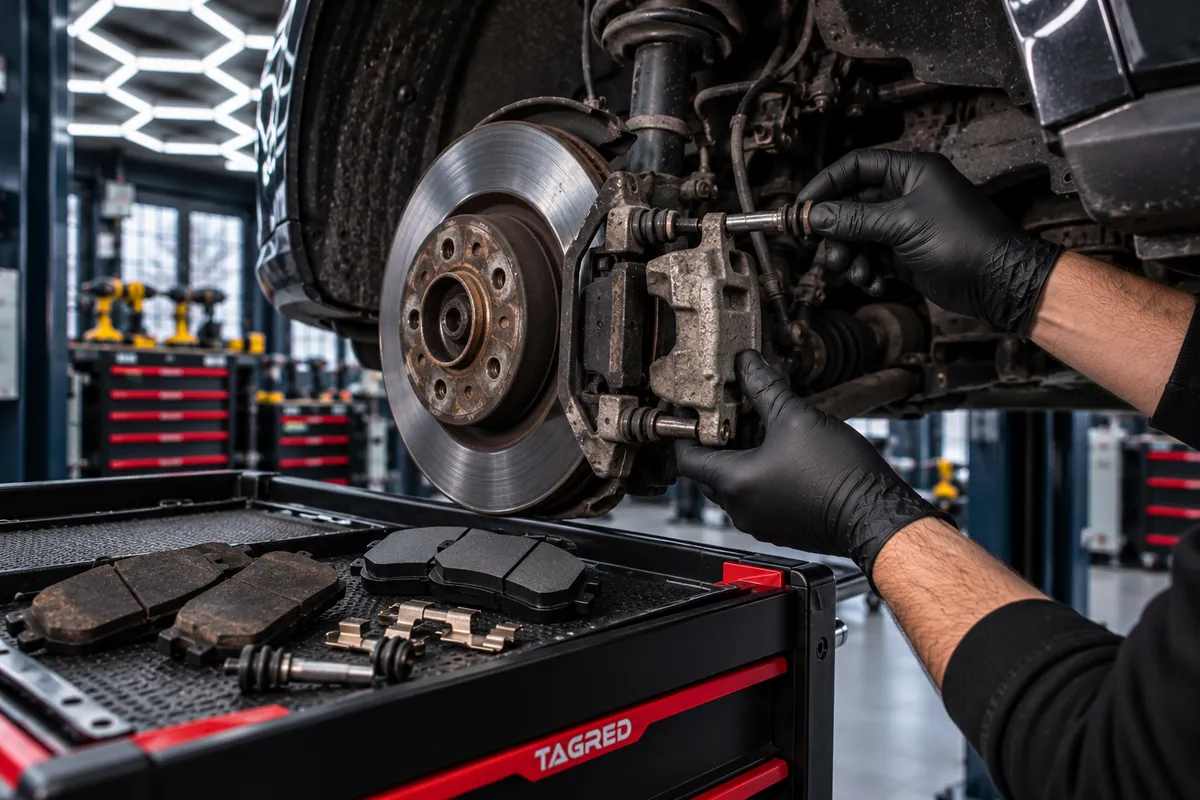
Proper adjustment therefore starts with checking the rear brakes: the condition of pads or shoes, the operation of the self-adjuster, and free movement of the cables and levers. Only when everything works is the cable tension set so that the brake holds after a few clicks of the lever (the range is given by the manufacturer) and the wheels turn freely when released.
Do not “pull up” the cable by force to make the lever sit lower. An over-tightened cable can make the rear brakes drag constantly, overheat, wear faster and raise fuel consumption.
Electric parking brake (EPB) — warning light, faults and service mode
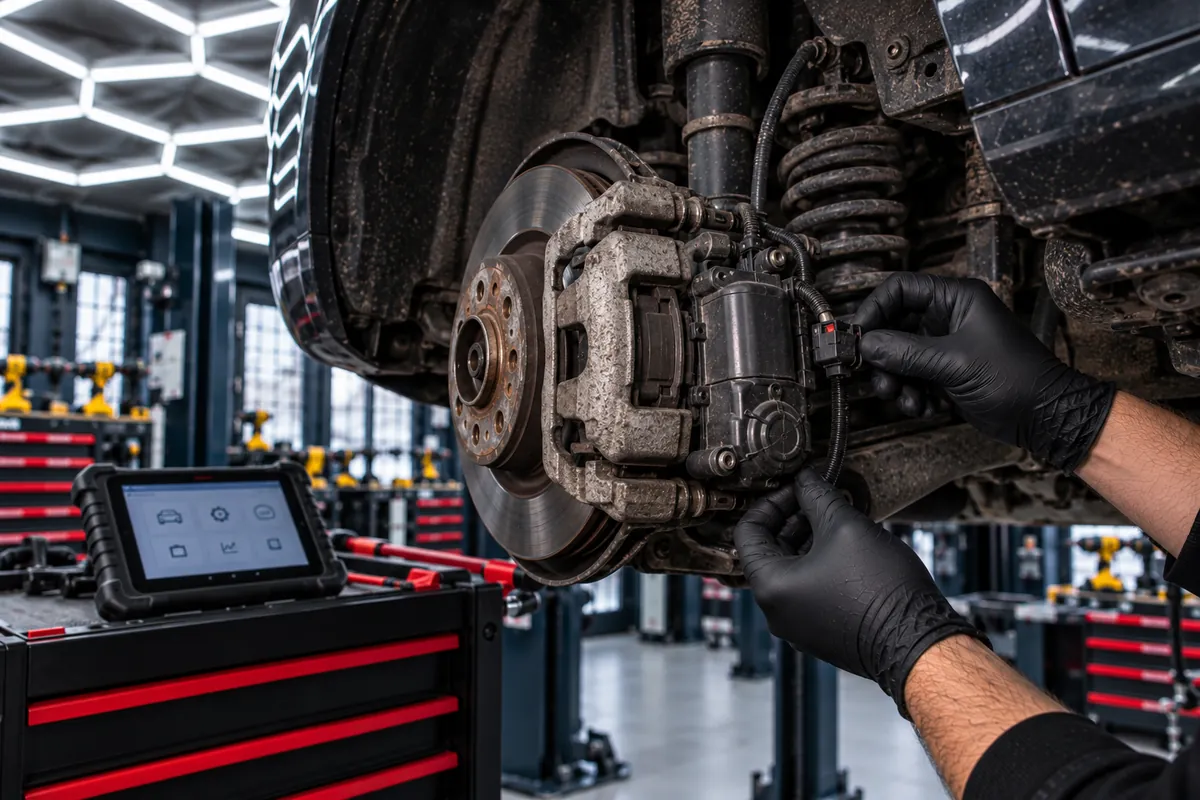
An EPB has no cable to adjust — play is taken up automatically and the control unit monitors the motors on the rear calipers. When something is wrong, a fault light comes on and a fault code is stored. The most common causes are a failed motor or its gearbox, corrosion on the connector, chafed wiring near the suspension, too low battery voltage, and sometimes a seized caliper piston that puts up too much resistance.
Replacing the rear pads on a car with EPB requires the so-called service mode. With a diagnostic tool (and on some models with a procedure described in the manual) the pistons are retracted electrically, and after the new pads are fitted the system is closed and often calibrated. Forcing the piston back with the motor fitted can damage the gearbox.
Because EPB is electronic, diagnosis always starts with reading fault codes and live data — only they show whether the culprit is the motor, wiring, control unit or the caliper mechanics. Replacing a motor “blind” without checking the cause often does not solve the problem.
If the EPB will not release, check the manual for an emergency release procedure. Do not try to dismantle the caliper or disconnect the motors at the roadside — call the workshop and we will help work out a safe way to get the car to us.
Parking brake at the technical inspection — why the car fails
| Examiner’s remark | Possible cause | What to do |
|---|---|---|
| Parking brake efficiency too low | Seized mechanism in the caliper or drum, worn or contaminated shoes/pads, stretched cables | Diagnose the rear brakes, fix the cause, only then adjust |
| Large force difference between left and right wheel | One cable or one caliper is not working properly | Check free movement of cables and mechanisms on both sides |
| Brake does not release fully (rolling resistance) | Seized cable, caliper lever or over-tightened cable | Repair or replace the cable/caliper, adjust correctly |
| EPB fault light, no operation | Motor, wiring, connector, control unit, battery | Computer diagnostics and electrical measurements |
| Damaged cables or boots, leaks at the rear calipers | Corrosion, chafing, leaking piston | Replace the damaged parts |
At the vehicle inspection station the examiner measures braking forces on a roller tester — separately for the service brake and the parking brake — and from this calculates efficiency relative to the car’s weight. If the parking brake does not reach the minimum value set by the regulations, the inspection ends with a fail and you have to come back after the repair. The examiner also checks the condition of cables, mountings and warning lights.
On cars with EPB and on four-wheel-drive cars the measurement may need a special procedure (e.g. a roller-test mode activated by the driver or with a tool) — that is normal. The problem is only too little force or a system fault.
It is worth checking the parking brake a few days before the inspection date rather than after a fail. That leaves time to order parts if a cable or caliper turns out to need replacing.
What to do when the handbrake does not hold or will not release
- 1If the brake holds poorly: park on level ground, leave the car in gear (manual) or in P (automatic) and turn the wheels towards the kerb on a slope. Do not rely on the handbrake alone until it is repaired.
- 2If the brake does not release: do not force the car to drive. Driving with the rear brakes clamped quickly overheats them — increasing the risk of damaging discs and pads and reducing braking performance.
- 3In winter, if the cable has frozen: try applying and releasing the brake several times, and if that does not help — leave the car until it thaws (e.g. somewhere warm). Never heat the area around the brakes with an open flame.
- 4If after a short drive one rear wheel is noticeably warmer or you smell burning — stop, let the brakes cool and arrange to get the car to a workshop.
- 5In a car with EPB, if the fault light is on: note when it appeared and do not disconnect the battery “to try” — book computer diagnostics.
When leaving a wet car parked for a long time in frost, in many models with a conventional lever it is better (if the manual allows and the ground is level) to leave it in gear or in P instead of with the handbrake pulled hard — this reduces the risk of it freezing on.
How we diagnose the parking brake
- 1A conversation with the driver: what system it is, how long the problem has been there, whether any lights are on, whether the car failed its inspection and what the examiner noted.
- 2Function check: lever travel or EPB operation, holding on a slope, free wheel rotation after release, rear wheel temperature after a drive.
- 3On a car with EPB — computer diagnostics: reading fault codes, motor parameters and voltage, an apply and release test, and if needed measurements of the wiring and connectors.
- 4On the lift: condition of the rear pads or shoes, discs and drums, operation of the caliper levers and self-adjusting mechanism, free movement of the cables in their sheaths, piston tightness.
- 5A quote for approval — fixing the cause (mechanical parts, cables, EPB motor), and only then adjustment and, if needed, calibration of the system with a scan tool.
- 6Check after the repair: holding on a slope, full release of the brake, no faults in the control unit and a test drive.
If it turns out along the way that the rear pads or discs are worn, we tell you before starting the work — we do not carry out extra work without your consent. If there is also a soft pedal or low fluid level, we check the whole hydraulic system (see soft brake pedal).
Handbrake repair — cost in Warsaw
| Service | Price (labour) | When it is needed |
|---|---|---|
| Computer diagnostics | 100 zł | EPB fault light, control unit faults, calibration |
| Brake pad replacement — rear | from 250 zł | Worn rear pads; on EPB cars including service mode handling |
| Pads and discs replacement — rear | from 350 zł | Worn or corroded rear discs |
| Brake fluid change | from 200 zł | After a caliper replacement, moisture-laden fluid |
| Handbrake adjustment, cable replacement | price after diagnosis | Long lever travel, seized or broken cables |
| Drum-in-disc shoe repair, caliper or EPB motor replacement | price after diagnosis | Poor holding, seized mechanism, EPB fault |
The prices are for labour; parts are priced separately in the quote. The cost of adjustment or of replacing cables, a caliper or an EPB motor depends on the design of the specific car and the condition of the parts, so we give it after diagnosis — you approve the quote before we start. The full price list is on the Pulsecar price list page.
We give a 6-month warranty on labour. You can read more about the scope of work on the brake repair and auto electrician pages. If you hear knocking when braking, see the guide knocking when braking.
Handbrake repair in Warsaw, Bielany — Pulsecar, ul. Arkuszowa 176
Pulsecar is located at ul. Arkuszowa 176 in Warsaw’s Bielany district, close to Żoliborz, Bemowo and Łomianki. We are open Monday to Friday 09:00–18:00 and Saturdays 09:00–15:00.
Call +48 571 058 591 or book a visit online. If the parking brake will not release and the car cannot be driven safely, call us — we will agree how to get it here. You always receive a quote for approval before the repair starts. Directions are on the contact page.