
ABS Warning Light On – What It Means and Can You Drive?
An illuminated ABS warning light most often means the car has detected a fault in the system that stops the wheels from locking up under braking. Your basic brakes usually still work, but ABS may be unavailable, which raises the risk of skidding in an emergency stop. If the ABS light is on, check whether any other brake-related warnings are showing as well.
If only the ABS light is on, the brakes feel normal and there are no other warnings, you can usually drive carefully to a workshop – just avoid hard braking.
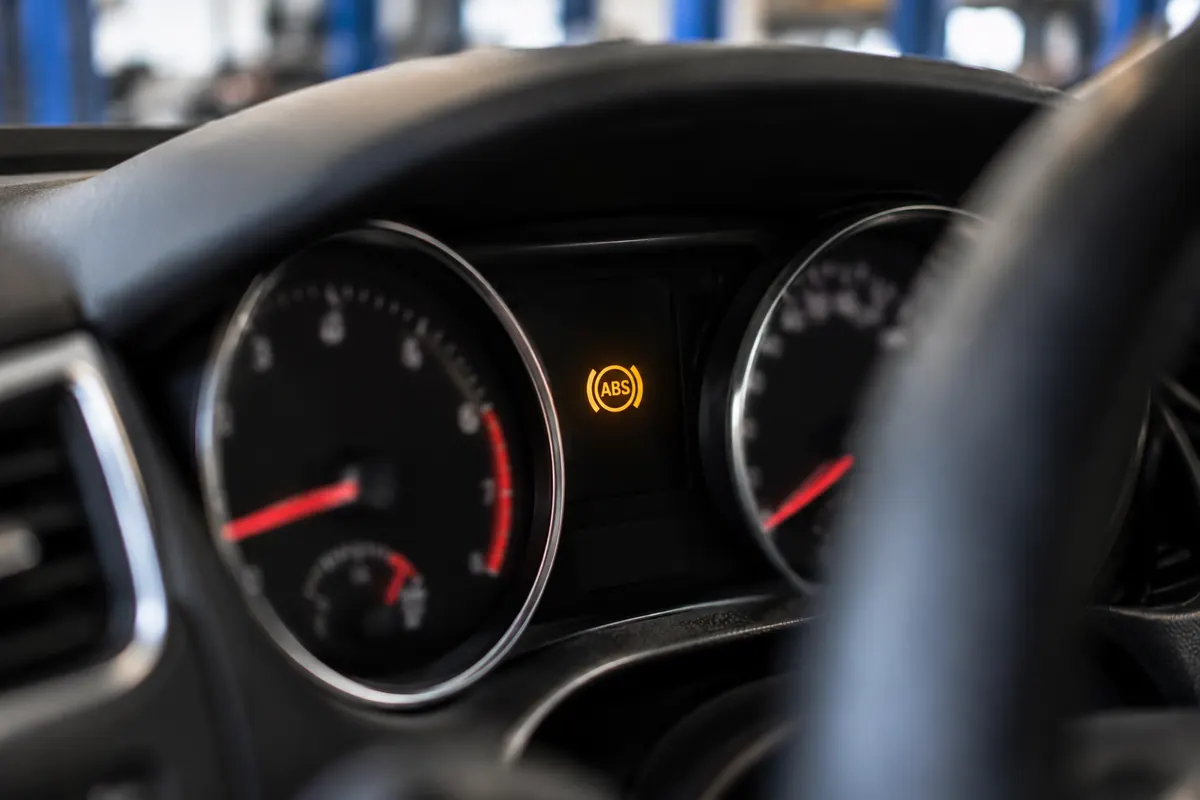
What does the ABS light on the dashboard mean?
ABS (Anti-lock Braking System) limits wheel lock-up during heavy braking. In many situations this lets the driver keep steering control. It does not, however, guarantee a shorter stopping distance on every road surface.
The ABS light is usually yellow or amber and shows the letters ABS inside a circle. Its exact look depends on the car maker. A brief flash when you switch on the ignition is normally just part of the system self-test.
If the light stays on after the engine starts or comes on while driving, the control unit has most likely detected a problem. On some cars an ABS fault also limits ESP or traction control.
ABS light on – when can you keep driving?
- Yellow ABS light stays on: likely fault, usually reduced system function.
- ABS light comes on briefly with the ignition: usually the bulb self-test.
- ABS plus red brake warning light: possible serious fault – stop driving.
- ABS light flashing: meaning depends on the model; check the owner's manual.
If only the yellow ABS light is on, the brake pedal feels normal and the car brakes predictably, a careful drive to a workshop is usually possible. Leave a bigger gap to other vehicles and keep your speed down.
If the red brake warning light comes on at the same time, the pedal goes soft, the car pulls to one side under braking or you notice a fluid leak, stop the car safely. In that situation carrying on could be dangerous.
It also helps to tell the ABS light apart from a pulsing pedal during hard braking. Pulsing while ABS is active is usually a normal sign of the system regulating pressure, not proof of a fault.
Most common causes of an ABS warning light
| Cause | Other symptoms | Urgency |
|---|---|---|
| Wheel speed sensor | ABS light stays on, ESP sometimes off | High – diagnostics |
| Damaged wire or connector | Fault comes and goes, e.g. after rain | High – diagnostics |
| Reluctor ring or wheel bearing part | Incorrect wheel speed reading | High – diagnostics |
| ABS module or pump | Several fault codes, possibly other warnings | High – check urgently |
| Power supply problem | Warnings from other systems at the same time | High – check wiring |
Most often the problem lies in the speed signal from one of the wheels, the wiring or a control component. Still, you should never replace a sensor just because the light is on.
What to do when the ABS light comes on
- 1Check whether only ABS is lit or other warning lights too.
- 2Assess how the brakes feel without doing hard test stops on a public road.
- 3If braking feels wrong or a red warning is on, stop the car.
- 4If the brakes work normally, slow down and keep a larger distance.
- 5Book computer diagnostics and tell us when and how the fault appeared.
Don't clear fault codes before the cause is known. The stored information can help pinpoint the faulty component.
If the light only comes on when turning or driving over bumps, make a note of it – this can help track down a faulty wire or sensor.
How we diagnose ABS faults at Pulsecar
Computer diagnostics at Pulsecar costs 100 zł. We read the available fault codes and analyse data from the control units, where the car provides it.
Depending on the result, we may need to check the wiring, sensors, connectors or mechanical parts at the wheels. A fault code alone doesn't always point clearly to the faulty part.
If the problem is linked to the suspension or related components, suspension diagnostics for 100 zł can help. We present the scope of repair and a cost estimate for your approval before any work starts.
How much does ABS repair cost in Warsaw?
The cost of an ABS repair depends on the cause. The price of replacing a sensor or repairing the wiring or ABS module is set after diagnostics, as there is no single figure that fits every car.
Computer diagnostics costs 100 zł. If additional brake work is needed, replacing front pads costs from 200 zł labour, and front discs with pads from 300 zł. These are not, however, standard fixes for an ABS fault.
Parts are priced separately in the estimate. Labour comes with a 6-month warranty. You can pick a time slot via online booking.