Shock absorbers — signs of wear, testing, replacing in pairs and cost
Worn shock absorbers do not fail overnight — the car gradually bounces more, dives under braking and holds the road less well. We explain how to recognise the symptoms, how to check the dampers and why they are replaced in pairs.
8 min read · Pulsecar team · updated:
Worn shock absorbers — the short answer
The most common signs of worn shock absorbers are the body bouncing after a bump, the nose diving noticeably under braking and the rear squatting when pulling away, the car wallowing in corners and in crosswinds, longer braking distances, uneven “cupped” tyre wear, oil on the damper body and knocks from the suspension. Some of these symptoms can also have other causes — play in control arms, anti-roll bar links or mounts — so a suspension check is worth doing before replacing anything.
Shock absorbers wear gradually, so drivers get used to the car handling worse and often do not notice the problem. There is no single mileage at which they must be replaced — it all depends on the roads, the load and the quality of the parts. It makes sense to check the suspension at every service and always to replace dampers in pairs on one axle.
What a shock absorber does and why it is a safety issue
The spring carries the car’s weight and absorbs bumps, but on its own it would keep bouncing. The shock absorber damps these oscillations — it turns the energy of movement into heat by forcing oil through valves. That way the wheel quickly regains contact with the road after a bump, and the body does not sway.
When a damper loses its effectiveness, the wheel bounces more often on uneven surfaces and at times presses less firmly on the road. In practice that means less grip in corners, longer braking distances — especially on broken tarmac — and a greater tendency to aquaplane. ABS and ESP also work less effectively, because the tyre lacks stable contact with the surface.
A worn damper also speeds up wear of other parts: tyres, control arm bushes, anti-roll bar links and mounts. One cheaper component can therefore raise the cost of the whole suspension.
Signs of worn shock absorbers
- Bouncing: after a speed bump or pothole the body rocks several times instead of settling quickly.
- Nose-diving under braking: the front drops noticeably when braking and the rear squats under hard acceleration.
- Wallowing and body roll: the car leans more in corners, “floats” when changing lanes and is sensitive to crosswinds and ruts.
- Longer braking distance: especially on uneven surfaces the wheels bounce and the ABS cuts in more often.
- Uneven tyre wear: “cups” appear on the tread — local worn patches spread around the circumference.
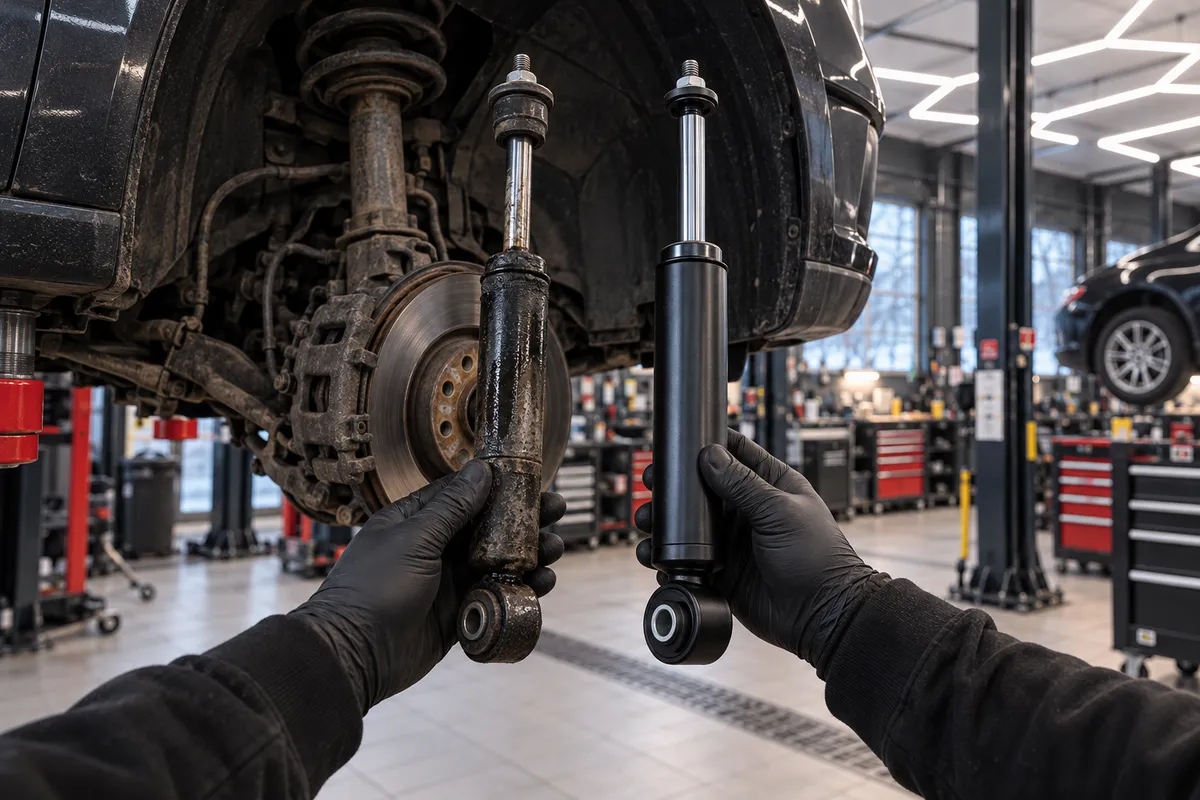
- Oil leaks: a damp, dirty damper body, oil running down the casing.
- Knocking and thumping over bumps: this may come from the damper, but also from mounts, bump stops, anti-roll bar links or bushes.
- Steering wheel vibration at certain speeds — usually as a result of uneven tyre wear.
Symptom → cause → what to do
| Symptom | Possible cause | What to do |
|---|---|---|
| Bouncing over bumps | Worn shock absorber | Suspension check, replace the pair of dampers |
| Oil on the damper body | Leaking shock absorber | Replace the pair on the axle |
| Knock when mounting a kerb or speed bump | Top mount, bump stop, anti-roll bar link, control arm bush, less often the damper | Check for play on the lift |
| Creaking when turning the wheel at a standstill | Top mount bearing of a MacPherson strut | Replace the mount, ideally together with the damper |
| Car pulls or steering wheel off-centre after a repair | Wheel settings changed after replacing suspension parts | Measure and set the alignment |
| “Cupped” tyres, steering wheel vibration | Damper, unbalanced wheel, bad alignment | Suspension check, wheel check |
| Car sits lower on one side | Broken or sagging spring | Replace springs in pairs |
The last two rows show that not every handling problem is a damper. If the steering wheel shakes under braking or at a certain speed, also see our guide steering wheel vibration — causes.
How to check shock absorbers yourself
- Visual check: look behind the wheel with a torch. A light film at the rod seal can be normal, but oil running down the body means a leaking damper.
- Bounce test: push down hard on a corner of the car a few times and let go. The body should come back up and stop almost immediately. If it keeps bouncing, the damper may be weak.
- Test drive: drive calmly over a few speed bumps and watch whether the car rocks, and listen for knocks.
- Tyres: run your hand over the tread — irregular “cups” and waves are a typical sign of running on weak dampers.
- Compare the sides: if the car sits unevenly or one side responds clearly differently to pressure, check the springs too.
The bounce test only catches a badly worn damper. In many newer cars with firm suspension even a weak damper can “pass” it. A reliable assessment needs an inspection on the lift combined with a test drive.
Why shock absorbers are replaced in pairs on an axle
The dampers on one axle should damp oscillations in the same way. A new damper on one side and an old, tired one on the other means the wheels behave differently: the car may react differently under braking, in corners and over bumps, and the stability systems get inconsistent conditions. That is why manufacturers and workshops recommend always replacing them in pairs — both fronts or both rears.
You do not have to replace all four at once, though. If the rear ones are in good condition, the front pair is enough. It is just worth having dampers of similar quality on both axles, not very stiff at the front and very soft at the rear.
The exception is mechanical damage to a new damper, e.g. after hitting a kerb shortly after replacement. In that case replacing a single unit with an identical one can be considered — but we decide after assessing the other side.
Bump stops, dust covers and mounts — what to replace with the damper
- Dust cover (gaiter, “bellows”): protects the piston rod from grit and water. A cracked cover shortens the life of a new damper, so a new one is usually fitted.
- Bump stop: a rubber or foam part that stops the suspension travel on a big bump. A crumbled bump stop means hard, metallic hits when the suspension bottoms out.
- Top mount (strut mount): connects the damper to the body and damps vibrations. When worn it causes knocks and creaks. In front MacPherson struts it often contains a bearing that works every time you turn the wheels.
- Springs: replaced when broken, corroded or when the car sits noticeably lower — also in pairs.
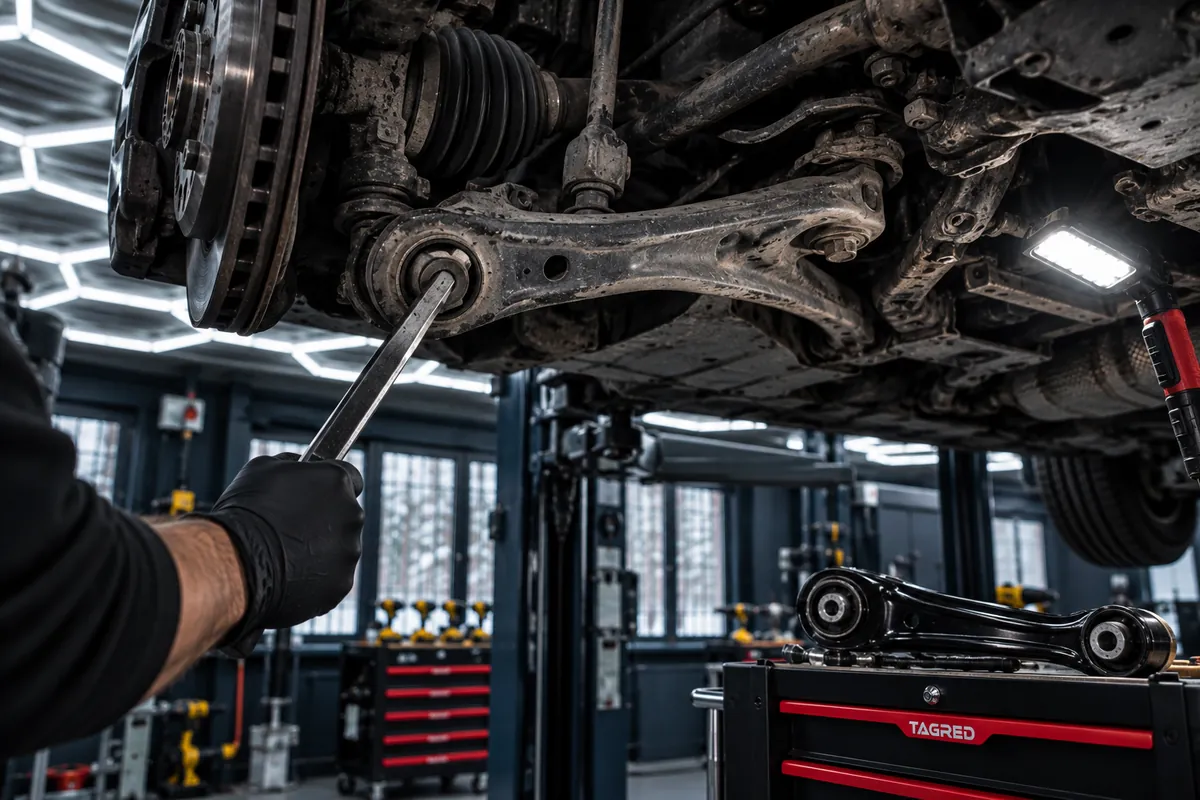
- Anti-roll bar links and control arm bushes: not part of the damper, but when the suspension is apart their condition is worth assessing. More about bushes and control arms in our guide control arm and bushes — replacement.
Replacing a front damper in a MacPherson strut means dismantling the strut, so replacing the dust cover, bump stop and top mount at the same time does not add much labour. What actually needs replacing is assessed on the lift and written into the quote.
Wheel alignment after replacing shock absorbers
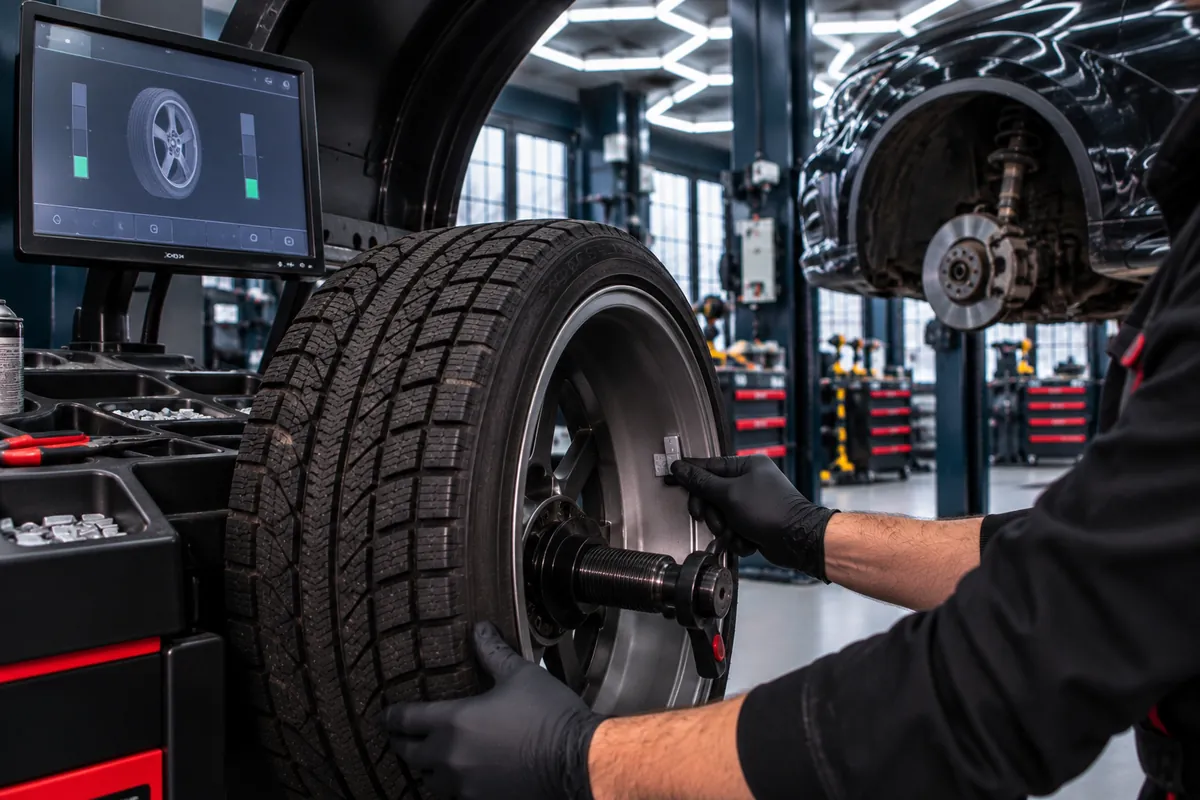
In many cars, especially with MacPherson front suspension, the damper is a part that locates the wheel. Replacing it — or the mounts or springs — can change the wheel settings, above all toe and, in some designs, camber. That is why after replacing the front dampers we recommend checking and setting the alignment.
Skipping this step can leave you with an off-centre steering wheel, a car that pulls and faster tyre wear. When else alignment is worth doing is covered in our guide wheel alignment — when, and the service itself is on the wheel alignment page.
Suspension diagnosis at Pulsecar
- 1A talk with the driver: what the symptoms are, when they appear, whether the car has had recent suspension work or hit a kerb.
- 2A test drive: how the car behaves over bumps, under braking and in corners, and where knocks come from.
- 3Inspection on the lift: leaks from the dampers, condition of dust covers, bump stops, springs and top mounts.
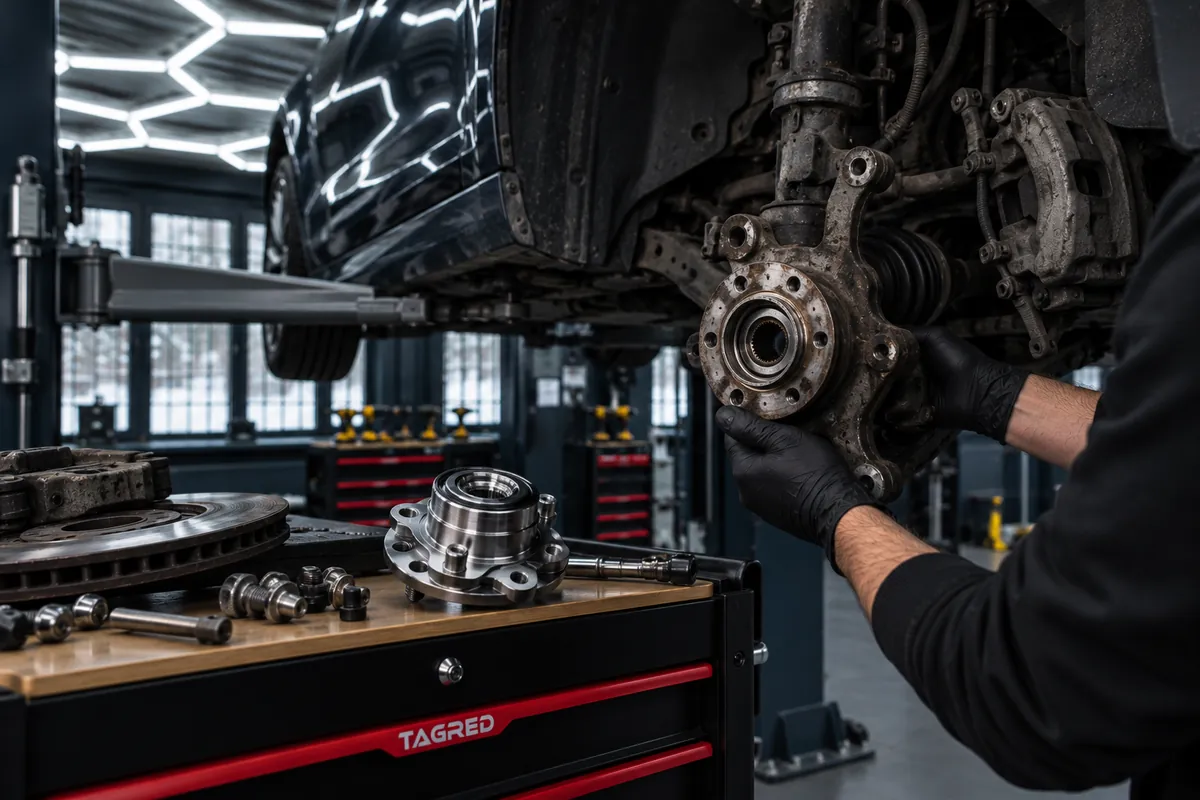
- 4Checking for play: control arms and their bushes, ball joints, anti-roll bar links, tie-rod ends, wheel bearings.
- 5Tyre check: the wear pattern often tells what is going on with the suspension and alignment.
- 6Presenting the result, photos and a quote for approval — only then do we order parts and start work.
The aim of diagnosis is to find the specific cause, not to replace “everything just in case”. If the dampers are fine and, say, an anti-roll bar link is knocking, the repair is simpler and cheaper. More about suspension repairs is on the suspension page.
How much does replacing shock absorbers cost in Warsaw
| Service | Price (labour) |
|---|---|
| Suspension diagnostics | 100 zł |
| Front shock absorber replacement | from 200 zł |
| Anti-roll bar link replacement | from 100 zł |
| Control arm replacement | from 200 zł |
| Wheel alignment — 1 axle / 2 axles | 150 zł / 300 zł |
| Rear dampers, springs, top mounts | quoted after diagnosis |
Prices are for labour at Pulsecar; dampers and other parts are quoted separately depending on the model and the chosen quality. Remember that we replace a pair, so labour covers both sides of the axle. Before work starts you receive a quote for approval. We give a 6-month warranty on labour, and new parts carry the manufacturer’s warranty. The full list is in our price list.
Can you drive on worn shock absorbers? The car will move, but it brakes and holds the road worse, especially on wet and uneven surfaces. A clear leak, knocking or heavy bouncing is a signal not to put off the repair.
Shock absorbers in Warsaw Bielany — Pulsecar, ul. Arkuszowa 176
We check and repair suspension at the Pulsecar workshop at ul. Arkuszowa 176 in Warsaw’s Bielany district. We are open Monday to Friday 09:00–18:00 and Saturdays 09:00–15:00. We speak Polish, Ukrainian, Russian, English and Belarusian.
The easiest way is to book online or call +48 571 058 591. Note when the symptoms appear — over speed bumps, under braking, in corners — that speeds up the diagnosis.