Squealing multi-rib (auxiliary) belt — causes, signs of wear and replacement
A squeal from under the bonnet at start-up, in frost or when turning the wheel is most often the auxiliary belt. We explain where the noise comes from, how to spot a worn belt, what happens if it snaps and when to replace it with the tensioner.
9 min read · Pulsecar team · updated:
Squealing auxiliary belt — the short answer
A multi-rib belt squeals when it slips on the pulleys. The most common causes are a worn, hardened belt, a weak or worn tensioner, idler pulleys with worn bearings, a faulty alternator one-way clutch pulley, oil or fluid on the belt, and moisture and frost. A short squeal at a cold start in rain or frost that disappears within a few seconds is not necessarily a fault. A squeal that comes back every day, gets louder or appears when you switch on the air conditioning or turn the steering wheel is a reason to have it checked.
The auxiliary belt drives the alternator, the A/C compressor, the power steering pump (in cars with hydraulic power steering) and in some engines the water pump too. So a snapped belt means not only no charging, but sometimes engine overheating, and in some engines even timing damage. Below we describe how to identify the cause, when to replace the belt and why this is usually done together with the tensioner.
What the multi-rib belt drives
- Alternator — without it the battery is not charged and the car will eventually stall.
- A/C compressor — in some cars it has a separate belt.
- Power steering pump — only in hydraulic systems. Many newer cars have electric power steering that does not depend on the belt.
- Water pump — in some engines driven by the auxiliary belt, in others by the timing belt or chain, or electrically.
- Less often: the radiator fan, a vacuum pump or other components, depending on the engine design.
It is worth knowing exactly what the belt drives in your car. That decides whether, after it snaps, you can carefully drive to a workshop or have to stop immediately. Basic information is in the owner’s manual, and a mechanic’s look gives certainty.
Most common causes of squealing
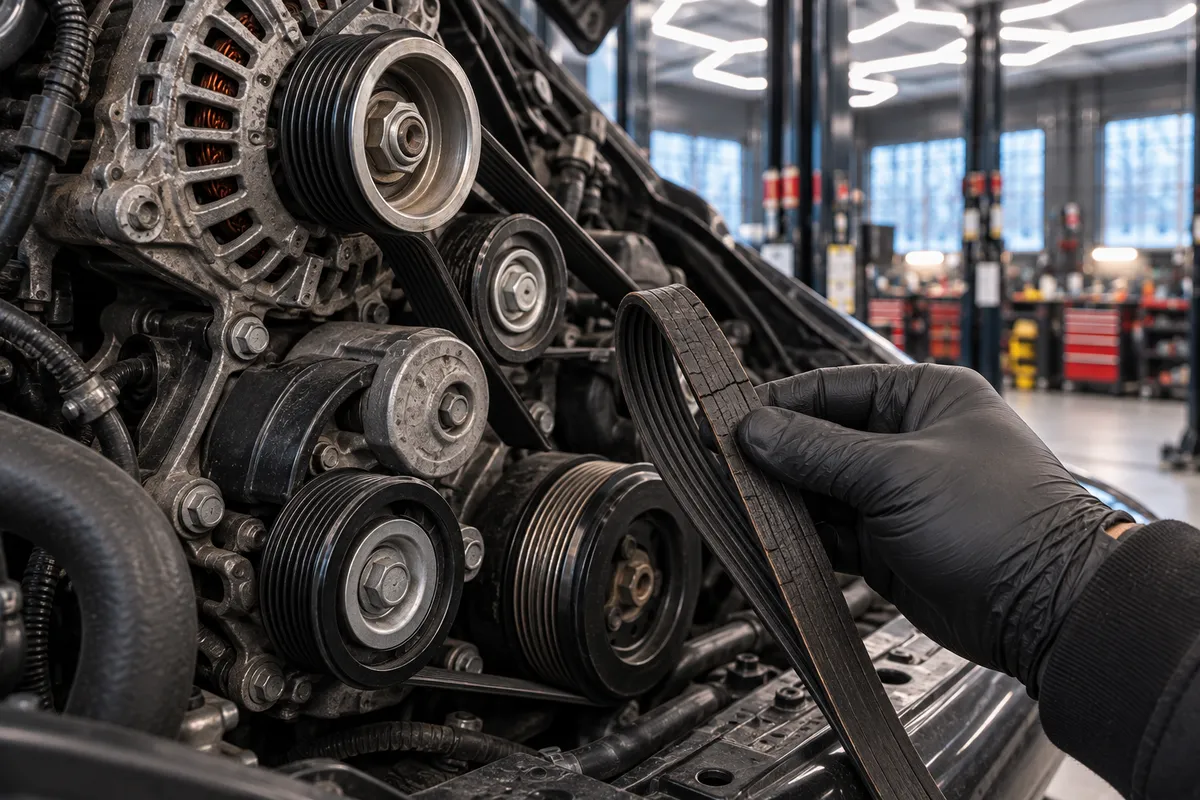
- Worn belt: over time the rubber hardens, the ribs wear down and the belt grips the pulleys less well. Modern belts often wear without visible cracks.
- Tensioner: an automatic tensioner with a tired spring or worn damper gives too little tension or vibrates. In older cars with manual adjustment the belt may simply have loosened.
- Idler pulleys and tensioner pulley: a worn bearing hums, squeals or has play, making the belt run out of line.
- Alternator one-way clutch pulley: when it seizes or slips it causes belt flutter, rattling and squealing, especially when the engine is switched off. More in our guide alternator — failure symptoms.
- Fluid on the belt: oil from a leaking gasket, coolant or power steering fluid. A contaminated belt slips and deteriorates faster.
- Moisture and frost: water on the pulleys and cold, harder rubber cause a short squeal after start-up.
- Overload: a seizing A/C compressor, an alternator with a failing bearing or a power steering pump working against resistance put too much load on the belt.
- Misaligned pulleys: a belt running at an angle gives a rhythmic “chirp” and uneven edge wear.
When it squeals → likely cause → what to do
| When it squeals | Likely cause | What to do |
|---|---|---|
| A few seconds after a cold start, in rain or frost | Moisture, hardened rubber, slightly reduced tension | Keep an eye on it; if the squeal lasts longer or returns with a warm engine — have it checked |
| When the A/C is switched on | Worn belt, weak tensioner, stiff compressor | Check the belt, tensioner and compressor |
| When turning the steering to full lock | Load from the power steering pump, worn belt or tensioner | Check the belt and the power steering system |
| When switching the engine off, with rattling at idle | Alternator one-way clutch pulley, tensioner | Check the pulley and tensioner |
| Constant hum or squeal rising with revs | Bearing in an idler, the tensioner or the alternator | Listening and checking for play with the belt removed |
| Rhythmic chirping | Misaligned pulleys, damaged idler | Check alignment and pulley condition |
| Squeal with a visible leak under the engine | Oil or fluid on the belt | Fix the leak and replace the belt |
If, when turning the wheel, you also feel the steering is heavy or hear the pump whining, see our guide power steering — symptoms.
Signs of belt wear and cracking
- Cross cracks on the ribs — a few small ones are normal ageing, but a dense network of cracks means replacement.
- Chunks missing from the ribs, delamination, loose threads.
- Smooth, shiny rib sides — the belt has been slipping and overheating.
- Frayed or worn edges — a sign that the belt runs out of line.
- Traces of oil or fluid, a sticky or swollen belt.
- Belt flutter at idle, clear jumping of the tensioner arm.
Modern EPDM belts often do not crack visibly but gradually lose material from the ribs. They look fine and still slip. That is why workshops also check rib depth with a special gauge rather than just looking for cracks.
Do not inspect the belt with the engine running and keep your hands away from the pulleys. Inspect it with the engine off and the key out, and in cars with start-stop make sure the engine cannot start by itself.
Risk of snapping — what happens then
When the belt snaps, the charging light usually comes on straight away. In cars with hydraulic power steering the steering suddenly becomes very heavy, which can catch the driver out when manoeuvring. The air conditioning stops working. If the belt drives the water pump, the engine temperature starts to rise quickly — you must stop and switch off the engine to avoid overheating and head gasket damage.
A snapped belt can also wrap around the pulleys and damage wiring, sensors or the crankshaft oil seal. In some engines pieces of the belt can get under the timing cover and interfere with the timing belt — the result can be the timing jumping and serious engine damage. That is why, on such engines, after an auxiliary belt failure it is worth checking the timing as well. More about it in our guide timing belt replacement — cost and symptoms.
If the belt squeals ever louder or has visible missing material, do not put the visit off. A planned replacement costs much less than towing and repairing the consequences of a snapped belt.
When to replace the belt and why together with the tensioner
The auxiliary belt replacement interval is set by the manufacturer — it depends on the engine and varies. In many cars the belt is replaced together with the timing belt or according to the service schedule, and regardless of mileage whenever it is worn, contaminated or noisy. During a timing belt job it has to come off anyway, so replacing it then keeps the extra labour down.
A new belt fitted to a worn tensioner or idler often starts squealing again soon and also wears faster. The tensioner, idlers and belt work as one system and age together, which is why at higher mileage we recommend replacing the complete kit. We decide after checking for play, the movement of the tensioner arm and the condition of the bearings.
Some cars use a so-called stretch-fit belt without a tensioner. It is fitted with a special tool and is not reused once taken off — any job that requires removing it means fitting a new belt.
Home remedies — what not to do
- Do not use “belt squeal” sprays. They silence the noise for a while but collect dirt and can damage the rubber, and the cause remains.
- Do not lubricate the belt or pulleys with oil or grease — the belt will slip even more.
- Do not tension the belt “by eye” in cars with an automatic tensioner — its tension is set at the factory.
- Do not ignore a squeal combined with the charging light or rising engine temperature.
The only lasting repair is dealing with the cause of the slip: replacing worn parts, fixing the leak or the component that creates excessive resistance.
How we check it at Pulsecar
- 1A conversation: when the squeal appears — when cold, with the A/C on, when steering, when switching the engine off.
- 2Listening with the engine running and watching the belt and tensioner arm while switching on more loads.
- 3Inspecting the belt with the engine off: cracks, missing material, contamination, measuring rib wear.
- 4Removing the belt and checking play and bearing condition of the idlers, tensioner, alternator pulley and other pulleys.
- 5Looking for oil and fluid leaks that may have reached the belt.
- 6The result with photos and a written quote for approval — only then do we order parts.
Sometimes we also spray a small amount of water on the belt with the engine running. If the squeal briefly stops, the cause is more often pulley alignment or the belt surface; if it gets louder, the tension is too low. This is only a pointer, and the test is done by a mechanic — do not do it yourself. More about mechanical repairs is on the general repair page.
How much does an auxiliary belt replacement cost
| Service | Price (labour) |
|---|---|
| Auxiliary belt replacement | per quote |
| Belt replacement with tensioner and idlers | per quote |
| Alternator one-way clutch pulley replacement | per quote |
| Timing belt replacement — when doing both belts together | from 600 zł |
| Computer diagnostics (when the charging or engine light is on) | 100 zł |
The cost of replacing the auxiliary belt depends on the engine and access: on some cars the belt is changed in a quarter of an hour, on others covers or a wheel have to come off or the engine has to be supported. Then there is the cost of parts — the belt alone or a kit with tensioner and idlers. We give the exact amount in a quote after inspection, before work begins. We give a 6-month warranty on labour, and new parts carry the manufacturer’s warranty. Other prices are in our price list.
You will find Pulsecar at ul. Arkuszowa 176 in Warsaw’s Bielany district. We are open Monday to Friday 09:00–18:00 and Saturdays 09:00–15:00. Book a visit online or call +48 571 058 591.