Engine and gearbox mounts — symptoms of wear, diagnosis and replacement
The engine shakes the whole car at the lights, something jolts when you pull away, and you feel a thump when you select reverse? These are typical signs of worn engine or gearbox mounts. We explain how to tell them from other faults and what replacement costs.
7 min read · Pulsecar team · updated:
Engine mounts — the short answer
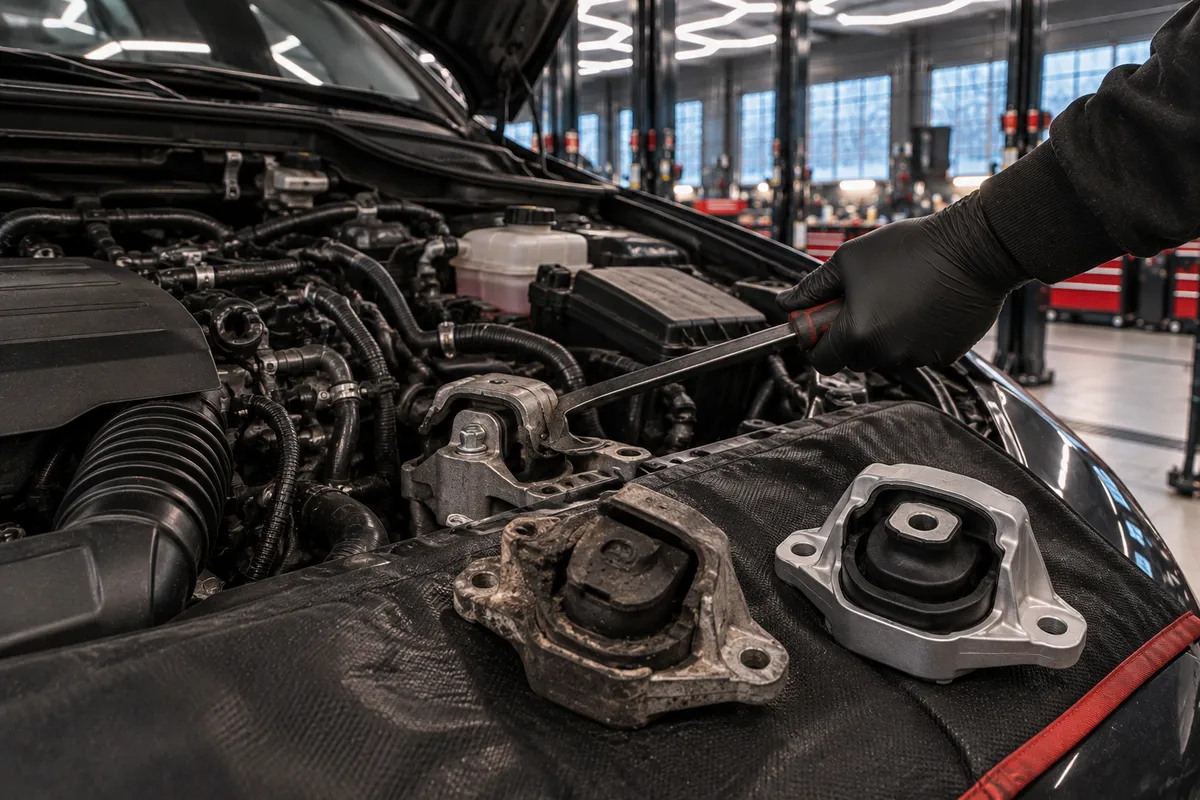
Engine and gearbox mounts are rubber or rubber-and-fluid mountings that hold the powertrain in the body and damp its vibrations. When they wear out, the typical symptoms are clear vibration at a standstill and at idle, a jolt when pulling away and changing gear, a clunk or thump when you suddenly press or lift off the throttle, and vibration or a “kick” when selecting reverse, especially in an automatic.
Similar symptoms can also come from misfires, a worn dual-mass flywheel or problems with the wheels and suspension. That is why it is worth confirming the mounts are really to blame before replacing them. In the workshop this is quick: an inspection on the lift, watching the engine move under load and — when needed — computer diagnostics. A worn mount is usually not a fault that strands the car, but left for long it puts extra load on other components.
Types of mounts — rubber, hydraulic and active
- Rubber (rubber-to-metal) mounts: the simplest, with a block of rubber between metal brackets. They wear out as the rubber cracks and hardens or comes unbonded from the metal.
- Hydraulic mounts (hydromounts): inside they have chambers of fluid that flows through small channels and adds damping. The typical fault is a fluid leak — the mount sags, gets wet and stops damping.
- Active or switchable mounts: controlled by vacuum or electrically by the engine control unit. They can change stiffness, e.g. soft at idle and firm while driving, and in some cars actively cancel vibrations. The fault may be the mount itself, but also the valve, a vacuum line or the wiring.
- Torque rod (also called a dog bone or pendulum mount): a link with bushes that limits the engine rocking backwards and forwards under acceleration and engine braking. Worn bushes give typical clunks when you press the throttle.
Most cars with a transverse engine have two, three or four supports: an engine mount, a gearbox mount and one or two torque rods. Rear-wheel-drive cars with a longitudinal engine usually have two engine mounts and a gearbox mount. Each wears differently, so diagnosis should point to a specific part, not “all the mounts”.
Symptoms of worn engine and gearbox mounts
- Vibration at a standstill and at idle transmitted to the steering wheel, seats and pedals — often stronger with the air conditioning on or with “D” selected in an automatic.
- A jolt when pulling away and changing gear, as if the engine were jumping in the engine bay.
- A knock or dull thump when you suddenly press or lift off the throttle, for example in traffic.
- Vibration and a thump when selecting reverse — the torque then acts in the opposite direction and a worn mount does not hold the engine.
- Noticeable engine rocking when starting and switching off, especially in a diesel.
- Knocks over bumps coming from the engine area rather than the suspension.
- Visible cracks in the rubber, a wet, oily hydromount, an engine sitting lower on one side.
Symptoms often build up slowly, so drivers get used to them. A good check is to compare with another car of the same model or with how your car used to behave. If you feel vibration mainly through the steering wheel while driving, see our guide steering wheel shaking — that is more often wheels and suspension than mounts.
Symptom → possible cause → what to do
| Symptom | Possible cause | What to do |
|---|---|---|
| Vibration at a standstill, engine runs smoothly | Worn engine or gearbox mount, failed hydromount | Inspection on the lift, watching engine movement |
| Vibration at a standstill, engine runs rough | Misfires, injectors, spark plugs, coils | Computer diagnostics, misfire counters |
| Jolt when pulling away, clunk on the throttle | Torque rod, gearbox mount, possibly driveshaft joints | Test under load, checking for play |
| Thump when selecting reverse | Gearbox or engine mount (especially in an automatic) | Watching the engine when selecting D and R on the brake |
| Vibration at idle and when switching off, rattle when pulling away | Dual-mass flywheel | Assessing the dual-mass flywheel, test drive |
| Vibration when operating mode changes, fault code stored | Active mount: valve, vacuum, wiring | Computer diagnostics, checking vacuum lines |
| Steering wheel shake at speed | Wheel balance, rims, discs, suspension | Wheel balancing, suspension diagnostics |
The key distinction: a worn mount does not make the engine run unevenly — it only damps vibration less well. If the revs hunt, the car jerks while driving at steady throttle or the engine light flashes, look for the cause in ignition and fuelling — more in our guide misfires — engine jerking.
Mounts and the dual-mass flywheel — why the symptoms get confused
The dual-mass flywheel and the engine mounts work towards the same goal: keeping engine vibration away from the body and gearbox. A worn dual-mass flywheel passes more torsional vibration into the gearbox and body, while worn mounts pass more engine vibration into the body shell. What you feel in the cabin can be similar: vibration at idle, jerking when pulling away, thumps when switching off.
Replacing the dual-mass flywheel “to see” when the mounts are to blame is an expensive mistake — and vice versa. Typical for the flywheel is a metallic rattle when switching off and pulling away, and vibration at low revs under load. Typical for mounts is movement of the whole engine visible to the naked eye and knocks when the torque changes direction. More on recognising a worn flywheel is in our guide dual-mass flywheel symptoms.
Worn mounts do not by themselves destroy the dual-mass flywheel, but an engine that rocks heavily puts extra load on the whole driveline when pulling away and changing gear. With long-neglected mountings some driveline components may wear faster.
What else suffers from worn mounts — exhaust and other parts
- Exhaust system: the manifold and front pipe are bolted to the engine, and further back the exhaust hangs on rubber hangers under the body. When the engine rocks heavily, the flexible joint (braided section) and hangers work harder than designed, may crack, and the exhaust starts knocking against the underbody.
- Driveshaft joints: with large engine movement the joint angles change, which adds load during jolts.
- Gear change cables or linkage: gear selection may become less precise, and in extreme cases gears can start jumping out.
- Hoses and lines: coolant, vacuum, fuel lines and wiring harnesses are stretched with every engine movement.
- Fan and radiator: with a broken mount the engine may shift far enough for something to start rubbing.
If we replace mounts because of heavy engine rocking, we also check the exhaust flexible joint and hangers, the driveshaft joints and the hoses. It takes a few minutes on the lift and can save you another visit.
How we check it at Pulsecar
- 1A talk with you: when you feel the vibration — at a standstill, when pulling away, when selecting reverse — and whether anything changed after another repair.
- 2Computer diagnostics when misfires are suspected or the car has active mounts: fault codes, misfire counters, operation of the mount control.
- 3Inspection on the lift: cracks and unbonded rubber, leaks from hydromounts, torque rod bush condition, a sagging engine, rubbing marks.
- 4Checking for play with a pry bar and watching engine movement with the bonnet open — with the brake pressed, an assistant gently switches between D and R or lightly releases the clutch.
- 5A test drive: pulling away, sudden throttle on and off, reverse, idling with the air conditioning on.
- 6The result with photos and a written quote for approval — we replace only the mountings that are worn.
Often replacing one mount or the torque rod is enough. When the car has high mileage and all the mountings are clearly tired, we will suggest a full set — but the decision is yours. More about mechanical repairs is on the general repair page.
Can you drive with a worn engine mount?
With a slightly worn mount that only gives a bit more vibration at a standstill, you can keep driving and plan the replacement soon. It is different when the mount is cracked or completely unbonded and the engine visibly jumps when pulling away and on engine braking. Then the driveshafts, exhaust, lines and the remaining mounts are loaded more — those mounts take on a bigger share of the work and wear faster.
Do not put it off if you hear a heavy thump when pulling away, gear changes feel worse than usual or something starts rubbing against the engine. That is a sign the mounting has stopped doing its job.
Replacing engine mounts does not usually require a wheel alignment. The exception is cars where the subframe or suspension beam is unbolted along the way — then we will say so in the quote.
How much does an engine mount replacement cost in Warsaw
| Service | Price (labour) |
|---|---|
| Computer diagnostics | 100 zł |
| Suspension diagnostics on the lift | 100 zł |
| Engine mount replacement | from 150 zł |
| Gearbox mount, torque rod, active mountings, exhaust | priced in the quote after diagnosis |
Prices are for labour at Pulsecar; mounts are priced separately, as their cost depends on the model and type — hydraulic and active ones are usually more expensive than rubber ones. Replacement time depends on access: some mounts take a quarter of an hour, others require supporting the engine and taking off ancillaries. You get the exact amount in the quote before work starts. We give a 6-month warranty on labour and the manufacturer's warranty on new parts. The full list is in our price list.
We are at ul. Arkuszowa 176 in Bielany, open Monday to Friday 09:00–18:00 and Saturdays 09:00–15:00. You can book online or call +48 571 058 591.