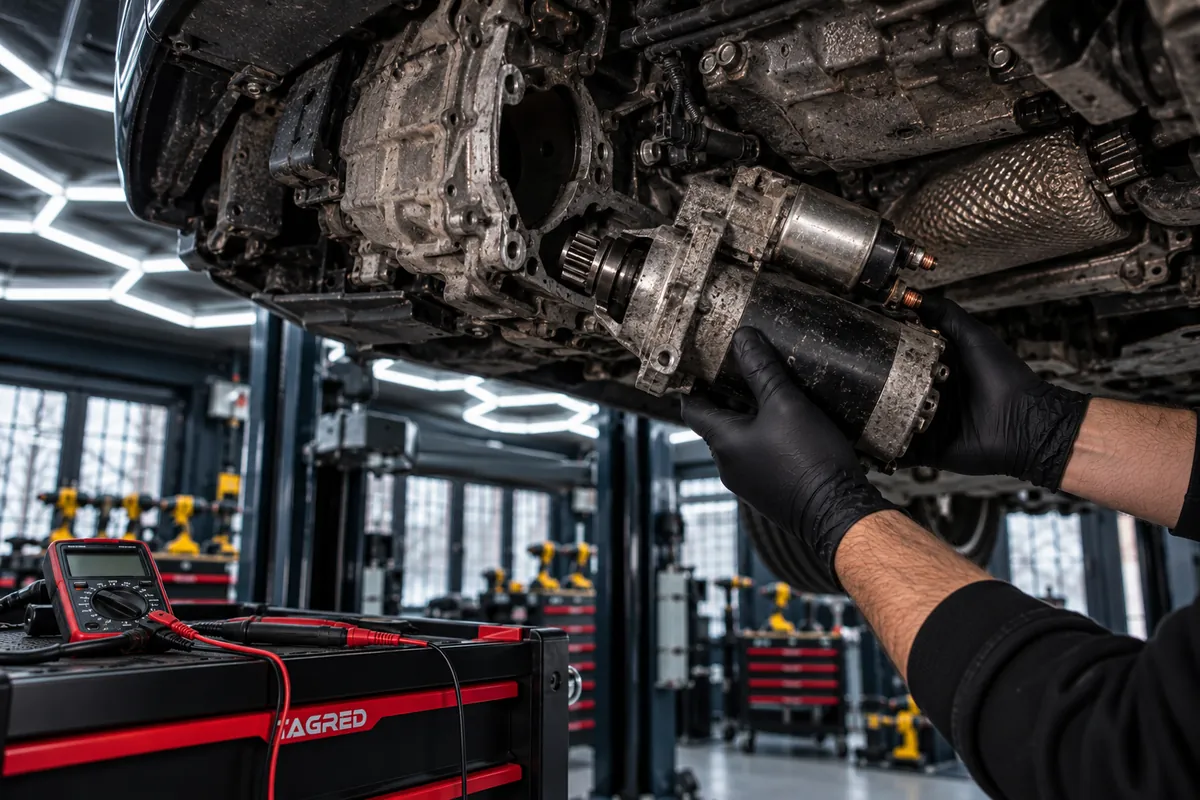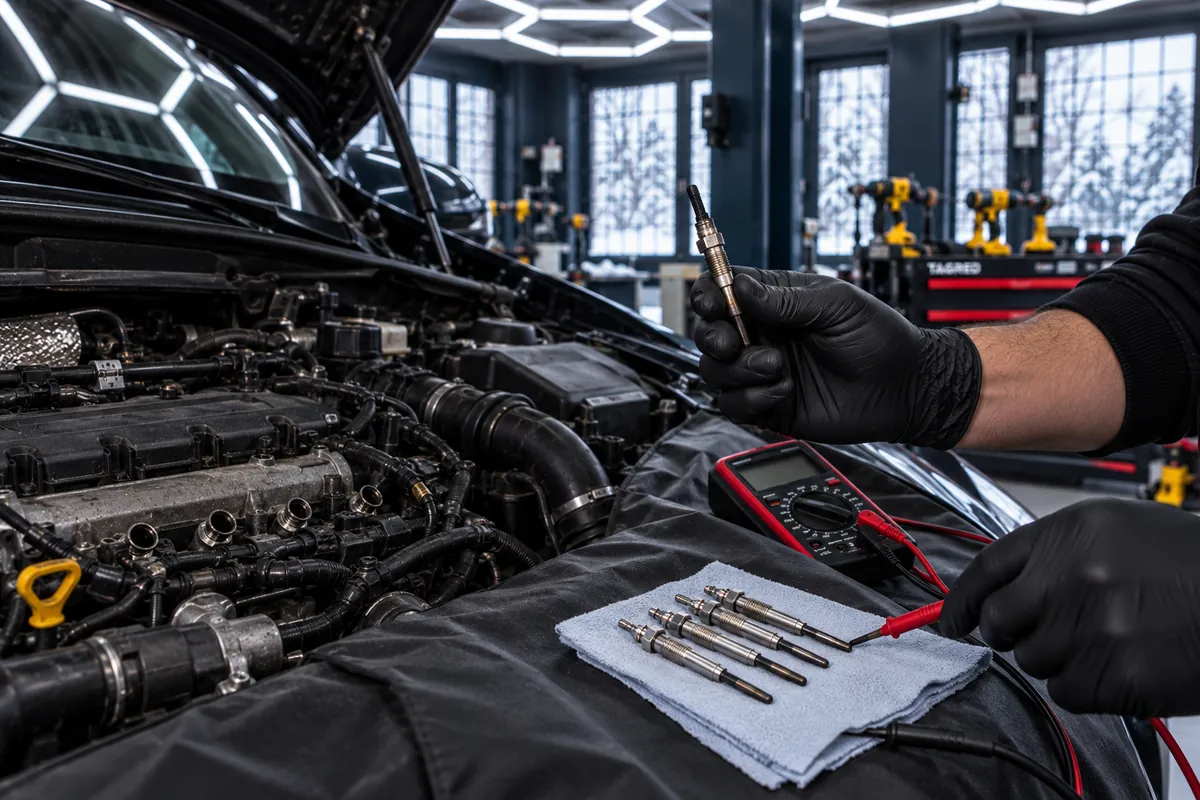
Engine misfire — jerking, shaking and rough running: causes and diagnosis
Is your engine jerking under acceleration, shaking at idle, with the check engine light on or flashing? These are typical signs of a misfire. We explain what causes it, when you should stop driving and how to quickly find the faulty cylinder.
8 min read · Pulsecar team · updated:
Engine misfire — the short answer
When the engine jerks under acceleration, shakes at idle or clearly loses power, most often the mixture is not burning properly in one or more cylinders — this is called a misfire. In petrol engines the most common causes are worn spark plugs and faulty ignition coils; less often ignition leads, injectors, an intake (vacuum) leak, carbon build-up on the intake valves in direct-injection engines, or low compression in a cylinder.
If the check engine light is flashing, keep driving to an absolute minimum: unburnt fuel goes into the catalytic converter and can overheat and damage it in a short time. The good news is that a misfire can usually be located quickly — the engine control unit points to the cylinder, and a simple coil swap test often reveals the culprit straight away. Below we describe the symptoms, causes, fault codes and what diagnosis in the workshop looks like.
Misfire symptoms — how to recognise it
- Vibration and “shaking” of the engine at idle, felt through the steering wheel, seat or gear lever; the revs may hunt up and down.
- Jerking under acceleration, especially under load: pulling away uphill, overtaking, in a high gear at low revs.
- A clear loss of power — the car “won’t pull”, as if the engine were running on one cylinder fewer.
- An uneven, “popping” exhaust note, sometimes a smell of unburnt fuel.
- The check engine light on or flashing; in some cars also a reduced-power message.
- Higher fuel consumption and harder starting, especially with a cold engine or in damp weather.
- Symptoms that appear only on LPG — a gas system is more sensitive to worn plugs and weak coils.
Note when the problem occurs: cold or warm engine, at idle or under load, in rain or in the dry, on petrol or on gas. This information speeds up diagnosis considerably and helps narrow down the list of suspect parts faster.
Flashing check engine light — when not to drive on
A steady engine light means the control unit has stored a fault — it needs checking, but you can usually drive calmly to the workshop. A flashing light is a different matter: the control unit has detected a misfire severe enough to threaten the catalytic converter. Fuel that did not burn in the cylinder burns in the converter, the core heats up rapidly and can melt or crack. Replacing a catalytic converter costs many times more than a new spark plug or coil.
More about what the different states of the light mean and why it should not be ignored is in our guide check engine light.
When the light flashes: slow down, avoid hard acceleration and high revs, and if you can, stop somewhere safe and do not continue. It is better to have the car transported on a tow truck or drive a short distance with minimal load than to add the cost of a catalytic converter to the repair.
Fault codes P0300–P030x — what they mean
| Code | Meaning | What it usually points to |
|---|---|---|
| P0300 | Random or multiple cylinder misfire | A cause shared by several cylinders: intake leak, fuel pressure, MAF sensor, worn plugs, carbon on valves, incorrect valve timing |
| P0301 | Misfire in cylinder 1 | A single-cylinder problem: plug, coil, injector or compression |
| P0302–P0304 | Misfire in cylinder 2, 3 or 4 | As above — the last digit of the code is the cylinder number |
| P0305–P0308 | Misfire in cylinder 5–8 (5-, 6- and 8-cylinder engines) | As above |
| P0351–P0358 (typically) | Ignition coil circuit fault | Often a failed coil, connector or coil supply wire |
| P0171 / P0174 | System too lean | Often accompanies P0300 when there is an intake leak |
A fault code tells you where the control unit detected the problem, not which part has failed. P0302 means a misfire in cylinder 2 — the cause may be the coil, plug, injector or low compression. Cylinder numbering depends on the engine, so we always check it in the documentation. Manufacturers also use their own codes, and the per-cylinder misfire counters in live data are often more valuable than the code itself.
Causes of misfires — table
| Symptom | Most common cause | What to do |
|---|---|---|
| Misfire in one cylinder, worse under load | Faulty coil or worn spark plug | Coil swap test, inspecting the plugs |
| Problem in rain or after washing the engine | Cracked coil or plug boot, arcing on an ignition lead | Inspecting coils and boots, replacing the faulty part |
| Misfire in several cylinders, hunting idle, P0171 | Intake (vacuum) leak | Checking intake tightness, vacuum hoses and gaskets |
| Jerking on a cold direct-injection engine | Carbon on the intake valves | Endoscopy, intake cleaning |
| Misfire in one cylinder despite a new coil and plug | Injector or low compression | Swapping injectors, compression test |
| Rough running only on LPG | Worn plugs, weak coils, gas injectors or system calibration | Checking ignition first, then the gas system |
| Misfire in all cylinders after timing work | Incorrect valve timing | Checking the timing setting |
The key question to start with: does the problem affect one cylinder or all of them? A single-cylinder fault is usually one specific part, while a random misfire points to something common to the whole engine — the mixture, the intake or the timing.
Spark plugs, coils and ignition leads
A spark plug wears gradually: the electrode gap grows and an ever higher voltage is needed for the spark to jump. Eventually the coil cannot keep up and the spark becomes irregular — first under load, then at idle too. The plug replacement interval depends on the engine and plug type (standard, platinum, iridium) and is given in the service schedule; in cars running on LPG it is worth changing them more often. How frost affects plugs and starting is covered in our guide glow plugs and spark plugs in winter.
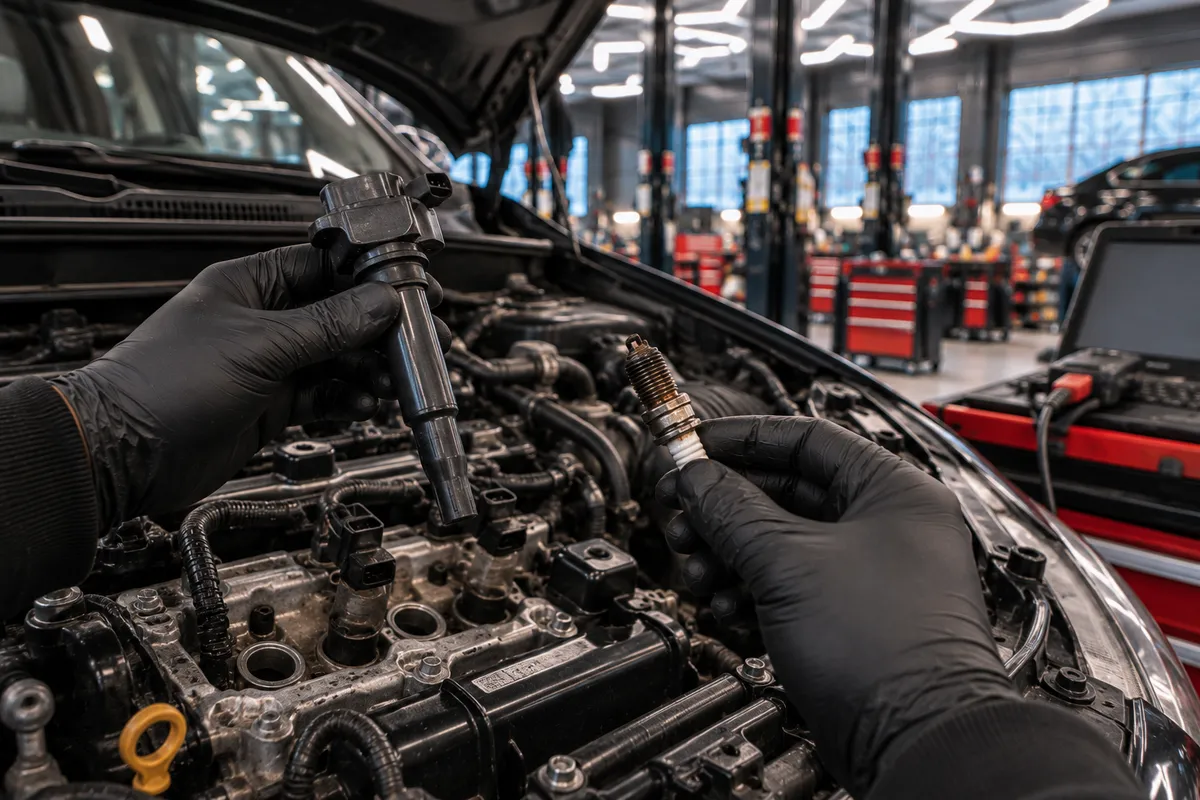
An ignition coil (on newer engines a separate one per cylinder) may have a cracked body, broken-down insulation or a damaged winding. The typical sign is a misfire in one cylinder that gets worse under load or in damp weather. Worn plugs speed up coil failure, so when we replace a coil we always check the plugs too. In older engines with ignition leads, a breakdown in the lead insulation gives similar symptoms — sometimes you can even see sparking in the engine bay in the dark.
If you replace one coil and the plugs have high mileage, change them at the same time. A new coil working with a worn plug is overloaded sooner, and the dismantling has already been done anyway.
Injectors, intake leaks and carbon on the valves
When the ignition is fine, look at the mixture. A dirty or sticking injector delivers too little fuel or atomises it poorly, while a leaking one drips fuel that burns badly. In that case the misfire “moves” with the injector when it is swapped with another one. Injector symptoms and diagnosis are covered in the article injectors — symptoms.
An intake leak — air drawn in bypassing the mass air flow sensor (a cracked vacuum hose, manifold gasket, crankcase breather hoses, throttle body) — makes the mixture lean. It is most noticeable at idle: the engine shakes, the revs hunt, and P0300 often appears together with P0171. Under load the symptoms may ease.
In direct-injection petrol engines the fuel goes straight into the combustion chamber and does not wash the intake valves. Over time carbon from breather vapours and exhaust gas from the EGR system builds up on them, disturbing the airflow and valve sealing. Typical signs are rough running when cold, jerking at low revs and misfire codes in several cylinders. The deposits are assessed with an endoscope, and the cleaning methods are described in our guide intake cleaning.
Low compression — when the cause is mechanical
If ignition and fuelling are fine but the misfire stays in one cylinder, the compression needs to be checked. Too little pressure in the cylinder means the mixture escapes before it can burn properly. Causes include a leaking or burnt valve, worn or stuck piston rings, a damaged head gasket or a faulty hydraulic lifter. A misfire in all cylinders after a repair or with noise from the timing drive, on the other hand, may point to incorrect valve timing.
A compression test shows whether the problem is mechanical, and endoscopy lets us look into the cylinder through the spark plug hole: you can see the condition of the bore, piston crown and valves, and any traces of coolant or oil. So you decide on the next step of the repair based on actual photos, not guesswork.
A diesel has no spark plugs but can also “shake”: most often because of the injectors, low compression or — on a cold engine — faulty glow plugs. Diagnosis is similar: reading fault codes, injector corrections and a compression test.
How we check it at Pulsecar
- 1A talk and a test drive: when the jerking occurs, cold or warm engine, on petrol or LPG, since when and after which repairs.
- 2Computer diagnostics: reading fault codes, per-cylinder misfire counters and live data — fuel trims, MAF sensor and lambda sensor operation.
- 3Inspecting the ignition system: coils, boots and connectors, removing and assessing the plugs — the colour and wear of the electrodes say a lot about combustion in each cylinder.
- 4Coil swap test: we move the coil from the misfiring cylinder to another cylinder, clear the codes and check whether the misfire “followed” the coil. If needed, we check the plug or injector the same way.
- 5Checking intake and vacuum hose tightness when the data points to a lean mixture.
- 6A compression test on all cylinders if ignition and fuelling are working.
- 7Endoscopy of the cylinder or intake valves when we suspect mechanical damage or carbon build-up.
- 8The result with photos and an explanation, plus a written quote for approval — only then do we order parts and start the repair.
This approach avoids replacing parts “on spec”. Often it turns out early on that one coil and a set of plugs are enough, and if the swap test shows nothing, the next steps lead straight to the mixture or a mechanical cause. More about electronics and ignition diagnostics is on the auto electrician page.
How much does diagnosing and fixing a misfire cost
| Service | Price |
|---|---|
| Computer diagnostics (fault codes, misfire counters, live data) | 100 zł |
| Engine endoscopy | from 300 zł |
| Spark plug or ignition coil replacement | per quote after diagnosis |
| Injectors, intake tightness, intake cleaning | per quote after diagnosis |
| Mechanical repairs (valves, head gasket, timing) | per quote after diagnosis |
The cost of the repair depends on the engine and on what diagnosis reveals: on some cars getting to the coils and plugs takes a few minutes, on others it requires removing the intake manifold. That is why we start with computer diagnostics for 100 zł, and before any work you receive a written quote for approval. We give a 6-month warranty on labour, and new parts carry the manufacturer’s warranty. Current prices are in our price list.
Pulsecar is at ul. Arkuszowa 176 in Warsaw’s Bielany district, open Monday to Friday 09:00–18:00 and Saturdays 09:00–15:00. If the engine is jerking and the light is flashing, do not wait: book a visit or call +48 571 058 591.