Power steering — fault symptoms, causes and diagnosis
Has the steering suddenly become heavy, does the pump whine when you turn, is there a fluid puddle under the car or has the power steering light come on? We explain how the different systems work, what fails in them and when you should not drive on.
8 min read · Pulsecar team · updated:
Power steering — the short answer
The most common signs of a power steering fault are heavy steering (all the time or only now and then), whining or groaning from the pump when turning, a fluid leak under the car, a power steering warning light on the dashboard, and knocks or play in the steering. In a hydraulic system the usual culprits are low fluid, leaking hoses or a leaking steering rack, a worn pump or the drive belt. In an electric system (EPS) — the torque sensor, the assist motor, the control unit, the power supply or a weak battery.
A power steering fault rarely means you completely lose the ability to steer — the steering wheel is still mechanically connected to the wheels — but suddenly heavier steering can catch you out on a roundabout or when parking. So it is worth coming in quickly with these symptoms, and with a large leak or a snapped belt you should not drive on. Below we describe the types of power steering, typical faults, the right fluid and what diagnosis in the workshop looks like.
Types of power steering — hydraulic, electro-hydraulic and electric
| Type | How it works | Typical faults |
|---|---|---|
| Hydraulic | A belt from the engine drives the pump; pressurised fluid assists the steering rack | Leaks from hoses and the rack, pump whine, a worn pump, a slipping or snapped belt |
| Electro-hydraulic | The hydraulic pump is driven by an electric motor controlled by a module | Fluid leaks, pump motor or module failure, power supply problems, a fuse |
| Electric (EPS) | An electric motor on the steering column or on the rack; no fluid | Torque sensor, motor, control unit, connectors, low voltage, knocks from the column |
The type of power steering is easy to check: if there is a power steering fluid reservoir under the bonnet, the car has a hydraulic or electro-hydraulic system. If there is no reservoir and the dashboard has a warning light with a steering wheel and an exclamation mark, it is most likely electric EPS. Both the list of possible faults and the method of diagnosis depend on the type.
Symptoms of a power steering fault
- Heavy steering — all the time, only at low speed, only when cold, or intermittently, in “jumps”.
- Whining, groaning or squealing when turning, loudest at full lock and when stationary.
- A fluid puddle under the front of the car, wet hoses, pump or rack boots, fluid level dropping in the reservoir.
- Foamy or dark fluid that smells burnt.
- A power steering warning light (amber or red) or a steering fault message — typical of EPS.
- Knocks when turning on the spot or over bumps, felt through the steering wheel.
- Play in the steering — the car “wanders” on a straight road and needs constant correction.
- The steering wheel does not return to the centre by itself after a bend.
Some of these symptoms do not necessarily mean a fault in the power steering itself. Steering can also be heavy with low tyre pressure or seized ball joints and strut top bearings, and steering wheel vibration at speed usually has other causes — we describe them in the article steering wheel shaking.
Symptom, cause, what to do — table
| Symptom | Most common cause | What to do |
|---|---|---|
| Pump whine when turning | Low fluid level, air in the system, a worn pump | Check level and tightness, find the leak, assess the pump |
| Heavy steering, squeal when pulling away or when cold | Slipping pump drive belt or a worn tensioner | Check the belt and tensioner |
| Fluid puddle, level dropping in the reservoir | Leaking hose, pump or rack seals | Locate the leak and fix it rather than topping up “just in case” |
| Warning light, heavy steering (EPS) | Torque sensor, motor, control unit, power supply, weak battery | Computer diagnostics, voltage measurement |
| Assistance cuts out intermittently | Low voltage, loose connector, system overheating or a worn pump | Reading fault codes and live data, checking charging |
| Knocks when turning and over bumps | Rack bushes, tie rods, play inside the rack | Suspension and steering diagnostics |
| Play in the steering, the car “wanders” | Worn tie rod ends or tie rods, steering rack | Checking for play on the lift, then wheel alignment |
The key rule: do not keep topping up the fluid. If the level is dropping, there is a leak somewhere, and a pump working with air in the system wears out very quickly.
Hydraulic power steering — pump, hoses and belt
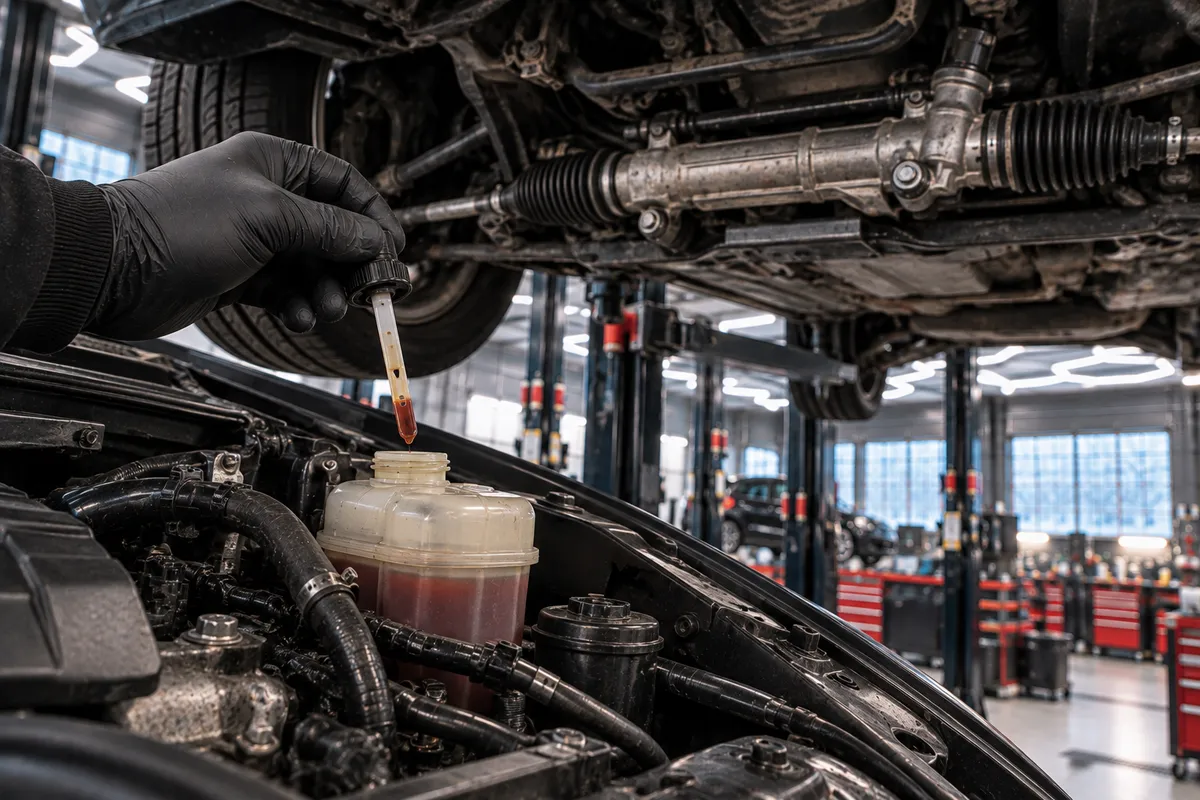
In a classic hydraulic system the power steering pump is driven by the multi-rib (auxiliary) belt from the crankshaft. The pump pushes fluid at high pressure to the steering rack, and a control valve directs it to the correct side of the piston. When there is too little fluid the pump draws in air — hence the typical whine when turning and foamy fluid in the reservoir. Driving for a long time with a low level usually ends with a seized pump.
The most common leak points are the high-pressure hose and its crimped fittings, the return hose, the pump shaft seal and the rack seals — in that case the fluid collects in the rubber boots at the ends of the rack. Heavy steering with a squeal when pulling away or when cold often means a slipping belt; how to recognise a worn belt and tensioner is covered in the article auxiliary belt squealing.
Do not hold the steering wheel at full lock for more than a few seconds. At full lock the pump works against the relief valve and the fluid heats up quickly — an extra load on the pump and hoses, especially when parking.
Which power steering fluid — ATF or CHF
- The correct fluid is specified by the car manufacturer: in the owner’s manual, the service documentation, sometimes on the reservoir cap.
- Some cars use ATF-type fluid (for example to a Dexron specification), others special CHF fluids, often synthetic.
- Do not mix different types of fluid — mineral-based and synthetic fluids can be incompatible and harm the seals.
- Colour is not a reliable guide: different fluids can look alike.
- Check the level against the marks on the reservoir — often separate ones for cold and warm fluid.
- Dark fluid that smells burnt or contains metal particles is a sign the system needs checking, not just topping up.
If you do not know what is in the system, do not top up with “whatever is at hand” — it is better to come to the workshop, where we will check the specification for your model. The wrong fluid can, over time, lead to seal leaks and a noisy pump.
Electric power steering (EPS) — warning light and heavy steering
An EPS system has no pump or fluid. A torque sensor on the column measures how hard you are turning the wheel, and the control unit sets the electric motor’s assistance accordingly. A fault usually shows as a warning light and a sudden loss of assistance — the steering becomes very heavy, especially when parking. The cause may be the torque sensor, the motor, the control unit, a damaged wiring loom or a connector.
EPS draws a lot of current, so it is sensitive to voltage. A weak battery or faulty charging can cause intermittent loss of assistance and fault codes even though the steering itself is fine. On some cars the steering angle sensor also has to be calibrated after the battery has been disconnected or after a repair — until then the warning light may stay on. Columns with an assist motor can also develop knocks from the gear or the intermediate shaft, felt in the steering wheel.
Knocks and play in the steering — rack, tie rods and tie rod ends
Knocks when turning on the spot or over bumps, felt through the steering wheel, most often come from the steering rack mounting bushes, from the tie rods (the joint at the rack) or from play inside the rack itself. Play in the steering and the car “wandering” on a straight road typically mean worn tie rod ends or tie rods. Such faults reduce steering precision and safety, and at the roadworthiness test play in the steering is a serious defect.
Replacing a tie rod end or a tie rod changes the toe setting, so the wheel alignment must always be set afterwards. Without it the tyres will quickly wear on the edges and the car may pull. When and why alignment is done is covered in our guide wheel alignment — when.
Can you drive with a power steering fault?
Carefully and only briefly — to the workshop. Without assistance the car can still be steered, but it takes much more effort, especially at low speed, and the assistance may cut out suddenly, for example in the middle of a manoeuvre. Drive calmly, leave a bigger margin on bends and roundabouts, avoid difficult manoeuvres and do not force the wheel at full lock.
Do not drive on if fluid is clearly leaking (the pump will soon seize, and fluid can drip onto hot engine and exhaust parts), if the belt has snapped — on many cars the same belt also drives the alternator and sometimes the water pump — or if there is obvious play or loud knocking in the steering. In that situation it is safer to have the car transported on a tow truck.
Take a red power steering light or a message telling you to stop seriously — stop the car in a safe place and check in the owner’s manual what it means for your model.
Diagnosis in the workshop — how we check it at Pulsecar
- 1A talk and a test drive: when the steering is heavy, whether there is whining or knocking, whether the fault appears when cold, when parking or over bumps.
- 2Computer diagnostics: reading fault codes from the power steering control unit (EPS or electro-hydraulic pump) and live data — voltage, torque sensor and steering angle signals.
- 3On a hydraulic system: fluid level and condition, tightness of the pump, hoses and rack, belt condition and tension.
- 4Checking the power supply: battery condition and charging, because low voltage can switch electric assistance off.
- 5Suspension and steering diagnostics on the lift: play in the tie rod ends and tie rods, rack mountings, boots, column joints.
- 6The result with photos and an explanation, plus a written quote for approval — only then do we order parts and start the repair.
After repairing steering components we check the assistance on a test drive, and after replacing tie rods or tie rod ends we set the wheel alignment. More about our services is on the suspension and steering page.
How much does power steering diagnosis and repair cost
| Service | Price (labour) |
|---|---|
| Computer diagnostics | 100 zł |
| Suspension and steering diagnostics | 100 zł |
| Tie rod end replacement | from 150 zł |
| Wheel alignment — 1 axle / 2 axles | 150 zł / 300 zł |
| Power steering pump, hoses, steering rack, EPS repair | per quote after diagnosis |
The cost of the repair depends on the type of power steering, the car model and what diagnosis reveals — sometimes a hose and fresh fluid are enough, sometimes a pump or a rack repair is needed. That is why we start with diagnostics, and before work starts you receive a written quote for approval. We give a 6-month warranty on labour, and new parts carry the manufacturer’s warranty. The full list is in our price list.
Pulsecar is at ul. Arkuszowa 176 in Warsaw’s Bielany district; we are open Monday to Friday 09:00–18:00 and Saturdays 09:00–15:00. If the steering has become heavy or the pump is whining, book a visit or call +48 571 058 591.