Alternator — failure symptoms, diagnosis and repair
Battery light on, lights dimming and the battery going flat every few days? It is often the alternator. We explain the symptoms, how to check the charging voltage, what fails most often and when a rebuild pays off.
9 min read · Pulsecar team · updated:
Alternator — the short answer
A failing alternator most often shows itself through the charging warning light (battery icon) on the dashboard, dimming or pulsing lights, a battery that goes flat even though you drive, and whining or squealing from under the bonnet. Sometimes there is also a smell of overheated insulation or rubber. The most common faults are worn brushes, a faulty voltage regulator, the diode bridge, the bearings and the overrunning (one-way clutch) pulley.
The basic test is simple: with the engine running, the voltage at the battery terminals should be roughly 13.8–14.7 V. In newer cars with smart charging management the values may be different and change while driving, so the result has to be interpreted together with data from the control unit. Below we describe the symptoms, how to check, the typical faults and when a rebuild pays off and when replacement is better.
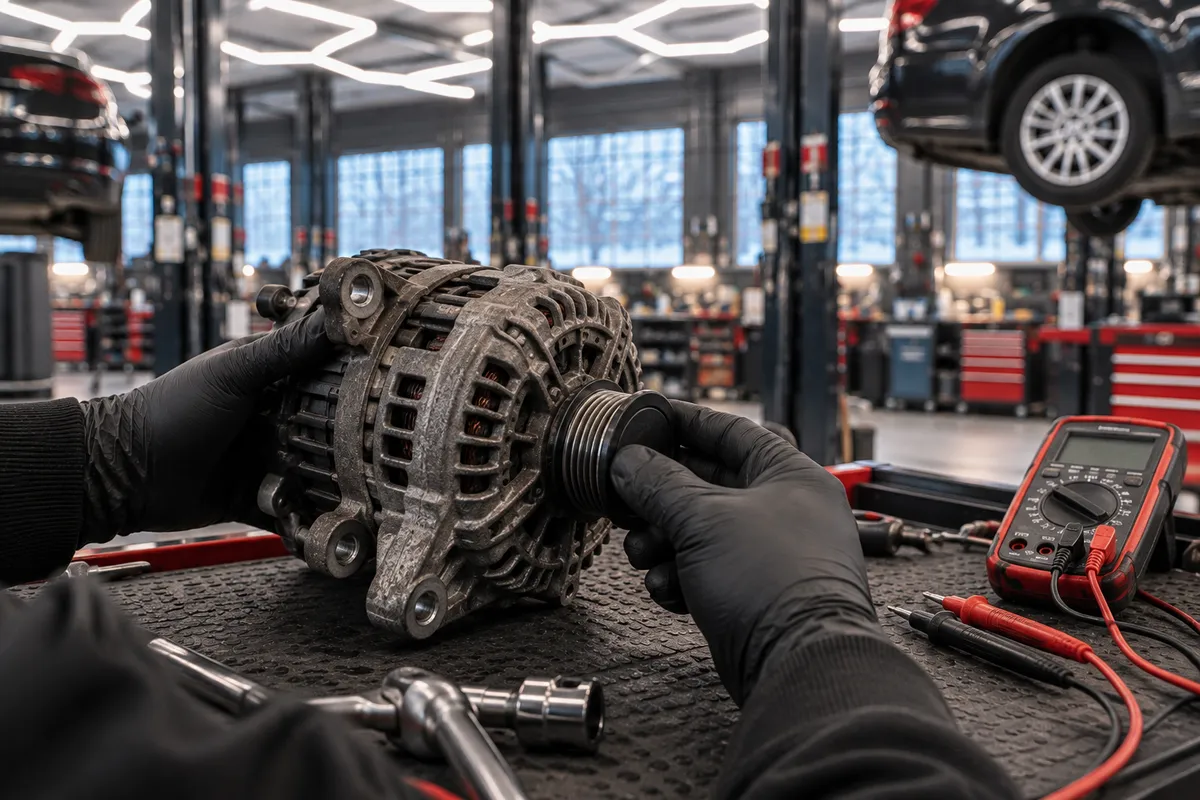
How an alternator works and what fails in it
- Brushes and slip rings — wear with mileage; the result is intermittent or fading charging.
- Voltage regulator — can undercharge or overcharge. Too high a voltage harms the battery and electronics.
- Diode bridge — a failed diode reduces output, can cause voltage ripple, a hum in the speakers and the battery draining while parked.
- Bearings — when worn they whine or hum, and eventually they can seize.
- Overrunning alternator pulley (one-way clutch) — damps vibrations from the crankshaft; when worn it causes belt flutter, rattling and squealing.
- Stator and rotor windings — fail less often, e.g. after overheating or water ingress.
The alternator is driven by the auxiliary belt from the crankshaft. It produces alternating current, which the diode bridge rectifies into direct current, and the regulator keeps the voltage in a safe range. Once the engine is running, the alternator powers all the car’s electrics and recharges the battery. If it stops charging, the car runs on the energy stored in the battery — until it is drained.
Symptoms of a failing alternator
- The charging light stays on, flickers or comes on at low revs.
- Lights dim at idle and brighten when you rev, the blower or wipers slow down.
- The battery goes flat even though you drive regularly, and a new battery is weak again after a few weeks.
- A whine or hum that rises with engine speed — typical of bearings or failed diodes.
- Squealing at start-up or when big loads are switched on — the belt slips on the alternator pulley or the one-way clutch has stopped working.
- Rattling and belt flutter at idle, sometimes visible shaking of the tensioner.
- A smell of overheated insulation or hot rubber from around the alternator.
- Electronic fault messages, comfort functions switching off, the start-stop system not working properly.
The charging light can also come on when the auxiliary belt snaps. If that belt drives the water pump in your car, stop in a safe place and check the engine temperature — driving without the pump quickly leads to overheating.
Symptom → possible cause → what to do
| Symptom | Possible cause | What to do |
|---|---|---|
| Charging light on, about 12–12.5 V with the engine running | No charging: brushes, regulator, snapped or slipping belt | Limit driving, switch off unnecessary loads, diagnostics |
| Voltage above about 15 V | Faulty voltage regulator | Do not keep driving — risk of damaging the battery and electronics |
| Battery goes flat while parked | Failed diode, excessive drain from another consumer, worn battery | Parasitic drain measurement and battery test |
| Whine rising with revs | Alternator bearings, less often diodes | Listening with a mechanic’s stethoscope, load test |
| Rattling, belt flutter at idle | Worn one-way clutch pulley or tensioner | Checking the pulley and tensioner with the belt removed |
| Dimming lights, weak charging under load | Worn brushes, failed diode, poor earth or cable connection | Measuring voltage under load and voltage drops on the cables |
The table helps narrow down the cause, but alternator, battery and starter symptoms often overlap. If the car mainly struggles to start, also read our guides battery in winter — symptoms and starter motor — symptoms.
How to check the charging voltage
- 1Get a simple multimeter set to DC voltage (20 V range).
- 2Measure the voltage at the battery terminals with the engine off, ideally after a few hours parked. A charged battery usually shows about 12.6 V or slightly more; below about 12.2 V means it is heavily discharged.
- 3Start the engine and measure again at idle. As a guide it should be about 13.8–14.7 V.
- 4Switch on the lights, the blower at maximum and the heated rear window. A brief drop is normal, but the voltage should not fall clearly and stay at battery level.
- 5Raise the revs to about 2000 rpm and watch whether the voltage settles. A value clearly above about 15 V points to a regulator problem.
This measurement will detect an obvious lack of charging or overcharging, but it will not show a single failed diode, worn brushes that still make contact, or a weak one-way clutch. For that you need a load test of the alternator and an assessment of voltage ripple.
In many cars with start-stop and smart charging the control unit deliberately lowers the charging voltage when the battery is charged and raises it during engine braking. A reading of about 12.5–13 V therefore does not have to mean a fault — it must be compared with data from the control unit and the battery sensor.
Regulator, brushes and the one-way clutch pulley
In many alternators the voltage regulator and the brushes form one module. Worn brushes give symptoms that build up gradually: at first the light comes on occasionally, usually at low revs or when hot, later charging disappears for longer. A faulty regulator, on the other hand, may overcharge — then the battery overheats and gasses, and bulbs blow more often. In newer cars the regulator is controlled by the engine control unit (e.g. over a LIN bus), so the fault may also be in the communication rather than the alternator itself.
The one-way clutch in the pulley lets the alternator keep spinning under its own inertia when the crankshaft speed briefly drops. This makes the belt and tensioner run more smoothly. A worn clutch may lock in both directions or slip — the signs are belt flutter and rattling at idle, a squeal when the engine is switched off and faster wear of the belt and tensioner. More about noises from this area is in our guide multi-rib belt squealing.
Not every alternator has a one-way clutch — some cars have a plain, solid pulley. The clutch is checked with the belt removed: in one direction the pulley should turn freely, in the other it should lock to the alternator shaft.
Can you drive with a faulty alternator?
When the alternator stops charging, the car runs on the battery. For how long depends on the battery’s condition and the number of loads switched on; it is usually more like a few dozen minutes than many hours. When the voltage drops, the electronics, electric power steering and ignition start to have problems, and the engine may stall while driving. So with the charging light on, switch off unnecessary loads and drive straight to a workshop or a safe place, ideally without switching the engine off on the way if starting is doubtful.
Overcharging (voltage clearly above 15 V) is more dangerous for the battery and electronics than no charging — in that situation it is not worth continuing a longer journey. Frequent jump-starting with cables or a booster only masks the problem and puts extra strain on the battery.
Rebuild or replace the alternator
- Rebuild: replacing the worn parts — brushes, regulator, bearings, diode bridge, one-way clutch. It makes sense when the housing, stator and rotor are in good condition.
- Exchange rebuilt alternator: a ready, tested unit, usually with the old one handed back. It shortens the time the car is off the road.
- New alternator: the most expensive, but no surprises about the condition of its components; often the only sensible option with damaged windings or housing.
- Repairing a single part without removing the alternator — rarely possible, mainly for the pulley or wiring.
The choice depends on the type of fault, the age of the alternator and the availability of parts for the specific model. It is also worth assessing the auxiliary belt and tensioner — a new alternator with a worn belt or tensioner will soon come back with the same noise. New parts carry the manufacturer’s warranty (usually 12–24 months); the workshop gives no warranty on parts supplied by the customer.
How we check it at Pulsecar
- 1Interview: when the light comes on, whether the battery has been replaced, whether the car goes flat after standing, whether there are noises.
- 2Computer diagnostics: reading fault codes, battery sensor data and the requested charging voltage in cars with smart charging.
- 3A battery test, to rule out the battery as the cause.
- 4Measuring charging voltage and current at idle and under load, assessing voltage ripple and voltage drops on the cables and earth.
- 5Checking the auxiliary belt, tensioner and alternator pulley, listening to the bearings.
- 6If needed, measuring parasitic drain while parked.
- 7The result with photos and an explanation, plus a written quote for approval — only then do we order parts.
This approach avoids the most common mistake: replacing the alternator when the battery, earth cable or belt is to blame — and vice versa. More about our electrical services is on the auto electrician page.
How much does alternator diagnosis and repair cost
| Service | Price |
|---|---|
| Computer diagnostics and charging system test | 100 zł |
| Alternator rebuild (brushes, regulator, bearings, diodes) | per quote after diagnosis |
| Replacing the alternator with a new or rebuilt unit | per quote after diagnosis |
| Replacing the alternator pulley, auxiliary belt, tensioner | per quote after diagnosis |
The cost of an alternator repair depends on the car model, access to the alternator (in some cars other components have to be removed first) and whether you choose a rebuild or a new alternator. That is why we start with diagnostics for 100 zł, and before work begins you receive a quote for approval. We give a 6-month warranty on labour. Prices of other services are in our price list.
Pulsecar is at ul. Arkuszowa 176 in Warsaw’s Bielany district. We are open Monday to Friday 09:00–18:00 and Saturdays 09:00–15:00. Book a visit online or call +48 571 058 591. If the charging light is already on, come as soon as possible and without unnecessary stops.