
Transmission Warning Light – What Does Limp Mode Mean?
A transmission warning light usually means a fault has been detected in the gearbox or its control system. An automatic gearbox may switch to limp mode, which limits the available gears and the car's performance. Not every such warning means the gearbox needs an overhaul, but the problem does need diagnostics.
If the gearbox jerks, slips, won't select gears or shows a red warning, stop the car safely; with a mild yellow warning, follow the manufacturer's instructions.
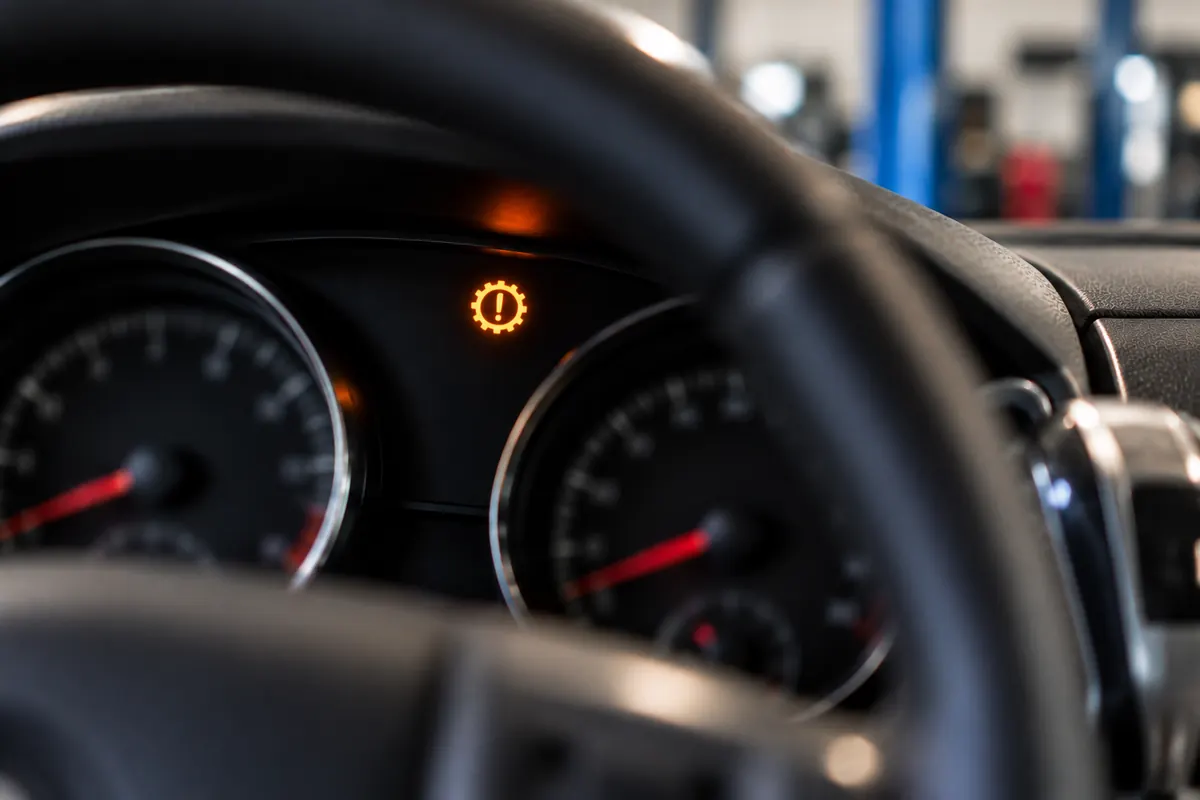
What does the transmission warning light mean?
The transmission light may show a gear wheel with an exclamation mark, a thermometer or a text message. Some cars signal a fault by flashing the PRNDS letters or other unusual behaviour of the gear position indicator.
A yellow or amber symbol usually means a check is needed, while a red one may indicate a situation that requires you to stop. The exact meaning depends on the manufacturer, the type of gearbox and the wording of the message.
Transmission limp mode is a control unit strategy designed to reduce the risk of further damage. The car may stay in one gear, pull away with a delay or limit engine torque.
On some cars a transmission warning may be linked to an electrical supply or engine management problem. That's why you shouldn't judge the condition of the gearbox from the symbol alone.
Light on or flashing – when can you drive?
- Yellow transmission light: needs a check and a fault code read.
- Red light or temperature warning: stop the car as the manual instructs.
- Flashing PRNDS: on some models signals a gearbox fault.
- Unable to select a gear: don't try to force the car to move.
- Severe jerking or slipping: stop driving and arrange transport.
If a yellow warning appears but the car shifts smoothly and the owner's manual allows limited driving, you can drive carefully to have it checked. Avoid heavy loads and hard acceleration.
With severe jerking, slipping clutches, an inability to select a gear, unusual metallic noises or an oil leak, driving on can make the damage worse.
A red transmission temperature message calls for following the owner's manual. In many cases you need to stop somewhere safe and discontinue your journey.
If the light disappears after restarting the engine, that doesn't automatically mean the fault is gone. The control unit may have stored an intermittent fault that needs checking.
Most common causes of transmission limp mode
| Cause | Other symptoms | Urgency |
|---|---|---|
| Incorrect oil level or condition | Jerking, delayed engagement | High |
| Gearbox overheating | Temperature warning, reduced operation | Immediate |
| Speed or position sensor | Gear selection faults, limp mode | High |
| Hydraulic control or mechatronic unit | Incorrect gear changes | High |
| Worn mechanical parts | Slipping, noise, missing gears | Immediate with severe symptoms |
| Electrical supply problem | Several warnings at once | High – diagnostics |
The causes depend on the gearbox design. A conventional automatic, a dual-clutch gearbox and a CVT have different control components and oil requirements.
What to do when the gearbox goes into limp mode
- 1Check the colour of the light and the wording of the message.
- 2Look out for jerking, slipping, noise and gearbox temperature.
- 3With a red warning or serious symptoms, stop the car safely.
- 4Don't force a gear if the gearbox isn't responding properly.
- 5If the manual allows limited driving and there are no dangerous symptoms, drive carefully to have it checked.
- 6Book gearbox diagnostics and tell us the circumstances in which the fault occurred.
Don't try to restore normal gearbox operation by repeatedly accelerating hard or moving the selector lever. This can put more strain on damaged components.
Note whether the problem occurs when the gearbox is cold or warm. This information can help find the cause of the fault.
How we diagnose a transmission warning light at Pulsecar
Computer diagnostics costs 100 zł. We read the available gearbox control unit fault codes and analyse live data where the car allows it.
Depending on the symptoms, the oil condition and level, the electrical wiring, sensors or control components may need checking. A fault code alone doesn't always clearly identify the faulty part.
If the problem relates to the clutches or the drivetrain, the scope of further inspection depends on the gearbox design. Don't assume every fault requires replacing the entire gearbox.
How much does a gearbox repair cost?
Computer diagnostics at Pulsecar costs 100 zł. An automatic transmission oil change costs from 400 zł labour, but it won't fix every limp mode problem.
If the car has a manual gearbox and a clutch replacement is confirmed as necessary, labour costs from 600 zł. Repairs to control units, the mechatronic unit and internal components are priced after diagnostics.
Parts and materials are priced separately. Before starting work we present a cost estimate for your approval, and labour comes with a 6-month warranty.
Pulsecar is located at ul. Arkuszowa 176 in Warsaw. You can pick a time via online booking, and contact details are available on the contact page.