Car thermostat — failure symptoms, checking and replacement
Temperature gauge sitting low, a lukewarm heater and higher fuel use? Or the opposite — the engine overheats? The thermostat is often to blame. We explain the symptoms of both kinds of failure, how to check the thermostat and when you must stop driving.
8 min read · Pulsecar team · updated:
Thermostat — the short answer
The thermostat is a valve that decides when coolant starts flowing through the radiator. When the engine is cold the thermostat is closed and coolant circulates only in the so-called small circuit, so the engine warms up faster. Once operating temperature is reached the thermostat opens and coolant goes to the radiator. A faulty thermostat can stick in two positions, and each produces completely different symptoms.
A thermostat stuck open is annoying but not sudden: the engine takes a long time to warm up, the heater is weak, fuel consumption rises and the ECU often stores code P0128. A thermostat stuck closed is dangerous: the engine overheats quickly and you must stop driving immediately, as it risks damaging the head gasket or even the cylinder head itself. Below we describe both cases, electronically controlled thermostats, how to check and what replacement involves.
How a thermostat works
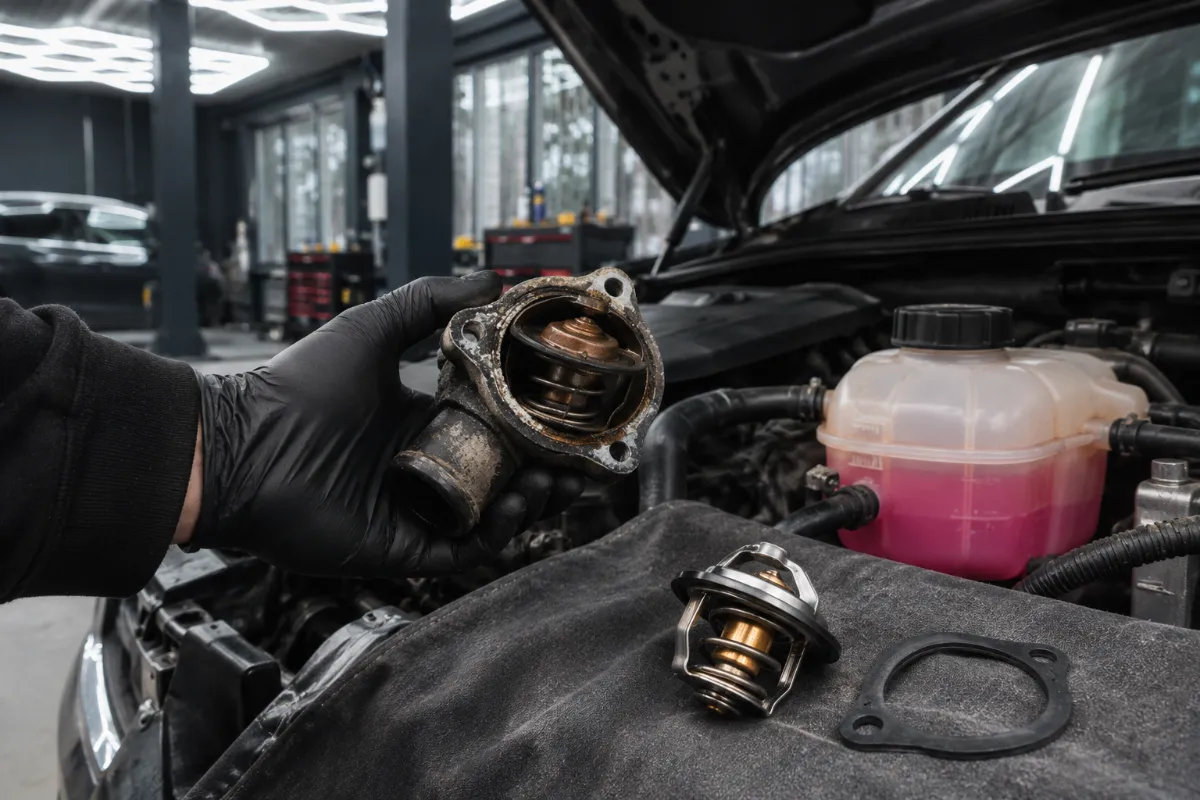
A conventional thermostat has a wax element. When heated, the wax expands and opens the valve against a spring; when it cools, the spring closes it again. The typical opening temperature in passenger cars is about 80–95°C, depending on the engine — it is usually stamped on the thermostat body. The thermostat does not snap open but opens gradually, reaching full opening several to over a dozen degrees higher.
Many newer cars use electronically controlled thermostats: a heating element built into the wax element lets the engine ECU heat it and so open the thermostat earlier. As a result the engine runs warmer during gentle driving (reducing friction and fuel use) and cooler under heavy load. Some engines use a thermal management module with a rotary valve driven by an electric motor instead of a thermostat.
A thermostat wears like any other part: the wax element loses its properties, the spring weakens and deposits and contamination from the coolant can jam the valve. That is why thermostat failure is typical of higher-mileage cars and systems where the coolant has not been changed for a long time.
Faulty thermostat symptoms — table
| Symptom | Likely cause | What to do |
|---|---|---|
| Engine takes very long to reach temperature, in winter barely at all | Thermostat stuck open or opening too early | Diagnostics, read the temperature in live data |
| Weak heating, especially on the motorway and in frost | Thermostat open, possibly an airlock or clogged heater matrix | Check the thermostat and heater matrix flow |
| Code P0128 (coolant temperature below thermostat regulating temperature) | Thermostat open or coolant temperature sensor | Computer diagnostics, comparing readings |
| Gauge drops on the motorway and rises in town | Thermostat not closing fully | Replace the thermostat |
| Rapid overheating, gauge in the red, boiling coolant | Thermostat stuck closed, but also water pump, low coolant, fan | Stop the car immediately, do not drive on |
| Upper radiator hose hot, lower hose cold with a hot engine | Thermostat not opening | Replace the thermostat, check the head gasket |
| Temperature fluctuates — sometimes too high, sometimes too low | Sticking thermostat, airlock, thermostat heater fault | Diagnostics, bleeding, check thermostat control |
| Coolant leak around the thermostat housing | Cracked housing (often plastic) or worn seal | Replace the housing or seal, top up coolant |
Many of these symptoms can also come from a faulty coolant temperature sensor or water pump — so before you buy a new thermostat, it is worth confirming the fault.
Thermostat stuck open — the engine does not warm up
- The engine takes a very long time to warm up, and on frosty days or on long runs may never reach operating temperature.
- Weak cabin heating — the air is lukewarm, windows take longer to defrost and fog up more easily.
- Higher fuel consumption: the ECU treats the engine as cold and enriches the mixture, and idle speed stays raised longer after a cold start.
- Code P0128 and the check engine light — though not in every car and not straight away.
- In diesels with a DPF a cold engine makes proper filter regeneration harder.
- Faster engine wear and fuel dilution of the oil when it constantly runs too cold.
You can usually drive such a car to the workshop, but do not put it off for weeks. Note: in many cars the dashboard temperature gauge is damped — it sits in the middle of the scale over a wide temperature range. So a low gauge is already a clear signal, while a normal reading does not rule out a problem. Only diagnostics give a reliable reading. You can read what an engine fault light means in our guide check engine light, and about other causes of weak heating in heater not working.
Thermostat stuck closed — overheating
When the thermostat does not open, coolant does not reach the radiator and engine temperature rises fast — the gauge climbs after a few to a dozen or so minutes of driving, the red temperature warning may come on and steam may come from under the bonnet. A typical sign is a hot engine and upper hose while the radiator or lower hose stays cold.
In this situation pull over somewhere safe and switch off the engine. Do not open the expansion tank cap while the engine is hot — the coolant is under pressure and can scald you. Driving with an overheated engine even for a few kilometres can end with a failed head gasket, a warped cylinder head or a seized engine. If the engine has overheated, after replacing the thermostat it is worth checking that the head gasket has not suffered — we describe the symptoms in head gasket — symptoms.
If you have to drive a few hundred metres to a safe place, turn the heating to maximum with the fan on full — the heater matrix will take away some of the heat. This is only an emergency measure, not a way to keep driving.
Electronically controlled thermostats — BMW, VAG and others
In thermostats with a heater the fault may affect not only the valve itself but also the electrical circuit: the heater, the wiring or the connector. The ECU then stores thermostat heater circuit codes (in the OBD standard these include P0597–P0599), and the engine may run at the wrong temperature. We often see them in BMWs — at Pulsecar about one in six cars in the workshop is a BMW — but other makes use map-controlled thermostats too. In many BMWs the thermostat is expensive and hard to reach, and when replacing it it is worth assessing the water pump, which is electric in some engines.
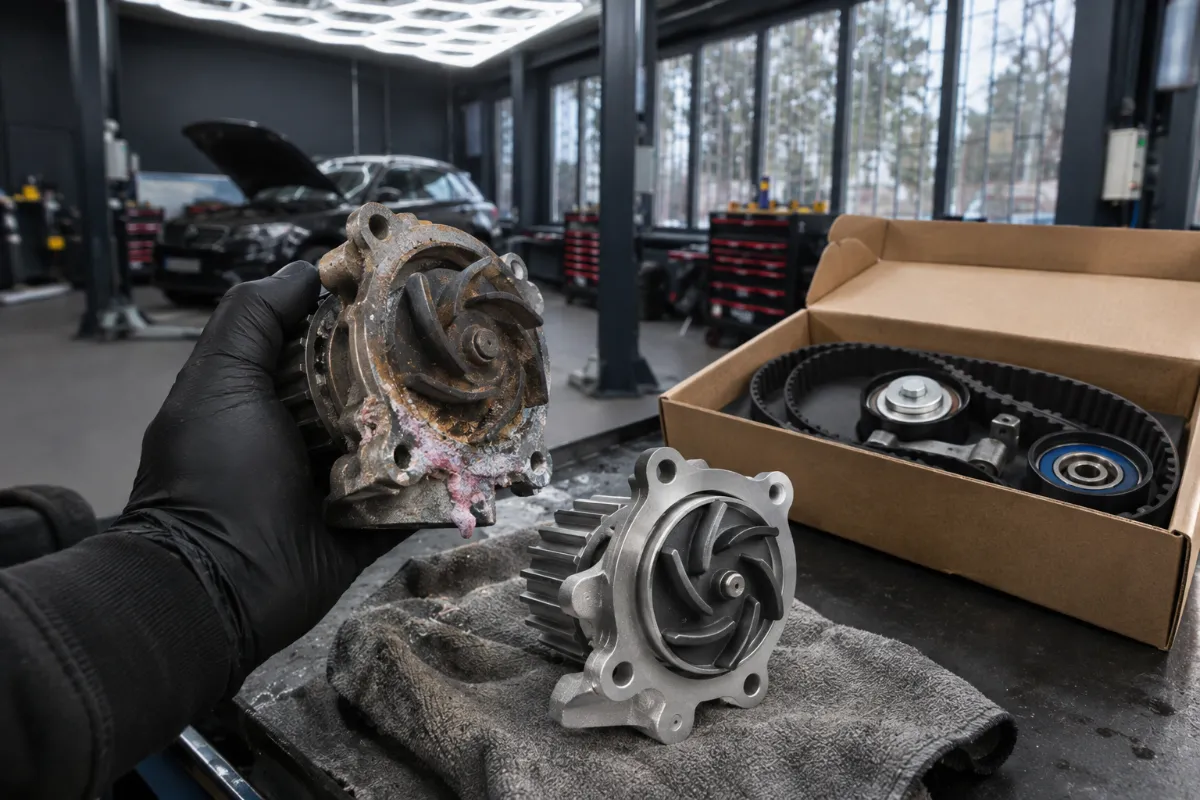
In newer VAG group engines (VW, Audi, Škoda, Seat), instead of a conventional thermostat there is often a thermal management module with a rotary valve, integrated with the water pump housing. Its typical faults are leaks from the plastic housing and valve position sensor errors. The repair usually means replacing the whole module, sometimes the pump as well — more in our guide water pump — symptoms.
In cars with electronic temperature control the engine may normally run above 100°C during gentle driving. This is not a fault — so do not judge the temperature by eye, but compare it with the target values in the ECU live data.
How to check the thermostat yourself
- 1Start with a cold engine and check the coolant level in the expansion tank — low coolant gives symptoms similar to a faulty thermostat.
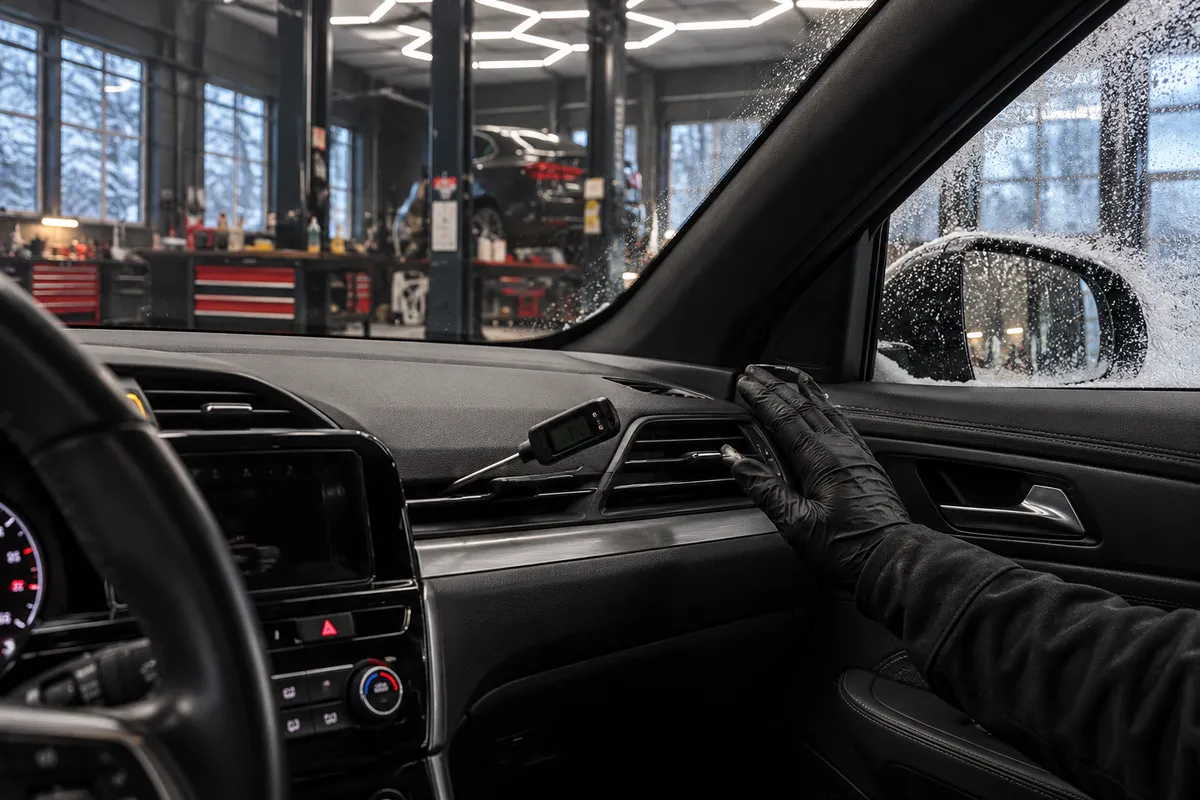
- 2Start the engine and carefully feel the upper hose to the radiator. For the first few minutes it should stay cool.
- 3If the hose gets warm straight away, together with the engine, the thermostat is probably stuck open.
- 4If the engine is already hot, the gauge high, and the hose and radiator stay cold, the thermostat is probably not opening. Switch off the engine.
- 5Watch the temperature gauge on a long drive: if it drops at a steady speed, the thermostat is most likely not closing fully.
- 6If you have an OBD interface, read the coolant temperature in live data and any fault codes.
Watch out for the radiator fan, which can start even with the engine off, and for hot components. This test gives a first assessment of the thermostat but does not rule out a faulty temperature sensor or water pump.
Thermostat replacement — what it involves
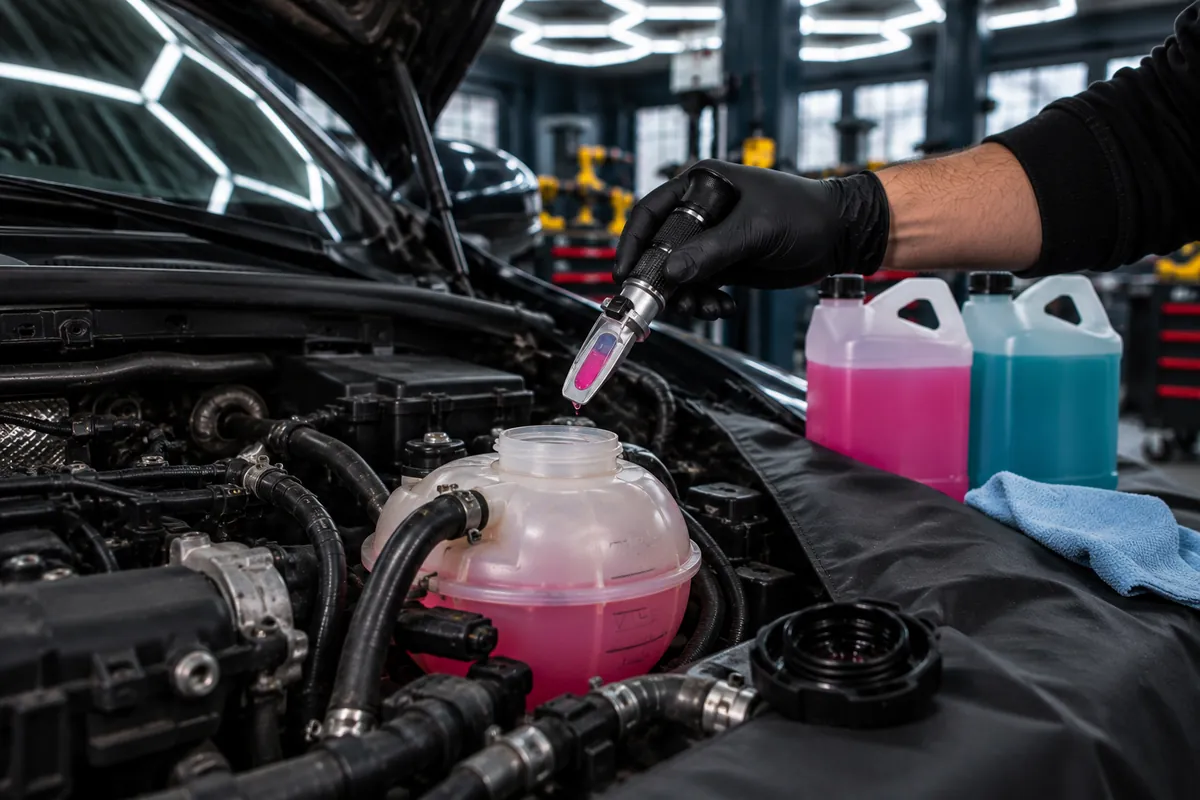
Replacing the thermostat means draining some or all of the coolant, removing the housing and fitting a new thermostat with a new seal. In many cars the thermostat is integrated into the housing and they are replaced together. After fitting, the system must be filled with coolant of the correct specification and properly bled — an airlock can produce symptoms similar to a faulty thermostat. Which coolant to choose is explained in which coolant.
If the coolant is old or contaminated, it makes more sense to replace it completely than just top it up. While at it, it is worth checking the hoses, clips, water pump and fan operation.
Fit a thermostat with the opening temperature specified by the engine manufacturer. A “cooler” thermostat will not improve cooling, but it can increase fuel consumption and trigger code P0128.
How we check it at Pulsecar
- 1A chat: when the problem appears, whether the engine has overheated, whether you top up coolant, how well the heater works.
- 2Computer diagnostics: fault codes, coolant temperature in live data and, in cars with an electronically controlled thermostat, target values and a test of the heater or module control.
- 3Measuring hose and radiator temperatures while the engine warms up.
- 4Checking coolant level and condition, system tightness, water pump and fan.
- 5The result with an explanation and photos and a written quote for approval — only then do we order parts.
This approach avoids replacing the thermostat when the culprit is the temperature sensor or an airlock. More about cooling system repairs on the cooling system page.
How much do diagnosis and thermostat replacement cost
| Service | Price |
|---|---|
| Computer diagnostics | 100 zł |
| Coolant change | from 200 zł |
| Thermostat or thermostat housing replacement | per quote after diagnosis |
| Thermal management module or water pump replacement | per quote after diagnosis |
The cost of replacing a thermostat depends on the car: in some it is easy to reach, in others ancillaries have to come off, and part prices — especially for electronically controlled thermostats and modules — vary widely. That is why we start with diagnostics, and before any work you get a quote for approval. We give a 6-month warranty on labour, and new parts carry the manufacturer's warranty. Other prices are in our price list.
Pulsecar is at ul. Arkuszowa 176 in Bielany, Warsaw, open Monday to Friday 09:00–18:00 and Saturday 09:00–15:00. Book a visit or call +48 571 058 591. If the engine is overheating, do not drive it to us — use a tow truck instead.