Water pump — failure symptoms, diagnosis and replacement
Losing coolant, hearing a whine from under the bonnet, and the temperature gauge creeping up? It may be the water pump. We explain the symptoms, mechanical vs electric pumps, and when to replace the pump together with the timing belt.
8 min read · Pulsecar team · updated:
Water pump — the short answer
A failing water pump (coolant pump) usually gives itself away in three ways: the coolant level drops and you can see dried trails under the car or on the engine block; there is a hum, whine or rattle from under the bonnet that rises with engine speed; and the engine starts to overheat, especially in traffic and under load. In cars with an electric pump, such as many BMW models, the typical sign is an overheating or limp-mode warning, often with no earlier leaks or noise at all.
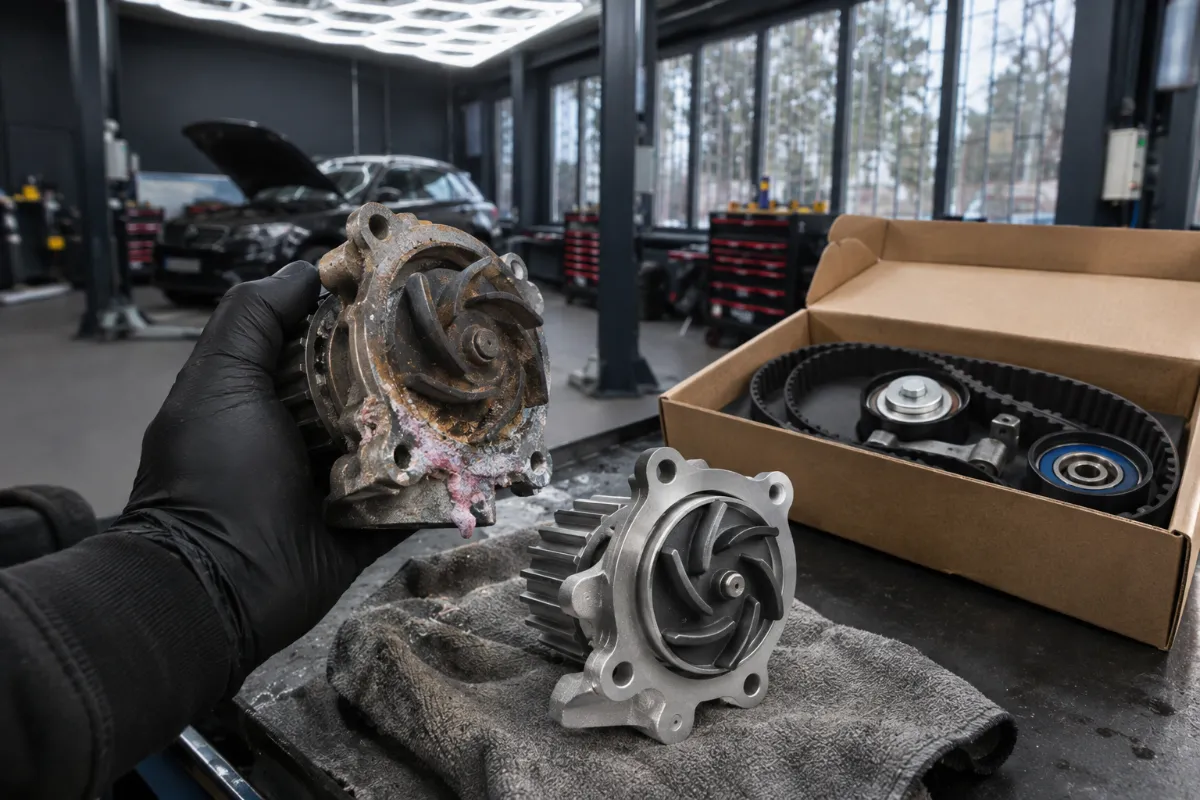
In many engines the pump is driven by the timing belt. In that case it is replaced together with the timing belt — a leaking pump can ruin a new belt, and a seized bearing can make the belt jump or snap. Below we describe the symptoms, causes, how to check the pump and when driving with a suspect pump is risky.
How a water pump works and what goes wrong
- Shaft seal — wears with age and mileage; coolant starts to seep out of the weep hole in the pump body.
- Bearing — once its grease is washed out, or if the belt is over-tensioned, it starts to hum and whine and eventually develops play.
- Impeller — a plastic one can crack or slip on the shaft, a metal one corrodes and erodes; the pump turns but moves little coolant.
- Gasket or O-ring between the pump and the block — the leak appears at the joint, not from the weep hole.
- Electronics of an electric pump — failed motor or pump controller, communication fault; the pump stops working suddenly.
The pump circulates coolant between the engine, thermostat, radiator and heater matrix. A classic mechanical pump has a shaft running in a bearing, a mechanical face seal and an impeller sitting in the coolant. It is driven by the timing belt, the auxiliary (multi-rib) belt or, less often, a chain. Newer cars increasingly use electric pumps or mechanical pumps with a switchable impeller, controlled by the engine ECU.
Symptoms of a failing water pump
- The coolant level in the expansion tank keeps dropping and there are no other visible leaks.
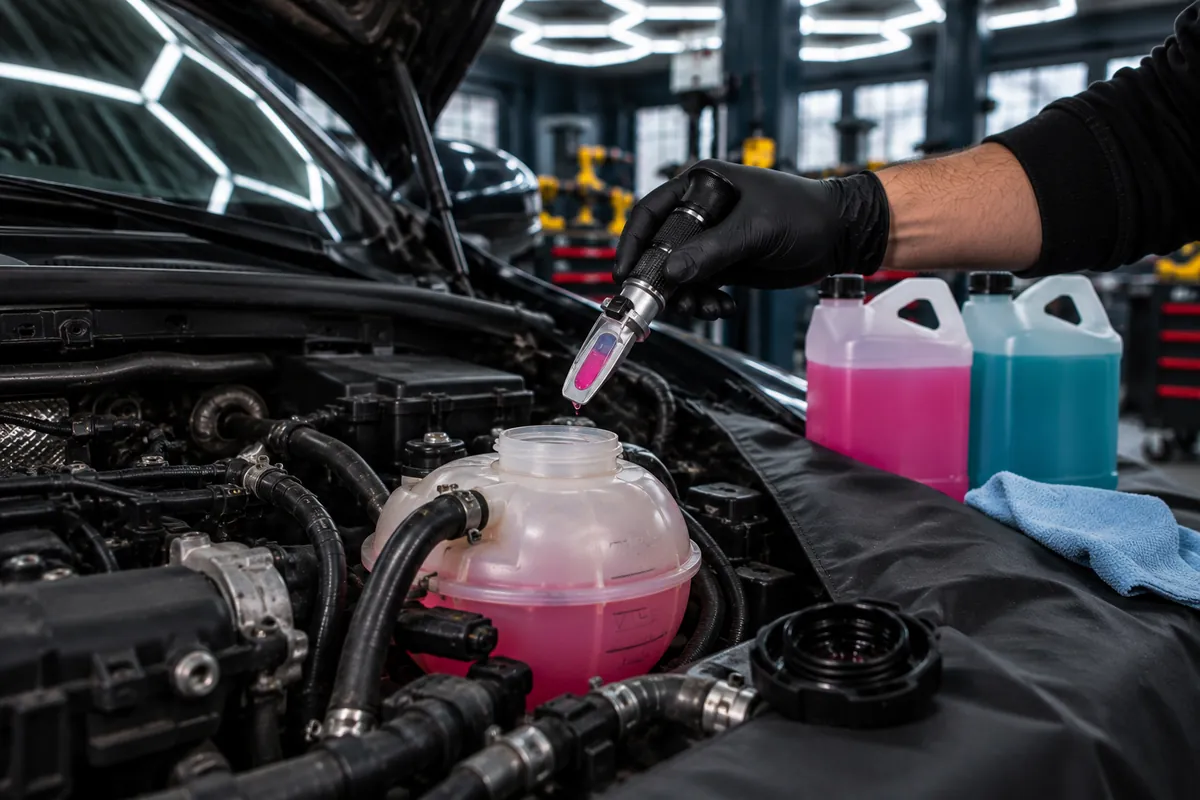
- Dried pink, green or blue trails or white crust on the pump, under its pulley or on the engine block.
- Drips or a puddle of coolant under the front of the car after parking, a sweet coolant smell after a drive.
- Humming, whining or rattling that changes with engine speed — typical of a worn bearing.
- Play or wobble in the pump pulley, an auxiliary belt that runs unevenly.
- Temperature rises in traffic or uphill, the radiator fan runs more often and for longer than usual.
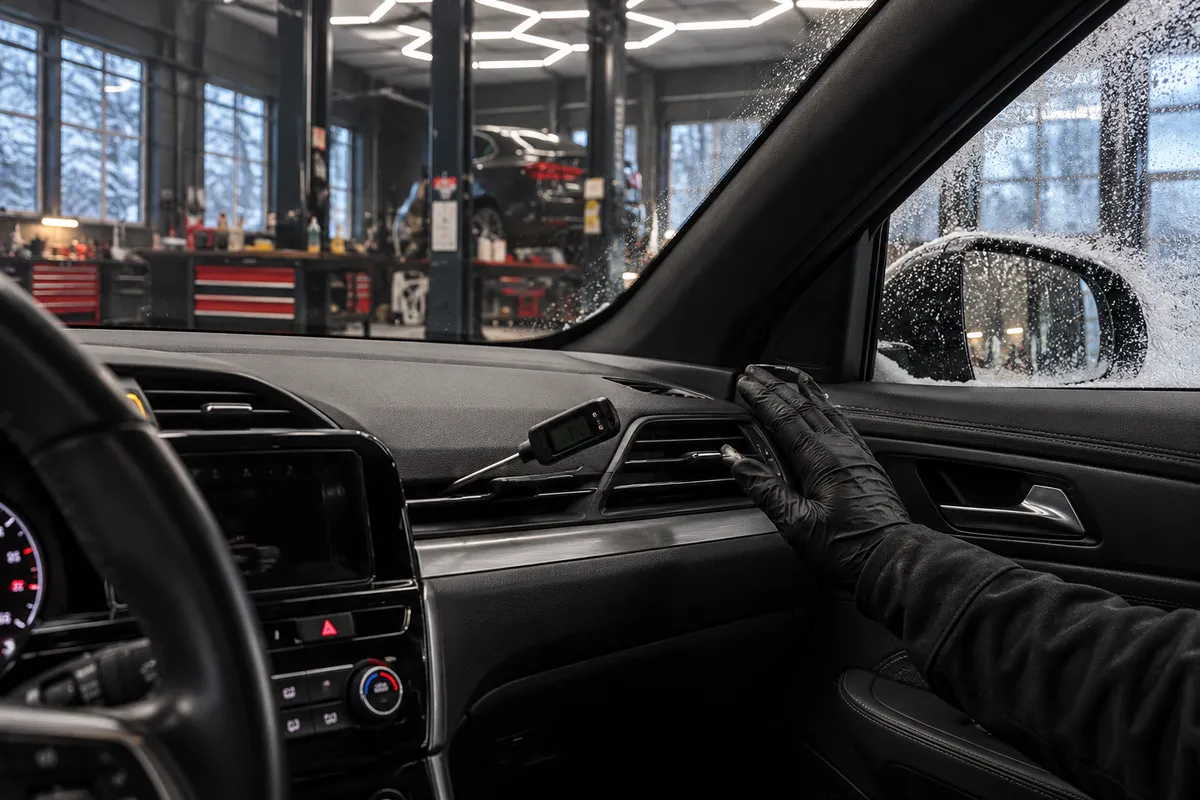
- The heater blows weakly, or alternates between warm and cold — coolant is circulating too slowly.
- In cars with an electric pump: overheating warning, engine warning light, reduced power, sometimes the fan running at full speed straight after starting.
A small leak from the weep hole is a warning sign, not a reason to panic — but do not ignore it. The seal usually fails gradually, the leak grows over time and can take the bearing with it. Check the coolant level regularly with the engine cold.
Symptom → possible cause → what to do
| Symptom | Possible cause | What to do |
|---|---|---|
| Coolant loss, trails under the pump pulley | Worn pump shaft seal | Visual check and cooling system pressure test, plan pump replacement |
| Whine or hum rising with revs | Pump bearing, less often a tensioner or idler pulley | Listen with a mechanic's stethoscope, check for play with the belt off |
| Overheating with no visible leaks | Damaged impeller, thermostat, clogged radiator, fan | Measure radiator inlet and outlet temperatures, read ECU data |
| Weak heater, coolant level OK | Poor flow (impeller), air in the system, thermostat | Bleed the system, check the thermostat and coolant flow |
| Overheating warning in a BMW or another car with an electric pump | Failed electric pump or its power supply | Computer diagnostics, pump test via the ECU |
| Coolant loss, white exhaust smoke, bubbles in the tank | Head gasket, not the pump | CO2 test of the coolant, pressure test |
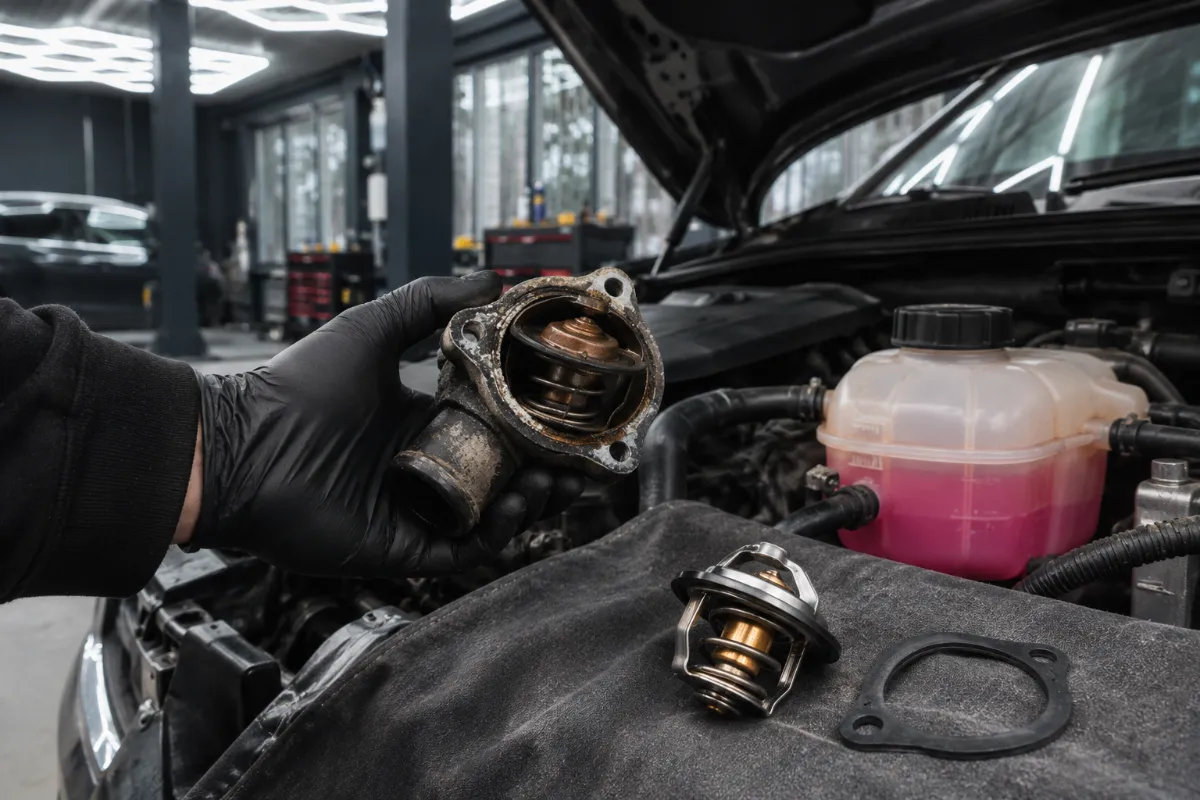
Overheating has many causes and the pump is only one of them. If the engine takes ages to warm up or the temperature jumps around, also read our guide thermostat — symptoms. If coolant disappears without a trace and there is white smoke from the exhaust, check the symptoms of a blown head gasket.
Pump driven by the timing belt — replace it with the belt
In many petrol and diesel engines, including popular VW Group, Renault, Ford and Fiat models, the water pump is driven by the timing belt. If its bearing seizes or the impeller jams, the belt can jump teeth or snap. In an interference engine that means valves hitting pistons and an expensive cylinder head repair. Coolant leaking from the pump onto the belt also speeds up belt wear.
That is why replacing the water pump is standard practice during a timing belt job, even if the pump shows no signs of wear yet. The labour to get to it is shared, and the cost of the pump itself is small compared with the risk. It works the other way round too: when a belt-driven pump starts leaking, it usually makes sense to replace it together with the belt, idlers and tensioner. We explain when to change the timing belt and what it costs in timing belt replacement — cost and symptoms.
In engines with a timing chain the pump is usually driven by the auxiliary belt or has its own drive. It is then replaced on its own, but it is worth checking the multi-rib belt and tensioner at the same time.
Electric pumps — BMW and other newer cars
Many BMW engines (including petrol straight-sixes and newer four-cylinders) have an electric water pump controlled by the engine ECU. This lets the engine warm up faster and matches cooling to the load, but the pump contains electronics that fail with age. A typical scenario: the car drives normally, then suddenly shows an overheating warning and reduces power. Sometimes the ECU stores pump speed or operation faults beforehand. At Pulsecar about one in six cars in the workshop is a BMW, so we see this case regularly.
Electric pumps are used by other makes too, often as auxiliary pumps — for the turbocharger, heater, intercooler or hybrid system. Their failure does not always cause overheating, but it can trigger fault codes, poor heating or turbo overheating after the engine is switched off. After an electric pump is replaced the system must be bled thoroughly — in many cars this is done with a routine started from the diagnostic computer.
You cannot diagnose an electric pump by ear. If your BMW shows an engine temperature warning, pull over and do not carry on driving — the cause has to be read from the fault memory and live data.
Can you drive with a faulty water pump?
With a small weep-hole leak and a stable temperature you can usually drive to the workshop, keeping an eye on the coolant level and the temperature gauge. But do not put the repair off for months: the leak grows, coolant gets onto the belt and a bearing without grease wears quickly.
If the temperature gauge climbs, an overheating warning appears or steam comes from under the bonnet, stop somewhere safe and switch the engine off. Driving with an overheated engine can damage the head gasket within minutes, warp the cylinder head and, in extreme cases, seize the engine. Do not open the expansion tank cap on a hot engine — the coolant is under pressure and can scald you. If a timing-belt-driven pump starts whining or rattling, drive no further than necessary: a seized bearing can break the belt.
How we check it at Pulsecar
- 1Interview: how long you have been losing coolant, whether the car has overheated, whether the heater works, when the timing belt was last changed.
- 2Inspection of the pump, hoses, radiator and the area around the weep hole — we look for trails and crust, with a UV lamp and dye if needed.
- 3Cooling system pressure test, which reveals leaks that are invisible on a cold engine.
- 4Computer diagnostics: fault memory, temperatures and, in cars with an electric pump, pump speed and a pump test via the ECU.
- 5Listening to the bearing and checking pulley play with the belt off, checking the tensioner and idlers.
- 6If in doubt, a test for exhaust gases in the coolant to rule out the head gasket.
- 7Results with photos and an explanation, plus a written quote for your approval before we order any parts.
After replacing the pump we fill the system with the correct coolant, bleed it and check for leaks and for correct thermostat and fan operation. Which coolant to choose and whether different types can be mixed is explained in which coolant to use. The full range of cooling work is on the cooling system repair page.
How much does a water pump replacement cost
| Service | Price |
|---|---|
| Computer diagnostics | 100 zł |
| Coolant change | from 200 zł |
| Timing belt replacement | from 600 zł |
| Water pump replacement (mechanical or electric) | per quote after diagnosis |
The cost of replacing a pump depends mainly on how it is driven and how hard it is to reach. A pump driven by the auxiliary belt can sometimes be reached in under an hour, a pump behind the timing belt takes essentially the same labour as a timing belt job, and an electric pump costs more as a part. New coolant comes on top. We give the exact price in a quote after diagnosis and start work only after you approve it. We give a 6-month warranty on labour; new parts carry the manufacturer's warranty (usually 12–24 months).
Pulsecar is at ul. Arkuszowa 176 in Bielany, Warsaw, open Monday to Friday 09:00–18:00 and Saturday 09:00–15:00. Book a visit online or call +48 571 058 591. If the engine is already overheating, do not drive on — call us and we will work out how to get the car here safely.