Lambda sensor — failure symptoms, diagnosis and replacement
Check engine light on, the car using more fuel and idling roughly? A common culprit is the lambda sensor. We explain the difference between the sensors before and after the catalytic converter, what the fault codes mean and how to test it before buying a new one.
8 min read · Pulsecar team · updated:
Lambda sensor — the short answer
A faulty lambda sensor (oxygen sensor, O2 sensor) usually shows itself with a check engine light, higher fuel consumption, rough idle, slight jerking under light load or a poor exhaust emissions result. The ECU typically stores codes in the P0130–P0141 range (sensor circuit, voltage, response time and heater) or — when the sensor after the catalytic converter is involved — code P0420, which concerns catalyst efficiency.
A fault code alone does not prove that the sensor needs replacing, though. The sensor often just reports another problem: an intake or exhaust leak, misfires, a faulty injector or low fuel pressure. So before you buy a new sensor, it is worth checking how it works on live data and, if in doubt, with an oscilloscope. Below we describe the sensor types, symptoms, codes and how we diagnose them.
How a lambda sensor works — before and after the catalytic converter
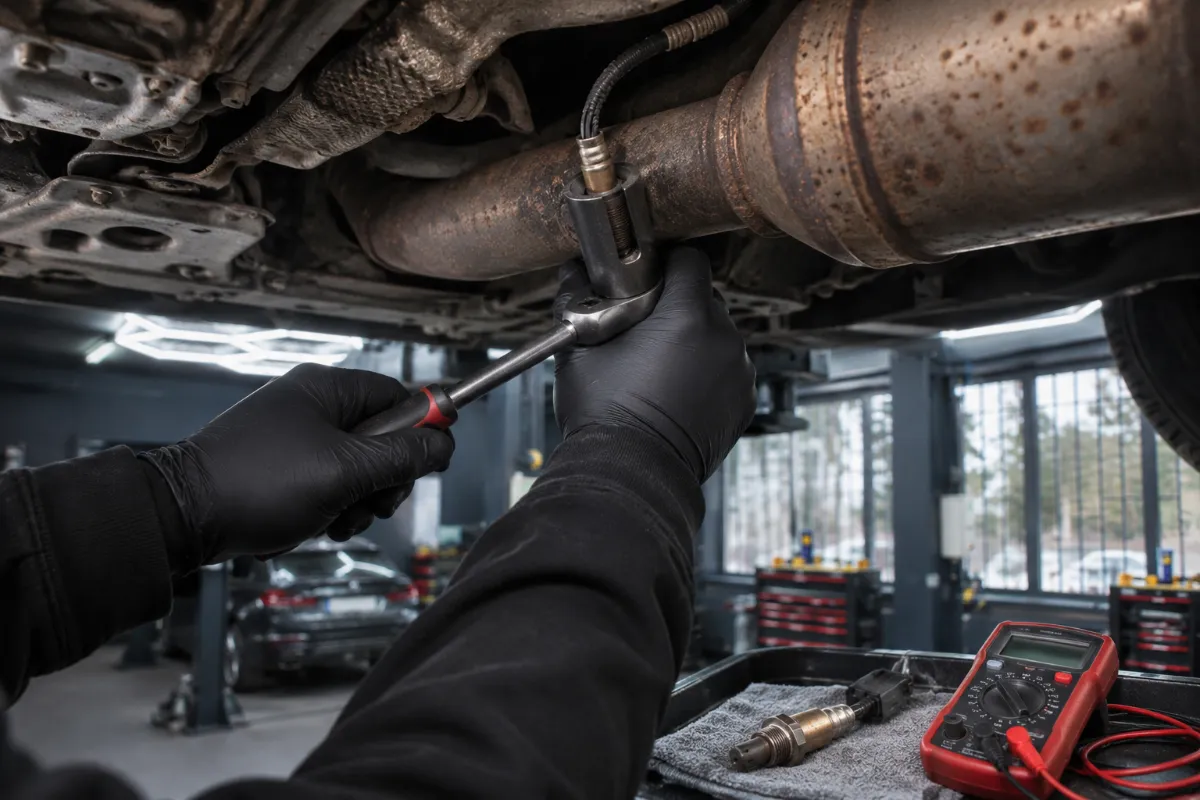
- Upstream sensor (before the catalytic converter, the control sensor, “sensor 1” in fault codes) — the ECU's main source of information; a fault directly affects the mixture, fuel consumption and how the engine runs.
- Downstream sensor (after the catalytic converter, the monitor sensor, “sensor 2”) — checks whether the converter stores oxygen and cleans the exhaust; its signal should be clearly calmer than that of the upstream sensor.
- Narrowband (switching, zirconia) sensor — produces about 0.1–0.9 V and switches between lean and rich; when healthy and on a warm engine it does so quickly and regularly.
- Wideband sensor (e.g. LSU type) — measures the exact lambda value over a wide range using a pump current, and is used as the upstream sensor in many newer petrol cars and in diesels.
- Sensor heater — every modern sensor has a heater that brings it up to operating temperature quickly; an open heater circuit is one of the most common faults.
The lambda sensor measures the oxygen content of the exhaust gas. Based on this, the engine ECU adjusts the amount of fuel so that the mixture stays as close as possible to stoichiometric (lambda = 1) — that is where the catalytic converter works best. Most petrol cars built since the early 2000s have at least two sensors, and V6 and V8 engines have two per cylinder bank.
Symptoms of a failing lambda sensor
- The check engine light is on constantly or comes on from time to time, especially after a longer drive.
- Higher fuel consumption with no change in driving style or routes.
- Rough idle, hunting revs, slight jerking at a steady speed.
- Poorer throttle response, loss of power, in extreme cases limp mode.
- A smell of unburnt fuel or black soot on the exhaust tip — a sign of a rich mixture.
- High CO readings or a failed lambda result in the emissions check at the technical inspection.
- In the longer term, overheating and damage to the catalytic converter if the engine runs rich for a long time.
In most cars the downstream sensor has no noticeable effect on fuel consumption or how the engine runs — its failure usually shows only as a check engine light and a stored code. If the car is both using more fuel and running roughly, look for the cause upstream of the converter.
Fault codes P0130–P0141 and P0420 — what they mean
| Code | Meaning (bank 1) | What we usually check |
|---|---|---|
| P0130 | Upstream sensor circuit malfunction | Wiring, connector, supply and sensor signal |
| P0131 / P0132 | Upstream sensor voltage too low / too high | Exhaust and intake leaks, fuel pressure, short circuit in the wiring |
| P0133 | Upstream sensor slow response | Sensor ageing, contamination with oil or coolant |
| P0134 | Upstream sensor no activity | Heater, wiring, failed sensing element |
| P0135 | Upstream sensor heater circuit fault | Heater resistance, fuse, power supply |
| P0136–P0140 | Downstream sensor circuit, voltage, response or no activity | Downstream sensor signal, wiring, exhaust leaks |
| P0141 | Downstream sensor heater circuit fault | Heater resistance, power supply, connector |
| P0420 | Catalyst efficiency below threshold | Comparison of both sensor signals, exhaust leaks, misfires, converter condition |
Codes P0150–P0161 mean the same for the second cylinder bank on V engines. Manufacturers can also use their own codes, so we always read the full description and the freeze-frame data recorded when the fault was stored. For a general look at what a lit warning light means, see our guide check engine light.
P0420 — sensor or catalytic converter?
Code P0420 does not mean the sensor has failed; it means the ECU, based on the downstream sensor signal, has judged the converter's efficiency to be too low. When the converter works well, the rear sensor signal is steady; when it loses its ability to store oxygen, the rear sensor starts switching much like the front one.
Before deciding to replace the converter, other causes have to be ruled out: an exhaust leak between the sensors, a worn or lazy sensor, misfires, excessive oil burning or mixture faults. Misfires are particularly dangerous, because unburnt fuel burns inside the converter and can overheat it — more on this in misfires — engine jerking. Replacing the converter without fixing the cause often ends with the same code coming back.
Why sensors fail
- Age and mileage — the sensing element reacts more and more slowly; the sensor becomes “lazy” before it stops working altogether.
- Oil burning — ash from the oil coats the sensor and slows its response.
- Coolant in the exhaust (e.g. with a failed head gasket) and silicone from unsuitable sealants — they poison the sensing element.
- A rich mixture — faulty injectors or a faulty air flow meter cause soot build-up.
- Mechanical damage and corroded wiring, a chafed loom, water in the connector.
- An exhaust leak before the sensor — drawn-in air gives a false lean reading even though the sensor is fine.
Replacing the sensor alone will not help if the cause is, for example, oil burning or an exhaust leak — the new sensor will soon show the same fault or get poisoned. That is why we start with the cause, not the part.
Can you drive with a faulty lambda sensor?
In the short term usually yes — the ECU switches to substitute values and the car keeps going. If the upstream sensor is faulty, however, the engine may run too rich: fuel consumption rises, carbon builds up and the catalytic converter can overheat and get damaged. A cheap repair then turns into an expensive one. The downstream sensor is less urgent, but a lit check engine light hides any further faults that may appear in the meantime.
If the check engine light is flashing and the engine is clearly jerking, keep driving to a minimum — this is usually misfiring, which quickly destroys the converter. Before the technical inspection at a vehicle inspection station, fix the fault in good time: clearing the code just before the inspection does not repair the sensor, and incorrect exhaust composition can lead to a failed result.
How we check it at Pulsecar
- 1Interview: how long the light has been on, whether fuel consumption has gone up, whether the car runs on LPG, whether there were earlier engine or exhaust repairs.
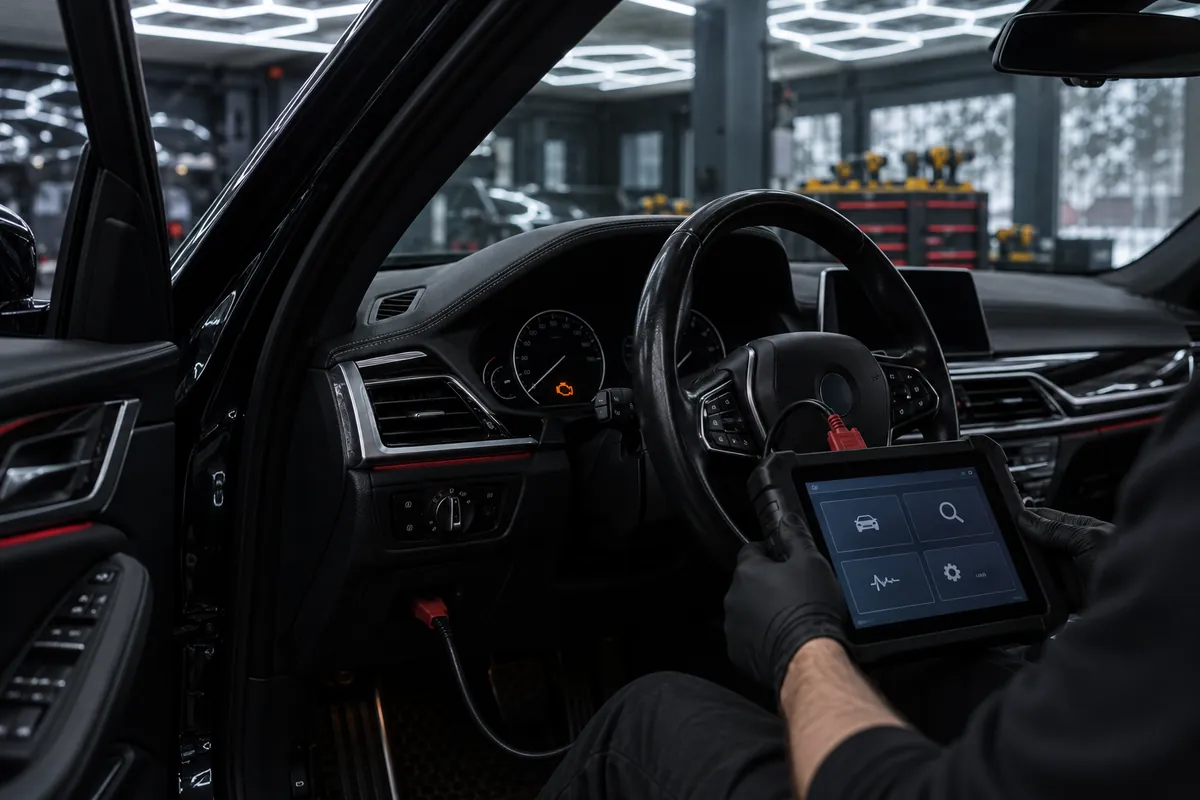
- 2Computer diagnostics: reading fault codes and freeze-frame data, checking the status of the ECU's readiness monitors.
- 3Live data on a warm engine: voltage or lambda value of both sensors, short- and long-term fuel trims, behaviour at idle and at raised revs.
- 4Response test: briefly enriching and leaning the mixture and watching how fast the sensor reacts. If a lazy sensor is suspected, we connect an oscilloscope and assess the shape and switching time of the signal.
- 5Measuring heater resistance and supply, checking the wiring and connectors.
- 6Looking for underlying causes: intake and exhaust leaks, misfires, injection problems.
- 7Results with an explanation and a written quote for your approval — we replace only what is actually faulty.
After the repair we clear the codes, do a test drive and check that the ECU has completed its sensor and catalyst tests. If the main reason for your visit is higher fuel consumption, also see our guide increased fuel consumption — causes. Diagnosing electrics and sensors is part of our auto electrician service.
How much does lambda sensor diagnosis and replacement cost
| Service | Price |
|---|---|
| Computer diagnostics (fault codes, live data) | 100 zł |
| Oscilloscope sensor test, heater and wiring measurement | per quote after diagnosis |
| Replacing an upstream or downstream lambda sensor | per quote after diagnosis |
| Repair of sensor wiring and connector | per quote after diagnosis |
The replacement price depends on the type of sensor (wideband sensors cost more than narrowband ones), how easy it is to reach and whether the thread in the exhaust has seized. We start with computer diagnostics for 100 zł, and before replacement you get a quote to approve. We give a 6-month warranty on labour; new parts carry the manufacturer's warranty (usually 12–24 months); there is no workshop warranty on parts supplied by the customer.
Pulsecar is at ul. Arkuszowa 176 in Bielany, Warsaw, open Monday to Friday 09:00–18:00 and Saturday 09:00–15:00. Book a visit online or call +48 571 058 591.